For decades now, we’ve been force-fed the dogma that American higher-education is the epitome of “woke”–a fully-owned subsidiary of “the Left.” I spent three years working for the National Association of Scholars, an outfit dedicated to manufacturing and marketing propaganda of this kind. I spent twenty-six years in higher education, teaching at a dozen institutions on two continents. I happen to live in a college town, Princeton, have lived here for fifteen years, am walking distance from Princeton University, and spend time on campus just about every day. I happen to work near another college town, New Brunswick, home to Rutgers University, and spend time on campus there about once a week. And I have friends and colleagues in higher education across the United States and Canada. So I’m no stranger to higher education or to controversies about it.
There’s no way for me to convey how fraudulent and nonsensical the “Woke Left” narrative is except to pile fact on fact until the cumulative weight of those facts is acknowledged by the skeptical and evasive. And the most obvious counter-example to it is the red carpet reception given to the military on campus. No single piece of writing in any genre, much less a blog post, can convey the military’s depth of ingression into academic life in the United States. It’s simply too big a subject for such a treatment. The influence of the military is everywhere on campus; the more you look, the more you see, assuming you know where to look. To paraphrase the Qur’an, if the trees were pens, and the seas ink, I could exhaust them both and still have on-topic things to say (Qur’an, 31:27). But consider just one example for now.
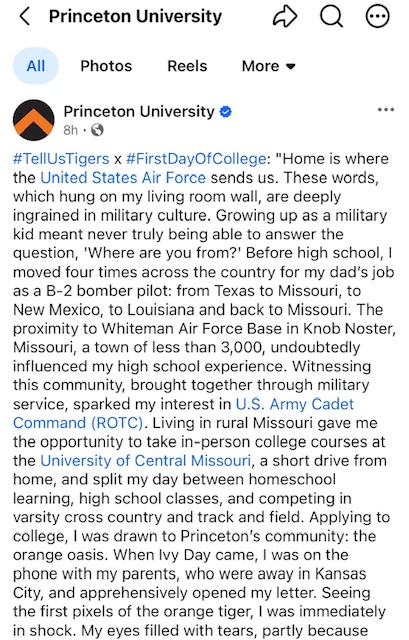
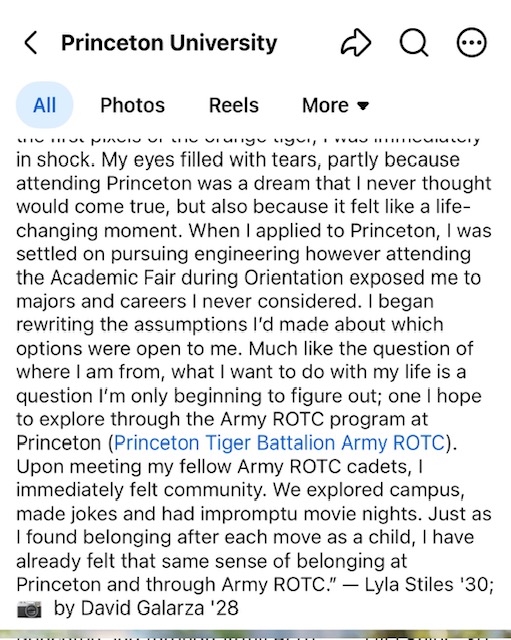
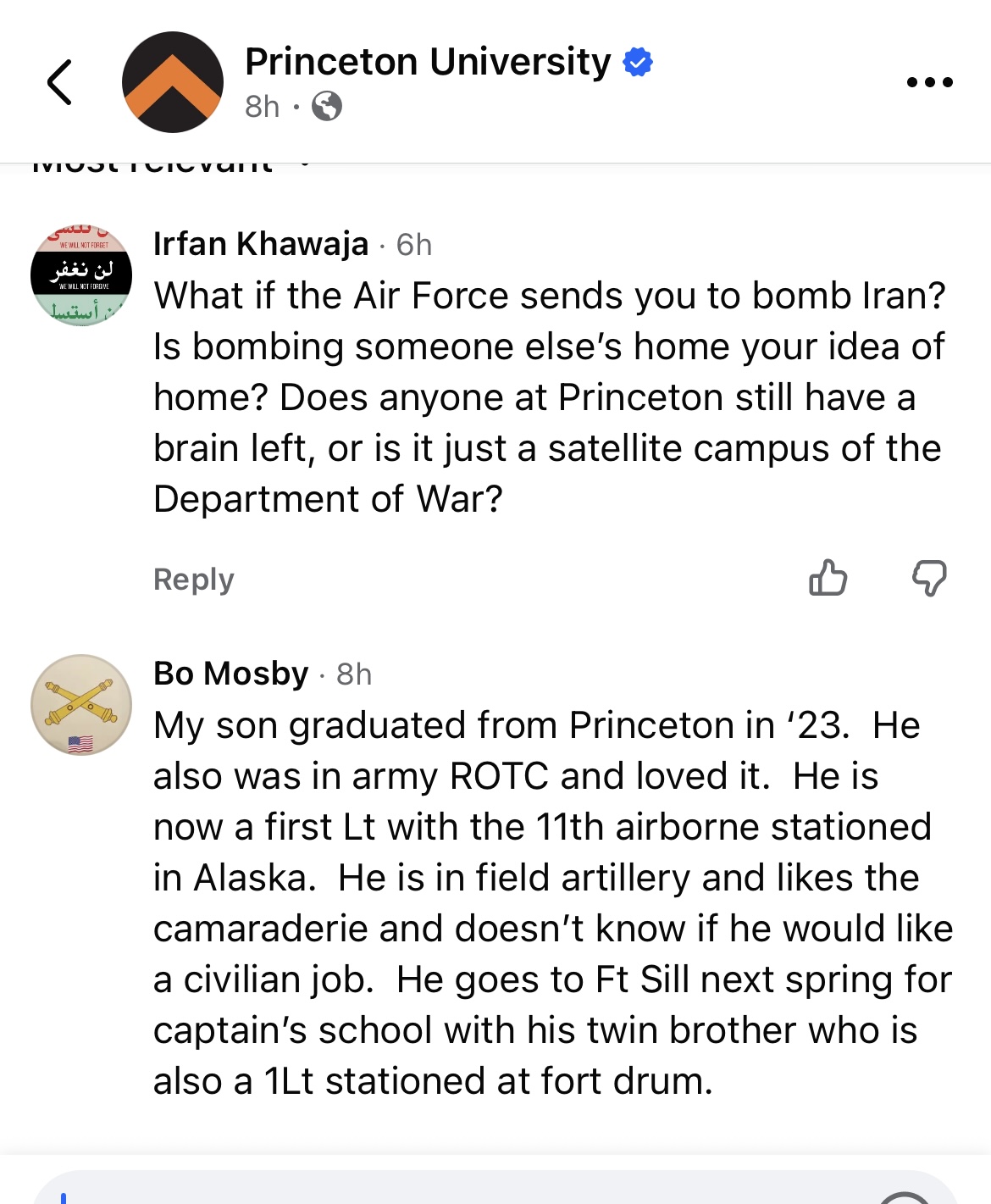
It’s the first week of the semester at Princeton, and Princeton’s PR machine is in high gear. This is one of the first posts they put up on the University’s Facebook account. I’ve transcribed it just below, re-paragraphed it for easier readability, and put screenshots of the original post under the separator at the bottom. It’s testimony by a first-year undergraduate, Lyla Stiles, Class of 2030, describing her first day on campus.
“Home is where the United States Air Force sends us.” These words, which hung on my living room wall, are deeply ingrained in military culture. Growing up as a military kid meant never truly being able to answer the question, “Where are you from?” Before high school, I moved four times across the country to my dad’s job as a B-2 bomber pilot: from Texas to Missouri, to New Mexico, to Louisiana and back to Missouri. The proximity to Whiteman Air Force Base in Knob Noster, Missouri, a town of less than 3,000, undoubtedly influenced my high school experience. Witnessing this community, brought together through military service, sparked my interest in U.S. Army Cadet Command (ROTC). Living in rural Missouri gave me the opportunity to take in-person college courses at the University of Central Missouri, a short drive from home, and split my day between homeschool learning, high school classes, and competing in varsity cross country and track and field.
Applying to college, I was drawn to Princeton’s community: the orange oasis. When Ivy Day came, I was on the phone with my parents, who were away in Kansas City, and apprehensively opened my letter. Seeing the first pixels of the orange tiger, I was immediately in shock. My eyes filled with tears, partly because attending Princeton was a dream I never thought would come true, but also because it felt like a life-changing moment. When I applied to Princeton, I was settled on pursuing engineering however attending the Academic Fair during Orientation exposed me to majors and careers I never considered. I began rewriting the assumptions I’d made about which options were open to me. Much like the question of where I am from, what I want to do with my life is a question I’m only beginning to figure out, one I have to explore through the Army ROTC program at Princeton (Princeton Tiger Battalion Army ROTC). Upon meeting my fellow Army ROTC cadets, I immediately felt community. We explored campus, made jokes and had impromptu movie nights. Just as I found belonging after each move as a child, I have already felt that same sense of belonging at Princeton and through Army ROTC. –Lyla Stiles ’30

Lyla Stiles ’30, on campus. Photo credit: David Galarza ’28
Consider the timing of this post. The United States is currently involved in a war of aggression against Iran (and with Israel, against Lebanon), prosecuted in large part by the Air Force. The Air Force is, as I write and as Princeton was posting the preceding post, actively engaged in bombing Iran. Though the U.S. media insists that the Air Force is engaged in “targeted strikes” on military targets–it claims implausibly never to target civilians–civilians have been hit, and it’s an indisputable fact that Hegseth’s military has downgraded the usual (supposed) imperative to avoid civilian casualties. (Hegseth is, of course, a Princeton graduate and a Princeton plagiarist, but I’ll save both topics for another time.)
Now consider the implicit message of the post. Princeton University, a supposedly woke, left-captured institution, has decided to valorize the military as a career at precisely the moment when the U.S. Air Force is engaged in wanton aggression in the service of mass death and mass destruction. The University has no problem whatsoever in encouraging students along a career path of aggression, signing on to the military’s mission of aggression, treating this mission as expressive of the university’s own mission, and putting it front and center in its PR campaign.
Put explicitly, the message is:
- War in the service of the United States is a noble enterprise;
- The U.S. military is a glorious institution;
- The war in Iran is presumptively justified and respectable–respectable enough to send kids to;
- A bombing campaign during a war of aggression is precisely the time to celebrate careers dedicated to mass destruction through aggression.
Somehow, the partisans of institutional neutrality, quick to jump on such fraught and weighty issues as partisan commencement speeches and departmental votes, have missed the loud, unapologetic, materially supported connection between higher education, the Department of War, and an actual war. Jason Arday is their proxy for the structural defects of higher education, not Lyla Stiles.
But if they’ve forgotten, Princeton University is here to remind them. Institutional neutrality says that institutions like universities must refrain from make public statements about matters of public controversy. Well, either Princeton University is openly flouting institutional neutrality, or it’s adhering to it on the assumption that nothing about the military is all that controversial. Your guess is as good as mine as to which thing is happening.
Actually, it’s a little hard to regard the actions of the U.S. military, or the legitimacy of the institution itself, as literally uncontroversial, even for an institution as sleepy and delusional as Princeton. So it seems more likely that Princeton is violating institutional neutrality than adhering to it. But as I said, the usual defenders of institutional neutrality have been entirely indifferent to this obvious, flagrant violation. Institutional neutrality, to repeat, tells universities to refrain from making public statements about matters of public controversy. Princeton’s relationship to the U.S. military is a paradigmatically controversial topic. Yet Princeton has defended that relationship in as loud and unapologetic (and complacent) a manner as can be imagined.
Here is President Christopher Eisgruber of Princeton, rhapsodizing in 2023 about the wonders of Princeton’s relationship with the Navy in a piece called “Expanding Engagement with the Nation’s Armed Forces“:
On April 12, I stood with other new members of the Education for Seapower Advisory Board (E4SAB) at the Navy Yard in Washington as Secretary of the Navy Carlos Del Toro administered the oath of office.
Secretary Del Toro’s strategic plan articulates a commitment to “Empowering [the Navy’s] People,” including by ensuring that Naval educational institutions “expand access for all personnel” and “provide world-class curricula, research opportunities, and partnerships.”1 E4SAB provides the Navy with independent advice relating to the Naval War College, Naval Postgraduate School, and U.S. Naval Community College.
I am honored to serve on E4SAB, and I hope that I can contribute productively to its mission. I also hope that, by learning more about the Navy’s educational program, I might identify new opportunities for constructive engagement between Princeton and the nation’s armed services.
I have made it a priority to grow those connections during my presidency. In 2014, during the first year of my presidency, I brought the Naval Reserve Officers Training Corps program back to the University after an absence of more than 40 years.
We have encouraged and supported Princeton’s Army, Air Force, and Navy ROTC programs throughout the past decade. The number of ROTC students on campus has grown from 28 in fall 2013 to 58 today.
This year, in response to a student request, I hosted a presidential dinner for Princeton’s ROTC students. The cadets and midshipmen packed the main dining room at Prospect House. It was an inspirational evening: I enjoyed hearing directly from our students about their experiences, achievements, and aspirations.
In 2018, we relaunched Princeton’s transfer program so that we could attract outstanding community college students and military veterans—most of whom earned some college credits while serving their country—to Princeton’s student body. This fall, we began to double the size of the program. Military veterans have added tremendously to our community. Their experience, talent, and commitment to service enhance both the excellence and the diversity of our campus.
A growing number of Princeton faculty are engaged with our ROTC and veterans’ programs. This year, the Department of History and Tiger Battalion—Princeton’s Army ROTC unit—resumed their collaborative trip to Normandy, France. Professor David Bell, Professor Phil Nord, and graduate student Joanna Hope Toohey co-led the trip, providing insights about World War II and French history, along with Lieutenant Colonel David Gunther of the Tiger Battalion.
Note the ease with which Eisgruber folds Princeton’s mission into the strategic plan of the Navy. “Princeton in the Nation’s Service,” becomes Princeton in the Navy’s service. So much for Princeton’s autonomy from both.
Note further that expanded engagement with the military is a “priority.” Given that priority, there’s no reason to wonder why the advocates of divestment, whether from fossil fuels or the military itself, keep getting their asses kicked by this administration. One priority contradicts and overrides the other. The military is the biggest fossil fuel polluter in the universe. And it’s hardly going to tolerate divestment from itself or from allied military powers. So the hard truth is, if the military’s needs are Eisgruber’s priority, as he admits they are, divestment has no chance of success.
And note how the “expanded engagement” Eisgruber mentions leads directly to the recruitment of students like Lyla Stiles: by rummaging through community colleges, Princeton increases the probability of recruiting financially needy students who are likely to choose a military pathway. Does Princeton worry that its recruiting these students might kill them, or kill innocent others? Hell, no! What it worries about is whether their experience, talent, and commitment to service will enhance both the excellence and diversity of Princeton’s campus. In other words, what it worries about is whether it can exploit their naivete and ignorance for long enough to “grow” its programs, then shunt them off to the military to get them blown up in some faraway country.
Say what you want about this speech, but seldom has a university president more explicitly forfeited the civilian immunity of his institution to anyone seeking its destruction. The speech can fairly be read as Eisgruber’s practically begging for Princeton to be turned into a military target. If Princeton was in Gaza rather than New Jersey, Eisgruber’s speech could be cited as the justification for the firebombing and mass killing of tens of thousands of people. It would be obvious to even the dullest mind that his leaden, self-congratulatory prose turns everyone in the vicinity into a human shield, and threatens to make campus itself into a kind of Monte Cassino of Mercer County. In its present context, of course, it merely serves to underscore the complacent banality of Eisgruber’s mind, the insouciance with which he turns what was previously a liberal arts university into a military base while extolling the “inspiration” and “enjoyment” of the exercise. Warfare is ever so much fun.
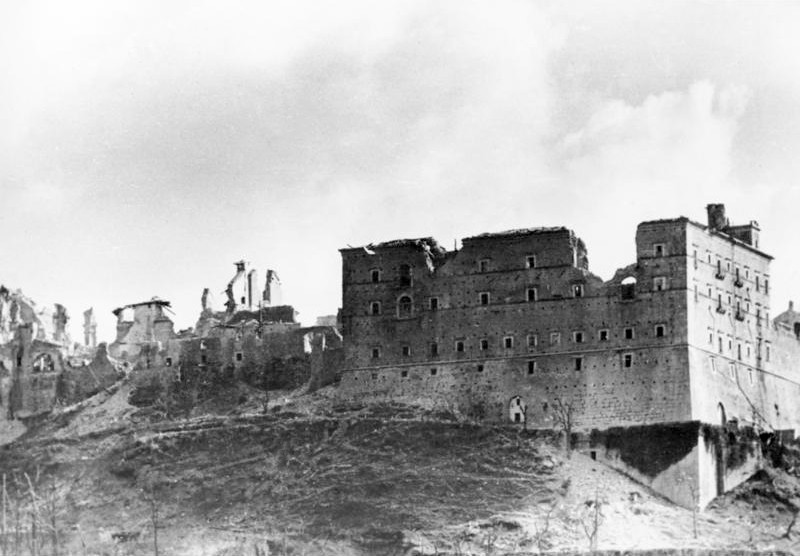
Monte Cassino, February 1944 (photocredit: Wikipedia)
I have never seen any advocate of institutional neutrality take a university to task for defending ROTC’s presence on campus. The implicit lesson is clear enough: A university that divests or dissociates from Israel, or signs on to the aims of Gaza Solidarity Encampment, violates neutrality and deserves condemnation. A university that signs on to the destruction of Iran, Lebanon, and Palestine honors neutrality, deserves accolades, and deserves increased federal funding.
Now go back and consider the style and content of Ms Stiles’s own statement. She comes out and tells us that she has been indoctrinated in military values since childhood. Her entire family life has revolved around the military. She admires her father, the B-2 bomber pilot, but not once does she pause to consider what it means to do the job he does. A bomber pilot drops bombs on people in order to kill them and destroy their surroundings. On whom did her father drop bombs? How many people did he kill, and to what end? It doesn’t seem to matter. Ms Stiles describes the father’s vocation as though it was just another ordinary job–doctor, lawyer, engineer, stockbroker. But it isn’t. The United States has not won a war since 1945. It arguably has not fought a just war since 1945, either. What Ms Stiles omits is that her father has spent his life helping the United States lose a series of unjust wars. Neither fact is mentioned or even adverted to, drowned instead in a sea of saccharine sentimentality.
Consider how many times Ms Stiles invokes the concept of “community.” In doing so, she inadvertently makes clear how embedded the military is in the civilian life of the American “community.” Even the civilian community (she tells us) is “brought together” by military life. Dad flies a B-2 bomber; Lyla goes to high school nearby. No one questions the proximity of the one thing to the other–of high school to Air Force base, of track and field to B-2 bomber. Military options are always front and center throughout Lyla’s narrative precisely because they are literally, physically, always nearby and easy to get to. Even in high school (and probably earlier), a military career path beckons. At first she attends a college near her home; naturally, military options are on offer there. Then she applies to Princeton, and of course military options are on offer there, too.
This, not “wokeness,” is the one thing you can always count on in American higher education. Not all institutions are woke. Some aren’t woke at all. But virtually all institutions of higher learning in the United States revere the military, and make it possible for students to join up. I would know. Before I knew any better, I used to write letters of recommendation for students looking to join the military. When I taught at Princeton, students went straight into the officer corps, or straight into the CIA. When I taught elsewhere, they went straight into the rank-and-file of the Army, the Navy, or the Marines. Either way, they went with alacrity and zeal–with my help, as a faculty member–because they thought it was a bargain to be paid to kill America’s foreign enemies.
If you can find anything woke about that, feel free to tell me. At any rate, look carefully the next time you see one of those confected “studies” about the “left-wing bias” of American higher education. Note carefully which institutions are included within the study, and which ones are not. It’s a known and admitted fact that these surveys are not representative of American higher education as a whole. They don’t include institutions like the one Lyla Stiles attended in Missouri. I’ve taught at institutions like that. The official name for them is “military friendly institution.” Which is not a synonym or even close to one, of “woke.”
Ms Stiles tells us that she came at first to study engineering at Princeton. This sounds as though she wants to build things. But if you’re in ROTC, you agree to serve in the military for eight years after graduation. That suggests to me that Ms Stiles had her heart set on a career as a military engineer, designing things like weapons systems that destroy rather than build. That choice, after all, coheres best with the military career she had in mind, and that is in part obligatory anyway. She now tells us that she’s reconsidering. Maybe she wants to study comparative literature? Or philosophy? It doesn’t matter. Whatever she studies will have to serve military ends. Though it sounds as though her options are open, they aren’t. She has closed them with the eager cooperation of Princeton University, ROTC, and the Department of War.
Like it or not, her free ride at Princeton via ROTC means that she must serve the military that is paying for her college career. Any choices she makes will have to be consistent with the eight years she’ll be obliged to spend in the military after graduation. When she tells us that she intends to “explore” her options “through” Army ROTC, what she means is that she intends to explore the options Army ROTC has made inevitable. Whatever she does, she can’t become a peacenik at this point, or a radical critic of American militarism or imperialism. She would also be well advised to stay away from the Palestinian Studies Colloquium or Students for Justice in Palestine. Those people are her sworn enemies, the people her future employer wants to wipe off the face of the planet. To sympathize with them would be treason. And treason, as she must know, is a capital offense. Those are the options you have in the military. You’ve tied yourself to a mast that threatens to impale you.
Is this really worthy of celebration? How edifying a spectacle is it to coerce, manipulate, and deceive kids into the military, giving them a free ride through college, but then demanding that they become cannon fodder for a decaying empire governed by clowns? That’s what American higher education has done and become.
And I’m as guilty as anyone. I wrote all those fucking letters of recommendation myself (at Princeton, no less) when I could and should have said “no.” I spent twenty-six years in the business without really pushing back as hard as I might have. I supported the “War on Terror” at first, then grew disillusioned, disconnected from it all, and fled the scene–until, after seeing the battlefields with my own eyes, I finally grasped what the scene really was and meant.
The evil that pervades American higher education is not wokeness but the temptations of militarism, mass destruction, and mass death. We desperately need to get our priorities straight before we produce another generation of trauma, disability, disillusionment, and corpses. We need to look these students straight in the eye and tell them the truth about the chamber of horrors they’ve entered. And we need to look the Trustees and Administrations of these universities in the eye, along with the military officers commanding university ROTC programs, and free the hostages they’ve taken. People keep talking about “wars of liberation.” The abolition of ROTC is the only one worth fighting. ROTC has to end. Nothing less will suffice.