As I’ve mentioned here a few times, I split my time between Princeton and West Orange, New Jersey. So I pay attention to local politics in both places, and engage in activism in both.
Since the fall of 2025, I’ve written seven or eight posts here describing the effort to persuade West Orange’s municipal government to take a stand in favor of migrant rights and against ICE. In 2025, the effort focused on getting West Orange Council to pass a resolution in favor of the Immigrant Trust Act. In 2026, it’s focused on getting the Council to pass what’s commonly called ICE-Free legislation.
For decades now, we’ve been force-fed the dogma that American higher-education is the epitome of “woke”–a fully-owned subsidiary of “the Left.” I spent three years working for the National Association of Scholars, an outfit dedicated to manufacturing and marketing propaganda of this kind. I spent twenty-six years in higher education, teaching at a dozen institutions on two continents. I happen to live in a college town, Princeton, have lived here for fifteen years, am walking distance from Princeton University, and spend time on campus just about every day. I happen to work near another college town, New Brunswick, home to Rutgers University, and spend time on campus there about once a week. And I have friends and colleagues in higher education across the United States and Canada. So I’m no stranger to higher education or to controversies about it.
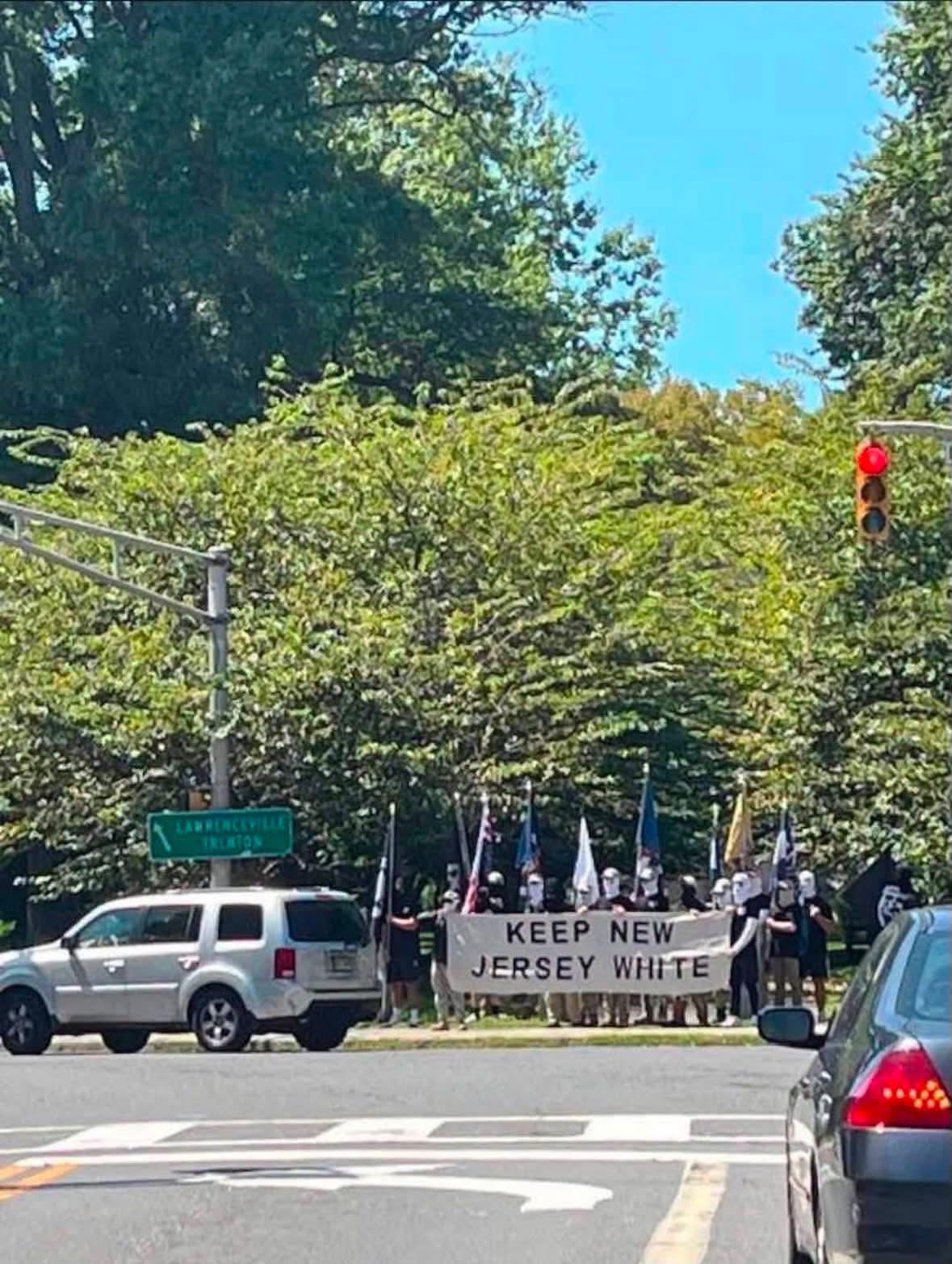
Princeton Patch has now confirmed that a white supremacist rally did in fact take place in Princeton this past Saturday afternoon, August 29th. Don’t miss the neo-Nazi video embedded in the article, “Youth in Revolt.” Apparently, the spirit of Leni Riefenstahl never quite died.
Unfortunately, the rally is (like so many things) increasingly being seen as a law enforcement matter, and the police, fixated by definition on matters of law enforcement, are now pursuing the thought that the people participating in the rally lacked a permit to march down the street or through Monument Park, and should have had one. Law enforcement’s idea of a solution to the rise of neo-Nazism in Princeton is to set up a Permit Raj: demand that activists get permits to exercise the privilege of assembling, marching, chanting, or holding signs. And make sure to demote those activities to the status of privileges in the process.
I posted this yesterday but pulled it after I started to doubt the provenance of the photo. The photo seemed real enough, but I wasn’t sure exactly when the event had happened, and was worried that it was old footage recently unearthed but misleadingly described as recent.
I’ve now traced the source of the photo to my own satisfaction, and am convinced both that the photo is real and that the event it depicts really did take place this past weekend–on Saturday, August 29th. The original eyewitness source appears to be one Andrea Christo of East Windsor, New Jersey, who filmed the demonstration as she drove by, and then either took a still of the scene below or screenshotted her own video. Here’s a link to her Facebook post, and here’s a link to her video. I’m grateful to Ms Christo for documenting this event, and hope that it finds its way into the local press.
People have been telling me for fifteen years that my worries about the rise of fascism and neo-Nazi racism are overblown. Well, here’s a photo of the corner of Nassau and Stockton Streets, taken on August 29th in the supposedly woke college town of Princeton, New Jersey. “Keep New Jersey White.” Since New Jersey isn’t white, their point, obviously, is that it has to be made white at gunpoint. Any guesses how?
(ht: Zellie Imani and Rev Erich Kussman; photo credit: Andrea Christo)
I originally posted this with a critique of the message involved, but about an hour after I posted it, got skeptical that the photo was either real or genuinely depicted an event that took place on August 29th, as is being alleged online. So I’ve deleted the original post pending verification that the photo depicts a demonstration that took place at Nassau and Stockton in Princeton on the afternoon of August 29, 2026.
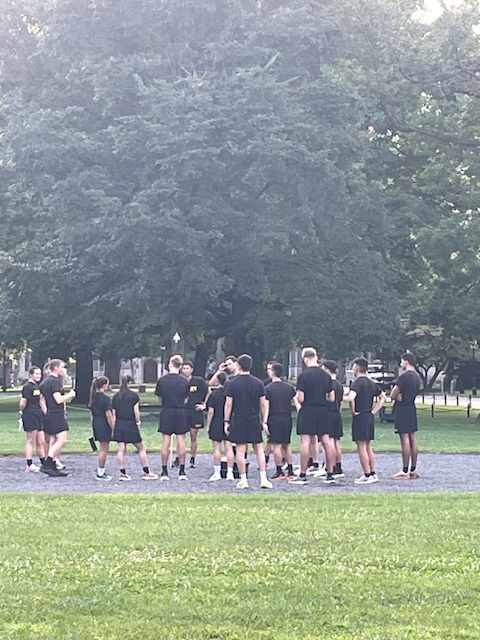
“Organized activity”–aka, peaceful political activity–has been banned at Princeton University’s Cannon Green since the enforced closure of Gaza Solidarity Encampment in May 2024, a first since the British Army’s occupation of Princeton in 1777.
There’s one notable exception: ROTC. That’s what you’re looking at just above. I took the photo last Friday morning. It’s Princeton’s Army ROTC unit using Cannon Green for military training.
The New York Times ran an article the other day that’s notable both for how ordinary and how extraordinary it is. The facts are extraordinary, the attitudes taken to it predictably complacent. It’s yet another addition to my running series here on the use of “Human Shields,” not in Gaza or Southern Lebanon, but right here at home. “The U.S. Start-Up Making Low-Cost Interceptors for the Iran War,” it’s called, describing a military start-up based in downtown West Palm Beach, Florida. Here’s the beginning:
For Florida-based Powerus, becoming a global supplier of counterdrone technology has meant involving the Trumps, a golf course and a new way of doing business.
In a small warehouse in the United Arab Emirates, workers spend up to 12 hours a day snapping together 3-D printed components to make interceptors capable of knocking Iranian drones out of the sky at speeds of up to 200 miles per hour.
The facility, which came online last month, is being used by Powerus, a start-up in West Palm Beach, Fla., to make inexpensive interceptors.
The factory is the company’s first foray into the Middle East, and part of its plan to become a global supplier. Factories affiliated with Powerus make roughly 3,000 drone interceptors a month, a spokesman said, and the company is trying to establish a network of factories that will increase production to 15,000 a month worldwide by mid-2027. It would not publicly disclose the identities of its customers or contract manufacturer in the Emirates.
True to form, Bret Stephens has an essay in yesterday’s New York Times in which, following AOC’s claims that “Woke 1.0” was “crazy,” he reiterates her point, then offers up a list of nine of Woke 1.0’s victims, and demands restitution for them. The common denominator of all of these victims is that they’re writers or intellectuals of centrist to conservative views, all of whom unjustly lost their jobs (or so we’re told) to the forces of Wokedom.
The Times “Covers” the Iran War Here’s The New York Timesdescribing recent developments in the US-Israeli war against Iran and Lebanon:
The June memorandum of understanding was widely seen as a boon for Iran, granting the regime badly needed sanctions relief even as talks over tough concessions like nuclear enrichment were postponed for later. But Iranian leaders opted to escalate again rather than consolidate their gains from the deal, according to Nate Swanson, an Iran expert at the Atlantic Council, a Washington-based research group.
Ships could move through the Strait of Hormuz freely before the war. Iran’s insistence that the deal’s vague language on the issue gave it control over the waterway led to the deal falling apart. Iran began firing on ships that transited in channels outside Iranian waters, and American forces retaliated by bombing southern Iran, prompting a cycle of attacks and counterattacks across the Middle East.
In other words, according to the Times, “expert” opinion tells us that the failure of the ceasefire is to be chalked up to Iranian belligerence and irrationality. In fact, what it actually tells us is that the “experts” are full of shit. Every claim made in this passage is factually challenged nonsense.
A bunch of us had a contentious discussion the other day about institutional neutrality, apropos of my then-upcoming talk about it at the Heterodox Academy conference. One topic that came up was how institutional neutrality relates to curricular decisions. Is there an institutionally neutral way of deciding, say, whether a given topic or discipline merits inclusion within the curriculum of a given institution of higher education? Or a neutral way of deciding whether a program, department, division, school, or university itself ought to set aside the resources to make something a formal subject of study? Since not everything can be studied, decisions have to be made about what gets included and what doesn’t. Can those decisions be made “neutrally”? Continue reading →
 Policy of Truth