For decades now, we’ve been force-fed the dogma that American higher-education is the epitome of “woke”–a fully-owned subsidiary of “the Left.” I spent three years working for the National Association of Scholars, an outfit dedicated to manufacturing and marketing propaganda of this kind. I spent twenty-six years in higher education, teaching at a dozen institutions on two continents. I happen to live in a college town, Princeton, have lived here for fifteen years, am walking distance from Princeton University, and spend time on campus just about every day. I happen to work near another college town, New Brunswick, home to Rutgers University, and spend time on campus there about once a week. And I have friends and colleagues in higher education across the United States and Canada. So I’m no stranger to higher education or to controversies about it.
Continue readingTag Archives: History
The Neo-Nazis and the Permit Raj
Princeton Patch has now confirmed that a white supremacist rally did in fact take place in Princeton this past Saturday afternoon, August 29th. Don’t miss the neo-Nazi video embedded in the article, “Youth in Revolt.” Apparently, the spirit of Leni Riefenstahl never quite died.
Unfortunately, the rally is (like so many things) increasingly being seen as a law enforcement matter, and the police, fixated by definition on matters of law enforcement, are now pursuing the thought that the people participating in the rally lacked a permit to march down the street or through Monument Park, and should have had one. Law enforcement’s idea of a solution to the rise of neo-Nazism in Princeton is to set up a Permit Raj: demand that activists get permits to exercise the privilege of assembling, marching, chanting, or holding signs. And make sure to demote those activities to the status of privileges in the process.
Continue reading“Keep New Jersey White” Mystery Photo
UPDATE: See my August 31 update to this post.
I originally posted this with a critique of the message involved, but about an hour after I posted it, got skeptical that the photo was either real or genuinely depicted an event that took place on August 29th, as is being alleged online. So I’ve deleted the original post pending verification that the photo depicts a demonstration that took place at Nassau and Stockton in Princeton on the afternoon of August 29, 2026.
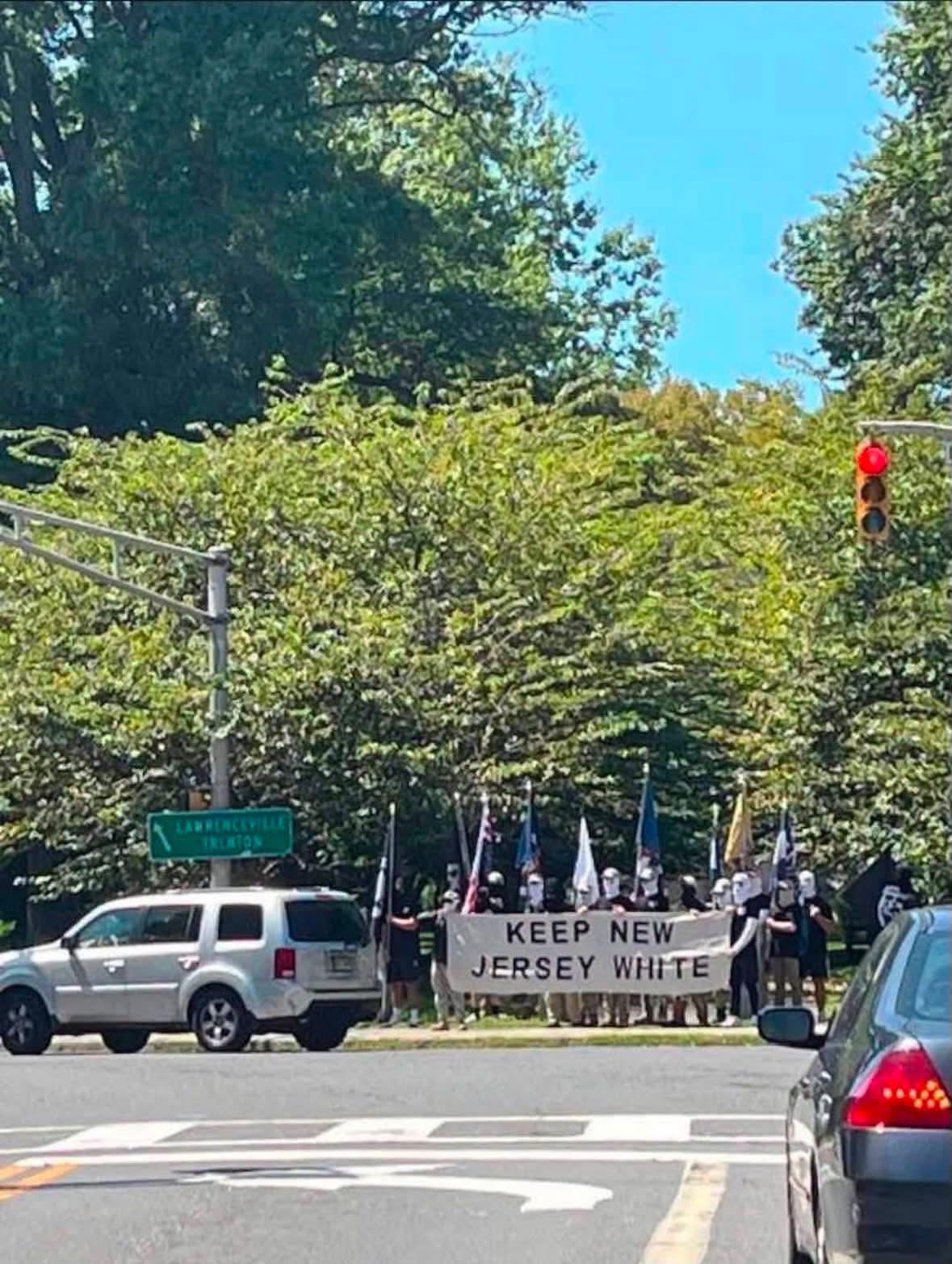
(ht: Zellie Imani and Rev Erich Kussman)
Continue readingPrinceton in the Service of Empire
“Organized activity”–aka, peaceful political activity–has been banned at Princeton University’s Cannon Green since the enforced closure of Gaza Solidarity Encampment in May 2024, a first since the British Army’s occupation of Princeton in 1777.
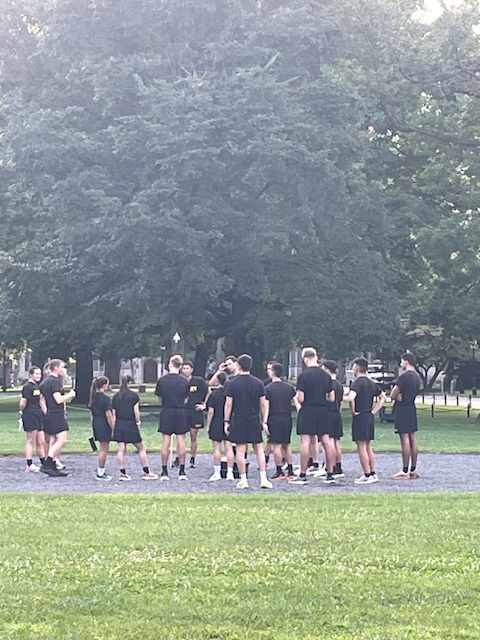
There’s one notable exception: ROTC. That’s what you’re looking at just above. I took the photo last Friday morning. It’s Princeton’s Army ROTC unit using Cannon Green for military training.
Continue readingAristotle vs. Institutional Neutrality
A bunch of us had a contentious discussion the other day about institutional neutrality, apropos of my then-upcoming talk about it at the Heterodox Academy conference. One topic that came up was how institutional neutrality relates to curricular decisions. Is there an institutionally neutral way of deciding, say, whether a given topic or discipline merits inclusion within the curriculum of a given institution of higher education? Or a neutral way of deciding whether a program, department, division, school, or university itself ought to set aside the resources to make something a formal subject of study? Since not everything can be studied, decisions have to be made about what gets included and what doesn’t. Can those decisions be made “neutrally”? Continue reading
“Iran’s Fractured Leadership”
I wrote the post below the line back in April, but got pulled into other things, and never posted it. But I feel pretty vindicated: since late March, the Times’s narrative has turned 180 degrees. In March, they were quoting officials quite sure that Iran’s leadership was too “fractured” to act in a unified way. By July 29, the narrative became: “Trump Encounters a More Determined Iran as War Widens.” By August 1, it was: “In Iran, the U.S. Appears Headed for Strategic Defeat, Allies Fear.”
Good call, NYT, but how the fuck did that happen? How did Iran go from being all fractured and confused to achieving victory over the supposedly unified and all-powerful United States in four months? One possibility is that though “fractured,” Iran had the capacity to heal its “fractures” pretty fast. The other is that Iran was never all that fractured in the first place. In the first case, we’ve gotten no account from the Times of the transition from the one thing to the other; in the other, we’ve gotten no acknowledgement of its false assessment of Iranian dysfunction. Either way, the question arises: how much do these journalistic “experts” really know, anyway? To the extent that they know anything, how much of their knowledge is ultimately neutralized by the desire to generate nationalist propaganda? Continue reading
Institutional Neutrality, Coeducation, and History
Since my first post here on institutional neutrality in 2025, Heterodox Academy has, predictably, re-affirmed its commitment to the doctrine by way of the same tired “arguments” for it, and done its fair share of bragging about the latest institutions to have signed on to it. For all their talk about “viewpoint diversity” and the burdens of rational discourse, the defenders of institutional neutrality seem pretty oblivious to the arguments that have been made against it. I haven’t, for instance, seen any serious attempts to deal with the complicity-based objections I’ve raised to it over the last year. I’ll take that as my cue to deploy yet another of the (literally) dozens of counter-examples I have to institutional neutrality, if only for the fun of piling them up. Continue reading
Our Sacred Honor
I can’t say that I’ve felt very much enthusiasm for the 250th anniversary of the founding of the United States, insofar as 1776 marks that date (and arguably, it doesn’t). It tells you all you need to know that I spent the Fourth of July under a tree in a nearby park, reading Machiavelli in hundred degree heat. But two of my friends wrote notable and interesting pieces commemorating the 250th, and did so in interestingly similar and dissimilar ways. Both are on Substack, and both are worth reading. My friend Bob Massie has a piece called “A New Birth of Freedom” on his Substack. And my friend Chris Sciabarra has one called “From America 200 to 250: A Personal Journey” on his.
Continue readingPort Newark Activists on Trial
On May 26th and 28th, I mentioned a group of activists who’ve put their bodies on the line at Port Newark/Elizabeth, not far from Delaney Hall, to stop military shipments through those ports to Israel. These activists are part of a little-discussed worldwide effort–spanning Italy, France, Spain, Morocco, Denmark, the UK, Canada, and the U.S. (Newark, Norfolk, Houston, Seattle, Tacoma, Oakland, Los Angeles) to block the flow of military hardware to Israel.
Continue readingDelaney Hall: Would They Lie to You?
Politico Gets It Wrong, GEO Group Evades Another Inspection
Here are a couple of footnotes on yesterday’s post critiquing Holly Schepisi’s views on Delaney Hall. I argued there that Schepisi had egregiously misrepresented the facts about the New Jersey Department of Health’s (NJDOH) May 28, 2026 inspection of Delaney Hall.
 Policy of Truth