I recently attended a webinar on “commencement neutrality” sponsored by Heterodox Academy. In it, the presenters, John Tomasi and Jeffrey Flier, argue that
Students receiving diplomas while a speaker condemns their political values, whether progressive or conservative, are justified in objecting.
The graduation stage is not an op-ed page, a political blog, or a partisan rally, though some wish to make it one.
This claim extends the idea of “institutional neutrality” to commencement speeches, and is elaborated at further length in Flier and Tomasi’s recent Boston Globe piece, “Keep Politics Out of Commencement Speeches” (May 14, paywalled). The basic argument is that commencement speeches have a ceremonial or celebratory function which is incompatible with the discomfort provoked by sharp political commentary.
During the webinar, I asked the following question (appears at minute 43:30 of the video in the first link):
Would Jeff Flier or John Tomasi have prevented Martin Luther King from addressing the topic of Jim Crow in a speech given in 1965 on the grounds that the topic is not ceremonial or celebratory, or would make people uncomfortable?
I was alluding to an actual speech, Martin Luther King Jr’s commencement speech in June 1965 to the graduating class of Oberlin College, “Remaining Awake Through a Great Revolution.” The speech, which aptly invokes Washington Irving’s short story, “Rip Van Winkle,” is quite literally a defense of “wokeness.” (Crediting Corey Robin, I’ve made the same allusion to the same end here.) I’ve transcribed below Flier and Tomasi’s answer to my question, to which I’ll respond in a forthcoming post. Suffice it to say for now that I don’t find it convincing.
Tomasi: Fabulous question.
Flier: No it’s a great question. Well, what I would say is, if I was in the position of trying to decide that in 1965, I wouldn’t have prevented him from giving that speech. And even today, if he was alive, depending on what the speech would be, I would not oppose it, because this is in the category that Jim Crow, which existed, was a real thing, [and] was a horrible injustice to people in America who were subject to it. So I would not have elevated that to the category of a contentious topic, that, you know, there were supporters of Jim Crow. In fact, I was going to say earlier: there are special circumstances to the argument that I think I was making, and some of them might incorporate the question of Jim Crow and Martin Luther King.
Now, I would say: if I was in a role to talk to Martin Luther King, which sadly I wasn’t, I would say, “Remember, this is a celebratory event. Make some comments about it, but don’t make the whole thing a speech about Jim Crow. Well, you don’t have to make it the total topic of your speech. You just need to reflect upon it in a way that will be very memorable and very powerful.” This is not an issue where we have to respect people who think that there should be separated provisions for black and white individuals, etc. So I don’t know: does that make sense to you?
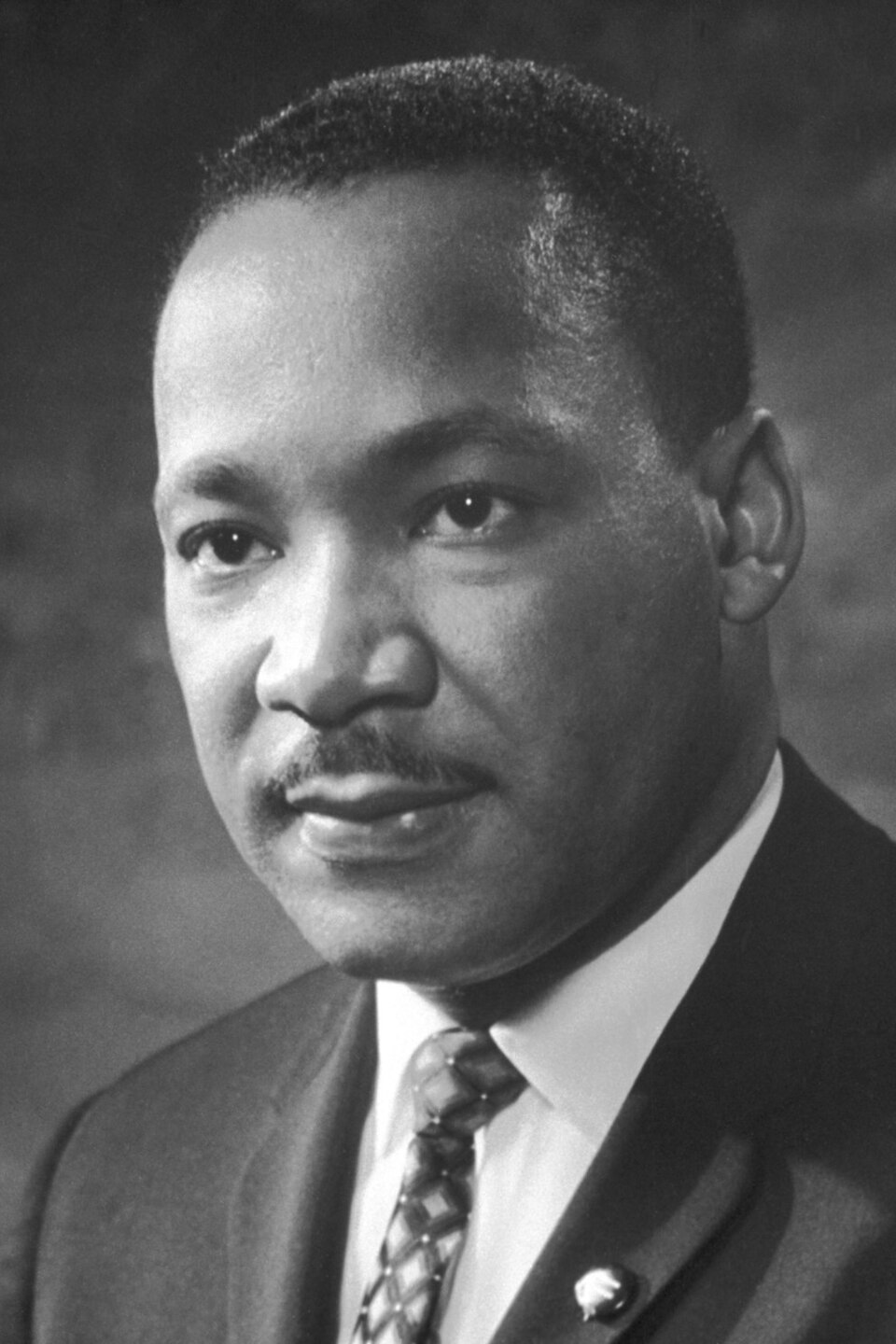
Martin Luther King, Jr. in 1964, anachronistically wondering whether it really makes sense (photo credit: Nobel Foundation, Wikipedia)
Tomasi: It does. I’m just looking at the question a little more closely now, and realizing that it’s kind of written in a way that I think we could answer fairly readily, because it says we would be prevented [i.e., we would be preventing King] from addressing the topic. I think addressing the topic is OK. I think addressing any topic is OK. The question is, how do you address the topic? Do you do it in a broad-minded way? Do you do it in a way that engages the reasons of people who disagree with you?
[Imagine that] the question were tweaked in such a way as to say that Martin Luther King would be prevented from giving a speech condemning Jim Crow. Then the question becomes a bit harder, because Jim Crow is wrong, and by 1965, there were still incredible debates about that. That makes the question tougher. I think our point, Jeff, is not that we oppose the addressing of political topics in commencement addresses, if they’re handled in a broad-minded way that brings people in and tried to build bridges.
Let’s imagine someone giving a talk today in the US about the polarization of American society, addressed that topic, an extremely difficult topic, but did it in a way that tried to do something positive, about seeing some way of moving forward as a community, and come together perhaps. We’re OK with that. But I think just one position, you know, MAGA or not, whatever, that would be objectionable. But this is a really great question. Another thing I was doing while reading the question was changing the dates. I read it three different ways. I read it: 1965, 1865, 1765. And I’m not sure if it makes it any easier to make it 1765, when these debates were happening in a lively way. It’s an excellent question, and it pushes really hard on this: well, don’t we know anything morally? Haven’t we learned something?
Flier: Well I think that there are moral underpinnings that a graduation commencement speaker can incorporate that are totally appropriate, but they should be made explicit, and they should be justified, and they should be, as you say, reaching out to people who might have an alternative view. I don’t know, honestly, on the issue of Jim Crow, whether I would want to advise the speaker, Martin Luther King or someone else, who was going to say some negative things about Jim Crow, I don’t think I would want to advise them [to say] that there are some good points to Jim Crow. I wouldn’t do that. So I think there are grey zones, and questions, and times, where things are different. The problem is, that there are people today who will say that the war in Israel and Gaza is one of those times, and every good person has to condemn X or Y, and I would take the position that that is not justified by the current situation, and the requirements of a ceremonial, inspirational speech. But there are going to be people disagreeing. I know that.
Tomasi: Yes, it’s a great question. In ’65, it was still a contested issue. Thank you, a super strong challenge. That was interesting.


Though neither Tomasi nor Flier name the following issue explicitly, it might be part of what they are getting at: the attitudinal position of the audience members with respect to receiving (or at least tolerating, not just resisting) the relevant moral truth (or accusation or condemnation). In some cases, the speaker would perhaps make some people a bit uncomfortable, but would not be provoking resistance and fighting spirit. In other cases, one would provoke resistance and anger (and not be doing much persuading and probably frustrating the celebratory or coming-together ends of a graduation speech). Similarly — though probably with more cases falling in the “starting a fight” category — when the putative moral truth (or associated accusation or condemnation) is not certain but rather something legitimately controversial.
LikeLike
That’s a very charitable version of making their claims explicit. I think one could with equal textual fidelity say that their claim is: neutrality sometimes applies to politics, and sometimes not, and sometimes applies, and sometimes not; it’s a fabulous question how to come up with the principle that explains both the prescription and the exception cases, but oddly enough, it never occurred to them to ask. But whether they have an answer or not, neutrality should reign, because what if someone mentions Gaza?
The only clear claim they make is Flier’s assertion that talk of Gaza has to be ruled out. The “argument” as a whole strikes me as a textbook case of motivated reasoning, question begging, and irresponsibility. The gods of “viewpoint diversity” haven’t bothered to consider even the most obvious counter-examples to their view–MLK condemning Jim Crow!–but they’re totally confident (despite pro forma avowals of “humility”) that their prescription should be put into practice.
It’s true that an inept commencement speaker could go out of his way to provoke a pointless fight with the audience, but the problem there is rhetorical ineptitude, not non-neutrality, and the remedy is rhetorical competence, not neutrality. It would be unfair of me to object to their view that a politically neutral speech could be boring and banal (which it definitely could be). Boring banality is not inherent in politically neutral content. An apolitical comedy routine (or just a funny speech on the usual commencement themes) could be memorable and valuable, but it could also be a cliche-ridden bore. If it ends up being the latter, the advice to give the speaker is not “Next time, talk politics,” but “Next time, do better.” The same inept speaker could talk politics, and fuck it up. There’s a real confusion here between competence and content.
I actually don’t agree with the premise that a commencement speech has to be “celebratory” or unifying. That seems to me to involve a fallacy of composition. Maybe the whole event has that aspect, but it doesn’t follow that the speech must. The speech has to be memorable, thought-provoking, and interesting–like all speeches.
Setting aside cases where the speaker gratuitously goes out of his way to provoke anger, I think it’s very hard to know how a speech will be received. The best strategy is to say what you want to say without gratuitous rhetorical flourishes, and not worry too much about the reception. No one can write well (a speech or anything else), while focusing on the expected reception of the crowd, whether angry or applauding. It’s a mistake to appease the first or aim too hard at the second. You have to have a generalized read of the room, but then you just have to say what you want to say.
That, by the way, is why there is something really ludicrous about the criticisms made of Derek Peterson at Michigan that he “went off script” (which Tomasi makes in the webinar). The idea of a speech based on a rigid script is just a contradiction in terms. A speech is partly extemporaneous, even if there is a manuscript. For people who make such a big deal about “ceremony” and “ritual,” and this and that, it strikes me as pretty amazing that it has apparently never occurred to Tomasi and Flier that (outside of a totalitarian state, a cult, or allocuting to a crime in a court of law) giving a speech does not = reading the approved words on a page.
I think King’s Oberlin speech is a good test case. Many people in 1965 might have been made angry by it. At a place like Ole Miss, King’s speech would probably have started a riot. It really is an explicit defense of wokeness. If that makes people angry today, it certainly would have done so then. But the speech is perfect as written. It would have been a rhetorical crime to tone it down to appease some audience.
I think this really comes down to cases. Tomasi and Flier seemed to take exception to Derek Peterson’s recent (supposedly controversial) commencement speech at Michigan. It is totally obscure why, and I would love to hear them try to explain it. Peterson mentions the University’s Palestinian activists in one sentence at minute 4:30 of a 5:30 speech. He talks about them for maybe 15 seconds. They’re mentioned as one example in a series of examples. What he says about Israel is not particularly radical. It’s become a commonplace both in the US and in Israel, and all over the world. The crowd was not angry at hearing Petersen say what he said. They cheered him more loudly for the Palestine part of the speech than for any other. What is the problem supposed to be? That it was a crowd pleaser but didn’t please 100% of the crowd? What is wrong with the speech?
The more you look at it, the more it becomes clear that the problem is mentioning Gaza or Palestine at all. Palestine is a taboo, and it has to remain a taboo, even if the taboo-promoters wrap their injunctions up in the dumbest, most incoherent arguments imaginable. How is that not “starting a fight”?
LikeLike
It seems right that, in not considering the precise case you brought up (and some other similar ones), Tomasi and Flier have failed to hammer out a good, explicit case. “Here’s my view and here’s how it deals with the hard cases.” If you don’t do that, then of course whatever considerations loom large in your mind (whether or not this is, in this case, a pre-determined conclusion regarding the Gaza conflict) will carry the day.
LikeLike
I don’t think either of my cases are hard. They’re paradigms of the commencement speech genre. King’s Oberlin speech is a paradigm at the high end, and Peterson’s is more ordinary. But I will write up a more direct critique in a little while, when I get a chance.
LikeLiked by 1 person
MLK gave the commencement speech at Antioch College on June 19th, 1965 (in my hometown, Yellow Springs, OH), five days after the Oberlin address. Probably quite similar in content to the Oberlin speech (literally “woke” in arguing against complacency in the face of injustice). Coretta Scott King was an Antioch alumna.
LikeLike
Apparently, MLK went on a speaking tour that began in April and continued into June: UCLA, Oberlin, Antioch, and the University of the West Indies (Jamaica), among others. It’s interesting that the non-commencement speech was more aggressive in tone than the commencement. He gave a 55 minute speech at UCLA in April 1965 called “Segregation Must Die.”
So he certainly tailored each speech to the occasion. But none of the speeches is neutral in any sense of the term. And we forget that MLK was a controversial figure in his time, not the accepted symbol of moral respectability he is today. That was the point of the “Letter from the Birmingham Jail.” It was addressed to eight specific critics, on the premise that the eight critics represented a much larger consensus. King’s call to civil disobedience, inspired by an exotic foreign source (Gandhi), after King’s trip to India (a socialist country) at a time when King was himself regarded as a communist, did not sit well with the public. So inviting King to do a commencement speech was a decidedly anti-neutral act.
The activists of the civil rights movement–SNCC, Freedom Riders and the proponents of Freedom Summer–were all derided and abused in much the way that the Gaza Solidarity Encampers are today. Beyond that, the civil rights movement gave rise to plenty of “extremists,” like Stokely Carmichael, Angela Davis, Mark Rudd, Mario Savio, etc.
A Call for Unity – Wikipedia
The call for unity King’s critics issued is not different from Tomasi and Flier’s insistence that commencement speeches aim to unify. It just seems obvious to me that they have not grappled with any of this history in any serious way, or with the current activist movements in any serious way. They need critics who will tell them, flat out, that the view they’re defending is indefensible, incoherent, and shallow. If only such critics existed.
LikeLike
Pingback: Our Sacred Honor | Policy of Truth
Pingback: A(nother) Reductio for Institutional Neutrality | Policy of Truth
Pingback: Home Is Where the Bombs Are | Policy of Truth