Adventures at Old Nassau (2)

Linda McMahon, Divestment, and the Strange Discrepancies of Christopher Eisgruber

As I was saying in my last post in this series, I happened to attend yesterday’s meeting of the Council of the Princeton University Community (CPUC), presided over (intuitively enough) by Christopher Eisgruber, the President of Princeton University. About twenty minutes into the meeting, right on schedule, President Eisgruber raised agenda item #4 from the “Government Affairs Update“: “Letter from the Department of Education to Universities.” This was a letter, dated August 6, 2026, from Linda E. McMahon, United States Secretary of Education. Here is a three page PDF of it.

Continue reading →
Adventures at Old Nassau (1)

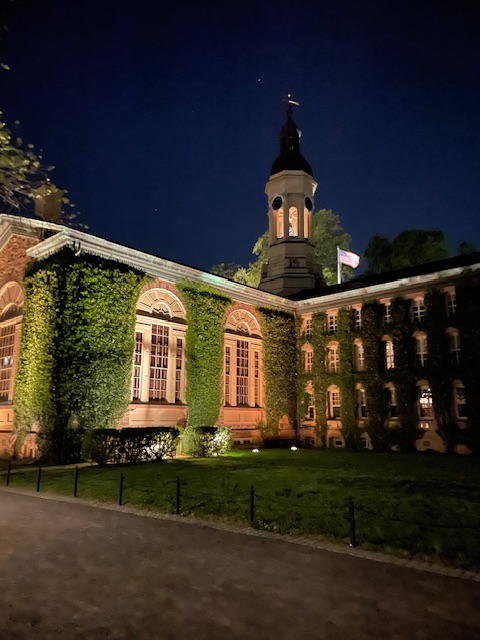
I went to Princeton, I’ve taught at Princeton, I’ve lived in Princeton, and I spend time at Princeton almost every day of the week, but it’s only belatedly occurred to me what a ridiculous place it is. I had not, 39 years after matriculating at Princeton and 35 after graduating, ever learned the words or melody of “Old Nassau,” the University’s theme song (or whatever you call it), so I decided five minutes ago to look them up.

Continue reading →

Question Time for Nassau Hall

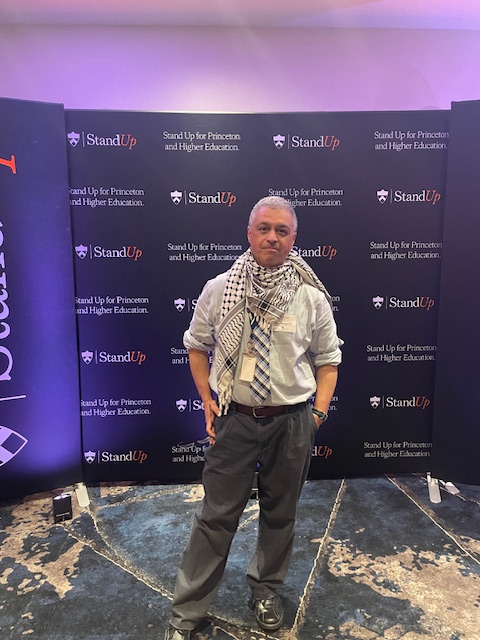
After two delays due to work conflicts, I’ve finally decided to take time off from work to attend the November 9 meeting of the Council of the Princeton University Community (CPUC) this Monday. The gist of my question: The University refuses to disclose the nature of its investments in military matters, and claims the prerogative to refuse to disclose unless nearly impossible conditions are met. Meanwhile, it asks alumni to “stand up” for it against attacks by the Trump Administration. It seems an illegitimate demand. How can the University ask us to “stand up” for it when it refuses to disclose what it stands for?

Standing up for disclosure, dissociation, and divestment, New York Marriott Marquis, April 16, 2026 (photo: Rabbi Gil Steinlauf)

“Gaza as World Event”

The Executive Board of the North American Society for Social Philosophy (NASSP), recently asked its membership (of which I’m one) for nominations of keynote speakers for its Forty-Fourth Annual Conference in mid-July 2027. The keynote at an academic conference is usually given by a well-known, distinguished professional in the field, and is usually focused on the theme selected that year for the conference. The theme at next year’s NASSP conference will be “Situated Stories: Belonging, Erasure, Replacement.”

Continue reading →

Salad Days with Sean Wilentz

I’d just walked out the door of Alfalfa after enjoying a nice salad there when I unexpectedly confronted a pair of “piercing blue eyes.” It was Sean Wilentz, the subject of a recent post here. He gave me what seemed a look of disdain, then hustled down Nassau, too swift to catch except at the risk of my coming across as a stalker.

So many questions. “How come you never acknowledged my post, Professor Wilentz? And what do you think about salads? Tacos are one thing, but can we live on salads?”

Why We’re Surrounded by Assholes

What Dale Caldwell Has in Common with Justin Goldsman and Mikie Sherrill
West Orange Patch has a headline this morning, “Around West Orange: Political Scandal.” The headline suggests that a scandal has taken place in West Orange. Has it? No, the scandal Patch has in mind is the recent resignation from office of New Jersey Lieutenant Governor Dale Caldwell. Caldwell lives and works in New Brunswick. He answered to Governor Mikie Sherrill, who lives in Princeton and works in Trenton. It’s not clear exactly where the malfeasances alleged against him took place, but it’s clear that none took place in West Orange.

Continue reading →

Question Time for Nassau Hall

Question submitted for the September 28, 2026 meeting of the Council of the Princeton University Community:

On November 11, 2024, I asked this body whether, given evidence of the University’s complicity in grave wrongdoing via its investments, it would in principle disclose the nature of those investments. I was told both orally and in print that it would not. The University now has a campaign in which it asks alumni like me to “Stand Up” for Princeton. This strikes me as an illegitimate request. It’s one thing to make a request for support in a context of reciprocity: you disclose; we decide. What Princeton is asking is that we stand up for it while it conceals what it stands for. How can that be justified? Indeed, how can it be differentiated from an outright scam?

The CPUC meets Monday, September 28 at 4:30 pm in the All Purpose Room of Frist Hall at Princeton University.
(I unfortunately missed this meeting again, stuck at work, and will have to ask the question at the CPUC’s next meeting on November 9th.)

Nassau Hall during Gaza Solidarity Encampment, April 29, 2024

Home Is Where the Bombs Are

For decades now, we’ve been force-fed the dogma that American higher-education is the epitome of “woke”–a fully-owned subsidiary of “the Left.” I spent three years working for the National Association of Scholars, an outfit dedicated to manufacturing and marketing propaganda of this kind. I spent twenty-six years in higher education, teaching at a dozen institutions on two continents. I happen to live in a college town, Princeton, have lived here for fifteen years, am walking distance from Princeton University, and spend time on campus just about every day. I happen to work near another college town, New Brunswick, home to Rutgers University, and spend time on campus there about once a week. And I have friends and colleagues in higher education across the United States and Canada. So I’m no stranger to higher education or to controversies about it.

Continue reading →

Aristotle vs. Institutional Neutrality

A bunch of us had a contentious discussion the other day about institutional neutrality, apropos of my then-upcoming talk about it at the Heterodox Academy conference. One topic that came up was how institutional neutrality relates to curricular decisions. Is there an institutionally neutral way of deciding, say, whether a given topic or discipline merits inclusion within the curriculum of a given institution of higher education? Or a neutral way of deciding whether a program, department, division, school, or university itself ought to set aside the resources to make something a formal subject of study? Since not everything can be studied, decisions have to be made about what gets included and what doesn’t. Can those decisions be made “neutrally”? Continue reading →

“Iran’s Fractured Leadership”

I wrote the post below the line back in April, but got pulled into other things, and never posted it. But I feel pretty vindicated: since late March, the Times’s narrative has turned 180 degrees. In March, they were quoting officials quite sure that Iran’s leadership was too “fractured” to act in a unified way. By July 29, the narrative became: “Trump Encounters a More Determined Iran as War Widens.” By August 1, it was: “In Iran, the U.S. Appears Headed for Strategic Defeat, Allies Fear.”

Good call, NYT, but how the fuck did that happen? How did Iran go from being all fractured and confused to achieving victory over the supposedly unified and all-powerful United States in four months? One possibility is that though “fractured,” Iran had the capacity to heal its “fractures” pretty fast. The other is that Iran was never all that fractured in the first place. In the first case, we’ve gotten no account from the Times of the transition from the one thing to the other; in the other, we’ve gotten no acknowledgement of its false assessment of Iranian dysfunction. Either way, the question arises: how much do these journalistic “experts” really know, anyway? To the extent that they know anything, how much of their knowledge is ultimately neutralized by the desire to generate nationalist propaganda? Continue reading →