Every system of mass transportation I use—trains, buses, airlines—gives a discount to active service military personnel. Some go beyond this, giving them special lounges and priority in boarding. Isn’t this a form of complicity, however ostensibly minor, in the wars they fight? And hasn’t the time come to put an end to it?
Continue readingCategory Archives: Human Shields
Question Time for Nassau Hall
Question submitted for the September 28, 2026 meeting of the Council of the Princeton University Community:
On November 11, 2024, I asked this body whether, given evidence of the University’s complicity in grave wrongdoing via its investments, it would in principle disclose the nature of those investments. I was told both orally and in print that it would not. The University now has a campaign in which it asks alumni like me to “Stand Up” for Princeton. This strikes me as an illegitimate request. It’s one thing to make a request for support in a context of reciprocity: you disclose; we decide. What Princeton is asking is that we stand up for it while it conceals what it stands for. How can that be justified? Indeed, how can it be differentiated from an outright scam?
The CPUC meets Monday, September 28 at 4:30 pm in the All Purpose Room of Frist Hall at Princeton University.
(I unfortunately missed this meeting again, stuck at work, and will have to ask the question at the CPUC’s next meeting on November 9th.)
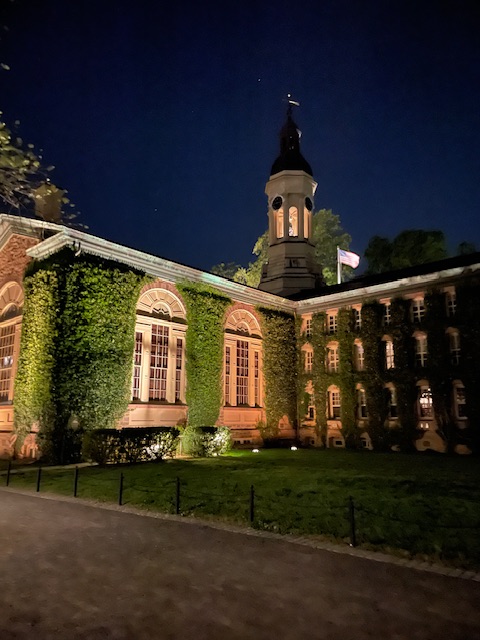
Nassau Hall during Gaza Solidarity Encampment, April 29, 2024
They Have Some Planes
“We have some planes…”
–Muhammad Atta, 9/11 hijacker
The great horror of 9/11 was supposed to be that Al Qaeda hijacked a bunch of American planes and used the civilians on them as mere cannon fodder for their military ends. The great redemption was supposed to be United Flight 93, which flew out of Newark, bound for San Francisco, but crashed in Shanksville, Pennsylvania when passengers stormed the cockpit and brought it down.
The horror hasn’t really ended. It’s just been concealed. United Flight 90 is the standard United flight to Tel Aviv out of Newark that I’ve taken for a decade, starting from the same place as Flight 93, but flying in the reverse direction. It turns out that everyone on it is, and has for some time been, a human shield for Israel. Our lives–and the honest truth–mean so little to our ruling class that they’ll sacrifice both to Israel without a thought.
Continue readingEvent: “On Direct Action”

I’ll be moderating this event, which takes place Saturday, September 19, 1-3 pm in Princeton. It’s a conversation with four of the ten activists who helped shut down Port Elizabeth, New Jersey this past May 22 to stop the shipment through the port of weapons to Israel.
Scan the QR code on the flyer to register. Confirmed attendees will receive the location of the venue, which by request of the venue is only to be divulged to confirmed attendees. You can also use this link.
Home Is Where the Bombs Are
For decades now, we’ve been force-fed the dogma that American higher-education is the epitome of “woke”–a fully-owned subsidiary of “the Left.” I spent three years working for the National Association of Scholars, an outfit dedicated to manufacturing and marketing propaganda of this kind. I spent twenty-six years in higher education, teaching at a dozen institutions on two continents. I happen to live in a college town, Princeton, have lived here for fifteen years, am walking distance from Princeton University, and spend time on campus just about every day. I happen to work near another college town, New Brunswick, home to Rutgers University, and spend time on campus there about once a week. And I have friends and colleagues in higher education across the United States and Canada. So I’m no stranger to higher education or to controversies about it.
Continue readingThe Human Shields of West Palm Beach
The New York Times ran an article the other day that’s notable both for how ordinary and how extraordinary it is. The facts are extraordinary, the attitudes taken to it predictably complacent. It’s yet another addition to my running series here on the use of “Human Shields,” not in Gaza or Southern Lebanon, but right here at home. “The U.S. Start-Up Making Low-Cost Interceptors for the Iran War,” it’s called, describing a military start-up based in downtown West Palm Beach, Florida. Here’s the beginning:
Continue readingFor Florida-based Powerus, becoming a global supplier of counterdrone technology has meant involving the Trumps, a golf course and a new way of doing business.
In a small warehouse in the United Arab Emirates, workers spend up to 12 hours a day snapping together 3-D printed components to make interceptors capable of knocking Iranian drones out of the sky at speeds of up to 200 miles per hour.
The facility, which came online last month, is being used by Powerus, a start-up in West Palm Beach, Fla., to make inexpensive interceptors.
The factory is the company’s first foray into the Middle East, and part of its plan to become a global supplier. Factories affiliated with Powerus make roughly 3,000 drone interceptors a month, a spokesman said, and the company is trying to establish a network of factories that will increase production to 15,000 a month worldwide by mid-2027. It would not publicly disclose the identities of its customers or contract manufacturer in the Emirates.
Silicon Valley’s Human Shields
Consider this excerpt from a Guest Essay in today’s New York Times by Sharon Weinberger, editor in chief of the Bulletin of the Atomic Scientists, and author of a forthcoming book, Valley of Death: How Big Tech is Fueling the Future of War.
People seem to forget that Silicon Valley was largely born on the back of Pentagon funding during the Cold War. Fairchild Semiconductor, a company that became the wellspring of the computer chip industry’s growth, was one of those beneficiaries. Conventional wisdom held that, by 2016, many firms, not to mention their employees, found the idea of working on defense projects distasteful, if not unthinkable. Mr. Trump’s election that year seemed to widen the divide. In 2018, Google, under pressure from employees, pulled out of Project Maven, a Pentagon-funded A.I. project to advance drone warfare.
Continue reading
Masters of the Universe
The Times “Covers” the Iran War
Here’s The New York Times describing recent developments in the US-Israeli war against Iran and Lebanon:
The June memorandum of understanding was widely seen as a boon for Iran, granting the regime badly needed sanctions relief even as talks over tough concessions like nuclear enrichment were postponed for later. But Iranian leaders opted to escalate again rather than consolidate their gains from the deal, according to Nate Swanson, an Iran expert at the Atlantic Council, a Washington-based research group.
Ships could move through the Strait of Hormuz freely before the war. Iran’s insistence that the deal’s vague language on the issue gave it control over the waterway led to the deal falling apart. Iran began firing on ships that transited in channels outside Iranian waters, and American forces retaliated by bombing southern Iran, prompting a cycle of attacks and counterattacks across the Middle East.
In other words, according to the Times, “expert” opinion tells us that the failure of the ceasefire is to be chalked up to Iranian belligerence and irrationality. In fact, what it actually tells us is that the “experts” are full of shit. Every claim made in this passage is factually challenged nonsense.
Continue readingGetting in the Way
“…Jesus did get in the way of empire…”
–Mary Anne Grady Flores, Ithaca Catholic Workers Movement
As I’ve mentioned here a few times (May 26, May 28, July 1), I support the direct-action activist effort to block weapons shipments from the United States to Israel. These shipments conscript our complicity in Israeli aggression, occupation, and war crimes, and also conscript (and are embedded in) civilian commercial networks that are exploited for military purposes. They turn all of us into accomplices of and human shields for wars of aggression and brutality, a status that I think we’re obligated to resist and refuse.
Continue readingUnfortunate Sons
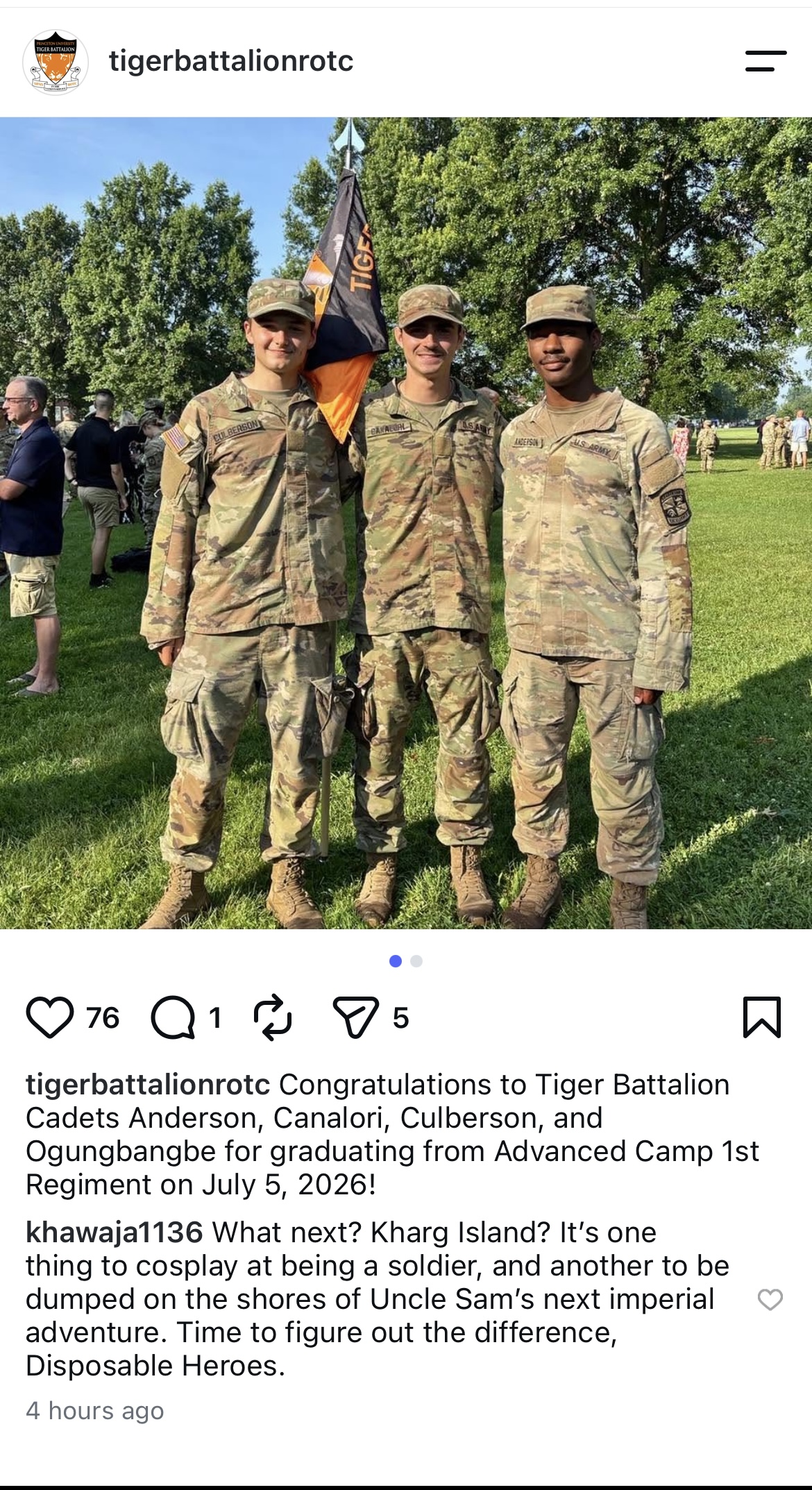
What’s remarkable here is the total lack of self-awareness with which these people will hold a graduation ceremony for soldiers (officers) in a public park, then rationalize the bombing of schools, hospitals, bridges, power plants, and crowds of starving civilians by claiming that the presumptive presence of n “terrorists” or “militants” at those locations makes it all OK. Wouldn’t the same logic rationalize blowing up everyone in the park pictured here, including all of the complacent but supportive civilians? What complaint could they offer if someone did here what was done at Old Dominion University?
Continue reading
