Princeton Patch has now confirmed that a white supremacist rally did in fact take place in Princeton this past Saturday afternoon, August 29th. Don’t miss the neo-Nazi video embedded in the article, “Youth in Revolt.” Apparently, the spirit of Leni Riefenstahl never quite died.
Unfortunately, the rally is (like so many things) increasingly being seen as a law enforcement matter, and the police, fixated by definition on matters of law enforcement, are now pursuing the thought that the people participating in the rally lacked a permit to march down the street or through Monument Park, and should have had one. Law enforcement’s idea of a solution to the rise of neo-Nazism in Princeton is to set up a Permit Raj: demand that activists get permits to exercise the privilege of assembling, marching, chanting, or holding signs. And make sure to demote those activities to the status of privileges in the process.
It doesn’t take much effort to figure out where this is headed. If today the police or the municipality makes this demand of neo-Nazi youth groups, tomorrow they’ll make it of partisans of Palestine solidarity, the anti-war movement, or migrant defense groups. People in Princeton hate some of us as much as they claim to hate Nazis; half of them equate Palestinians with Nazis. Unleash that hate and tie it to a permit regime, and we become collateral damage of the treatment supposedly intended for them.
Neo-Nazis march in Princeton once every blue moon. We make a point of marching here every week or every month. If permits become the norm, we’re the ones who’ll suffer, not them. The rise of a Princeton Permit Raj would in fact be a victory for the Nazis, not their antagonists. It would, granted, make the expression of Nazism harder, but would also in the process make overt antagonism to it harder. What we gained in peace and quiet through a permit regime, would soon be lost in lassitude to it. But peace and quiet is the last thing we need under the circumstances. Same with lassitude.
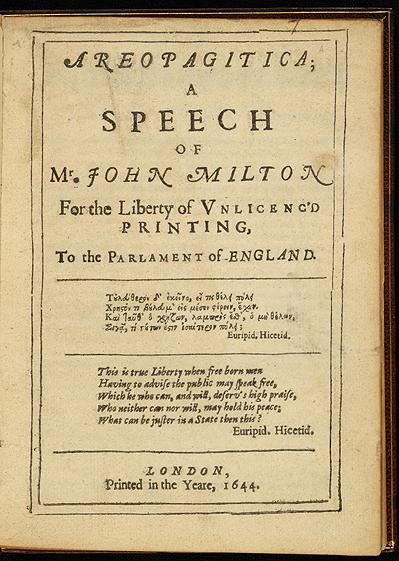
Milton’s Areopagitica
I wish people would learn the lesson that Milton taught us back in 1644. You can’t regulate your way out of ideological conflict. You can’t wish that the other side didn’t get off its ass, or stop it from doing so. You have to get off of yours. There’s no point in putting regulatory obstacles in the way of their protesting, or marching, or assembling. Regulations of that kind are a weapon against the most politically active and justice-committed members of a society. You’d only wield them against someone else if you doubted your own capacity for initiative of your own–your own commitment to what’s right, your own will to resist what’s wrong.
There’s no reason for doubt. There’s just a reason for a re-doubling of initiative. That’s what I’ve been saying here all along. It’s a mistake to think that anything much has happened or changed. A bunch of Nazi kids have organized a march through a small swatch of town. Big deal. So can we, through a bigger one.


“Apparently, the spirit of Leni Riefenstahl never quite died.”
Without her talent, however.
I love how they show a montage of great Western artworks as though they had some connection to them that vindicated their cause. I’m reminded of Sartre’s sarcastic remark about some French antisemite who had said that Jews were incapable of understanding Racine: “But the way is open to me, mediocre me, to understand what the most subtle, the most cultivated intelligence, has been unable to grasp. Why? Because I possess Racine – Racine and my country and my soil.” Or Rand’s similar comment on “the claim of a German brute to the status of a superior because his race has ‘produced’ Goethe, Schiller and Brahms.”
Suppose instead we showed a montage of beautiful European artworks, along with a montage of beautiful Arabic artworks and beautiful Chinese artworks and etc. etc. What moral should we draw from that?
LikeLiked by 1 person
I actually think there’s a coherent thought there, artworks and all. The basic idea is that there is such a thing as Western Civilization, a synthesis of the Judaic, Christian, Greek and Roman traditions. The synthesis takes place in the Renaissance and reaches its apotheosis in America. The synthesis blends the elements in such a way as to render any one of the elements–like, oh, say the Judaic–alien in its non-synthesized state. So valorization of “The West” is perfectly consistent with anti-Semitism. In fact, the West is where anti-Semitism originated, after all. Just ask the Seleucids, the Romans, or the Crusaders. Jews are fine–they’re almost white–but they need to have their own state, namely, Israel.
White people created Western Civilization and are its presumptive Premium Members. Others may apply and get membership by acclamation or payment, but white people must dominate in just the way (and for just the reasons) that Jews must dominate a Zionist state or Muslims an Islamic one. White people have to make the rules, and white people have to rule.
Continuing with the story: Western Civilization is now in eclipse due to the influx of barbarian hordes–African (“Negro”), Jewish, Muslim, Central American. So the rightful balance must be restored. Hence “Keep New Jersey White.” The artwork serves to remind Premium Members of the meaning and gravity of the cause. Arguably, Renaissance artwork often had a propagandistic purpose anyway. Lots of the Renaissance painters served the Medicis, and Trump is a kind of latter day Medici. Michael Anton, Trump’s Machiavellian Director of the Secretary’s Planning Staff, just came out with a book on Machiavelli. So it all fits.
It almost goes without saying that the whole package is evil, but it’s also pretty familiar, at least in diluted versions. Conservatives have been saying shit like this for as long as I can remember. The relevant point is that it all leads to Nazism, whether they admit it or not. And that’s where we’re going, thanks to them, pretty pictures and all. I’m surprised no one has stenciled a picture of Botticelli’s Venus to one of the walls of Delaney Hall, but I guess it’s a matter of time.
Beyond that, what I find contemptible about this is that while they’re putting kids front and center, it’s obvious that adults are behind the whole thing. Adults funded it and organized it. Adults did the driving. Adults did the logistics, adults created the cookout, and adults insisted on the images of Botticelli and Raphael in the video, and so on. The kids are just human shields, expendable, suggestible, and dumber than a box of rocks. Same as the Hitler Youth. None of this is going to end well.
LikeLiked by 1 person
“Lots of the Renaissance painters served the Medicis, and Trump is a kind of latter day Medici”
But with much worse artistic taste.
LikeLike
My friend Curtis Dozier sent this to me, apropos of this discussion (both the post and the comments). Highly relevant.
https://pharos.vassarspaces.net/2021/06/04/richard-spencer-who-we-are-white-identity-greco-roman-antiquity/
I highly recommend Curtis’s new book, The White Pedestal. He gave a book talk on it here in Princeton, and I’ve been thinking of reviewing it here for PoT.
https://yalebooks.yale.edu/book/9780300272734/the-white-pedestal/
LikeLike
“a sword in a stone clearly meant to evoke Excalibur”
Excalibur was the sword in the lake, not the sword in the stone. 😛
LikeLike
On a more sober note: Greco-Roman civilisation would have been impossible without extensive borrowing from, at the very least, Egyptian and Persian sources, and possibly Indian sources as well.
Yeah, I know, each element is “alien in its non-synthesized state.” But it’s not clear why that rule applies only to Asian and African influences, and not to, e.g., Celtic and Germanic ones, which were at least as alien to the ancient Greeks and Romans.
LikeLike
I think it’s totally clear why the rule applies only to Asian and African influences and not Celtic and Germanic ones. Ultimately, the “Western” synthesis serves imperial purposes. It typically serves that purpose by purporting to serve a pedagogical or cultural purpose, but that purpose itself is subordinated to an imperial one. “Western” is really just a convenient synonym for “superiority,” and superiority is an instrument of hegemony.
No imperial purpose is served by applying the rule to Celtic or Germanic tribes at this point, except maybe pro forma, to insist that the Western tradition can synthesize or integrate alien influences (or discard them) if it has to. But Asia and Africa currently float free of the hegemony of the West. Insofar as they claim some civilizational allegiance that isn’t Western, it has to be discredited and labeled inferior. As long as it’s not Western, the immediate inference is; it’s inferior.
That may seem cynical or reductionist, but I’ve spent a lifetime looking at the rhetorical uses of “the West,” and no matter how charitably I view it, in the end, the imperial hypothesis really makes the most sense to me. Appeal to the presumptive superiority (and sheer vagueness) of “the West” enables an inference to civilizational bestness without having to lapse into hereditarian racism. You can’t beat bestness. But you can use it to beat others.
The sheer vehemence of “Westernizers'” strictures against multiculturalism suggests that they have a deep investment in saying: we are best; we should rule. When people resist, the response becomes: we are best; you should die. The “you’s” are Asian, African, or else Central or South American. That’s a terrible set of claims, but they clarify a lot.
LikeLike