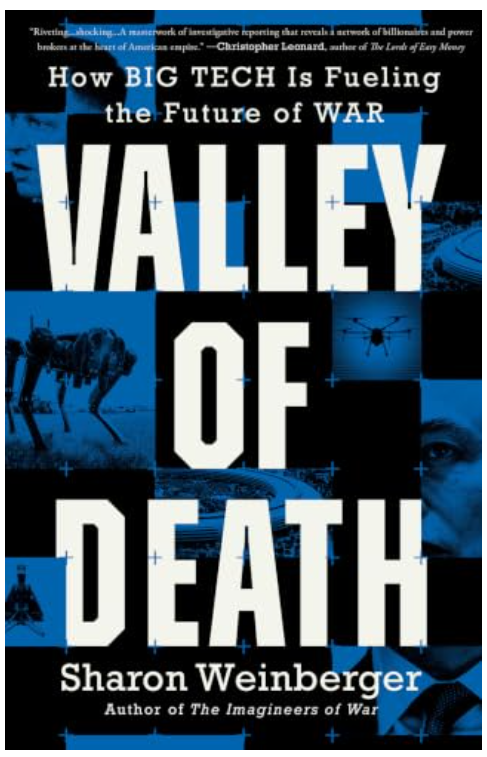
Consider this excerpt from a Guest Essay in today’s New York Times by Sharon Weinberger, editor in chief of the Bulletin of the Atomic Scientists, and author of a forthcoming book, Valley of Death: How Big Tech is Fueling the Future of War.
People seem to forget that Silicon Valley was largely born on the back of Pentagon funding during the Cold War. Fairchild Semiconductor, a company that became the wellspring of the computer chip industry’s growth, was one of those beneficiaries. Conventional wisdom held that, by 2016, many firms, not to mention their employees, found the idea of working on defense projects distasteful, if not unthinkable. Mr. Trump’s election that year seemed to widen the divide. In 2018, Google, under pressure from employees, pulled out of Project Maven, a Pentagon-funded A.I. project to advance drone warfare.
Today, the shift from consumer markets to defense industries is clearly visible at Mr. Andreessen’s firm, which has a dedicated division, called American Dynamism, that focuses on investing in weapons and technologies aimed at competing with China. Or even, potentially, waging war with China. Sequoia, one of Silicon Valley’s most storied venture capital firms, has spun out its China business and joined the growing number of venture capital firms funding companies dedicated to building military weapons. Sequoia’s initial defense tech investment was in a start-up founded by a 19-year-old that is building killer drones. …
As for Google, it only took a few years for the company whose motto was once, “Don’t be evil,” to again pursue contracts with the Pentagon. Not because of patriotism, but apparently out of financial self-interest. The federal government, and particularly the Pentagon, has emerged as one of the world’s largest customers for A.I. and autonomous weapons — technologies needed for war in the future, especially the Pacific. Earlier this year, Google agreed to provide the Department of Defense with A.I. for classified networks after Anthropic became embroiled in a dispute with the Pentagon over how its A.I. models were being used.
For Anthropic, the issue was never a choice between working for the Pentagon or competing with China, but a question of how much control it would have over its models and their use. Anthropic’s C.E.O. has frequently warned about the threat from Beijing, even saying that selling A.I. chips to China is like “selling nuclear weapons to North Korea.”
That’s quite the pivot. “Silicon Valley has changed partly because people realized you’re not going to make any money in China,” noted the Palantir Technologies C.E.O., Alex Karp, in 2024, as tech were again chasing defense business. Peter Thiel, the right-wing tech billionaire who co-founded Palantir with Mr. Karp more than 20 years ago, was early to recognize the potential and was long skeptical of China. (Not surprisingly, Mr. Thiel was also the first major Valley figure to back Mr. Trump in 2016, though he later soured on the Republican president.)
Few things illustrate this dynamic better than the poster child for defense start-ups, Palmer Luckey, the Hawaiian shirt-clad founder of Anduril Industries, which makes A.I.-powered weapons. Mr. Luckey was just 19 when he co-founded Oculus Rift to build virtual reality headsets for consumers. The Oculus Rift development kit from 2013 ended with a single line: “Made in China.” But like other tech companies, Oculus grew disillusioned with China as a consumer market, even if it still needed it as a manufacturer. The following year, Oculus suspended sales to China, reportedly over aggressive scalpers who were reselling the company’s hardware.
In 2014, Facebook bought Oculus, making Mr. Luckey a centi-millionaire. Facebook itself was then bullish about breaking into the Chinese market. That year, the Facebook founder Mark Zuckerberg swooned over a book by President Xi Jinping of China, “The Governance of China,” and recommended it to his employees.
Three years later, Mr. Zuckerberg’s company fired Mr. Luckey, who had become a Facebook executive after the Oculus deal, after it emerged that he donated to a pro-Trump group. (Mr. Zuckerberg has denied that the departure had anything to do with politics.) Mr. Luckey made what would become the most pivotal move of his career: He started an arms firm backed by Mr. Thiel’s Founders Fund, which had only just dropped language in its “vice clause” prohibiting investments in weapons.
Mr. Luckey once said his goal with Oculus was to make virtual reality “available to everyone.” A little more than a decade later, he wanted to make virtual reality available to everyone in uniform. “I strongly believe you are going to see augmented reality on every soldier’s head before you see it on every consumer’s head,” Mr. Luckey said last year. Facebook, today called Meta, is in fact now working with Anduril on a multibillion-dollar project to sell virtual reality headsets to the U.S. military.
This is, I admit, a very long excerpt. What inferences can we draw from it?
For years if not decades, we’ve been told that “terrorists” like those affiliated with Hamas and Hezbollah take the civilian populations around them “hostage” by treating them as “human shields.” In the case of Hamas, this amounts to the claim that a militia tasked with defending a territory the size of Philadelphia “uses” the proximate population as human shields simply by virtue of its physical proximity to that population. Being there is sufficient.
The people making this claim see no need to ask whether Hamas’s activity is defensive or aggressive; if defensive, whether any other location or mode of operation would be feasible for defensive purposes; whether Hamas’s aim is to treat the population as defensive shields, and how this is to be shown; and/or whether Hamas’s opponents themselves treat either the Gazan population or their own as human shields. What about, say, the Hannibal Directive or the Dahiya Doctrine? What about mutually assured destruction? Are Hamas’s tactics worse than those, or just different?
Critics also rarely if ever provide credible evidence of the “human shield” claim in any particular case. Take any of the Gazan hospitals destroyed by the Israeli military. The claim in every case is that the hospital was destroyed because it was being used (at the time?) by Hamas for military purposes. The underlying claim here is that Hamas routinely uses civilian facilities for this purpose because it regards civilians as human shields. But in virtually no case are we given any credible specifics by which to judge the accusation. The axiom is cited, the hospital destroyed, civilians are killed and maimed, an outcry arises, and the axiom is once again cited to shut the critics up. But no particularized evidence materializes, or is thought necessary.

Occasionally, we get the further claim that any and all civilian casualties in Gaza are Hamas’s fault because it treats civilians as shields. No argument is given for how the conclusion follows from the fact asserted, and no evidence is provided for the fact that gets the inference off the ground. “We all just know” that Hamas is a cynical, evil organization that would do anything to kill Jews. We don’t need a bill of particulars to bear this out, just the right feelings: a sustained sense of indignation and horror. Iterate this process for a few decades, and it becomes a routine. What’s striking about the routine is less the dogmatism it induces about Hamas, than the blindness it induces about the practices of the countries making it.
Now go back to Weinberger’s claims about the American tech sector. Here are some obvious inferences:
- Virtually all of the major American tech firms are part of a high-tech military-industrial complex.
- All of these firms sell themselves as civilian enterprises that promote human well-being.
- Yet integrated into the structure of these same civilian enterprises is a robust, profit-motivated commitment to warfare.
- In other words, all of the relevant firms are a seamless combination of the civilian and the military.
- The contribution that these companies make to the war-fighting capacities of the United States and its allies is substantial. One couldn’t subtract it from the overall equation and expect not to make a substantial difference to the overall outcome.
- Though the enterprise in question is colloquially described as a matter of “defense,” there is no suggestion whatsoever that the firms in question condition their dealings with the “defense sector” by demanding that the weapons or tech that they supply will be used exclusively for defensive purposes.
- Beyond considerations of profit, there is in fact no conditioning whatsoever. If the U.S. military wants weapons for overtly aggressive, imperialist purposes–e.g., attacking a foreign country, conquering it, blockading it, robbing it, murdering its people en masse–that’s business. If aggression, conquest, expropriation, and mass murder become profitable, they all become legitimate. There is no further ethical consideration that constrains corporate action: building a murderous weapon is on all fours with building a harmless (or indeed, helpful) gadget. The tech sector is, in that sense, decidedly not “woke,” regardless of where it stands (or claims to stand) on DEI, Gay Pride, trans rights, and the like. Believing in those things is perfectly compatible with making weapons systems that kill lots of people.
- Finally, the companies in question have what we might call a high depth of ingression into American society. They’re ubiquitous; they’re everywhere. Almost no one can avoid dealing with all of them, and most of us deal with more than one. How many people successfully avoid (or even try to avoid) dealing with Google, Microsoft, and Meta on a given day? Our dealings with them benefit us, but also benefit them, and in benefiting them, make a contribution to the business as a whole, including its various military dimensions.
Now step back for a moment and expand a bit on (8). Who is implicated in the activities of these firms? It’s obvious that the top of the corporate hierarchy is implicated. The owners and investors are obviously implicated. Executive and managerial personnel are implicated. But the top of the hierarchy only works because it sits atop the middle and bottom. So rank-and-file employees are implicated. Shareholders are implicated. And consumers are implicated. Beyond this, every firm operates within a series of complementary relationships with other firms–financial services, suppliers, logistics firms, transportation, etc. All of them are implicated as well. We needn’t draw this out to the last decimal place. The point is that a lot of people and a lot of organizations are implicated. “The implicated” constitute a vast, open-ended, always proliferating set.
What Leonard Read famously said about the manufacture of pencils in “I, Pencil,” applies in a more obvious way to the manufacture of weapons. A mere wooden pencil, Read argued, is the product of a vast, inter-connected network of commercial relations involving far-flung products and materials, brought together by the wonders of the free market: wood, ore, steel, food, rubber, etc. The same thing is true, at a much higher level of intensity and complexity, of high-tech weapons. And low-tech ones, for that matter. If it’s complicated enough to make a pencil, what does it take to make an M-16? An Abrams tank? An F-16? An F-35? A B-52? A nuclear submarine? An Anduril Lattice OS? A military UAV? An electromagnetic propulsion cannon? A drone killer laser? A hypersonic missile? An Oculus virtual reality headset? A waterboard? Contrary to Hillary Clinton, it takes more than a village. It takes a country.
What this suggests is that we are, as participants in this integrated civilian-military economy, human shields in a far more obvious and egregious way than the people of the Gaza Strip or South Lebanon. For one thing, we don’t face anything like the duress they face. We’re not under blockade. We’re not under occupation. We’re not under attack. We’re not crammed like sardines into an impoverished, stateless territory. We’re not victims of ethnic cleansing or genocide, and don’t inhabit what’s been called “the world’s largest open-air concentration camp.”
Yet we are full participants in the vast economies of scale that produce weapons for an imperial government and military. And in this knowledge, however subliminal, we quietly, mostly without resistance or fuss, accept the role of human shields. We invest in, underwrite, buy from, sell to, promote, and work for the merchants of mass death. We do it every day, multiple times a day, without paying our support or complicity a second thought. We do it while pointing fingers of accusation at people far worse off than us, indeed, some of the very people that our actions kill. Our corporate overlords, in turn, depend on our thoughtlessness, our evasions, and our double standards. They make money off of it, they destroy societies with it, they rely on it to kill with impunity, and they use it to laugh their way to the bank.
It’s a great paradox and mystery that the people who do this, who willingly occupy the aggressor’s position, somehow think themselves morally superior to their victims–sufficiently superior as to pass judgment on them, to make accusations of them that amount to confessions, and then to kill them in droves. It’s a paradox and mystery, I guess, until you consider the possibility that the mythology of righteous innocence involved is false, indeed, an inversion of the truth. Then the mystery becomes what to think, say, or do in response. It should surprise no one that there’s no app with the answer. And even if there was, it would have no future, since there’s zero chance that Big Tech would sell it.

