Linda McMahon, Divestment, and the Strange Discrepancies of Christopher Eisgruber
As I was saying in my last post in this series, I happened to attend yesterday’s meeting of the Council of the Princeton University Community (CPUC), presided over (intuitively enough), by Christopher Eisgruber, the President of Princeton University. About twenty minutes into the meeting, right on schedule, President Eisgruber raised agenda item #4 from the “Government Affairs Update“: “Letter from the Department of Education to Universities.” This was a letter, dated August 6, 2026, from Linda E. McMahon, United States Secretary of Education. Here is a three page PDF of the letter.
The letter begins with some pseudo-historical boilerplate, then launches into a series of veiled accusations. After wallowing a bit in these accusations–unsourced and mostly implausible–it “calls on” universities to satisfy a series of tendentiously-worded demands. Nothing in it says anything that the principal parties higher education–students, faculty, staff, administrators, trustees, fellow travelers–haven’t heard a million times before. None of it is well argued. And none of it legally binding. No one has any obligation even to read this letter, much less take it to heart, respond to it, or satisfy its requests. Doing so would be a waste of time, effort, and money, and would wrongly give Ms McMahon and others the impression that veiled, unsubstantiated accusations are a legitimate basis by which to make open-ended requests of administrators who presumably have better things to do.
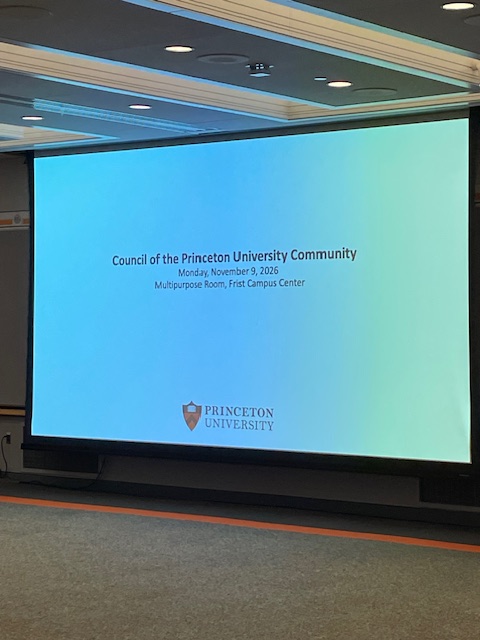
Le gran CPUC
Judging from the tone of his remarks at the CPUC meeting, Eisgruber seems to agree with me. He was relatively dismissive of the tone and content of the letter, and irritated by the prospect of answering it, or even of having others answer it for him. And yet he told us with alacrity that he had every intention of cooperating with McMahon. He didn’t tell us why.
The contrast with other petitioners is notable. Back in 2024, Princeton Israeli Apartheid Divest (PIAD) wrote up a 66 page document outlining its argument for divestment from Israel. Though divestment was shot down in 2025 on essentially procedural grounds–there was a lack of “consensus” for it, we were told–no one in the administration has ever responded in a substantive way to any of the claims made in the report.
Since then, there’s been a trickle of news reports describing Princeton’s connections with the Israeli military. This August 2026 piece in DropSite News reports that:
Princeton University records identify physicist Michael Romalis on a $600,000 contract called “Pulsed Scalar Atomic Magnetometer.” The university’s fiscal 2018 sponsored-awards report names the Government of Israel’s Ministry of Defense and the Defense Security Cooperation Agency as sponsors and gives a contract period from July 2015 through June 2019.
This February 2025 piece in Middle East Eye reports that:
Princeton University receives millions of dollars worth of contracts from the US Department of Defence as well as weapons manufacturers, tying it to several sites of conflict around the world, including Gaza and Sudan, a new report released by an anti-war group has revealed.
Several sources told Middle East Eye this week that the report is one of the first to showcase how modern American academia thrives as a US war machine service provider.
The report, published in early February and produced by a new anti-war group made up of independent researchers, comes on the heels of a student movement around the country that has called for universities to disclose and divest from companies purportedly profiting from the Israeli occupation and war on Gaza, which has been called a “genocide” by legal experts, human rights bodies and political leaders.
The Middle East Eye report cites The Anti War Initiative, whose Substack has ongoing reporting on the use of universities for military purposes.
Here are four pieces from the Anti-War Initiative site on Princeton itself. This piece discusses Eric Schmidt’s collaborations with the U.S. military along with his outsize role at Princeton. This one discusses the plethora of connections between Princeton’s leadership and the U.S. military. This one summarizes the connections between Princeton’s trustees and donors and Israeli militarism. This one discusses military research on campus.
The foreign policy expert William Hartung has tied much of this material together in a recent book, The Trillion Dollar War Machine, which I’ll be reviewing here sometime next year. It’s notable that the link before last goes to an interview with Hartung in The Corporate Crime Reporter. At a fundamental level, the topic here really is corporate criminality, whether for-profit or not-for-profit.
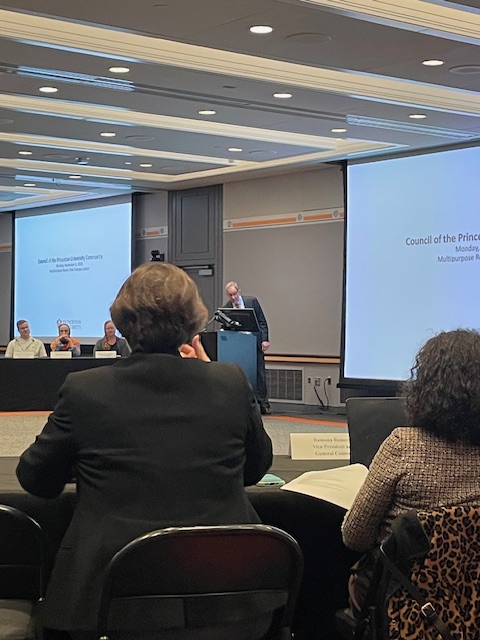
Eisgruber takes the stage, as Provost Rexford (’91), foreground, gestures administratively in his direction
The preceding sources have made a far more compelling case for the claim that Princeton in complicit in wrongdoing via its connections–through its investment, through contracts, through ROTC, through its employment of members of the military on faculty, through its avid moral support for the military–than McMahon has. Yet Eisgruber’s response to critics of Princeton’s involvement in military affairs has been a wall of silence: no disclosures, no dissociation, no divestment, no engagement, no acknowledgement. The silent treatment is his default setting for us.
So here is the question. Why does Eisgruber feel obliged to answer McMahon’s letter at all? He himself seems to regard the letter’s requests, by his own statements, as a waste of time and energy, as indeed they are. He himself seems to regard the letter as tendentious and ill-argued, as indeed it is. He himself complains that the University faces budgetary issues that require economizing on its activities, “doing business in a more efficient way” than has previously been done at Princeton. The obvious remedy would be to throw the letter in the trash and forget about it. You can’t get cheaper and easier than that. So why hasn’t he?
And what explains the discrepancy between the two cases? If he feels obligated to answer McMahon, why does he feel no commensurate obligation to answer the advocates of divestment–be it PIAD, SJP, Princeton Alumni for Palestine, or the student body itself, which voted for divestment? How did Linda McMahon come to matter more to Christopher Eisgruber than his immediate constituency and community, the “Princeton University Community”?
An uncharitable hypothesis suggests itself. McMahon matters more to Eisgruber because she bears a connection to power that the divestment movement lacks. And her letter matters more precisely because it is so ill-argued. Being ill-argued, it can be rebutted by an easily-generated cloud of academic PR of the sort that almost any administrator can compose in his sleep. By contrast, divestment from the military, whether Israeli or American, like divestment from fossil fuels or divestment from apartheid South Africa, presents Eisgruber with a trade-off between his glowing, lambent fantasy of turning Princeton into the Greatest Research University the World Has Seen and the pedestrian moral task of avoiding complicity in mass murder.
For all of the empty talk he generates about mission and moral values, what is blindingly apparent is his dogmatic refusal to face the trade-offs that confront him and his institution. The issue is much simpler than he or his fellow partisans would like to make it. If the US and Israeli militaries are engaged in a fundamentally unjust enterprise, then any entity that knowingly abets that enterprise is complicit in their wrongdoing. This obligation cannot be evaded by pretending or suborning ignorance or helplessness, by invoking procedural dogmas, or by fixating on red herrings. It has to be faced. I can promise President Eisgruber that as long as he refuses to face it, we will be here to remind him that there is no evading what has to be faced. “When these walls in dust are laid,” our message will remain.

