True to form, Bret Stephens has an essay in yesterday’s New York Times in which, following AOC’s claims that “Woke 1.0” was “crazy,” he reiterates her point, then offers up a list of nine of Woke 1.0’s victims, and demands restitution for them. The common denominator of all of these victims is that they’re writers or intellectuals of centrist to conservative views, all of whom unjustly lost their jobs (or so we’re told) to the forces of Wokedom.
I don’t trust Bret Stephens to get the facts right on anything, ever, and don’t trust his account of these nine cases. But let’s pretend, against all experience, that he is right: these nine people were or are victims of Woke 1.0. I’m now about to engage in some unapologetic what-aboutism, an activity I’ve defended at length in a previous post. Adjacent to this what-aboutism is some so-fucking-whatism. Let’s concede that Woke 1.0 had nine victims. What does this prove, and why should I care, much less pay restitution?
The Age of Woke 1.0 stretches roughly from 2010 to 2020. I was, during this time a professor of philosophy at Felician University, a small Franciscan institution in north Jersey. On a single day in January 2014, Felician fired sixteen members of its hundred-person faculty, invoking fake claims of “financial exigency” as an excuse. It had, prior to this particular day, engaged in a mania of terminations of non-faculty staff, and after that day, gone on periodic vendettas and sprees against particular faculty, including your humble correspondent. Not an exaggeration: you’d walk into your office and wonder where, say, Marilynn was, only to discover that she was the latest casualty of some administrative dictat. “Oh, Marilynn was let go on Friday,” you’d hear, wondering how she was handling this latest case of the Mondays.
I was in many cases familiar not only with the facts but with the documentation cited to justify these terminations. In literally none that I saw did I regard the termination as justified. What we’re talking about here are transparent vendettas, blatant corruption, and wild hysteria, all justified and explained away by handwaving appeals to a couple of spreadsheets or PowerPoints cursorily flashed on a screen by some administrative flunkie at a university “town hall.” The casualties involved were not nine random people picked off across a decade, but sixteen dedicated members of the faculty–16% of the institution’s faculty–shit-canned in a single day, followed eventually by most of the rest of the faculty. There was no tenure.
I left six years ago. Virtually no one who taught there when I did is still there. Almost everyone was fired, not because the place was in a condition of “financial exigency,” but because it felt the need to clean house and start with a new slate of faculty with no prior institutional memory, and no prior experience navigating the institution’s treacherous political waters. A new slate consists of blank slates, easier to deal with and control.
The university’s President herself was induced to “step down” shortly after I was pushed out; a very unwoke (and corrupt) naval admiral was hired in her place, and then he, too, was fired. The AAUP did a rigorous investigation of Felician’s termination spree, debunking its claims of “financial exigency,” and documenting its patent failures of academic freedom, its dishonesty and its corruption. It then put Felician on its censure list alongside dozens of fallen institutions. None of this had anything to do with wokeness. And none of it was noticed, either. Dozens of careers were ruined, but the ruination of dozens of careers was taken for granted in the wider culture, like gravity or rainfall, and so, not deemed newsworthy. The zeitgeist was focused on more interesting things. The censure list is itself ignored, despite the meticulous documentation behind it, and the earnest zeal with which the AAUP adds institutions to it, as if anyone out there cared.
You have to laugh at these bien pensants coming out of the woodwork after the Jason Arday debacle to denounce the “structural defects” of higher education, and calling, bless them, for a “reckoning.” A reckoning. Where the fuck have these people been for the last fifty or sixty years? Here are the top ten institutions on the AAUP’s censure list.
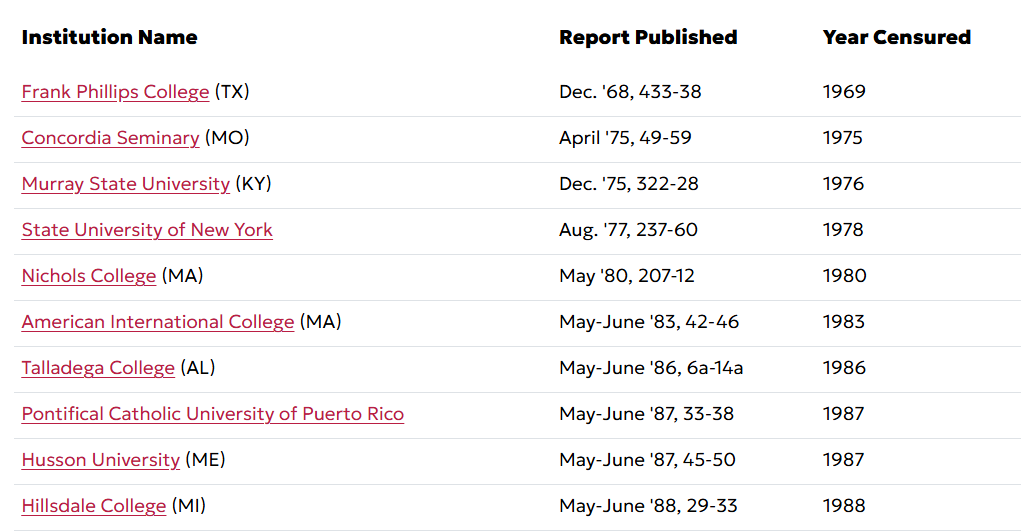
The list is as old as I am. And look at institution #10, Hillsdale College, the “tiny Christian college” commanding the war on wokeness, and so beloved of MAGA. Who would have thought any of that newsworthy? No one, obviously. If the script doesn’t fit, you must acquit. It’s not as though those of us working in the field were unaware that higher education had structural defects. The question is what they were, and it was not self-evident to me that “wokeness” was among them, at least where I was. I taught at a dozen institutions in three states over twenty-six years. Wokeness was not the central problem at any of those institutions, not even close. And certainly not at Felician. Or Hillsdale ca. 1988, or SUNY ca. 1978.
The Felician case is no different from dozens of similar cases throughout the Woke 1.0 Era. The wider phenomenon got some pro forma coverage, but nothing comparable to the fulsome attention lavished on the evils of wokeness. Can anyone cite empirical evidence that wokeness was a causally more significant phenomenon than the non-ideological venality of the administrative class governing higher education in the 2010s? I highly doubt it. But if no one cared about the latter phenomenon, why should those victimized by it now care about wokeness? There’s no shortage of evils in the world, and no shortage of a choice of evils to focus on. Why wokeness?
Forget academic life. It’s a commonplace of the American workplace that it’s governed by at-will employment. Any employee can be terminated with or without cause, with or without notice—and many are. Bret Stephens has trawled a whole decade to dig up nine cases of victimization-by-wokeness. Try to imagine how many people have, across the same duration, been victimized with the same result by at-will termination. If you think that the reasons behind woke terminations are bad, imagine how bad “reasons” can get when the person in power doesn’t need one. If I can fire you at will, I can fire you while indulging the basest, pettiest, most wildly irrational motivations imaginable. No one will know. No one can question me. No one can hold me accountable. What would I even be accountable for, and to whom? I don’t need a reason to do what I’m doing. Likely as not, no one knows the employee. So no one will publicize her case after she’s told to clean out her desk, and escorted out the door.
I knew a guy who was abruptly fired from his job while he was under treatment for prostate cancer, and depended on the job for health insurance. It’s a reasonable guess that his boss fired him because (a) he was active in the Occupy Wall Street movement, and (b) being aware of his medical condition, she knew she would be depriving him of medical treatment at a vulnerable time, something that clearly elicited her sadistic pleasure. I happen to have been familiar with the case in real time, and read the documentation inside out (and still happen to have it). There was nothing wrong with the employee. There was something wrong with the boss. But out he went.
Do you remember watching this story on “60 Minutes” or reading a guest essay about it in The New York Times? Why would you? Things like this happen every other minute in this country, at hundreds of job sites in every industry. The case I’ve just described happened in 2014, in the middle of the Age of Woke 1.0. Like so many unjust terminations that took place between 2010 and 2020–4 million people lost their jobs during the Great Recession of 2008-2010, and 22 million during COVID–this one wasn’t motivated by wokeness. The reverse, if anything.
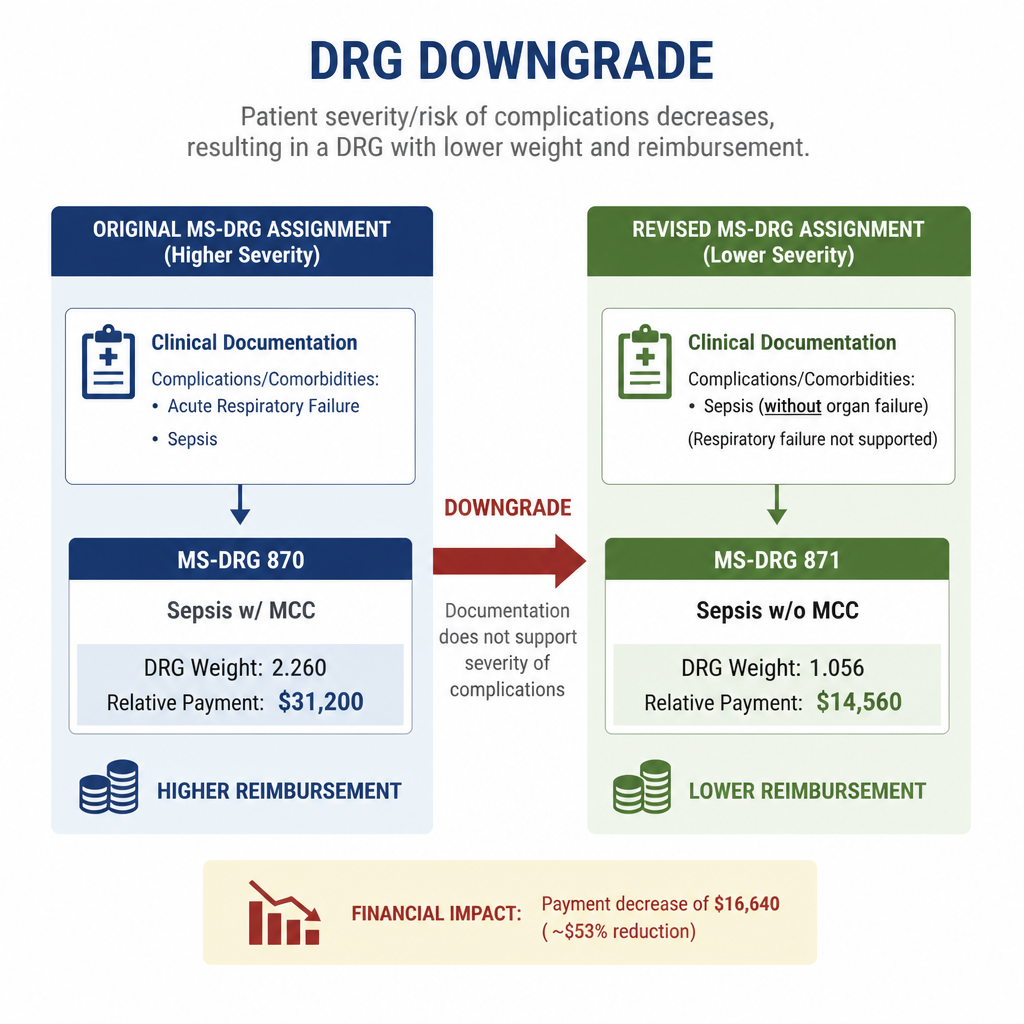
I currently work in denial management for hospitals, a field that came of age during Woke 1.0. It works like this. Hospitals get prior authorization from insurance to do procedures on patients. Having done the procedure, they bill insurance for the eligible part of the charged amount. It’s a commonplace, made famous by Luigi Mangione, that insurance companies engage in a great deal of manipulation and perfidy on both counts. It is a documented, indisputable fact that insurance companies wantonly deny medically necessary prior authorization claims, and likewise that they routinely downgrade or deny reimbursement on valid medical claims, leaving patients with bankruptcy-worthy bills while in the teeth of serious illness, or else sticking it to hospitals, with measurably adverse consequences on health care as an institution.*
We’re not talking about nine hapless victims in a decade. We’re talking about 4 million prior authorization denials a year, and 200 million claim denials a year.** Some hard-to-measure proportion of these lead to premature mortality, some to unnecessary morbidity, some to bankruptcy, some to job loss, all to hardship. Until Luigi Mangione shot Brian Thompson, most of this went under the radar screen. People groused about “the health care system,” and about insurance companies, but no part of the denial management process had the sex appeal of wokeness. Ask the average person how to read a medical bill, or how to initiate a denial appeal, or what happens if you do, and you’d get blank stares. Whereas cite the latest woke malfeasance du jour, and they’d be able to fulminate about it with the best of them.
Go back and watch re-runs of Tucker Carlson or Sean Hannity or Mark Levin or Ben Shapiro or Megyn Kelly or O’Reilly, or if you have the stamina, go back and read the collected works of Bret Stephens, or David Brooks or Ross Douthat or David French. Very little of what any of these people have to say is about the decisions of health care executives, or the consequences of their decisions. It’s all about The Woke, and their mythical power to destroy the country, one innocently somnolent media figure or academic at a time. But just ask yourself: which set of decisions has greater consequence for you, or for the modal resident of this country? Were you, on any given day in the 2010’s, more likely to be affected by the nature of your health insurance coverage and your insurance company’s prior authorization policy? Or by an attack of wokeness?
I could multiply examples of this sort indefinitely—mass incarceration, mass deportation, the pedestrian death crisis, etc. Any one of them had a greater likelihood of affecting the average person than wokeness, and of doing so in a more intense way. But nothing can compete with warfare, my favorite trump card. The decade of wokeness was a decade of constant warfare. The United States had formal military occupations in Afghanistan and Iraq. It fought proxy wars in Syria, Yemen, and Libya, along with lesser known wars throughout Africa, and it engaged in a militarized “pivot” against China and North Korea throughout the Far East. It was actively engaged in drone warfare all around the world, and still maintains an extra-territorial dungeon at Guantanamo Bay. By one estimate, the United States killed four million people in the “War on Terror” that stretched from 9/11 across the following two decades, including Woke 1.0.
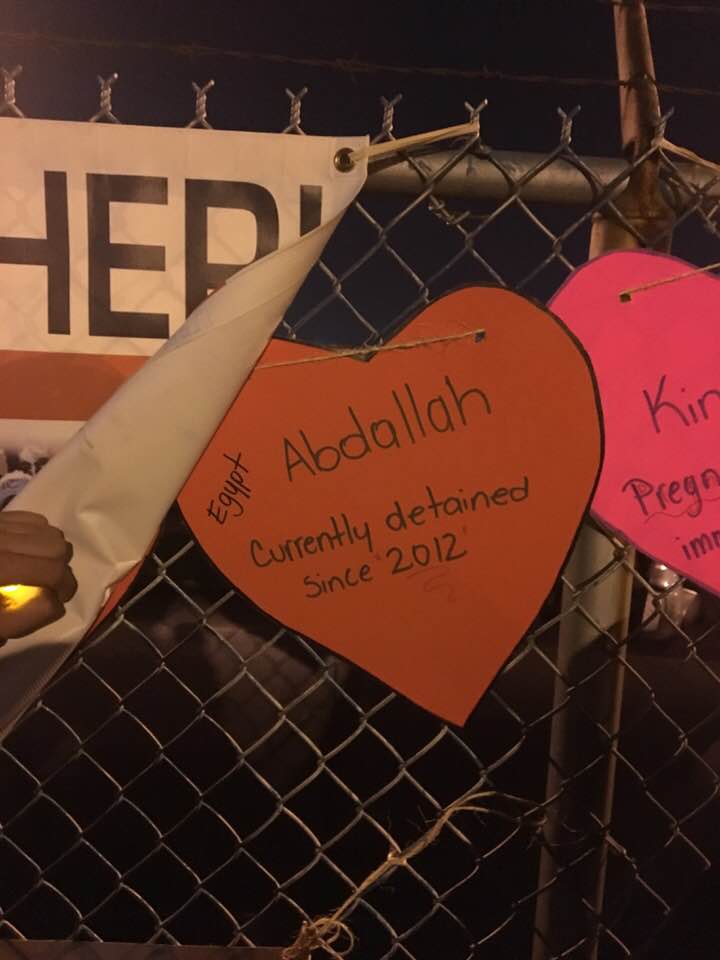
Elizabeth Contract Detention Facility, Elizabeth, New Jersey, taken February 2018, at the height of wokeness, under the presidency of Barack Obama, the wokest of them all
With the exception of a blip around the time of the Iraq War, there was no appreciable anti-war movement during the days of woke. On the contrary, there was an unashamed outpouring of pro-war cultural trends. Think of the gigantic proliferation of Superhero movies, along with “Zero Dark Thirty,” “Fury,” “Inglorious Basterds,” “A Mighty Heart,” “American Sniper,” “Anthropoid,” “War Horse,” “Beasts of No Nation,” “The Hurt Locker,” and “Darkest Hour,” to say nothing of the Star Wars franchise or Team America. Or think of TV series: “Game of Thrones,” “The Man in High Castle,” “Jack Ryan,” “Seal Team,” “NCIS,” “24,” and “Homeland.” Not to mention crime shows and crime films, or the music of Toby Keith or Billy Ray Cyrus, or the appropriation of heavy metal music for military purposes (AC/DC, Metallica). And then there are war-oriented video games. Gameranx lists 56 of them with the tagline: “Be a soldier, but safely.” How “woke” is a culture this addicted to the depiction of righteous violence?
Woke 1.0 was a media phenomenon whose victims were either part of the media or became part of it. The phenomena I’ve been describing involve invisible victims, anonymous numbers in proprietary databases. Yet the victimization I’ve described operates at a larger scale by orders of magnitude, involves victimization far more intense than anything Stephens describes, and is more indicative of broad socio-political trends than anything wokeness can even be claimed to have produced.
Here is my practical suggestion to Bret Stephens. You want to talk about restitution? Start with the people I’ve described. Try to imagine what it would take to compensate them for the injustices they’ve suffered, injustices by contrast with which Stephens’s cases barely register as micro-aggressions. If there’s anything left over, feel free to compensate the victims of woke with it.
I don’t dispute that such victims exist, or that they deserve compensation. What I dispute is that in the world we live in, the excesses of wokeness should take center stage as a problem commanding public attention or demanding a solution. I can see why phonies like Bret Stephens or AOC want to focus on it. In a media-driven world, you have to keep up with the trends to be heard above the noise, and anti-wokeness is nothing if not a trend. But if you want a sense of the mechanics of real injustice, you have to wake up to things that lie well beyond the ken of the anti-woke crowd. You have to plumb the surface of the hidden, the invisible, the walled off, and the concealed-from-view. Once you do, real victimization becomes visible. And once you see it, the world comes into perspective, with real victims at its center, and the excesses of wokeness at its most distant periphery.
*See the work of Miranda Yaver and Wendell Potter, among others.
**I corrected this sentence after posting. I had originally (erroneously) used a figure of 85 million for prior authorization denials, but that’s the figure for in-network claim denials, not prior authorization denials.


“Think of the gigantic proliferation of Superhero movies”
In fairness, Iron Man (2008), the movie that kicked off the MCU, is about a flippant weapons manufacturer who, after being forced to experience the devastation that his weapons cause, has a change of heart and announces that his company will no longer manufacture weapons, whereupon his corrupt second-in-command attempts to murder him.
Captain America: The Winter Soldier (2014) is about a military intelligence bureau that is planning mass surveillance of the civilian populace, and when the heroes object, the bureau tries to have them killed.
In Avengers: Age of Ultron (2015), the motivation of the (sympathetically portrayed) antagonists is that their family was killed by weapons produced by the aforementioned weapons manufacturer.
In The Punisher (season 1, 2017), the protagonist finds out that he was manipulated into carrying out illegal missions in Kandahar.
Admittedly a lot of other MCU fare could be described as pro-war and pro-military. But it’s not without contrary themes.
LikeLiked by 1 person
That’s a fair point. I didn’t mean to include them all. What I had in mind were more the Captain America movies, the 2012 version of Avengers, Wonder Woman, etc. I don’t actually watch very much film, and superhero movies even less.
That said, I’m at work on a long history of “wokeness” in which the films of the 1990s figure, so I’m actually having to go back and watch them. My specific claim is that “woke” talk re-entered our culture after some dormancy via Rage Against the Machine’s “Wake Up,” which became part of the soundtrack for “The Matrix,” and was then transmitted via hip hop (Lauryn Hill, Eryka Badu) to BLM.
LikeLiked by 1 person