I’m grateful for the many off-line responses to my roundabouts post, particularly those from decision-makers at Princeton Municipal Council. I thought I’d re-visit the issue to respond to some of what was said.
One set of comments suggested that I over-complicated a simple issue: roundabouts are safer than right-angle intersections, so that’s that. But it’s not that simple. “Safer” is equivocal as between safer at the intersection and safer all things considered, and it’s not clear that roundabouts are safer all things considered.
A second set of comments from the reverse direction suggested that I over-stated the safety benefits of roundabouts. Even if roundabouts are generally safer (one person said), there’s no reason to think that this particular intersection is unsafe. So why adopt so extravagant a solution to a non-existent problem? If the traffic light at Harrison and Terhune is broken, it can be replaced. Right turns on red are already illegal at most intersections in Princeton. If safety is the concern, feel free to break the bank and add a left-turn arrow at the light. Why isn’t that the sum total of the solution to any safety problem? If the issue is safety, the objection surely can’t be that replacing the traffic light is more expensive than putting it in a roundabout. The expense issue doesn’t bear on safety. So the best option (however expensive) turns out to be: replace the traffic light.
I basically agree with this line of reasoning myself, but like the pro-roundabout faction, find myself somewhat entranced by the idea that adopting a roundabout might save lives at this intersection. There was recently a fatal accident at a nearby intersection, and it’s tempting to want to do something to prevent the “next one.” So why not do it?
The issue turns on whether we’re trying to solve a discrete, existing problem (the safety problem at this intersection) or whether we’re trying to solve an open-ended one (saving lives in general). But if the latter is our goal, we have to think about the all-things-considered effects of adopting the roundabout, and as I pointed out, that doesn’t necessarily save lives. So to repeat what I said above: I don’t think roundabouts are a slam-dunk from a safety perspective.
One off-line interlocutor pointed out that I didn’t distinguish one-lane from two-lane roundabouts in my post. The current proposal (he continued) is for a one-lane, not a two-lane roundabout, and most of the problems I raised arise from multiple lane roundabouts, not one-lane ones. He then pointed out that Princeton already has two one-lane roundabouts (at Alexander St/University Place, and on Faculty Rd), and that the problems of avoidance I mentioned don’t seem to arise there.
Part of this criticism is unquestionably right. I was conscious of the fact that I didn’t distinguish one-lane from two-lane roundabouts in my post, but I didn’t because I thought the post was already getting overcomplicated, and I don’t think the issue makes as much of a difference as my interlocutor does. There is a real distinction between the two things, one explicitly stressed throughout the literature, and the negative effects I describe definitely are larger at two-lane than one-lane roundabouts.
But I think the effects are present in diminished form for one-lane roundabouts. I don’t own a car, but when I drive, I myself avoid the one-lane roundabouts in town, and so do others I know. Granted, I don’t know how strong that effect is, so I admit that the issue is inconclusive. That said, the adverse emergency response effect is worse at one-lane than two-lane roundabouts. It’s harder to drive a large rig through a one-lane than a two-lane roundabout, and harder to drive one through a roundabout than a right-angle intersection. A taxi driver with whom I discussed the issue also pointed out the obvious: it’s arguable that there isn’t adequate room even for a one-lane roundabout at that intersection, unless (I suppose) we contemplate the use of eminent domain, which I don’t think we should. So while the one-lane vs. two-lane distinction is a real and important one (which I probably should have mentioned), I don’t think it ultimately changes the overall picture in this case.
One last point: though it’s tempting to want to create a roundabout to avoid the “next” fatal crash in the area, it’s worth remembering that the last fatal crash in the area was at Terhune and Ewing. Though very close by, the fatality had nothing to do with the intersection at Terhune and Harrison, and could not possibly have been avoided by a roundabout at the latter intersection. I think it’s fair to say that the idea of a roundabout at Terhune and Ewing is simply absurd.
The issue all along Ewing, however, is poor visibility at the sightlines at each intersection. If you stop at the stop line at any stop sign on Ewing, you can’t see oncoming traffic from the relevant cross street. Think of the intersections at Ewing and Valley, or Ewing and Terhune, or coming from the other direction (down Cuyler), Ewing and Cuyler. The temptation is to creep forward in the intersection until you can see, by which time you’re in the intersection. Many drivers just skip the “creeping,” and roll through the intersection, which is one way in which you get accidents there. The solution is to improve the sightlines all along Ewing, an accident-prone corridor. This would be a cheaper fix than a roundabout at Terhune and Harrison, and a more clearly safety-conducive one. That said, it means confronting homeowners with overgrown shrubbery along the relevant streets, and confronting environmentalists who balk at killing or cutting down plants (particularly trees) under any circumstance. But I think it has to be done.
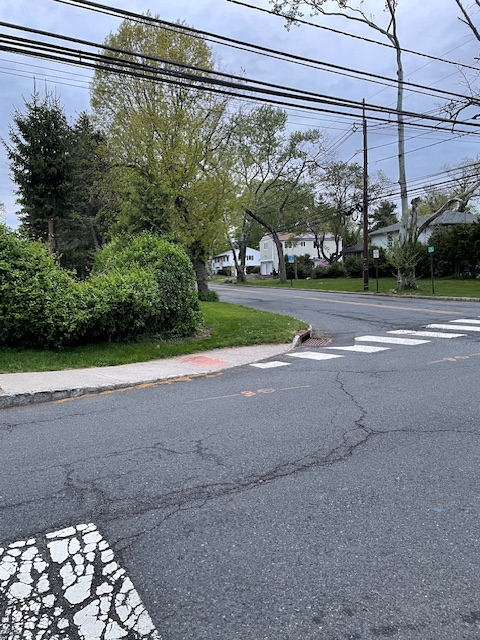
I took a series of photos of the relevant intersections back in April (when the crash happened), but was reluctant to bring the issue up, considering the sensitivity of the issue. (To be totally honest, it’s also because I live with an avid member of FOPOS, and raising this issue is going to get me in trouble with her.) But if we’re serious about reducing traffic fatalities, this, I think, is where we should focus. The shots below are of Ewing and Terhune, traveling north. The first shot shows how little of Terhune you can see from the stop line. It’s worth noting that people get ticketed for failing to stop at this line, despite the fact that stopping here is somewhat pointless. Yes, the law requires you to stop. But what does stopping here accomplish if you can’t see oncoming cross traffic?
The second shot shows how far into the intersection you have to go to see oncoming traffic.
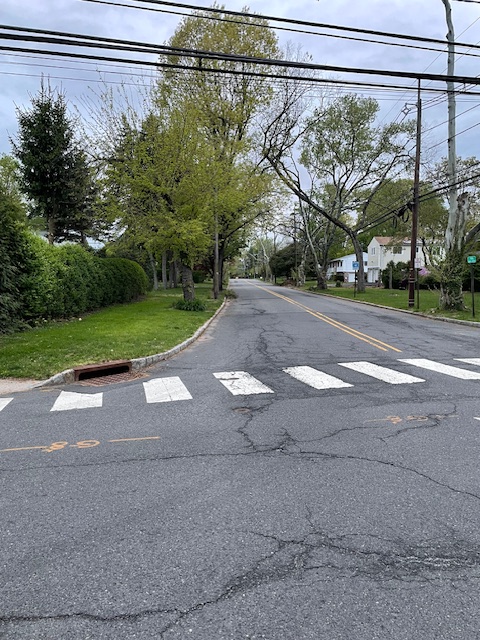
Now you can see what needs to be seen, but only after you’ve done an illegal “California roll” through the stop line. This is why people get cynical about announcements about “increased enforcement” along Ewing (and about the e-bike law). What’s being enforced is the letter of the law, but the letter of the law has no substantive bearing on safety. It has substantive bearing on revenue. Glad I don’t own a car!
The third shot is of the makeshift memorial to the deceased that stood for awhile.
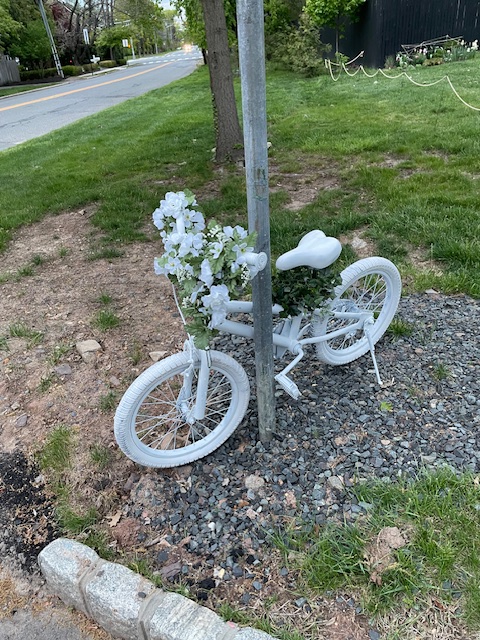
Let his memory be a blessing, as the Jewish saying goes, but let it also be a reminder. (Thanks to Richard Rein for the constructive conversation we had back in April about this accident.)
Brian McDonald pointed out that he hadn’t meant to come across as against roundabouts, but as agnostic. I take the point.
All things considered, I favor Mia Sacks’s proposal of replacing the traffic light at Terhune and Harrison.

