The Wokeness Threat is a Right-Wing Scam

I did my annual DEI certification at work the other day. It’s the same one I’ve done here since 2022. The training video is produced by a company called KnowBe4, which specializes in workplace risk reduction: “15+ years of behavior data, 70,000 global customers, 12-in-production security awareness agents…1 of 3 full time US workers has been trained by us.” Not a fly-by-night operation, and not unrepresentative of corporate DEI training. Just the reverse. The norm.

The training took all of 15 minutes. What did I learn? Six woke lessons.

Continue reading

All Roads Lead from Rome

I was walking down the street wearing a bright red keffiyeh when a police officer stopped and pointed directly at me. Before I could react, she broke into a broad smile, singled out the keffiyeh, and gave it a thumbs up. You know times have changed when the police have become pro-Palestine.

All roads, they say, lead to Rome. Well, the same roads lead away from it.

A Cato Institute Delegation to Delaney Hall?

Scenes from Delaney Hall (6)
Here’s a first: I was at Delaney Hall last night for The Peoples’ Vigil, a quasi-religious event held each Monday at 7:30 pm. During the vigil, Shane Claiborne, a self-described Anabaptist and founder of the New Monastic Movement, made admiring reference to the Cato Institute, of all things. “Even the Cato Institute,” he said, “is against this building…” He was alluding to the research of David J. Bier, Cato’s Director of Immigration Studies and Selz Foundation Chair in Immigration Policy, and in particular, to Bier’s paper, “Immigrants Cut Victimization Rates, Boost Crime Reporting” (Policy Analysis 1003, August 2025), which argues that contrary to popular belief, comparatively few immigrants are violent criminals. You’re more likely to be killed by a falling vending machine or hit by lightning than killed by an “illegal immigrant.”

Continue reading

Sonia Sotomayor Smiles for Palestine

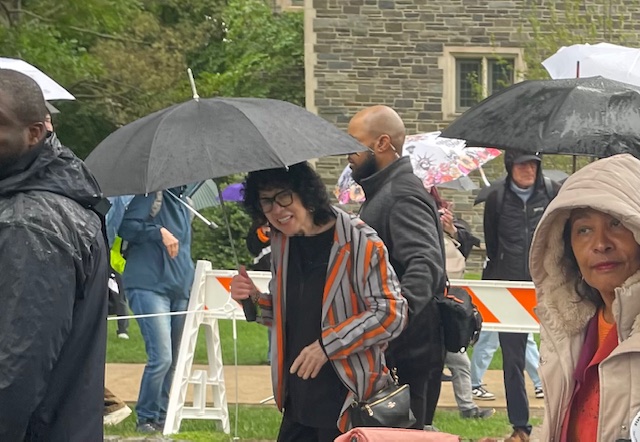
Our Stop the Wars rally found its way into Princeton University’s Reunions celebration, where we spent several hours making our anti-war case to the approbation and disapprobation of the several thousand revelers marching in Princeton’s annual P-rade. Among those apparently expressing approbation was Princeton alumna Sonia Sotomayor, as revealed in this photo, in which she smiled directly at activist leader Sireen Sawalha, who was standing right next to me.

Continue reading

Deviant Causal Chain

I was just at a protest of the Iran War where a passerby accused us, heatedly, of “killing Ukrainians.” Of all the accusations directed my way in years of protests, I don’t think I’ve ever heard an accusation quite that baffling. By not fighting a war in Iran, we are somehow killing Ukrainians. No matter how I try to conceptualize this, I can’t.

There’s a cottage industry in philosophy on “deviant causal chains,” cases where an agent’s intention causes an action, but in an unexpected or “wayward” manner, leading to the intended result without genuine agency or control. Add this one to the list, I guess, but don’t ask me what happens next. Or what happened in the first place.

First World Problems

I’m in a car, late as usual but on my way to work. The driver has 94.5 WPST-FM on, and the “morning crew” is inviting call-in comments on their deep discussion topic du jour: how long should you wait to complain at a restaurant before you regard your “server” as late in bringing your order? “Fifteen minutes.” “Twenty minutes.” One guy says he avoids the problem by telling everyone he’s in a hurry, whether or not he is. Ha ha! Funny! Happy Friday, everyone!

Continue reading

Eminent Domain and the Resort to Force

I was pleased to see that my letter on Princeton’s use of eminent domain to acquire Westminster Choir College was printed in the January 7 issue of Princeton’s Town Topics, with a note from the editor (p. 13): “Thank you for your letter. We stand corrected.” Good to hear it.

Whether the topic is genocide or eminent domain, mainstream American journalists have an addiction to euphemism about the use of force that should be corrected at every turn. If journalists described the use of force more vividly and accurately, people would grasp its ubiquity in public life, and stop being surprised when it took egregious forms, as in the killing of Renee Good. Continue reading

Stirring the POT (5)

Politics and the Problematics of Fun

I started my “Stirring the POT” series earlier this year as a vehicle for announcements, but it gradually morphed into a series of ruminations on conferences I attended. The latter turned out to be the more interesting enterprise, so I’ll close out the year with a belated conference rumination. This past April, I went to San Francisco, at the invitation of Roderick Long and the Molinari Society, to be on an Author-Meets-Critics panel on Gary Chartier’s Christianity and the Nation State. It promised to be a good time, and it was. Continue reading