Statement at Firestone Plaza
Princeton University
March 18, 2026
Hi, my name is Irfan Khawaja; I’m an alum of the Class of 1991. I’m affiliated with Princeton Alumni for Palestine, the alumni wing of the Princeton Palestine movement, but I’m speaking here for myself.
Like many of you, I have friends and family “over there,” in Jerusalem, the West Bank, Beirut, and the Gulf. Every morning now, I enact the same macabre ritual of looking at my phone to discover who’s been arrested, who’s been shot, who’s been bombed, who’s dead. And it’s not an idle question. At last count, Ahmad had been shot, Amer had been abducted and left for dead in the desert, Maha is likely not answering my calls because she’s been bombed or displaced from Beirut, and Naeem says he’s OK but is likely being deliberately insouciant about what’s going on.
Eventually my feelings about all this turn from apprehension to anger, and like all anger, mine seeks an object. Unlike much anger about matters pertaining to the “Middle East,” my anger finds proximate targets–not so much targets in Tel Aviv or Washington, but targets right here in Princeton.
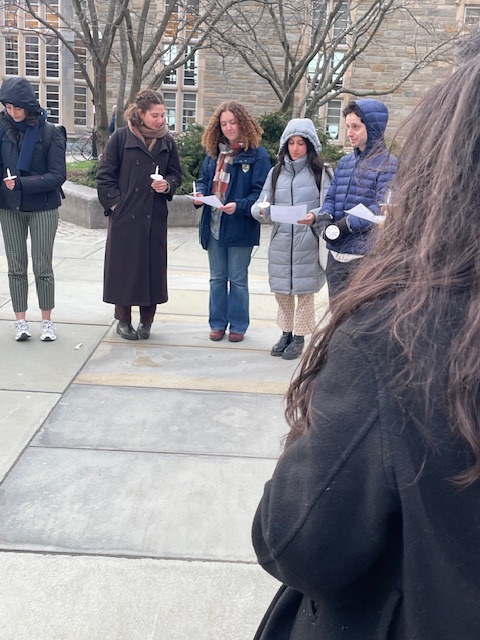
Kaddish, read by Alliance of Jewish Progressives, March 17, 2026
I remember how, in April 1984, Yoram Hazony, now the leader of the National Conservative movement, invited Rabbi Meir Kahane to this campus to make the case for the ethnic cleansing of the Palestinians. No one condemned his presence here or what he said. The university’s president at the time was William Bowen. I recently asked Nancy Weiss Malkiel, author of a book about Bowen’s presidency, and a professional historian of higher education, whether Bowen had ever spoken out about that event. No mention is made of the event in her book, and (she told me) there’s no mention of the event in the Bowen archives, either. In other words, Bowen didn’t say a word to condemn advocacy of ethnic cleansing at Princeton. Nor did anyone think to bring him before Congress to to so. Evidently, silence was thought the most prudent course of action, and so, prudence it was.
I remember how, in February 1988, in my second semester at Princeton, Kahane came back to make the same case in McCosh 50. This time, Kahane was invited to campus by Whig Clio rather than Hazony himself (who lived in Princeton but was no longer a student at the University); the talk was moderated by Hazony. The “Arabs,” Kahane told us, were to be ordered out of Israel by the Israeli army at gunpoint. I asked Kahane in the Q&A what would be done to those “Arabs” who refused the order. They would be killed, he said without equivocation. In other words, from ethnic cleansing we’d proceeded straight to genocide.
The president at the time was Harold Shapiro. Did Shapiro or his administration condemn Kahane’s advocacy of genocide on campus? No. Were Shapiro et al brought before Congress to answer for their failure? No, no one at the time could even have conceived of such a thing. Did anyone ask how Hazony, a non-student, had managed to sit up on stage with Kahane to moderate such an event in McCosh 50? Of course not.
Kahane was assassinated about two years after the event. Had security at Princeton been prepared for an assassination attempt? Obviously not. No one made a big deal about stuff like this–genocide, assassinations, death itself; how could any of that touch Princeton? Life at Princeton went on, as it always does. I asked Shapiro last year about this episode. Why the silence at the time? Any interest in breaking it now? He hasn’t answered yet, and I don’t think he ever will.
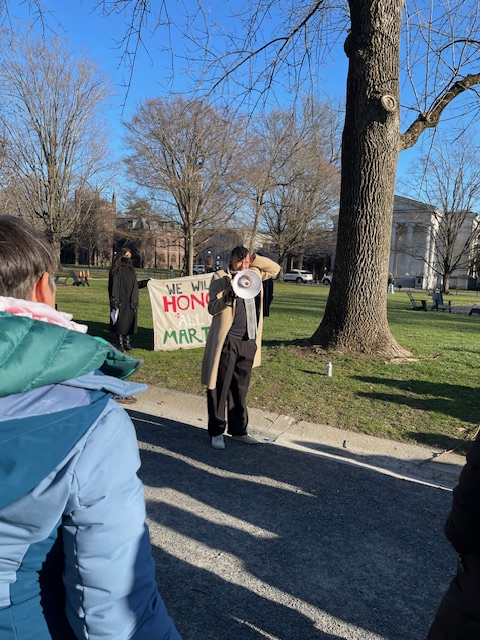
Anti-war rally near Cannon Green, March 18, 2026
Coming closer to the present, I remember the dismissive indifference with which Princeton’s CPUC received and responded to our petition for divestment. I remember the asshole behavior since the days of the solidarity encampments of PSafe, the asshole statements of Rochelle Calhoun and Jennifer Morrill et al, and the ideological cover given to them by faculty members like Keith Whittington and Stephen Macedo. I know the game these faculty members are playing because I was myself an academic for 26 years and know an academic game when I see one.
The University professed not to able to see their complicity in Gaza. The issue of genocide, it told us, was too complicated and obscure to be addressed, much less pronounced on. The university’s connection to Israel’s actions, it insisted, was too attenuated to be culpable. Israel had nothing to do with Princeton, we were led to believe. Israel has no presence at Princeton. The university’s investments had no connection to Israel. Or at any rate, there was no consensus on these matters. Failing a consensus, or any consensus on how to define or detect a consensus, the University was morally helpless, incapable of action: there was by design nothing it could do about the predicament in which it serendipitously found itself (and had put us); complicity in evil was just something we all had to accept with equanimity.
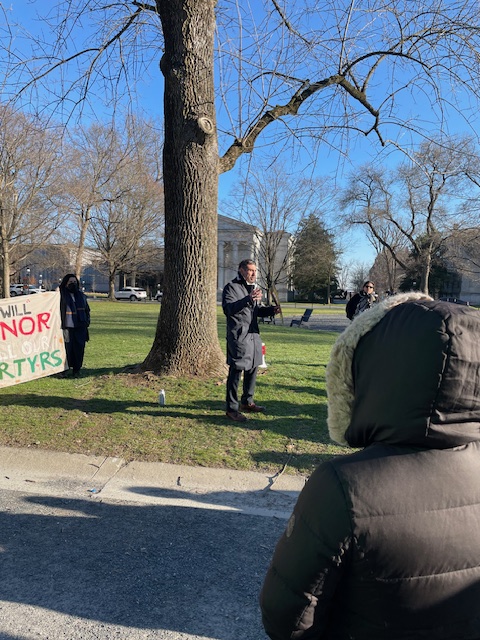
Congressional candidate Adam Hamaway, March 18, 2026
Whatever the credibility of these statements, February 28 has changed everything. It is now the United States that is at war with Iran, not just Israel, and the war in question is not a subtle matter. This war violates all of the criteria of just war, and does so in a flagrant, egregious way: ad bellum, in bello, post bellum. It’s unconstitutional. Besides that, we’re losing the war itself. And our precarious strategic situation is now inducing the normalization of escalation, plus the commission of atrocities up to and including nuclear war. This is not “complicated.” Our connection to it is not “attenuated.” The issues are plain, and our involvement is direct. Short of a mushroom cloud over Nassau Hall, we are facing a set of facts that is as in-your-face as any facts are likely to be.
What is our complicity in this war? If you seek its monument, look around: Take a walk down Alexander Road past Wawa and the train station; it’s called the Tiger Battalion of Princeton University’s Reserve Officer Training Corps (ROTC). Princeton ROTC is a tangible, visible, causally direct expression of Princeton University’s support for the United States military.
That military is now indisputably an army of aggression. Put differently, the United States military is little more than a criminal enterprise writ large. ROTC’s presence on this campus makes all of us accomplices to that crime, and the target of its victims. We are in the most obvious way human shields of the perpetrators of a criminal war of aggression. What happened at Old Dominion could happen here, and PSafe is a pathetic shield against it if it does. The question then becomes: do you want to wait for that day or do you want to take pre-emptive action against a real and mounting threat? It’s our military itself, not any foreign enemy, that constitutes the primary threat to all of us. The only way of responding to the threat is to remove it from our midst.
We nearly expelled ROTC in my day (over “don’t ask, don’t tell”), but like so many Princeton activist movements, we gave in too soon and never followed through. Who resurrected ROTC, gave it renewed life, and brought it back to campus? Partly General Milley, and partly Christopher Eisgruber. It’s time at last for Princeton to rise up and expel ROTC from this campus for good. It’s time to assert a firewall of separation between higher education and the military, and to tell the representatives of the military that we are not here to do their bidding or serve their purposes. We are not here to become their human shields, or to become cannon fodder for them, or targets for their enemies. They have worn out their undeserved welcome. It is time for them to leave.
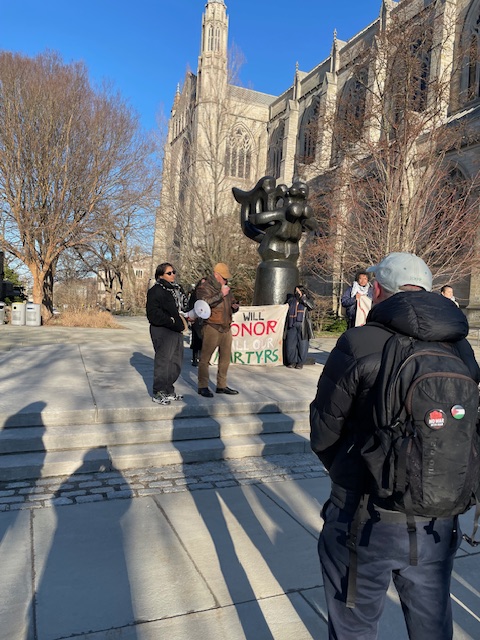
Chris Hedges with Aditi Rao, Firestone Plaza, March 18, 2026
They must be told, at any cost, to pack their things, pull up stakes, take their camouflage, their fatigues, their backpacks, their guns, and their bravado, and get out. There is a limit to how much we can be expected to endure in the way of prevarications, evasions, hypocrisy, mendacity, and gaslighting. When a university turns members of the community into targets for a foreign army, tells us that its incompetent toy soldiers (PSafe) will protect us from armed attack (when they obviously can’t), and rationalizes the whole endeavor by invoking the imperative to be “prepared” to participate in a war of aggression, we have reached the end of the line.
We should have one non-negotiable demand: Get ROTC off of this campus, and expel every other trace of the military along with them–whether in the name of safety, of honor, of justice, or any combination of the three. We should demand that they do it before we have more to regret than we already do. And we should be prepared to make them do it if they refuse.
This is the prepared version of the statement I gave at the anti-war rally held on Princeton’s campus on March 18, 2026. I departed somewhat in my actual speech from the prepared statement. Thanks to Aditi Rao for the invitation to speak, and to Daphne Lewis for coverage in The Daily Princetonian.
 Policy of Truth
We’ve been calling for this since the 1960s. (I mean “we” loosely, of course, as I was a tot.)
LikeLike
Yes, I’m well aware that “Bloody college hoodlums scream demands that ROTC units be banned from college campuses,” and that you are among the bloodiest and most hoodlum-like of the bunch.
https://courses.aynrand.org/works/philosophy-who-needs-it/
LikeLike
Rand’s style of expression when talking about 60s protesters is uncannily like that of Soviet officials (or their modern successors under Putin) talking about anti-govt protesters. At least this time she said “hoodlum” rather than “hooligan,” but she generally used the term “hooligan” quite freely, and in the same way the Russian authorities did and do, as a package-deal anti-concept term designed to obscure the distinction between criminal aggression and political protest — as for example when setting someone on fire and holding up an anti-war banner are both prosecuted as “hoologanism.”
https://en.wikipedia.org/wiki/Hooliganism#In_the_Soviet_Union_and_Russia
LikeLike
I’m reminded of another putatively anti-Soviet author much enamored of the term “hooligan.”
https://philpapers.org/rec/BREHAH-4
LikeLike
Ah yes, the hobbits. Just four of them were instrumental in overthrowing two military empires. Then they got home and overthrew the government they found there. Imagine if they’d been hooligans!
LikeLike
I actually had an undergraduate student at Felician who’d grown up in the USSR, and who’d had a “hooligan” upbringing in the Soviet-era heavy metal scene. I encouraged him to go to grad school in history and write about it, and he did–ended up doing an MA thesis on it.
https://rucore.libraries.rutgers.edu/rutgers-lib/43919/
LikeLike
Boris Von Faust? Was that his real name? Sounds more like a comic-book supervillain than a хулиган.
Speaking of Russian matters, I’ve been enjoying this:
LikeLike
Boris Von Faust was absolutely his real name, and what’s more, he was an anarchist.
LikeLike
If this is him, he’s certainly leaning in to the bit:
https://www.discogs.com/master/740725-Abazagorath-The-Spirit-Of-Hate-For-Mankind
LikeLike
Pingback: No Kings and the Anti-War Movement | Policy of Truth