For weeks now, the papers in Princeton have been full of news items about anti-Semitic graffiti discovered around town. In virtually every case, the reports have been vague to the point of deliberate concealment about what the messages have actually said. Here’s a typical example, from the April 29 issue of Town Topics:
On April 21 at 1:05 pm, officers responded to headquarters for a report of a threatening letter received at a religious organization on Cherry Hill Road. The letter, which was intended for a separate Jewish group that uses the location for gatherings, contained anti-semitic threats of violence. Investigation revealed similar letters had recently been sent to multiple Jewish organizations throughout Mercer County and Bucks County, Pa. The incident remains under investigation (p. 13).
It’s a marvel of obscurity. The threatening letter is received on Cherry Hill Road, but the officers report to headquarters on Valley Road. The letter is received at “a religious organization,” but was intended for “a separate Jewish group that uses the location for gatherings.” The letters contained anti-Semitic threats of violence, but we’re not told what they were. Three sentences meant to inform us have left us less informed than we were at the outset.
Some background missing from the item brings things into sharper focus. The letter was sent to the Unitarian Universalist Congregation of Princeton on Cherry Hill Road. The Unitarians lend or rent their space to various organizations, including String of Pearls, the Reconstructionist Jewish congregation of my very own household. The congregation “gathers” there for religious services, occasionally for Torah study or potluck brunches, but nothing more sinister than that. I’m guessing that the police reported to headquarters rather than the worship space because someone from String of Pearls brought the letter there.
My attendance at String of Pearls, I’ll admit, has been regrettably spotty in the past few years–for many reasons, but largely from my disillusionment with the God of Abraham, whose hectoring narcissism often gets on my nerves. But that’s just me. Other members of our household regularly attend services there. In a deep sense, then, String of Pearls is our synagogue. So I was curious to know what the threatening message actually said. Who was threatening us? And why?
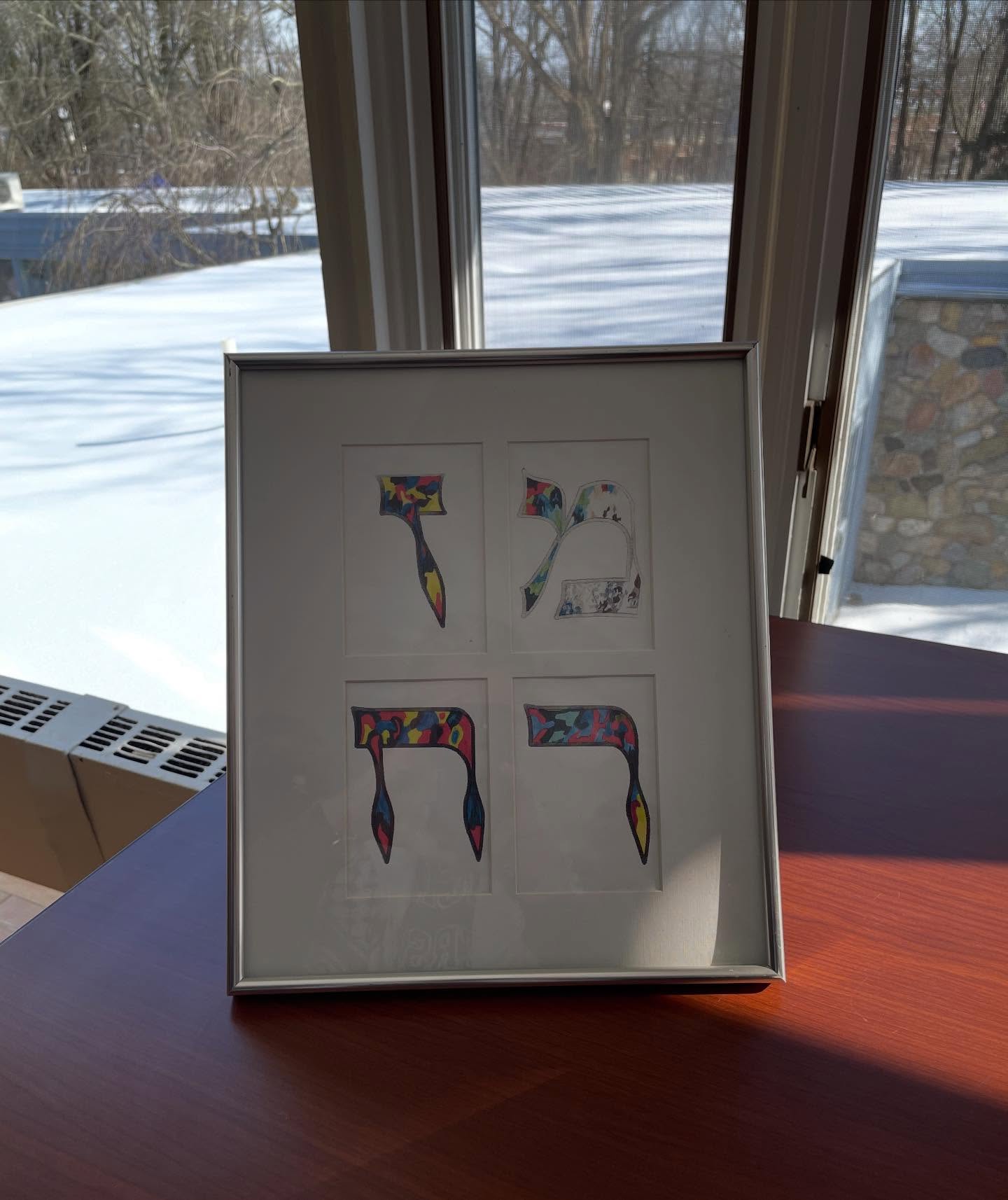
Mizrah in String of Pearls, indicating the direction of prayer for diaspora Jews
The police chief wasn’t particularly helpful on this score. I’d asked him what the threatening message said. He said:
The letter that was sent contained threatening language directed at Jewish communities described as “supporting the Israel occupation.” Importantly, there were no specific or localized threats made directly toward any particular congregation or community center.
Here we go again. The letter “contained threatening language,” but he’s not going to tell me what. It was “directed at Jewish communities,” but he’s not going to tell me how. Something is said about the Israeli occupation, but it’s not clear how it’s related to the rest of the message. So the message could say almost anything. It’s not clear how it’s threatening, how it’s anti-Semitic, or how it connects the occupation to Jews, or the occupation to the organizations that got the message. We’re left with when and a where, but no who, what, how, or why.
I made inquiries with people at String of Pearls and eventually got the answer. This is what the message actually said:
We all need to take America back from Israel.
I will start killing all Jews supporting the Israel [sic] occupation.
The sender, who (I’m told) hails from Lambertville, seems to have sent this same message to just about every Jewish organization in a short radius around Lambertville, from Princeton to Bucks County, Pennsylvania. (I don’t know how it was determined that he’s from Lambertville. And I’m just guessing that it’s a “he”; I don’t actually know.)
A couple of things need to be said here. For one thing, this really is a threat, and it probably satisfies the elements of bias intimidation. So (as I’ve said before) I have no objection to its being treated that way–by the police, by the recipients, by the municipalities involved, or by anyone else.
But the difference between the two cases–this case and the park case I’ve discussed before–is worth noting. It’s one thing to write “Globalize the Intifada” or “Death to the IDF” in a park, directed at no local individual in particular, expressing an admittedly aggressive political message but not one directed at an ethnicity or religious denomination as such. It’s another thing to send a note directly to a location where people physically gather for worship (or other peaceful activities), insinuate that the people gathering there support the occupation, and threaten to kill them, turning an apolitical synagogue (or even a political one) into a battle zone. The two cases are different, and ought to be treated differently.
Third, and relatedly, it pays to be explicit in one’s description of a threat in ways the police department and press have not been. If someone threatens to “kill” someone, the police ought to use the word “kill” in their account of what he said. If he threatens to kill “all Jews,” they should quote that. If he threatens to kill “all Jews supporting the Israel occupation,” they should quote that, grammatical warts and all.
What they should not do is paraphrase the message (as in the present case), or supply their own creative interpretations of it (as in the park case). They should just make the message public in a verbatim way, and let us mull it over and figure it out. As someone who was once arrested for making “terroristic threats”–threatening to murder the entire faculty of Felician University–it was and is obvious to me that if the people who had gotten me arrested had actually paid attention to what I was saying, they could not in good faith have gotten me arrested. Granted they could have gotten me arrested in bad faith, but there’s no cure for that. (If I was going to murder someone at Felician, by the way, it wouldn’t have been the faculty.)
Fourth, statements of the kind sent to String of Pearls and the other organizations must be condemned. There’s no acceptable justification for saddling all Jews with responsibility for the Israeli occupation, or for threatening either all Jews, or all the Jews in some particular place, or all the Jews that one idiosyncratically takes to support the occupation, with death. I don’t care who thinks there is one or why. There isn’t.
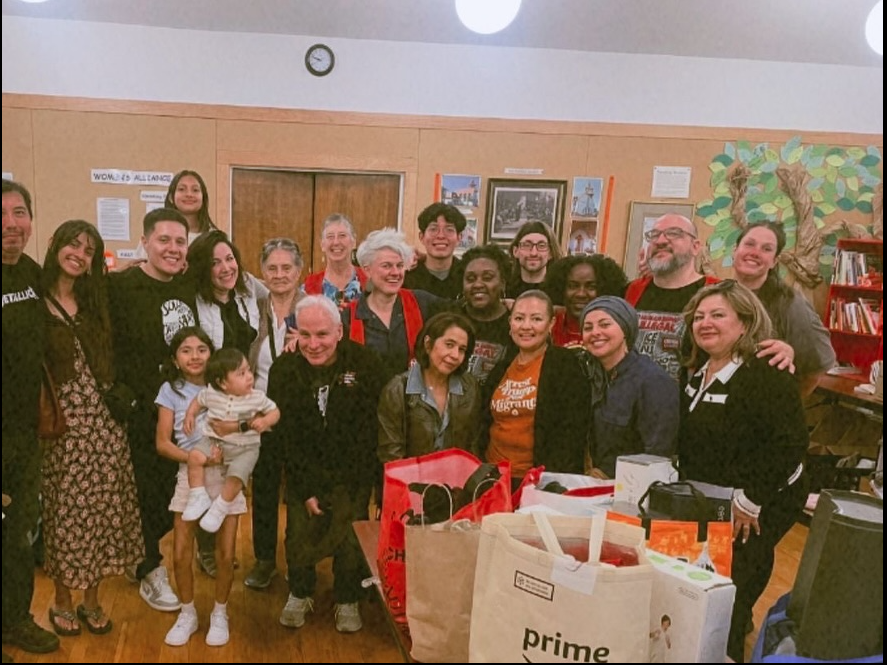
Co-users of the same building from Resistencia en Acción.
I also don’t care whether anyone doubts my sincerity on this topic, or accuses me of issuing a condemnation only because my (or our) synagogue was the one threatened. To paraphrase Aristotle, there are many ways of going wrong here, but only one way of doing right, and that’s to condemn what was said and done, and all things relevantly like it. Having condemned it, I would also say parenthetically that death threats of this sort don’t advance the anti-Zionist or pro-Palestinian cause, and have nothing to do with it. It’s worth noting, also parenthetically, that the building in question houses many different groups at any given time, so that an attack intended for one target would very likely involve casualties for another.
A fifth thing to say is that you can expect to get a rise in indiscriminate death threats when you inhabit a generalized atmosphere of defamation. Many people on all sides engage in defamation, but I think it’s fair to say that Israel’s defenders resort to defamation so loudly, so brazenly, so dishonestly, and so often, that the one thing they can’t do is lecture anyone on this topic, or at least, lecture anyone and expect them to listen.
There are armed sociopaths everywhere in our society, and there’s no way to guard against all of them, or even any significant number of them. I hate to put it this way, but if someone is really determined to kill you, they have a pretty good chance of success. As they say on social media, the chances of dying in a murder attempt, however low, are never zero. Just take solace in the fact that you’re more likely to be killed in a traffic accident than a murder attempt. I know how bad that sounds, but don’t shoot the messenger.
At any rate, we can only deal with what’s in our control, and what we choose to say is one of those things. One place to start might be to stop with the reflexive resort to defamation in our discourse, including the resort to retaliatory defamation. Condemn, criticize, or even engage in verbal attack, but tailor your claims to the evidence for them. Don’t accuse someone of wanting to kill Israeli children when he hasn’t said he did. Don’t accuse a congregation of supporting the Israeli occupation when you know nothing about them. Don’t throw the epithet “anti-Semitism” around like it’s a cost-free proposition, simply because it happens to be cost-free for you. And don’t equate “Jew” with “Zionist,” or “Israel” with “Jewish People” or distribute credit or blame indiscriminately across any or all of those categories. Etc.
They’re all truisms, but they’ve all, it seems, been lost in the din. Would it kill us to get back to basics and re-commit to them? No, but it might kill us not to.
 Policy of Truth