Since my first post here on institutional neutrality in 2025, Heterodox Academy has, predictably, re-affirmed its commitment to the doctrine by way of the same tired “arguments” for it, and done its fair share of bragging about the latest institutions to have signed on to it. For all their talk about “viewpoint diversity” and the burdens of rational discourse, the defenders of institutional neutrality seem pretty oblivious to the arguments that have been made against it. I haven’t, for instance, seen any serious attempts to deal with the complicity-based objections I’ve raised to it over the last year. I’ll take that as my cue to deploy yet another of the (literally) dozens of counter-examples I have to institutional neutrality, if only for the fun of piling them up.
Take one obvious but easily forgotten episode: the move from all-male universities to co-education in the elite institutions of the United States and Britain. We take co-education for granted today, but the reverse assumption prevailed until quite recently. As late as the early 1970s, co-education was considered a radical, and in some circles, crazy idea. The story is told in engaging detail by the Princeton historian Nancy Weiss Malkiel in her 2016 book, Keep the Damned Women Out: The Struggle for Coeducation. For present purposes, Malkiel’s story can be boiled down to the following points (click the following link for her own précis):
- All-male education was taken for granted in the United States and Britain until the 1960s or 70s, and was highly controversial when it was first proposed.
- A concerted private and public campaign was required to study, present the case for, lobby for, prepare for, and retrospectively defend co-education at the elite universities of the US and UK.
- The public part of this campaign required universities to adopt and defend an explicit public position on co-education in a sustained way, for years or in some cases for decades, against vigorous and in some cases virulent opposition.
- The adjustments required to fully integrate women into what had once been all-male enclaves took several decades after the initial decision. Each step in the process required both discreet private negotiations as well as public declarations of principle on matters of public controversy. It’s worth bearing in mind that Oxford did not fully move to co-education until 2008.
What inferences can we draw about institutional neutrality from these facts?
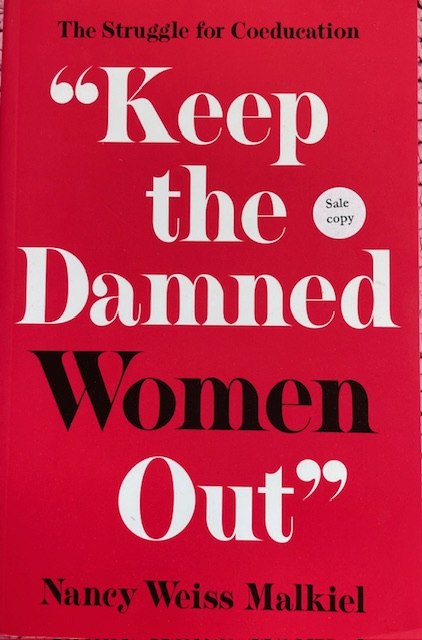
First and most obviously, it’s indisputable that as a matter of contingent historical fact, co-education required systematic, repeated violations of institutional neutrality. None of the institutions profiled in Malkiel’s book–Harvard, Princeton, Yale, Dartmouth, Cambridge, Oxford, and the two Seven Sisters schools that went co-ed (Vassar, Radcliffe)–can plausibly be seen as getting to co-education via institutional neutrality. Just the reverse. Neither did the dozens of institutions that followed that first cohort. Institutions that went co-ed publicly came out in favor of co-education despite its controversial nature. This raises a question for defenders of institutional neutrality: was it wrong for these institutions to have violated institutional neutrality? If so, why?
Maybe defenders of institutional neutrality want to say that while co-education was as a matter of contingent historical fact achieved through violations of institutional neutrality, it could in principle have been achieved on the neutralist down-low. But this supposition founders on a single word: how? Co-education was a matter of public controversy. Institutional neutrality prohibits public statements on matters of public controversy. To realize co-education consistently with institutional neutrality, the universities engaged in it would somehow have had to bring co-education about without publicly saying that they were doing so. Once you look at the history, politics, and logistics involved–e.g., by reading Malkiel’s book–this seems ridiculous.
Try to picture what covert co-education would have looked like. Imagine an institution that had been all-male for a century or two. Now imagine that a covert decision is made to make it go co-ed. The decision is kept secret in its research and planning stages (with gag orders on both), and implemented without public announcement or justification. Large-scale institutional reforms, adopted at dozens if not hundreds of institutions on two continents, are then carried out as covert operations on the model of the CIA or MI6. Facilities, bureaucracies, budgets, curricula, and personnel are “quietly” retro-fitted to accommodate the unprecedented influx of hundreds or thousands of women, but nothing is said out loud about the occurrence.
Once the women show up, angry protests arise from the male students, alumni, and faculty (as actually happened), which the university administration resolutely ignores. Eminent faculty compare women to “dogs” or “pigs” (Keep the Damned Women Out, pp. 150, 469). Students normalize the practice of calling them (and regarding them as) “bitches” or whores and reducing them to their sexual organs (Keep the Damned Women Out, pp. 481-85). Degrading songs are sung about them by groups of men, in public, on campus (Keep the Damned Women Out, pp. 482-3). Alumni, up in arms, insist that women simply aren’t up to the task of getting a degree at institution X or Y. The press writes article after article on the subject, calling the competence, intelligence, or sanity of the university’s decision-makers into question.
Yet no announcement, explanation, or justification emerges. Business proceeds as usual within the C-Suite, despite the fact that business is not proceeding as usual on campus. The contradiction is tolerated to avoid the controversy that might arise from publicly acknowledging the obvious. As questions mount on campus and in the press, administrations simply just sit there, mute, saying nothing for fear of provoking public controversy. Asked why they had made the decision to go co-ed, they profess assiduous neutrality as to the value of things like gender equality, fairness, or even efficiency and reputation. “Are you trying to implement gender equality?” someone asks, demanding a straight answer. Adherents of institutional neutrality would have to point silently to their pledges of neutrality and keep their mouths shut for fear of undermining the very enterprise of intellectual inquiry.
Why? Because the imperative of institutional neutrality demands it. What if institutionally admitting a commitment to gender equality had the result of chilling speech or inquiry against gender equality? What if condemning the degradation of women chilled the speech of those who sincerely regard them as less-than-fully-human? What if intellectual humility requires us to consider the possibility that women are reducible to their sexual organs? Wouldn’t it be a loss to chill the speech of those who regard women as “pieces of ass”?

Evelyn College for Women, the off-campus coordinate womens’ college at Princeton, 1887-1897
Considerations such as these demand that the university remain institutionally neutral on whether women are fully human, whether they deserve equal treatment alongside men, whether they deserve their places at the university, and whether they ought to be treated with consideration. Individual members of the university community may defend either position–women are full-fledged human beings deserving of equal consideration or women are worthless, undeserving sex objects or anything in-between–but the university itself dare not take a position on so controversial a matter.
Malkiel points out that co-education ended up being both lucrative and reputation-enhancing for the institutions that adopted it. But according to institutional neutrality, even lucrative, reputation-enhancing reforms would have to be kept under wraps. Such reforms are, after all, still matters of public controversy. A university could not, consistent with institutional neutrality, even point out that single-sex education failed a narrow cost-benefit analysis. That, too, could be–and was–controversial. What about the view that sexism trumps money?
If all of this sounds absurd, well, don’t blame me. Blame the sort of well-funded over-hyped doctrine that might lead us to absurdities of this kind. There’s no feasible way co-education would have happened in American higher education had institutional neutrality been observed. That’s not just a contingent fact but an instrumental necessity: large-scale reform at an institution like a university requires public discussion and public negotiation among rival political constituencies. If you don’t talk to them, you can’t get their buy-in. If you don’t get their buy-in, you can’t succeed. But “talking to them” requires sustained, candid, occasionally fraught public discussion. There’s no way to keep the whole conversation totally private and still call it a conversation. And conversation, after all, is what university self-governance is.
The only way to deny these facts, obvious to anyone who’s worked in higher education, is to put a dagger through the very idea of academic self-governance. Either refuse on principle ever to make large-scale reforms to higher education regardless of the moral gravity of the issue, or make them, but insist on doing so in a rigidly autocratic manner, top-down via the Board of Trustees plus the Administration, behind a perpetual veil of ignorance and silence.
This is the conception of higher education that the defenders of institutional neutrality favor, and worse still, defend by invoking neutrality, academic freedom, and the pursuit of truth. On this view, whatever the top of the institutional hierarchy decides or has decided is ipso facto “neutral” ground, simply because it’s been decided by them. Departures from their unilateral decisions then become departures from neutrality, and by implication, threats to academic freedom. Demands that the administration or Board satisfy even minimal norms of accountability are thus turned into threats to academic freedom. On this view, collective action on behalf of administrative accountability is practically a violation of academic freedom, and mass protest on campus the equivalent of a terrorist attack on the university itself. We need not ask what acts of evasion, dishonesty, or complicity provoked the protests. We only need to know that it is the administration’s prerogative to remain silent about anything and everything regardless of virtually any consideration but institutional self-interest.
When I publicly asked the Vice President of Princeton University in December 2024 whether the University would even consider divesting from an enterprise that was demonstrably evil, she said forthrightly that the University does not, as a matter of policy, factor such things as evil into its financial deliberations. Evil is neutral with respect to ROI, and the university is neutral with respect to evil. But even that much candor would be too much for the defenders of institutional neutrality. As far as their doctrine is concerned, the university is within its rights to invest in any evil of its choice without accountability of any kind–Auschwitz, killer robots, quadcopters, torture chambers, nuclear weapons, genocide, whatever–except that the Vice President should have had the sense to keep her mouth shut about it. The first rule of university administration is that you don’t talk about how you’re running the university. You just do it, and let ROI do the talking.
There’s nothing “neutral,” academically salutary, or truth-respecting about the vision behind this legalistic, money-obsessed conception of the university. It’s little more than the sterile, anti-academic ethos of the for-profit corporation grafted onto the university, declared “neutral,” and declared king. I would know. I’m one of the few (former) academic philosophers to have worked for Raytheon, American Cyanamid (a corporate predecessor of Pfizer), and the Carlyle Group. The defenders of institutional neutrality might well succeed at fooling their cloistered academic colleagues, but they’re definitely not fooling me.
The proponents of institutional neutrality might make one final stand, as those at Heterodox Academy have. They might introduce a few friendly amendments to the canonical formulations of institutional neutrality to allow for cases like co-education. (Leave aside the fact that these canonical formulations are only quasi-public, accessible only to those eligible for membership in the organization. Thanks to my friend Roderick Long, at Auburn, for forwarding this one to me.) The new, souped-up formulation:
When a contested social issue arises that does not directly concern the academic mission of our college or university, institutional leadership will not issue a position statement on that issue. On rare occasions when a public issue arises that directly affects the mission of this college or university, institutional leaders may issue statements that articulate the significance of that issue to our campus community.
Since co-education does directly concern the academic mission of the college or university, defenders of neo-institutional neutrality might argue, it’s permissible to issue public statements about it.
One problem here is that the doctrine in question is no longer recognizable as institutional neutrality at all. It’s not a friendly amendment to institutional neutrality, but a wholesale, ad hoc departure from it in an undefined class of cases. If an institution can depart from neutrality as required by the institution’s mission, then it’s free to define its mission in such a way as to dispense with neutrality altogether, or else to make neutrality the exception rather than the rule. If the defenders of neo-institutional neutrality think they have an argument that yields a more constraining conclusion, I’d like to see it. But so far, I haven’t seen one.*

Brian Soucek, author of The Opinionated University, with Joan Wallach Scott and Virginia Harabin (at podium), Labyrinth Books, Princeton, January 2026.
Second problem: The only fig-leaf of a connection to institutional neutrality left here is the a priori, evidence-free declaration that public issues requiring public statements will only “rarely” arise. No justification is given for this claim, but try to apply it to co-education. When exactly did the issue of co-education “arise”? And when it did arise, did it arise rarely or frequently? In fact, it arose when the first defenders of co-education first made a pitch for it. Pick your own date. It then arose every time they made another pitch for it. It then arose every time after they reached critical mass and became a movement for co-education. Is that rare or is it frequent? There’s no non-arbitrary way to answer the question because the claim is itself arbitrary to begin with.

Bullet hole from Israeli weapon discharge in the window of the main administrative building of Al Quds University, Abu Dis, Palestine. A neutral matter? For 42 years? Summer session, 2016
In any case, once the defenders of co-education reached critical mass and became a movement, it took decades for the decision in favor of co-education to be argued-for, decided-on, implemented, and integrated into the institution. There’s no final point of full integration, just a constant process of improvement toward a normative ideal. Rare occasion for public comment? Or frequent? Malkiel, writing in 2016, argues that much of the work of co-education lies before us. If work of this magnitude lies before you, and you’re serious about getting it done, do you work on it rarely or frequently?
Beyond this, co-education was just one of a set of similar reforms that included racial integration, accommodations for disabled students, along with acceptance of foreign students, acceptance of students of different social classes, acceptance of gay and transgender students, etc. All of this required similar public declarations to those given in favor of co-education, and for many of the same reasons. Given all this, is it correct to say that the issue of reform arises rarely on campus? Or frequently? The obvious answer is that it arises as often as there’s a need for reform. There’s no a priori way of saying that that only happens “rarely.”

More bullet holes, Al Quds University. Are shootings a priori rare on campus? Doesn’t it depend on which one? Summer session, 2016
Third: what does it mean for something directly to affect the academic mission of a university? If an institution is all male, co-education doesn’t directly affect the academic mission as currently construed. Ex hypothesi, it doesn’t affect that mission at all. Taken absolutely literally, the mission of an all-male university is ex hypothesi predicated on the existing all-male mission of the institution, for instance, to train the all-male leadership of the country (which was in fact the axiomatic conception of academic mission throughout both the Ivy League and Oxbridge prior to co-education). If we leave the mission in place, as currently construed, the would-be presence of women on campus is simply a counterfactual imagined state of affairs, not something that actually affects the mission of the university in the indicative voice.
So it’s consistent with even the souped-up version of institutional neutrality to say that institutional neutrality requires the rejection of co-education on the grounds that the mere consideration of co-education would require a public debate on the current construal of the institution’s mission. It requires a debate as to whether the mission should be re-conceived. But if it’s not re-conceived, it doesn’t affect the mission, whether directly or indirectly. Obviously, public debates about mission are highly controversial. Should they therefore never be had? Institutional neutrality seems to suggest not. This is another way of saying that institutional neutrality simply creates a conservative bias in favor of not re-conceiving any mission. The bias is: keep the mission as-is; then make public pronouncements only if something directly affects it, as currently conceived. But co-education didn’t fit that. No reform does.

Central European University, Budapest, Hungary, January 2019. Doesn’t look very neutral to me. Or like a one-off
If the defenders of the new version of institutional neutrality want to relax the doctrine to accept public debate on reform, I welcome the change, but that’s a change from neutrality to reformism, not a mere amendment to neutrality.
It’s worth adding that one reform is the elimination of complicity in injustice, a reform that was part of the movement for co-education. As Malkiel points out, at Princeton, for instance, co-education brought to light the university’s complicity in sexism. Princeton undergraduates were members of nominally off-campus all-male institutions, “eating clubs,” that received generous favors from the University. Many of these institutions went co-ed when Princeton did, but some did not. Those clubs that didn’t remained all-male redoubts. The University had to decide whether or not to cut ties with–i.e., dissociate and divest from–them (Keep the Damned Women Out, pp. 299-302). It’s precisely the bitter public controversy that followed that induced the University to do so.
For obvious reasons, women (and feminists generally) demanded divestment. In form, this is the structure of every argument that concerns complicity and divestment. If institutional neutrality is now going to be relaxed to admit co-education, its defenders have to admit that co-education uncovered complicity that demanded divestment. If institutional neutrality is consistent with all that, it’s at least logically consistent with calls for divestment from things like apartheid South Africa, the military-industrial complex, and Israeli apartheid. But this is precisely what the authors of the Kalven Committee Report were so anxious to deny. We now seem to have come full circle, then. The defense of the new version of institutional neutrality now requires the affirmation of what of the old version rejected. This strikes me as a descent into nonsense, not the defense of a coherent ideal.
We’re left with some questions. How does institutional neutrality relate to large-scale institutional reforms like co-education–compatible or incompatible? If compatible, how? If incompatible, what does that say about large-scale institutional reforms in higher education? Are they over?
Once you grasp the point in the case of co-education, you quickly come to see how many embarrassing counter-examples there are for this view. American higher education (Princeton in particular) played a significant role in the American Revolution. Was that wrong? Should Princeton, Harvard, Yale, and Columbia have said nothing about the war raging around them? American higher education played a significant role in the abolition of slavery. Should Oberlin, to pick another example, not have adopted a public position on the abolition of slavery, and not have participated in the Underground Railroad? Oberlin played a significant role in the early history of the Arab-Israeli conflict: it was the president of Oberlin, Henry Churchill King, who co-authored the famous King-Crane Report, intended to stave off the conflict. Should he not have done so?
Colleges and universities played an outsize role in the Civil Rights movement; it should be obvious enough that the integration of colleges and universities was a central part of that movement. Were the University of Alabama, the University of Georgia, and Ole Miss supposed to have been institutionally neutral about racial integration? Should Howard, Fisk, Jackson State, and North Carolina Agricultural and Technical not have defended civil rights? It is now clear that universities were complicit in apartheid South Africa and remain so in the military-industrial complex. Is it obvious that we can ignore all of that in the name of a doctrine that yields contrary implications on these issues?
I’ve so far focused parochially on American universities, but widen the lens and the absurdity of institutional neutrality becomes yet more obvious. Was institutional neutrality possible under Pinochet? Under apartheid South Africa? Under the Islamist regime in Algeria, or the authoritarian one in Hungary? What was the role of universities under military dictatorship in Pakistan, or military occupation by Israel? Should Afghan universities have come out in favor of co-education, or Indian ones stood up to defend Muslim equality against Hindu nationalism? How about Filipino universities, Indonesian ones, Haitian ones? Can Heterodox Academy’s one-size-fits-all neutrality really apply across all of these contexts? If not, isn’t it just a misleading prescription for blinkered quietism and parochiality?
The questions remain. But as long as neutrality prevails, don’t expect university administrators to ask or answer them. Expect them to clam up at strategically-chosen moments, to do so by invoking the pieties of neutrality, academic freedom, and viewpoint diversity, and to expect everyone to take them at face value. As long as we do, the strategy will continue to work. It only stops once the credulous stop giving it the credulity they’ve given it for decades. And that, for better or worse, is up to them.
*For a cogent critique of neo-neutrality, see Brian Soucek’s The Opinionated University, which I highly recommend, and hope to review here soon. See also John Tomasi’s attempted rebuttal of Soucek’s argument, a textbook case of quietly conceding one’s opponent’s case, and of moving the goalposts in the hopes that no one will notice.
 Policy of Truth
All-male education was taken for granted in the United States and Britain until the 1960s or 70s
I’m proud to say that Cornell, my doctoral alma mater, has been co-educational since 1870.
LikeLiked by 1 person
I noticed that. Harvard didn’t go fully co-ed until 1977. Malkiel is very adamant that Harvard followed Princeton, not vice versa. Actually, her larger point is that the decision to go co-ed was at least as much financial as ethical.
By a strange irony, my parents’ institutions in Pakistan went co-ed before mine.
Punjab University: 1882
King Edward Medical College: 1870
Princeton: 1969
Notre Dame: 1972
The explanation there turns out to be economic, as well.
LikeLiked by 1 person
Harvard admitted its first black student in 1847; Cornell did so in 1869. Point to Harvard.
However, Cornell had existed for only four years before admitting its first black student; whereas Harvard had existed for 211 years before admitting its first black student. Point to Cornell.
And Cornell’s VP even said that “if even one [black student] offered himself and passed the examinations, we should receive him even if all our five hundred white students were to ask for dismissal on that account.” (So, not economic.)
LikeLiked by 1 person