And a challenge to its defenders
Imagine a university whose administration passes what it takes to be a procedurally neutral rule–a “time, manner, place” restriction–prohibiting all protests on campus that take place either on grass or on thoroughfares. Protests inside university buildings are prohibited as well. Protests on grass, admin says, damage the grass, and protests on thoroughfares are a traffic hazard. Obviously, protests inside university buildings are too disruptive of university business to be permitted. All neutral considerations.
Now suppose that 99% of campus consists either of grass, thoroughfares, or buildings. It follows that large scale protests will be made impossible on such a campus.
Suppose that only large scale protests have any chance at political success: only large scale protests can attract the kind of attention to a cause that has any hope of producing real change. In that case, the university has, by ostensibly neutral means, ensured that no politically relevant protests will ever take place on campus. A procedurally neutral rule has ended up neutralizing protest altogether.
Now imagine that the university adopts institutional neutrality, which prohibits the university from making public statements on matters of controversy. Suppose it defines “matter of controversy” to include potential matters of controversy.
Now suppose that activists opposed to the rule demand a substantive justification for it. Given the preceding, the university should, in adherence to institutional neutrality, decline to give such a justification. The task of giving a justification for the pro-lawn policy could, after all, court public controversy. What if the protesters were to claim that the value of protest on a given issue–the university’s investments in genocide, torture, militarism, and/or mass surveillance, let’s say–superseded any damage that might be done to the grass on the quad? What if they claimed, for instance, that one issue simply mattered more than the other, and that the university’s supposedly neutral “time, manner, place” restriction was a disingenuous sham designed to evade the issues and neutralize protest?
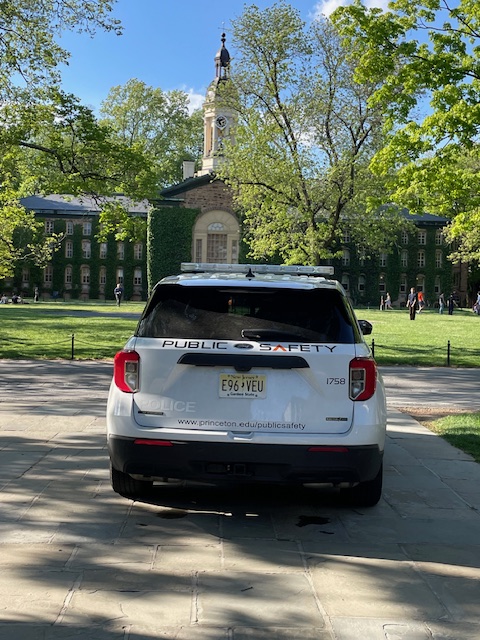
Public Safety guarding the lawn, April 2026
Obviously, a challenge of this kind could easily turn into a public controversy, requiring the university publicly to defend the imperatives of lawn care over those of justice. But institutional neutrality explicitly rules out the university’s involvement in public controversies, and on one plausible reading, that includes potential controversies like this one.
Given institutional neutrality, then, the university is absolved of any obligation to respond to the protesters, no matter how justified or true their objection. That in fact understates the point. The university isn’t just “absolved” of any obligation to respond; it’s required not to respond. According to institutional neutrality, the university should steer clear of any substantive issue that might generate controversy. It should simply assert its anti-protest rule, assert the neutrality and validity of the rule, enforce it, outsource any residual enforcement matters to local law enforcement, and leave the matter there. No need to justify anything. Truth and justification don’t matter here. What matters is the procedural validity of the rule and the imperatives of lawn care. The rule is on the books. The grass is on the quad. That’s what matters, and nothing else does.
Institutional neutrality is often defended on the grounds that it facilitates the pursuit of truth. But in this case, institutional neutrality makes truth irrelevant. The claims of truth are subordinated to the claims of grass.
Institutional neutrality is often defended on grounds of viewpoint diversity: by adopting institutional neutrality, we’re told, the university maximizes viewpoint diversity. But in this case, institutional neutrality shuts down discussion in a wholesale way in order to avoid the potential controversy that might arise from engaging in it. That’s not an augmentation of viewpoint diversity, but a deliberate diminution of it.
Even if institutional neutrality somehow promoted diversity, there are other relevant values in play here, among them uptake and institutional accountability. (“Uptake” is discursive responsiveness.) So even if we somehow (God knows how) inferred that the university’s silent treatment of the activists promoted viewpoint diversity, it would do so at the price of refusing them uptake and forswearing institutional accountability. In other words, even if diversity was maximized, uptake and accountability would be minimized to zero. By what calculus or standard does that trade-off become acceptable? Why should viewpoint diversity be pursued to the total detriment of uptake and accountability?
Having read hundreds of pages on both institutional neutrality and viewpoint diversity, I haven’t found a single work that squarely poses the preceding questions, much less answers them. If you know of any, feel free to respond in the comments with some citations.
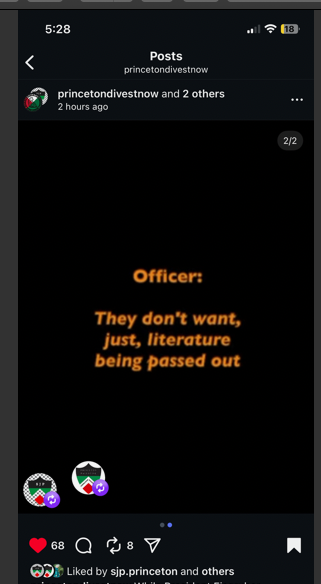
There’s another rule that says that you can’t pass flyers out on campus without permission.
It should be a scandal that the defenders of institutional neutrality should, for more than a decade, have advanced their neutrality juggernaut without ever having to face challenges like these. But they haven’t.
It should be a worse scandal that the scenario I described at the outset isn’t a fictional thought-experiment, but is, with trivial changes, the actual situation that exists at Princeton University. Evidently, the faculty at Princeton have no problem with that.
The advocates of institutional neutrality claim to prize free speech, free expression, viewpoint diversity, and academic freedom. I think it’s safe to say that this claim is a spectacular fraud. What they prize is discourse they can control by means of university administrations within their control. And what they fear and loathe is the campus activist movement that began with Black Lives Matter and the Occupy movement more than a decade ago, and re-surfaced with Gaza Solidarity Encampment in 2024. It’s obvious that the “neutralists” aim precisely to neutralize the activist movement by virtually any expedient available to them, no matter how disingenuous, coercive, or preposterous. This is the actual agenda behind the convoluted word salad they’ve offered up in defense of institutional neutrality–not truth, viewpoint diversity, or academic freedom.

Lawn care uber alles
Here’s a standing challenge to any defender of institutional neutrality. Invite me to your campus and debate me on this subject. I work a full-time corporate job, have no car, am not independently wealthy, and have no expense account. I have no patrons, no sponsors, and no organized source of support. But I know the issues, know the literature, and generally speaking, know my way around academic life. If you invite me, and we can agree on terms, I will do my best to make my way to your campus and debate you. (If your institution will pay my travel/lodging expenses, even better.) Whatever you do, don’t claim to support “viewpoint diversity” unless you’re willing to consider that offer in a good faith way.
Since I happen to live in Princeton (and went there, and have taught there), and Princeton is home to several well known advocates of institutional neutrality, a debate at Princeton would seem an attractive option for all involved. No travel or lodging expenses required, no significant logistical difficulties. Just a whale of a time at the stuffy and repressed campus we call home. Sound like something you want to do? Well, the start of the academic year is just a few months away. I’m looking at you, Keith, and you, Robbie, and you, PFS. Have your people contact mine!

