Scenes from Delaney Hall (6)
Here’s a first: I was at Delaney Hall last night for The Peoples’ Vigil, a quasi-religious event held each Monday at 7:30 pm. During the vigil, Shane Claiborne, a self-described Anabaptist and founder of the New Monastic Movement, made admiring reference to the Cato Institute, of all things. “Even the Cato Institute,” he said, “is against this building…” He was alluding to the research of David J. Bier, Cato’s Director of Immigration Studies and Selz Foundation Chair in Immigration Policy, and in particular, to Bier’s paper, “Immigrants Cut Victimization Rates, Boost Crime Reporting” (Policy Analysis 1003, August 2025), which argues that contrary to popular belief, comparatively few immigrants are violent criminals. You’re more likely to be killed by a falling vending machine or hit by lightning than killed by an “illegal immigrant.”
Tag Archives: politics
J’Accuse
Bret Stephens vs. Graham Platner
Graham Platner just won the Maine Democratic primary. I’m glad. To be honest, I can’t say that I was all that invested in Platner’s candidacy. I only really took notice of it a few days ago, and only because it belatedly occurred to me that Platner’s popularity is a slap in the face to centrist liberals, something I greatly enjoy. So I’m feeling good about their misery today.
The Fire This Time
Scenes from Delaney Hall (5)
It’s a serious mistake to rely exclusively on the mainstream media for news of what’s happening at Delaney Hall. If you’re doing this, you’re being misled by omission: you’re systematically depriving yourself of information that’s relevant to getting a balanced picture of what’s happening there, or for passing a verdict on it.
To illustrate this, I want to work through a representative example of mainstream journalism, a June 4 article on Delaney Hall in The New York Times. My aim here is not to find fault with the author, or to condemn the article, but simply to point out as a matter of objective fact that whether fault is involved or not, the article systematically misleads the reader to the detriment of the protesters. It fails to supply necessary background context, fails to ask the right questions, fails to answer them, and misses salient points of detail. Again, my point is not primarily that the author should have included this or that, but simply that given what he excludes, he misleads, full stop. Why this is the case is a separate question. How it’s to be remedied, or whether it can be remedied within mainstream media at all, is also a separate question.
Continue readingIan Austin, Outside Agitator
Scenes from Delaney Hall (4)
Just a postscript to my June 3 post, “Nowhere to Hide,” featuring Ian Austin. I heard last night through the activist grapevine that Austin had been arrested. The arrest is obviously a case of targeting one of the most charismatic ground-level leaders of the migrant defense movement. He’s repeatedly been arrested in just this way across the country, most often to have the charges dropped. The point is not to sustain the charges in court but to intimidate and harass him with the intention of undermining the migrant defense movement.
Outside Agitation
Scenes from Delaney Hall (3)
In 1963, an outsider named Martin Luther King, Jr. traveled from Atlanta, Georgia to Birmingham, Alabama to protest injustice there by deliberately intensifying “tension” in that, to him, foreign city. His presence, as well as that of his followers, was questioned by locals:
However, we are now confronted by a series of demonstrations by some of our Negro citizens, directed and led in part by outsiders. We recognize the natural impatience of people who feel that their hopes are slow in being realized. But we are convinced that these demonstrations are unwise and untimely.
King unapologetically doubled down on being an outsider:
Continue readingWould Mikie Sherrill Lie to You?
Both sides in the dispute over Delaney Hall have accused New Jersey Governor Mikie Sherrill of lying about the State Police response to the protesters outside of the facility. A preliminary to litigating any such dispute is to address a prior question: would Mikie Sherrill lie to you? Is she even capable of it? Are there conditions under which you could expect Sherrill to lie?
We’re forced to ask such questions because if one goes by PR appearances, the answer would seem to be no. Mikie Sherrill is a former Navy helicopter pilot, a former prosecutor, a successful former Congressional representative, and an attractive suburban soccer mom. Surely such a civic-minded person is incapable of lying to anyone?
Continue readingWhy We Upheld the U.S. War Crimes Act At Port Elizabeth and Were Arrested
On May 26, I posted a press release on the May 22, 2026 activist blockade of Port Newark/Elizabeth Marine Terminal. This post below is a reprint, with permission, of an item describing an earlier action of theirs that took place on October 3, 2025. For the original post,and more material, visit their Substack, Zoomed Out. I’ve supplied the hyperlinks.
I would just underscore the fact that if “[h]undreds of tons of tax-payer funded weapons are being shipped weekly from its docks to the Israeli ports of Ashdod and Haifa via commercial shipping companies, Maersk (Danish) and ZIM (Israeli),” then ostensibly civilian infrastructure and workers are being used as human shields, not just at Port Newark/Elizabeth itself, but at every point in this supply chain from beginning to end.
Continue readingBodies Blocking Bombs
New Jersey Activists Blockade Port Newark
Though press attention is currently riveted on what’s happening at Delaney Hall (and with good reason), the press release below describes a largely unnoticed activist action that took place at the same time at virtually the same place–the industrial east side of Newark and Elizabeth, New Jersey. Taking a cue from successes in Oakland (see this and this), activists are putting their bodies on the line to block the shipment of weapons out of Port Newark/Elizabeth to Israel. (I’ll be posting a report on a prior action at the same location from this past October, and also on activity by the Oakland Peoples’ Arms Embargo.)
Sonia Sotomayor Smiles for Palestine
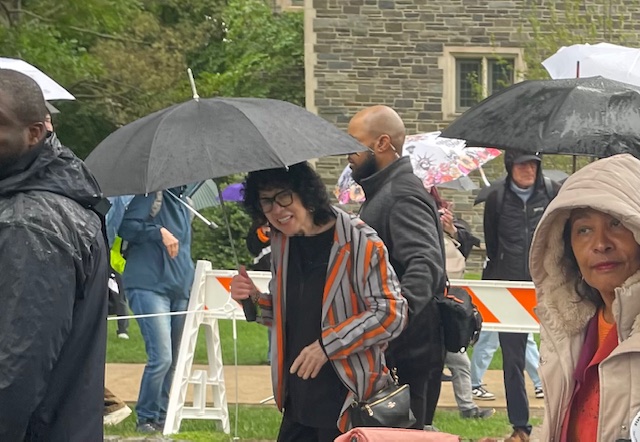
Our Stop the Wars rally found its way into Princeton University’s Reunions celebration, where we spent several hours making our anti-war case to the approbation and disapprobation of the several thousand revelers marching in Princeton’s annual P-rade. Among those apparently expressing approbation was Princeton alumna Sonia Sotomayor, as revealed in this photo, in which she smiled directly at activist leader Sireen Sawalha, who was standing right next to me.
They Can Hear Us
Our people’s distress calls won’t go unheard, either
Guest post by Paulo Almiron and Resistencia en Acción NJ
May 25
It’s been a year since Delaney Hall reopened. Sobibor and Auschwitz also opened around May, staining the spring with blood in their respective years.
I’ve been at Delaney several times to interview people and bear witness to everything happening in 2025. There’s been much to see at the site: priests being manhandled, colleagues arrested, a mayor arrested, three congresspeople assaulted, and an uprising inside, of which I am writing a memoir about the unrest outside. I am qualified to talk about the boots-on-the-ground experience outside Delaney, so to those who have only seen Delaney Hall from behind a screen, let me give you the shortest description possible: this concentration camp is the most repulsive sight in New Jersey.
Continue reading Policy of Truth