Two Jews, Two Views

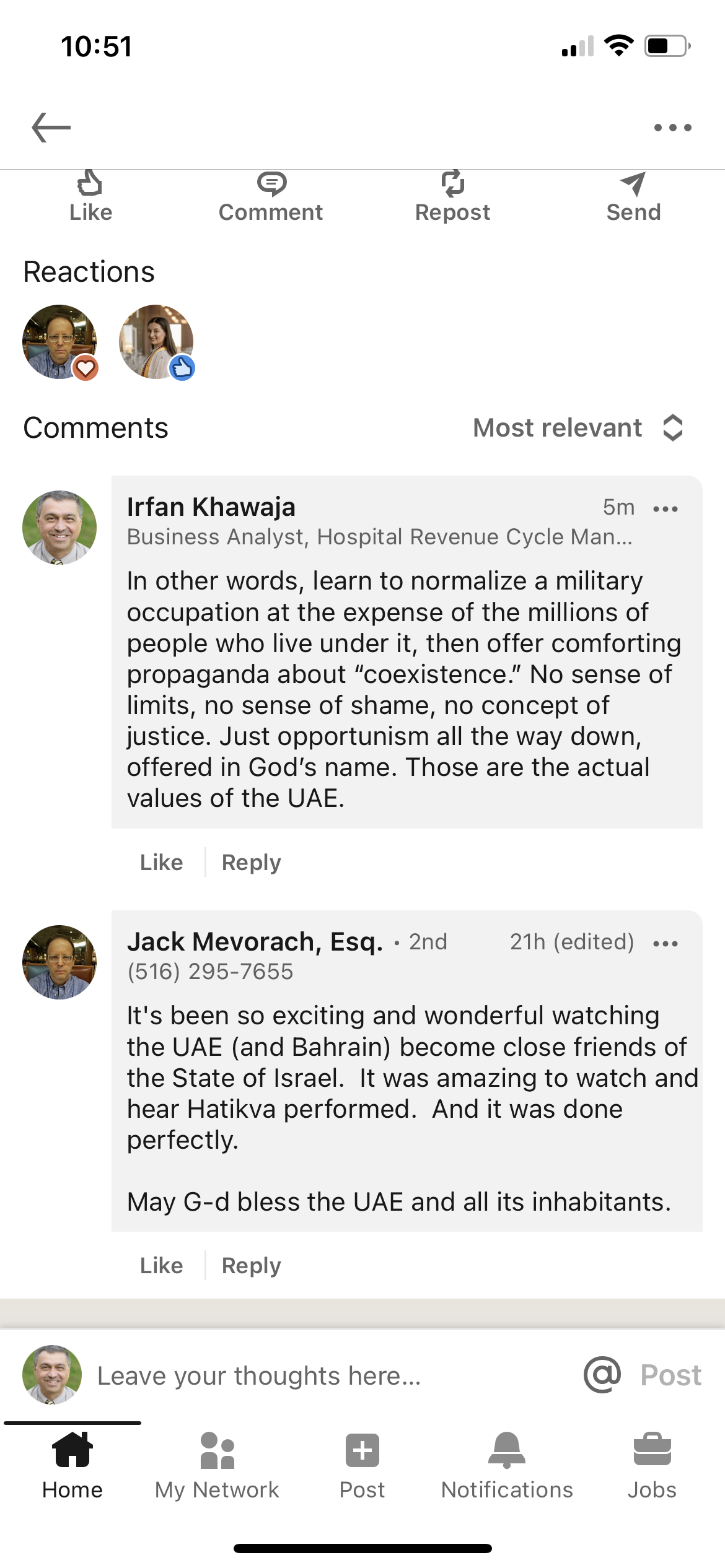
Am I really Jewish? Or just Jew-ish? I guess you’d have to ask your rabbi. Or mine.

This is from LinkedIn, in case you’re wondering. I agree, it’s probably not career-enhancing.

As for musical performances “amazing to watch and hear,” call me when the Emiratis sing “Kol Nidre.”

“Life After Privacy”: Thoughts on Big Data (4)

This is the fourth installment of my series on Big Data and privacy, focused on Firmin DeBrabander’s Life After Privacy. Part 1 was a summary of DeBrabander’s book. Part 2 criticized his “victim blaming” approach to the subject (scare quotes mine). Part 3 criticized what I termed his “counsels of despair” with respect to pushing back on Big Data. 

I had promised, at the end of Part 3, to discuss examples of successful activism vis-á-vis Big Data. But on second thought, it seems better to defer the case studies until the end of the series, treating them as a set of appendices to the main argument. So in this installment, I’ll continue with my main argument against DeBrabander, focusing on the last of his three “counsels of despair,” which I call Sour Grapes: Continue reading

The “Muhammad Painting” Case: An Update

Someone asked me last night for an update on the Hamline “Muhammad Painting” case. I’m happy to report that public opinion, in the US at least, seems largely to be going against Hamline, and in López Prater’s direction. Here’s a sample, focused mostly on the American reaction to the case. 

In the original post, I’d said that The New York Times article “tells you what you need to know.” That’s almost, but not entirely, true. Eugene Volokh at Reason magazine has reproduced the full texts of many relevant university communications on the controversy, not otherwise reported elsewhere in their entirety–memos, statements, scuttlebutt, etc. Some of the details matter, but none of them really alter anything I said in the original post. Continue reading

Erika López Prater and the Assault on Academic Freedom

I could belabor this case, but I’ll refrain. This New York Times article tells you what you need to know. A summary:

Erika López Prater, an adjunct professor at Hamline University, said she knew many Muslims have deeply held religious beliefs that prohibit depictions of the Prophet Muhammad. So last semester for a global art history class, she took many precautions before showing a 14th-century painting of Islam’s founder.

In the syllabus, she warned that images of holy figures, including the Prophet Muhammad and the Buddha, would be shown in the course. She asked students to contact her with any concerns, and she said no one did.

In class, she prepped students, telling them that in a few minutes, the painting would be displayed, in case anyone wanted to leave.

Then Dr. López Prater showed the image — and lost her teaching gig.

Continue reading

Harvest of Sorrow

Christopher Hitchens tells the possibly (probably) apocryphal story of Robert Conquest, the historian: after writing a first book on the brutalities of Soviet socialism, The Great Terror: Stalin’s Purges of the 1930s, Conquest submitted a second as-yet untitled manuscript on Stalin’s program of forced collectivization.  Asked what he wanted to call it, he came up with the ungracious and yet apt title, I Told You So, You Fucking Fools. The book was, in the end, called The Harvest of Sorrow: Soviet Collectivization and the Terror Famine, followed by a third, Stalin: Breaker of Nations. 

I lack Robert Conquest’s erudition, productivity, or grace, but I do have one thing in common with him: I told you so, too–not about Stalin, but about “football,” i.e., American football, a bloodsport whose deceptions begin with its name. Continue reading

Pelé, RIP

I’m not much of a sports fan, and haven’t been for awhile, but as a kid in the 70s, I had three sports idols. One of them was Reggie Jackson. The second was Muhammad Ali. The third, my personal favorite, passed away yesterday: Pelé, aka, Edson Arantes do Nascimento. I can’t equal the poetic eulogy published for him yesterday by the Brazilian writer José Miguel Wisnik, and won’t try. I’ll simply echo Wisnik’s sentiments: Continue reading

How to Keep Christ in Christmas: A Parable

A couple of weeks ago, during Advent, I decided to do something ostensibly “nice” for myself. I decided that it was time, despite my newly-found vocation as a perpetually depressed and isolated widower, to get out and do something enjoyable for a change. Music is something I enjoy, and so, I reasoned, I ought to get out and see a musical performance. In grad school at Notre Dame, I made it a habit each week on Sunday afternoons to watch a classical performance that took place right by the library where I did my studies. “Right by the library” literally meant a few paces from the library, so while the concert took place in the middle of the afternoon–premium study time–I couldn’t easily appeal to transit costs as an excuse for not going. Continue reading

Preferential Treatment in the ER?

Today’s New York Times has a well-written, informative, and potentially explosive article, “How NYU’s Emergency Room Favors the Rich.” Here’s a summary, but read the whole thing for the full scoop:

In New York University’s busy Manhattan emergency department, Room 20 is special.

Steps away from the hospital’s ambulance bay, the room is outfitted with equipment to perform critical procedures or isolate those with highly infectious diseases.

Doctors say Room 20 is usually reserved for two types of patients: Those whose lives are on the line. And those who are V.I.P.s.

NYU Langone denies putting V.I.P.s first, but 33 medical workers told The New York Times that they had seen such patients receive preferential treatment in Room 20, one of the largest private spaces in the department. One doctor was surprised to find an orthopedic specialist in the room awaiting a senior hospital executive’s mother with hip pain. Another described an older hospital trustee who was taken to Room 20 when he was short of breath after exercising.

The privileged treatment is part of a broader pattern, a Times investigation found. For years, NYU’s emergency room in Manhattan has secretly given priority to donors, trustees, politicians, celebrities, and their friends and family, according to 45 medical workers, internal hospital records and other confidential documents reviewed by The Times.

Continue reading