Molinari East and West

Lo, I have information about both the Eastern and Pacific meetings of the Molinari Society for 2025.  (Irfan has already previously posted some info about his presentation at the Eastern.)

Eastern meeting, NYC, January 2025:
The Molinari Society will be holding its mostly-annual Eastern Symposium in conjunction with the Eastern Division of the American Philosophical Association in New York City, 8-11 January 2025.

Here’s the schedule info:

Molinari Society symposium:  False Alternatives in the Politics of Knowledge

G3A. Wednesday, 8 December, 4:00-5:50 p.m., Sheraton Times Square, 811 7th Ave. & W. 53rd St., New York NY  10019, room TBA.

chair:
Roderick T. Long (Auburn University)

speakers:
Irfan Khawaja (Independent Scholar), “Pedagogy Under Occupation: Between Indoctrination and False Neutrality”
Cory Massimino (Center for a Stateless Society), “Between Convergence and Conspiracy”

commentator:
Roderick T. Long (Auburn University)

Frequent Molinari panelist Jason Lee Byas will also be presenting elsewhere on the program on “The Vocabulary of Society: Feasibility and Fit in Expressive Arguments” (10G, Friday 10 December, 9:00-10:50 a.m.).

Pacific meeting, SF, April 2025:
The Molinari Society will be holding its mostly-annual Pacific Symposium in conjunction with the Pacific Division of the American Philosophical Association in San Francisco, 16-20 April 2025.

Here’s the schedule info:

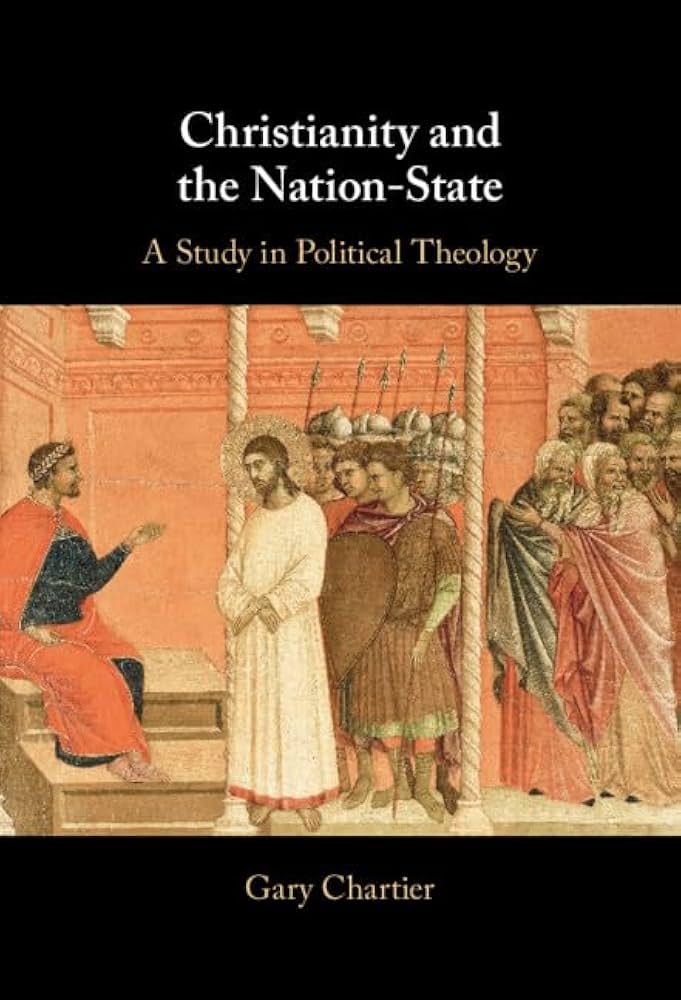
Molinari Society symposium: Author Meets Critics: Gary Chartier, Christianity and the Nation-State: A Study in Political Theology

G1H.  Wednesday, 16 April 2025, 6:00-8:00 p.m., Westin St. Francis Hotel, 335 Powell St. [unless a labour dispute forces a change of venue], San Francisco CA  94102, room TBA.

chair:
Roderick T. Long (Auburn University)

author:
Gary Chartier (La Sierra University)

critics:
David VanDrunen (Westminster Seminary California)
Mary Doak (University of San Diego)
Irfan Khawaja (Independent Scholar)

Be there or B2!

Thy Kingdom’s Will Be Done

I had a conversation the other day with a woman associated with a very liberal Protestant church who’d been organizing a charitable event for Gaza. The event was a dinner intended to raise money for a well-known medical relief organization. The event was a success, but she told me with chagrin that she had to be careful to advertise it in such a way as to avoid mentioning it to those members of the congregation who might have objected.

Continue reading

“False Alternatives in the Politics of Knowledge”

Just a reminder to anyone attending the APA Eastern in New York this January: the Molinari Society is hosting a session on “False Alternatives in the Politics of Knowledge,” Wednesday, Jan. 8, 2025, 4-5:50 pm, room TBA. Cory Massimino and I will be giving papers, with Roderick Long moderating and commenting. Cory’s paper is “Between Convergency and Conspiracy.” Mine is “Between Indoctrination and False Neutrality,” a defense of an advocacy-based conception of pedagogy, using the teaching I did under the Israeli occupation as a case study. For more details, click here.

A Christmas Sermon

In the Gospel of St Matthew, we read of King Herod’s Massacre of the Innocents. Herod put to death every male child under the age of two in the vicinity of Bethlehem. The Christian response was to render unto state power what belonged to it, without being able to identify what did and what didn’t. The results were predictable. First the Christians accommodated empire. Then Christianity became one.

Continue reading

On Love of Country

You’ve got to love a country where the President commutes the death sentences of 37 death row inmates, is widely praised for it, makes a pious speech about why the other three have to get the shaft for “terrorism,” and then, without a pause, continues committing genocide abroad while winning adulation for that. The part of the country fixated on the first part of that sentence is incomprehensible to the part fixated on the second, and vice versa. The day when the second group becomes large enough to be a real worry to the first is the day that we’ll witness the beginning of the end of the United States of America in the name of something better. It’s only when you grasp that the second group unapologetically wants to hasten that day that you’ll understand what the dispute was about in the first place. But believe me, we do.

The Evil Demon in the OR

EVS Journal 8: More Scenes from Life on Call in the OR

Up to this point, what I have accepted as very true I have derived either from the senses or through the senses. However, sometimes I have discovered that these are mistaken, and it is prudent never to place one’s entire trust in things which have deceived us even once.

Descartes, Meditations on First Philosophy, Meditation 1

I’m on call in the OR for New Year’s Day, 8 am to midnight–an irritation after a long sleep-deprived week of work, including all of New Year’s Eve spent in the OR. I wake up on New Year’s Day, and decide, on a mere hunch or whim, to drive to the hospital mid-morning, pre-empting the phone call that calls me in to the hospital, operating instead (so to speak) on the premonition that if I go to the OR unbidden, there’ll inevitably be a case waiting for me to do, which I’ll then be in a position to “head off at the pass,” whatever that’s supposed to mean in this non-cowboy context. Continue reading

Call Me

Scenes from Life On Call in the OR
EVS Journal 7

Every member of the OR EVS team takes emergency call on assigned weekends. The call shift starts at 8 am, ends at midnight, and takes place on two consecutive days. It’s an exercise in underpaid exhaustion. You get $5/hr every hour that you’re on call but not actively on a call. Once you get a call, you suit up (in scrubs) and punch in.  Once you suit up and punch in for a case, you get paid time and a half: $21/hr. When you’re done with the case, you punch out–you’re supposed to punch out–and go back to $5 an hour. Overtime past midnight is penalized, regardless of when the call comes in. Continue reading

Secure Your Own Homeland

ICE showed up at my workplace today–or rather, ICE in the guise of DHS, “The Department of Homeland Security.” The agent flashed a badge and started asking about some people with Spanish names. Did I know anything about them? I had nothing to say.

The only thing I have for ICE or DHS–the only product I can promise–is wholehearted, undying hostility. I doubt they want to hear me talk about that. So there’s nothing to say. In any case, the Homeland they’re securing isn’t mine to worry about, and the land that I live in isn’t theirs to secure. Not a promising basis for a meeting of minds–the only kind that interests me.

I opened the door this time because I didn’t know who was ringing. Next time, as far as I’m concerned, they can stand there for as long as it takes to induce someone else to open the door. I’m not the doorman. So it won’t be me.

Those Drones Explained

Zeynep Tufekci has a piece in The New York Times trying to explain the “drone panic” that has (supposedly) overtaken New Jersey. I live and work in central New Jersey, and have neither seen any drones nor encountered any panic, but am only too happy to borrow the premise.

Tufekci attempts a couple of explanations for the drone panic (and the drones), but conspicuously fails to mention one of the most prominent ones out there. About a week ago, South Jersey Congressman Jeff Van Drew vehemently suggested that the drones had been launched by an Iranian mothership, the implication being that they were imminently about to attack us, and constituted a major national security threat. He cited no real evidence for his claims, accused the Pentagon of covering up the threat, doubled down for awhile, and then retracted the whole thing. Van Drew is a standard-issue right-wing imbecile, but the explanation for making such claims is obvious. It’s called a guilty conscience. A belatedly guilty conscience.
Continue reading