
Limits in Chicago!

In addition to its usual Eastern symposium, the Molinari Society will be holding its first-ever Central Symposium in conjunction with the Central Division of the American Philosophical Association in Chicago, 18-21 February 2026.

Here’s the schedule info:

Molinari Society symposium: The Limits of Markets

G10E. Thursday, 19 February 2026, 7:00-9:50pm [that’s how long we have the room for; we’re unlikely to run that long], Palmer House Hilton, 17 E. Monroe St., Chicago IL 60603, room TBA.

chair: Roderick T. Long (Auburn University)

speakers:
James Stacey Taylor (The College of New Jersey) and Amy E. White (Ohio University), “Why Some Things Should (Typically) Not Be For Sale”

commentators:
Jason Lee Byas (Georgetown Institute for the Study of Markets and Ethics)
Ryan Davis (Brigham Young University)

Anarchy in Baltimore!

EDITED to change the order of presenters:

The Molinari Society will be holding its mostly-annual Eastern Symposium in conjunction with the Eastern Division of the American Philosophical Association in Baltimore, 7-10 January 2026.

Our symposium comprises two back-to-back sessions on Wednesday afternoon (both in the same room, we hope!). Here’s the schedule info:

Molinari Society symposium: Topics in Radical Liberalism

Session 1:
G2D. Wednesday, 7 December, 2:00-3:50 p.m., Baltimore Marriott Waterfront, 700 Aliceanna St., Baltimore MD 21202.

chair: Roderick T. Long (Auburn University)

speakers:
Irfan Khawaja (Independent Scholar), “Academia’s Complicit Executioners: A Critique of the Kalven Committee Report”
Zachary Woodman (Western Michigan University), “Extended Cognition as Property Acquisition”

Session 2:
G3D. Wednesday, 7 December, 4:00-5:50 p.m., Baltimore Marriott Waterfront, 700 Aliceanna St., Baltimore MD 21202.

chair: Roderick T. Long (Auburn University)

speakers:
Cory Massimino (Center for a Stateless Society), “A Liberal Socialism Must Also Be Left Market Anarchist”
Jason Lee Byas (Georgetown Institute for the Study of Markets and Ethics) “Distributed Justice: Can We Make Sense of Justice Outside the State?”

Robert Massie at Princeton

“Divestment and the Boundaries of Conscience”
As regular readers of this blog know, I’ve been involved since 2024 in the campaign to induce Princeton University to divest its holdings, not just from Israel, but from arms manufacture and military affairs as such. 

It was about a year ago that I got it into my head to get Robert K. Massie IV involved in our efforts. Massie is one of the architects and chroniclers of the decades-long campaign to divest from apartheid South Africa; I’d first encountered his book Loosing the Bonds twenty years ago, and been impressed by the rigor of his argument, as well as by the wealth of detail and moral passion he brought to the subject. Continue reading

Death Camps and Torture Chambers

An Addendum on Institutional Neutrality
I wanted to add a sort of postscript to my March 17 post on institutional neutrality, meant to clarify an inference that is slightly (but only slightly) more complicated than I made it in the original post. The post was already somewhat long, and I didn’t want to burden it with over-complications by addressing every possible objection, or chasing down every twist and turn in the argument. But I also don’t want to burden it with misunderstandings.

Continue reading

Academic Hiring and Genocide

“In the literature of complaint and reform, and in the endless reports from distinguished groups identifying a crisis in some element or all of higher education in America, a key defect is often the absence of practical solutions.” 

–John V. Lombardi, How Universities Work, p. 31. 

In an essay I posted here a few weeks ago, I argued that genocidaires seeking lower-level electoral office should be denied such offices at the ballot box. The argument was framed as a response to Jason Brennan’s account of the ethics of voting, which he describes as “the ethics of voting in political contexts.”(1) Though he doesn’t quite define “political contexts,” it’s obvious enough that he means voting in democratic elections for governmental office, e.g., for U.S. President, for legislative offices, and in some cases for judicial offices, taking U.S. electoral politics as the paradigm. Continue reading

Thy Kingdom’s Will Be Done

I had a conversation the other day with a woman associated with a very liberal Protestant church who’d been organizing a charitable event for Gaza. The event was a dinner intended to raise money for a well-known medical relief organization. The event was a success, but she told me with chagrin that she had to be careful to advertise it in such a way as to avoid mentioning it to those members of the congregation who might have objected.

Continue reading

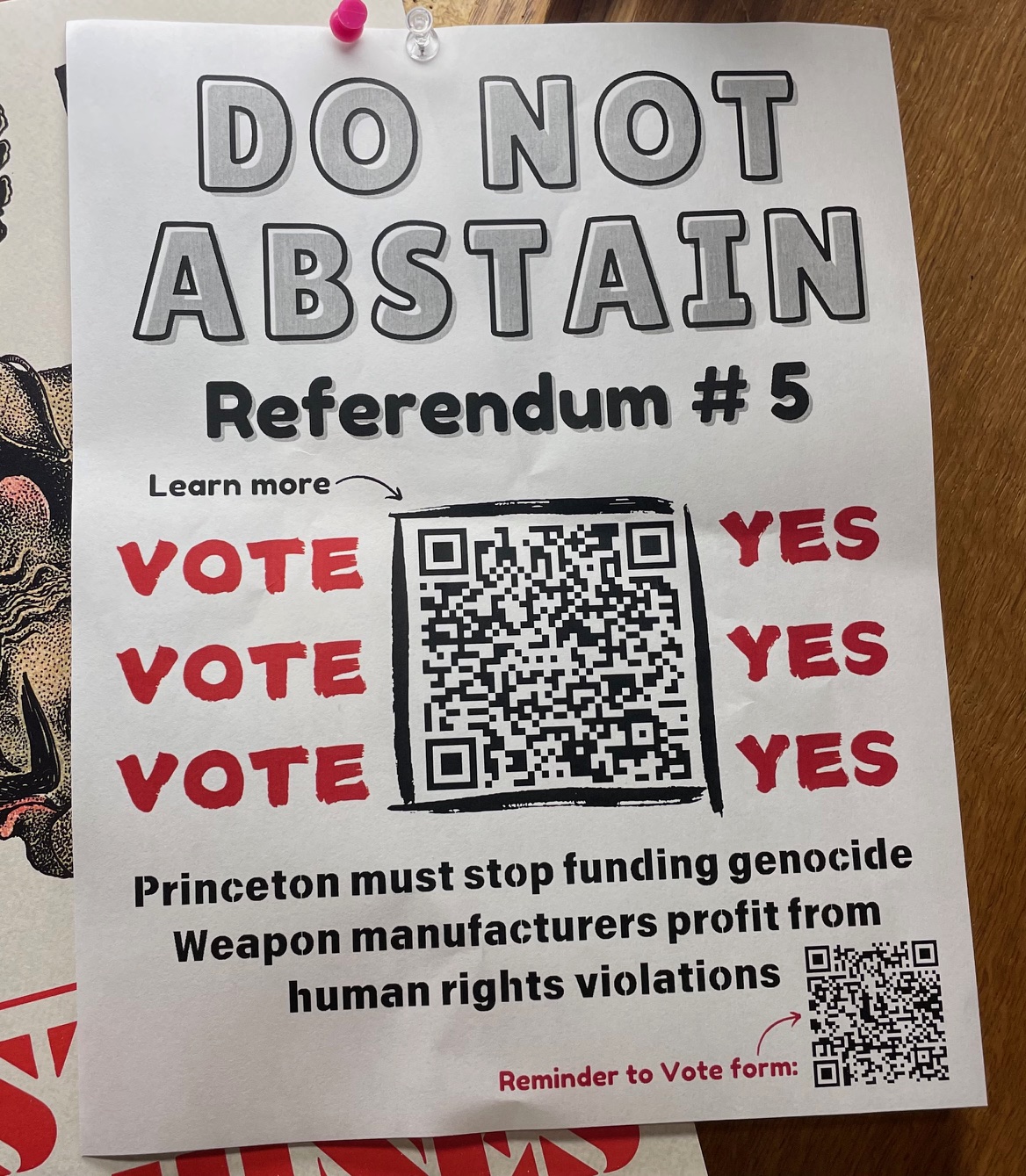
Princeton University USG Referendum Question #5: Divest

Referendum Question #5 of Princeton University’s forthcoming Undergraduate Student Government elections. Scroll down (you may have to click “download”) for a PDF with the wording of the referendum. Kudos to these students for the work they’ve done on this. If only I could vote on it, but I’m 33 years too late.

donotabstain

Continue reading

The Soft Domination of Everyday Life

Consider this post an unplanned addendum to my earlier series on domination and at-will employment.

A friend of mine just got “fired”–you’ll see in a minute why the word is in scare quotes–and we’re disagreeing about what it all means. Naturally, I thought I’d share tidbits of our discussion here. My friend blames himself; I blame his employer. Which of us is right? I’ll give you an impeccably impartial account below; you decide. Then feel free to chime in either way.

Let’s call my friend “Claude.” Claude was caught vaping on the job. There’s no explicit rule in his company’s handbook against vaping on the job. It’s simply understood that “one does not vape on the job.” It’s not clear why this is so. “It is what it is.” Argument is not invited, and evidence is not required. We all know evil when we see it. Continue reading

“Titanic Malice” Revisited

In a post I wrote here back on July 18, 2023, I argued that the Titan submersible accident was “diagnostic of the delusions of our society.” Here’s the first paragraph of the post, emphasis added:

The response to the Titan submersible event has, in my view, been both remarkable and bizarre. Some people have found it an occasion for gallows humor; others have tried to suggest that the crew/passengers felt no suffering as they died. Still others tell us that we should celebrate the heroism of people who take risks to explore the unknown, and point out that civilization itself depends on its bold risk takers. I find all three of these reactions delusional, and diagnostic of the delusions of our society.

It turns out that I was wrong (or likely wrong) about the italicized clause, and that David Potts, who commented on the post, was right. Continue reading

“Sick of the Bullshit”

It’s ordinarily a violation of the ethics of discourse to use the question-and-answer period of a talk to make a speech rather than ask a bona fide question. A question is a request for information. A request can, as a condition of its intelligibility, require a brief clarification or bit of context-setting, but there’s a difference between that and a speech. 

However, most norms, no matter how stringent, have exceptions. What if, day after day–hundreds or thousands of times across a solid year–the spokesperson for a person in authority engages questioners in egregious, obvious bad faith? What if, day after day, he tells smirking lies about life and death matters, makes up random bullshit at will, and evades the meaning of obvious questions in order to serve up whole stinking, decaying schools of red herrings? What if his bosses are concealing complicity in mass murder, and are about to lead the country into an insane, ill-conceived war (the second one in the last few years), not just on behalf of their own country, but on behalf of a foreign country? Continue reading