I’ve been receiving videos from Palestinian friends, of Israeli military actions taking place, not just in Jenin, but across the length and breadth of the West Bank. I so far have seen no indication from the mainstream American press that Israeli military occupations have extended beyond Jenin. But while nine Palestinians were killed in Jenin, one was killed in Ar-Ram (so Israeli military actions are obviously not confined to Jenin). Since then, there have been two widely-reported Palestinian attacks on Israeli targets as well, one in the settlement of Neve Yaakov, the other in a location that The New York Times vaguely describes as being “near a settlement in East Jerusalem.” Continue reading
Author Archives: Irfan Khawaja
“A” Is for Occupation
In a post I wrote back in 2020 explaining the A-B-C system that structures the Israeli occupation of Palestine, I described Area A, the area supposedly under Palestinian control, as follows:
Area A covers Palestinian urban centers, supposedly under full Palestinian control, both “civil” and “security” related…Area A is under “full” Palestinian control–except when Israeli military forces enter such an Area, as they often do, in which case “full” control becomes non-control for the duration.
Current events in Jenin illustrate this. Jenin is squarely in Area A. Area A is under full Palestinian control. But at the moment, Jenin is precisely not under Palestinian control. Apparently, some control is fuller than others. Continue reading
Facing the Whirlwind (1)
Revisiting the Book of Job: Introduction
As many of you by now know, and are no doubt sick of hearing, my wife Alison killed herself two years ago, in March 2021. The day after I heard, I decided, like a character in a Saul Bellow novel, to cope with what happened by reading the Book of Job. The day after that, less like a fictional character than my usual deranged self, I decided to blog my thoughts on Job in full consciousness (and willful defiance) of the fact that if “too soon” has any meaning, surely 48 hours after your wife’s death by suicide is it. Continue reading
Fourth Time’s the Charm
“Newport News School Was Warned 3 Times That 6-Year-Old Had a Gun, Lawyer Says,” The New York Times, Jan. 25, 2023.
Around 1 p.m. — about an hour before the shooting — another teacher reported that a student had come to the teacher crying, saying that the 6-year-old had shown him the gun at recess and threatened to shoot the student if the student told anyone, Ms. Toscano said.
“What did administrators do?” Ms. Toscano said at a news conference on Wednesday, where she announced plans to file the lawsuit. “Did administrators call the police? No. Did administrators lock down the school? No. Did administrators evacuate the building? No. Did they confront the student? No.”
Would anyone but an upper-level administrator summarily have been fired weeks ago? Yes.
Tell Me When It’s Over
“Ticketmaster Cast as a Powerful ‘Monopoly’ at Senate Hearing, The New York Times, Jan. 24, 2023.
Mr. Berchtold largely attributed Ticketmaster’s failings to an assault from online bots: automated programs, run by scalpers, that seek to snatch up tickets before they ever make their way to consumers. That drew a largely skeptical response from the senators.
“This is unbelievable,” Senator Marsha Blackburn, Republican of Tennessee, said, with more than a hint of anger in her voice. “Why is it,” she added, “that you have not developed an algorithm to sort out what is a bot and what is a consumer?”
Why is it that Congress hasn’t developed an algorithm to distinguish a monopoly from a market leader? Wouldn’t that be just as easy, and just as useful?
New Page: Discussion Groups
I’ve added a new page to the blog, Discussion Groups, housing information on the two discussion groups loosely associated with PoT.
Two Jews, Two Views

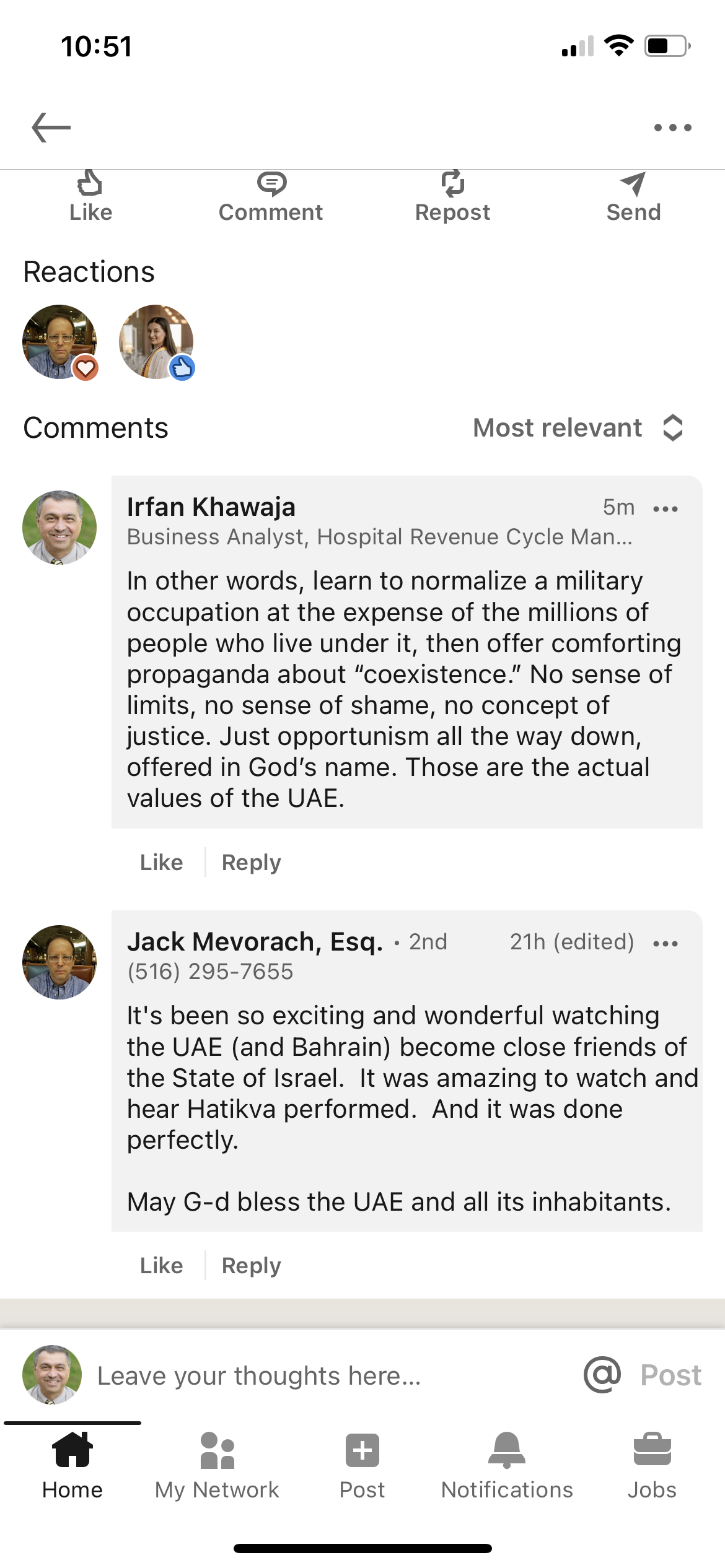
Am I really Jewish? Or just Jew-ish? I guess you’d have to ask your rabbi. Or mine.
This is from LinkedIn, in case you’re wondering. I agree, it’s probably not career-enhancing.
As for musical performances “amazing to watch and hear,” call me when the Emiratis sing “Kol Nidre.”
“Life After Privacy”: Thoughts on Big Data (4)
This is the fourth installment of my series on Big Data and privacy, focused on Firmin DeBrabander’s Life After Privacy. Part 1 was a summary of DeBrabander’s book. Part 2 criticized his “victim blaming” approach to the subject (scare quotes mine). Part 3 criticized what I termed his “counsels of despair” with respect to pushing back on Big Data.
I had promised, at the end of Part 3, to discuss examples of successful activism vis-á-vis Big Data. But on second thought, it seems better to defer the case studies until the end of the series, treating them as a set of appendices to the main argument. So in this installment, I’ll continue with my main argument against DeBrabander, focusing on the last of his three “counsels of despair,” which I call Sour Grapes: Continue reading
NB: Glitch in Comments Function
Read this note before you comment.
The “Muhammad Painting” Case: An Update
Someone asked me last night for an update on the Hamline “Muhammad Painting” case. I’m happy to report that public opinion, in the US at least, seems largely to be going against Hamline, and in López Prater’s direction. Here’s a sample, focused mostly on the American reaction to the case.
In the original post, I’d said that The New York Times article “tells you what you need to know.” That’s almost, but not entirely, true. Eugene Volokh at Reason magazine has reproduced the full texts of many relevant university communications on the controversy, not otherwise reported elsewhere in their entirety–memos, statements, scuttlebutt, etc. Some of the details matter, but none of them really alter anything I said in the original post. Continue reading
 Policy of Truth