One of the topics discussed at the Princeton Town Council this past Monday was roundabouts. The Council wants to install one at the corner of Terhune and Harrison, I believe it was. I don’t like roundabouts, and hope they don’t build this one, but I have to admit that the issue is more complicated and more interesting than my personal preferences, so I thought I’d lay out the structure of the problem involved.
The members of the Council divided into three-ish groups, those in favor of the roundabout, those against, and those ambivalent- but-somewhat-against.
David Cohen, speaking in favor, pointed out that roundabouts save lives.
Brian McDonald, speaking against, pointed out that they don’t necessarily put an end to all collisions at the intersections where they’re installed.
Mia Sacks, speaking for the ambivalent, suggested that she’d rather just fix the light at that intersection, but discovered that doing so would be more expensive than creating a roundabout.
Mark Freda, speaking against, expressed a dislike for the idea on the grounds of a lack of fit between the problem and the solution.
Paradoxically, I think that all of the speakers were correct, but that the issue can only be understood if put into a wider context.
Two facts about roundabouts are indisputably true, and tend to speak in their favor:
- Over the long term, roundabouts decrease the aggregate number of collisions that take place at the right-angle intersections they replace.
- Over the same long term, roundabouts decrease the severity of those collisions that do take place, decreasing the mortality, morbidity, and damage that arises from them.
Facts (1) and (2) might at first seem conclusive, but they’re not. They stop being conclusive when you ask why they hold.
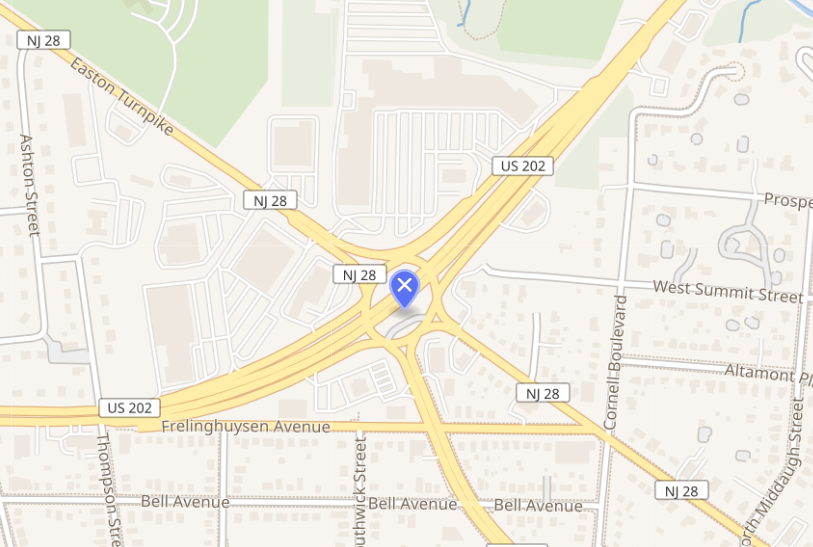
Somerville Circle, Somerville, New Jersey. A horror every time.
Fact (2) is easier to understand than (1). It’s also better documented, and involves the stronger effect. Collisions do take place at roundabouts, but the collisions that take place there tend to be less serious than collisions at right-angle intersections. This is because roundabouts slow traffic down. If you slow traffic down, then even if a collision takes place, the collision will be less serious than it might otherwise have been. That’s what explains the decrease in mortality, morbidity, and property damage in roundabouts.
Fact (1) is subtler, less well-documented, and involves a weaker effect, but still happens to be true. Over the long term, roundabouts decrease the aggregate number of collisions that take place at the right-angle intersections they replace. One significant reason is that they heighten drivers’ vigilance. There’s a tendency, when driving a straightaway, to drive on auto-pilot. Auto-pilot driving is accident-conducive. But autopilot-driving isn’t really possible in a roundabout: the circular shape of the roundabout forces you to pay attention. The increased vigilance induced by the circular shape of the roundabout forces drivers over the long term to pay attention in ways that reduces the aggregate number of collisions.*
The italicized phrase is crucial. It’s true that over the long term (it’s not clear how long), increased vigilance decreases collisions relative to the right-angle intersection replaced by a roundabout. The problem is, this vigilance is forced on drivers by the nature of the roundabout, and the semi-coercive dimension of the underlying mechanism, is itself a source of some problems.
As David Cohen suggested in the Council session, driver experience is important to any assessment of any traffic arrangement. As far as roundabouts are concerned, forced vigilance is often experienced by drivers as anxiety-producing. Some people regard this increased anxiety as conclusive all by itself. It doesn’t seem fair (they say) to force people into vigilance, even if doing so produces a good outcome, like (1) and (2) above. In forcing vigilance on them, it seems as though you’re terrorizing them into promoting social utility, and so, using them as a mere means to some larger end. I sympathize with this point of view, largely because it articulates how I feel when driving through a roundabout. But I don’t think things are quite as simple as the complaint suggests. Since it would take me too far afield to do justice to the complexities here, let me set this issue aside for now and move to a different one.
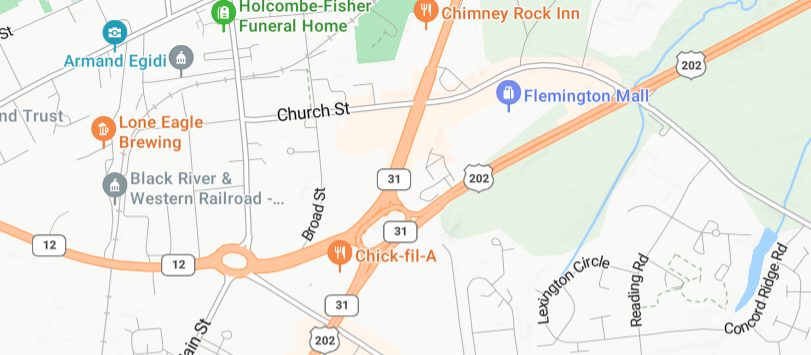
Flemington Circle, Flemington, New Jersey. Love the placement of Chick-fil-A.
Whatever we think about the preceding problem, we can see the problem another way. The reason why roundabouts create anxiety is that they’re experienced, correctly, as a kind of high-stakes divided attention task–a high-stakes form of multitasking.** I count three or four simultaneous tasks here.
(i) The driver wants expeditiously to get to her destination.
(ii) The driver also has to get through the maze you’ve created for her.
(iii) The maze creates anxiety, so she has to deal with her anxiety while negotiating the maze.
(iv) But there isn’t much time to deal with it, so she has to deal with it in a hurry.
And if she fails, she crashes. That’s the high-stakes element.
As I’ve argued here before, I regard multitasking as in general a bad idea. It feels bad because it is bad. When you ask people to multitask, you’re asking them to do several things at once. As a result, their mind has to go in several different directions at once. This dilutes what they’re doing on each discrete task, which reduces their overall mental efficacy. When you do this on a high-stakes activity, you’re really asking for trouble. When you put people in a high-stakes situation, and then ask them to multi-task, they choke. In this case, when they choke, they crash. They don’t die, but they still crash.
That’s what you can expect of roundabouts over the short term–crashes induced by confusion, and confusion induced by increased cognitive load.*** Granted, once people get used to the roundabout, the increased-collision effect tends to dissipate. But you can still expect an initial increase in crashes. Beyond this, there are two totally different reasons why the long-term decrease happens, and the two reasons have very different implications.
One reason why collisions decrease within roundabouts is that people get used to the roundabout and get better at driving through it. With increased practice and increased vigilance, you eventually get a reduction in collisions. And since whatever collisions take place are low speed collisions, you get a reduction in mortality, morbidity, and physical damage. So over time, you can expect good things to happen. That’s the good news for advocates of roundabouts.
Another reason why collisions might decrease, however, is that one sizable population might come to fear or resent the roundabout to such a degree that instead of driving through it, they may pick a route to their destination that avoids it. That would end up reducing collisions at the roundabout but by taking traffic elsewhere. Since you can’t build roundabouts everywhere, increased traffic “elsewhere” means increased traffic at other right-angle intersections. So the reduced collision/mortality/morbidity effect at the roundabout ends up being explained by (and is diluted by) an increased collision/mortality/morbidity effect elsewhere in town. That suggests that a net benefit at the roundabout is not necessarily a net benefit all things considered. You can reduce collisions at the roundabout because you’ve increased them a block away.
The only kind of roundabout that should exist (but of course, no longer does)
A final problem for roundabouts is that they’re bad for emergency response. It’s very difficult to drive a large fire truck or large rescue squad through a small roundabout. Arguably, it asks too much of emergency responders to demand this of them.
So that’s my take on roundabouts. They have benefits and they have costs, but it’s hard to tally them up in a conclusive way because the costs and benefits are hard to measure, some of the factors are purely a matter of preference, and there are many uncertainties involved. Personally, I think the costs exceed the benefits, but I doubt there’s any way to prove that.
That said, I think my little exercise above explains why each participant in Monday’s discussion was right.
David Cohen was right that roundabouts decrease mortality and morbidity through collisions. They do, but that’s not conclusive.
Brian McDonald was right to say that you’ll still get collisions. You will at first, but they’ll decrease over the long term.
Mia Sacks was right to wish we could just fix the problem by replacing the traffic light, and have done with it. Roundabouts solve intersection problems, but they involve a lot of complexity. Lights are more expensive but simpler.
And Mark Freda was right to express vague discomfort with the mismatch between problem and solution. Given his background in emergency response, I suspect he was wondering how his PFARS people would maneuver a rig with a patient in it through a roundabout. It’s a good question. As a former hospital worker, I’m sensitive to the often excessive demands people impose on emergency responders, as though emergency response was something we could all do in our sleep. It isn’t.

Imagine driving this thing through a roundabout? Come on, bro
So I end up agreeing with Sacks and Freda.
I can’t resist a couple of philosophical points here. If you’re reading this post just for what it says about roundabouts, exit now.
One point is that the method I’ve employed above is modeled on Aristotle’s conception of dialectic: set out the reputable positions; puzzle through the difficulties; vindicate the best of what remains of the reputable positions (Nicomachean Ethics VII.1). Dialectic works well to clarify the structure of a problem, but I wonder how well it does at solving it. I suppose it’s possible that the roundabout problem above can be solved by iterating a series of dialectical inquiries, but I somehow doubt it. It seems to me to need something else. I’m inclined to agree with Gregory Salmieri that Aristotle relies on both a dialectical and a non-dialectical method, and that we’re obliged to do the same. It’s neither turtles nor dialectic all the way down.
The other point is that the roundabout problem is a recurring type of philosophical problem. Many policy problems involve a mix of pros and cons. The pros and cons arise because differing courses of action have different sets of consequences, positive and negative. How are these consequences to be weighed up in such a way as to produce a defensibly non-arbitrary solution to the original problem without lapsing into consequentialism? It’s very unclear. I suspect that John Broome’s “weak consequentialism” provides some of the best answers here, but I don’t know how far Broome’s views go toward solving concrete problems like this one. At any rate, since this is a pretty roundabout point of entry into that topic, I’ll leave it for another time.
*There is a dearth of research on the specific claim I’ve made here, that enhanced vigilance is the underlying psychological mechanism that explains the decrease in collisions, but I think it’s a fair inference from the research that exists. See 1, 2, 3, and 4. Though these studies tend to focus on the external, environmental features of the roundabout (omitting the psychological ones), psychological ones are obviously relevant in any car with a driver. My claim is that these studies implicitly appeal to heightened vigilance as the relevant psychological variable. Take vigilance entirely out of the equation, and it’s hard to see why the factors cited lead to a decrease in collisions.
**Again, there is a dearth of research on the specific claim I make, but the existing research is highly suggestive, and what I say in the post is a reasonable inference from it. See 1, 2, 3, 4, and 5. I am, incidentally, setting obvious confounding factors, such as intoxication. None of what I say applies to someone driving under the influence.
***Note the allusion to “driver hesitation” in this discussion. This paper suggests that drivers experience hesitation before entry into the roundabout, which dissipates within the roundabout precisely because of the mental load required to get through it.


I always find the range of voices on this blog refreshing — philosophy alongside activist reporting pushes back against the usual academic siloing. Looking forward to the next batch of interviews; the Alison Bowles series is still the high-water mark for me.
LikeLike
Thanks. I greatly appreciate that. I do have more to say about Alison, but find writing about her very difficult, and often find excuses for avoiding it. I read a piece today by Chris Hedges, “The Dead,” that resonates very powerfully and is a hard act to follow. It strikes me as relevant that Hedges had to travel to Maine to write it. I would have to travel somewhere to access what I feel about Alison, but there are always a million reasons not to.
LikeLike
Pingback: Circling Back to Roundabouts | Policy of Truth