Politics and the Problematics of Fun
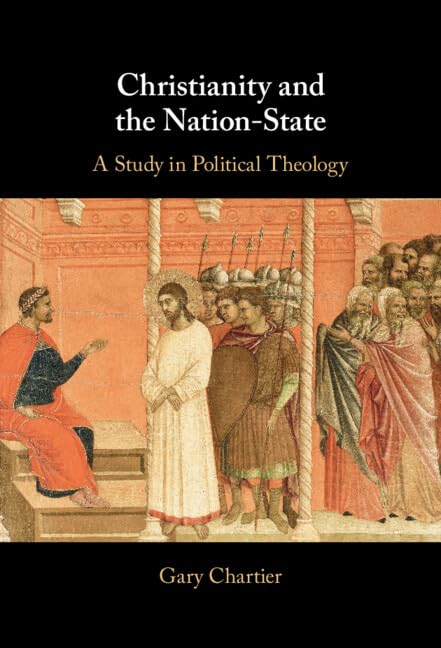
I started my “Stirring the POT” series earlier this year as a vehicle for announcements, but it gradually morphed into a series of ruminations on conferences I attended. The latter turned out to be the more interesting enterprise, so I’ll close out the year with a belated conference rumination. This past April, I went to San Francisco, at the invitation of Roderick Long and the Molinari Society, to be on an Author-Meets-Critics panel on Gary Chartier’s Christianity and the Nation State. It promised to be a good time, and it was.
The last time I was in San Francisco was the summer of 2019, when Michael Young and I attended NASSP at the University of San Francisco, with a side visit to David Potts’s home in the Oakland hills. Those were the days of the now-forgotten mass homelessness crisis in San Francisco. Our hotel, the (now defunct) Beresford, was up by Union Square, a couple of miles from the University, so we made a point of walking across town, down Golden Gate Avenue, through miles of homeless encampments, just to get a sense of what they were like.
What were they like? Well, more or less the squalid hell you’d think they were like: miles of suffering, filth, and desperation. They reminded me, incongruously, of the refugee camps I’d seen in northern Pakistan in the mid-1980s, which housed refugees from the Soviet invasion of Afghanistan. As I think about them now, of course, they remind me immediately of Gaza. I guess refugee tents start to blur into each other over time. None of these comparisons is particularly exact, but none really has to be to get the point across: it’s one thing to go camping in a tent, but you wouldn’t want to live in one.

Homeless person, Church St, San Francisco (photo credit: Christopher Beland, Wikipedia)
The tents were all gone now. This time it was my girlfriend Kate and I who drove down Golden Gate Avenue, only to find that the homeless and their encampments had miraculously vanished. It was tempting to think that the problem itself had been solved, but that was an illusion. The camps had simply been removed by the authorities, dispersing their inhabitants to the four corners of the city.
I’d seen a version of it happen at the Gaza Solidarity Encampment at Princeton University the year before, but a more gruesome version has been under way for years if not decades in Palestine. Trump’s fraudulent “Peace Plan” and “Cease Fire” are just mechanisms of expulsion by other means, as is the gradual annexation and re-settlement of the West Bank by Israel and its settlers. In the one case, the Palestinians are to be pushed through Rafah into Egypt. In the other, they’re to be pushed across the Jordan River into Jordan. Either way, the aim is to solve the problem the relevant people represent by getting rid of them.
The solution is unique neither to San Francisco, nor Princeton, nor Palestine. A grim version of the same “solution” has become the fate of the Afghan refugees I mentioned a moment ago. After decades in Pakistan, the Afghans are now being forced by the Pakistani government to leave Pakistan en masse, and start life anew in the Taliban’s Afghanistan. Something similar is true of the Afghans in Iran, and to a lesser extent the Sudanese in Egypt, also a number of ethnic groups in Russia, and of course Latin/Caribbean migrants in the Americas. Like the latest dance on TikTok, mass expulsion has become a trend.

Displaced Palestinians return to their homes at Nuseirat Refugee Camp, (photo credit: Ashraf Amra, UNRWA)
All of this was the (to me) unavoidable baggage I brought to Gary’s book, which itself has little to do with any of these things, at least not directly. Christianity and the Nation State is a defense of what Gary calls “radical consociationalism,” a form of anarchism inspired in part by the medieval natural law tradition and in part by Athanasian Christology. The idea is that both natural law and Christian Scriptural teaching point us away from the coercion and aggression that characterize the State, and toward a fundamentally anarchic social vision grounded in voluntary communities pursuing common goods of their own choosing.
This is probably the opposite of what anyone thinks of nowadays when they hear the phrase “Christianity and the Nation State”: Gary’s is a form of Christianity opposed to the nation state; by contrast, the loudest versions today revel in wielding state power, often for ends that lack any discernible connection to Christianity. I’m not sure whether this is a case of putting old wine in new bottles or new wine in old, but either way, it’s unconventional.
My two fellow panelists were David VanDrunen, a politically and theologically conservative Presbyterian, and Mary Doak, a politically and theologically liberal Catholic. I was the fish out of water: a theological fictionalist, philosophical pragmatist, and political insurrectionist, all views that skate perilously close to nihilism without falling directly in. What God thought of this improbable combination, only He knows, but I think it’s safe to say that the Viewpoint Diversity Gods got their pinch of incense. Of the three of us, I was, I suppose, the most sympathetic to Gary’s project–less the Christian part than the anarchist, but sympathetic nonetheless. The sympathy only went so far, however, and in some ways, I’m still not sure where we all ended up.
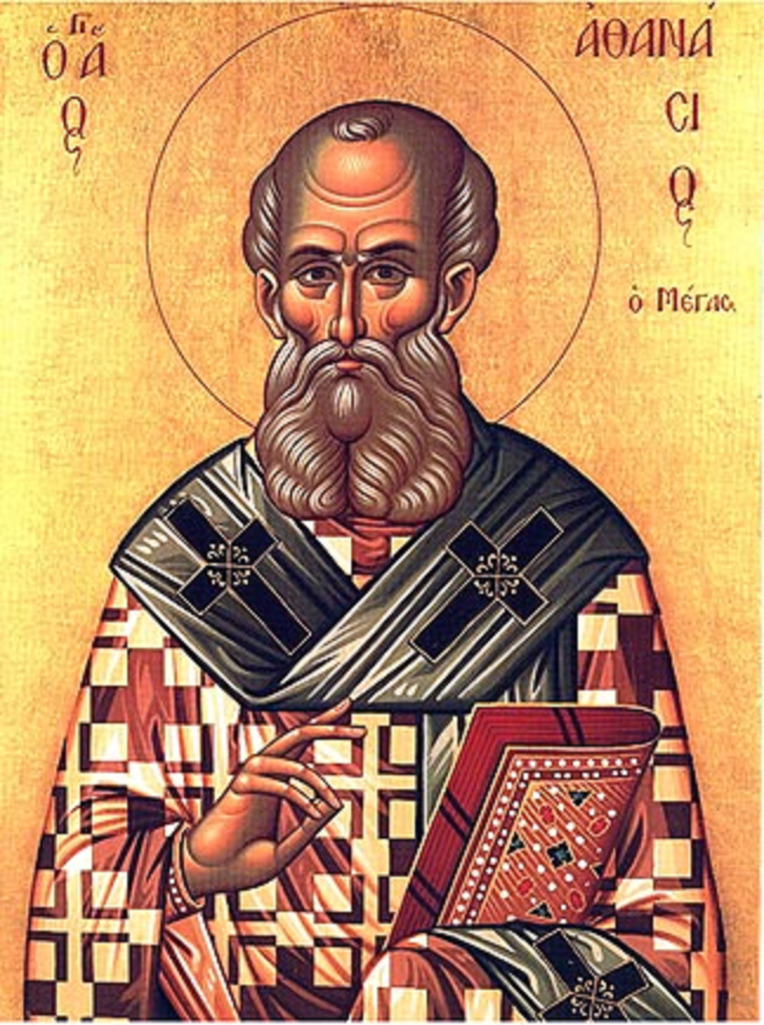
What would Athanasius do? I have no idea.
As a form of anarchism, Gary’s view implies that the State is illegitimate, and ought to be abolished and replaced by something better. Since we all live under States, however, and they exercise monopolistic control over us, the question arises exactly how to pull this off, or whether doing so is at all possible. The question gives rise to what I call the dilemma of political participation. Suppose that you accept Gary’s view for the reasons he gives. You conclude that the State is an immoral thing that ought to be abolished. Well, you live under the State, and that fact points in two different directions. As an immoral thing, you’d want, in the name of moral integrity, to steer clear of the State, if only to avoid complicity in its injustices. But as something you want to abolish, you’re forced, in the name of realizing your own convictions, to engage with it. You can’t do both, at least not in any obvious way. So what do you do?
If you engage, you face a problem of integrity. Unless you decide violently to overthrow the State (which Gary doesn’t advocate), you have to make your peace with it. But the more you do this, the more you’re likely to end up underwriting the State. If for instance, you participate in the State’s political processes or accept a job with the State and try to work within its parameters, you’re likely to be co-opted by it in ways that compromise your personal integrity and the integrity of your anarchist convictions.
If on the other hand, you refuse engagement, you face a problem of abdication. Ignoring the State won’t make it go away. Just the reverse: the more you ignore the State, the more of an opportunity you give it to infringe or violate your rights, or even to dispossess or destroy you. Unless you’re willing to accept the gamble and accept the price of losing, self-abdication won’t work.
There’s no obvious way to solve the problem here by combining engagement with disengagement, and no alternative to choosing between them. So, it seems to me, the dilemma is there and demands solution.
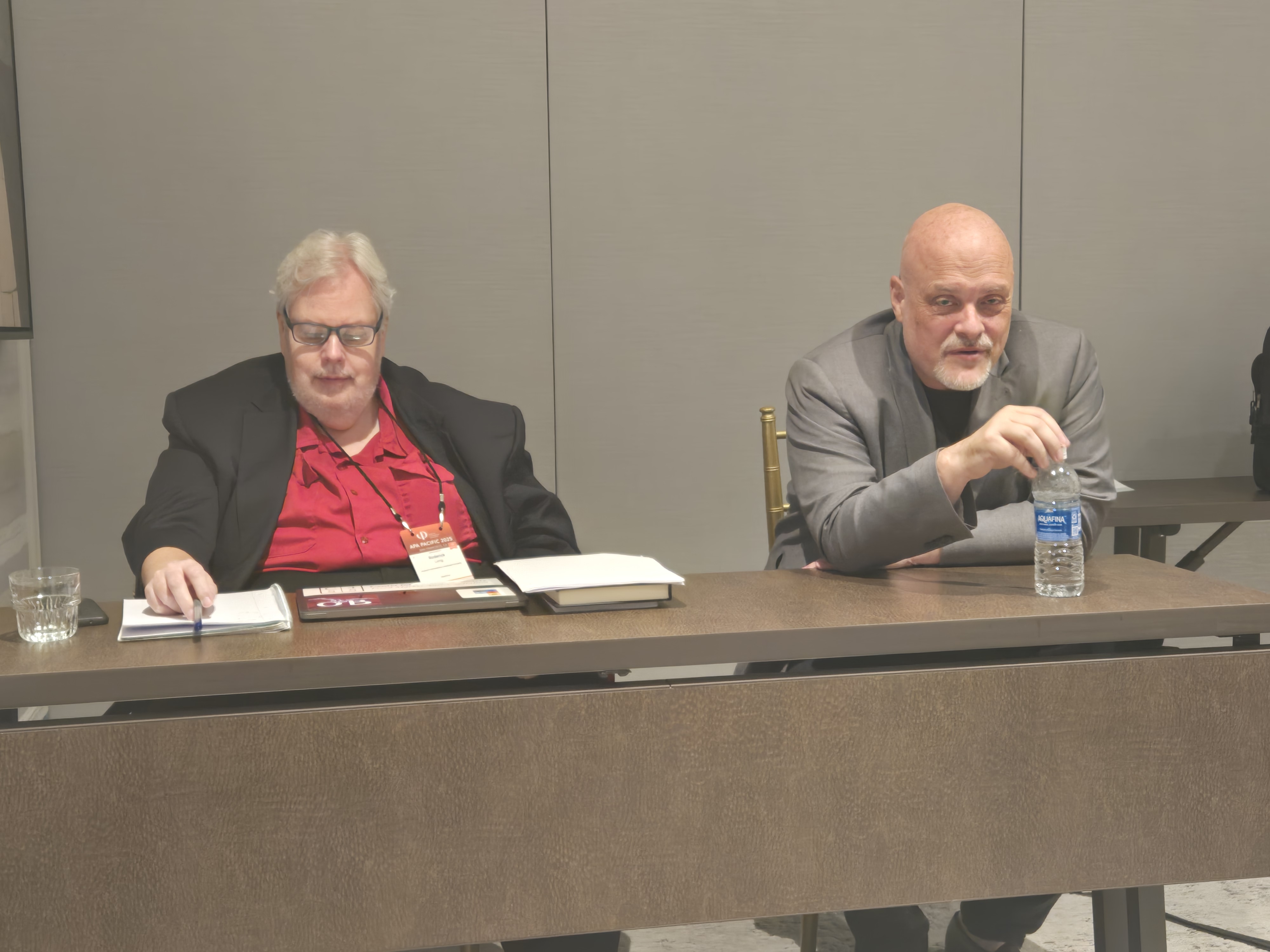
Roderick and Gary inconclusively pondering the dilemma. (photo credit: Kate Herrick)
Though I didn’t have time to get into it at the session, I actually had specific cases in mind when I came up with my engage/disengage options. Both arise from my personal experiences. I’ve worked on government contracts, and currently work within a corporate setting closely tied both to State-like bureaucratic processes and government itself. I’ve also been an activist who’s had to bargain with or confront government officials. The issue of co-optation has been an ever-present problem in both contexts, professional and activist, and one for which I see no clear solution. The very intractability of the problem makes it tempting to retreat to a place of apolitical solitude or isolation —a library, a park, a museum, the wilderness, bed—and wish the political world away. Unfortunately, wishing has never had the desired effects, so I’ve ultimately had to live the dilemma I’ve foisted on Gary.
I actually lived a bit of it on the San Francisco trip itself, opting to retreat from the political for as long as I could. Kate and I manage a bicoastal relationship—a concept that sometimes approaches the oxymoronic—and so, only spend a few weeks together across the span of the year. That became the rationale or excuse for a bit of abdication.
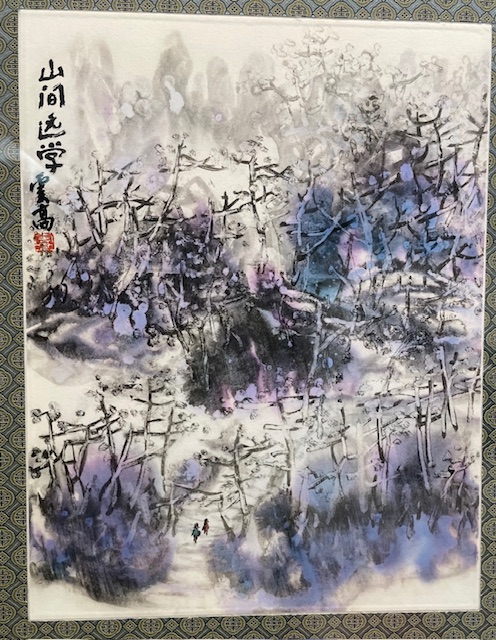
Nice, apolitical work of art, International Art Museum of America
Conference paper aside, then, we mostly decided to ditch the political for the week and have some fun. We visited a couple of art museums. We went out to dinner just about every night—Indian, Thai, Italian, Palestinian, Whole Foods, etc. We visited some friends in Los Gatos–The Cats–where we spent the day either plain old gossiping or else talking about Terrence Deacon’s philosophy of biology, a topic blissfully distant from politics. We took a ferry ride around the Bay. We strolled aimlessly around San Francisco, Oakland, and Alameda. I spent a day watching Kate teach a bunch of first-graders how to swim, which is what she does for a living. I gradually found myself seduced by the apolitical tranquility of it all–the weather, the Bay Area sights and sounds, the food, the amenities, and above all, the proximity of a cute chick. Surely there was some way to land a nice, tidy teaching or data analytic job nearby, abandon the travails of activism, and settle in to a normal, enjoyable West Coast life?
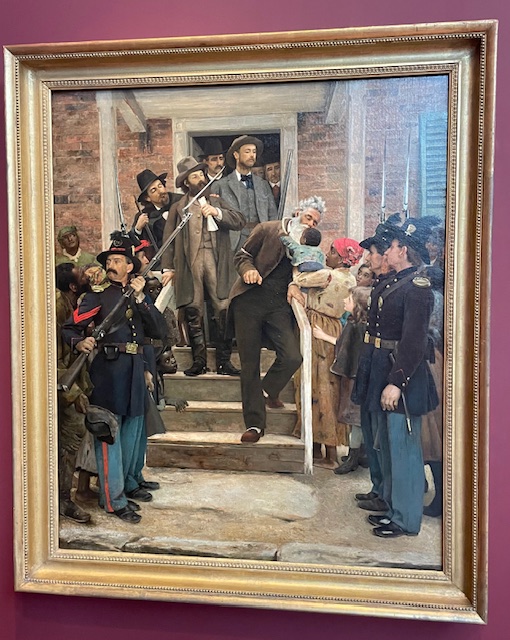
“Last Moments of John Brown,” Fine Arts Museum of San Francisco. No escape from wokeness!
You’d think so, but it wasn’t that easy to pull off, even for a single week. Politics ended up making subtle, subliminal inroads even here, cute chick notwithstanding. I spent 90 minutes on Zoom, attending a class on Machiavelli. The art museums went out of their way to be woke. Dinner one night was with a Palestinian friend of Kate’s who wanted the low-down on my Palestine activism. Our friends in Los Gatos noticed my keffiyeh and described their conversion over the previous year from pro- to anti-Israel.
For whatever it was worth, my keffiyeh (which I wore everywhere) attracted constant attention. One union guy with a “rat” outside the hotel (on strike during a labor dispute) gave me a thumbs up, yelling “Free Palestine!” A Palestinian woman in the Oakland Airport chased me down to tell me that the sight of my keffiyeh brought her to tears. Coming the other way around, every thought about the prospect of getting an academic job in the Bay Area was mediated by worries about whether, given my views, I’d be able to keep it. Would I wear my keffiyeh in class? Would I be allowed to? Would my BDS past (and present) follow me into the Dean’s Office? Would the Provost and President cave in at the first protests? What if the attempt to secure a quiet, tranquil life backfired?
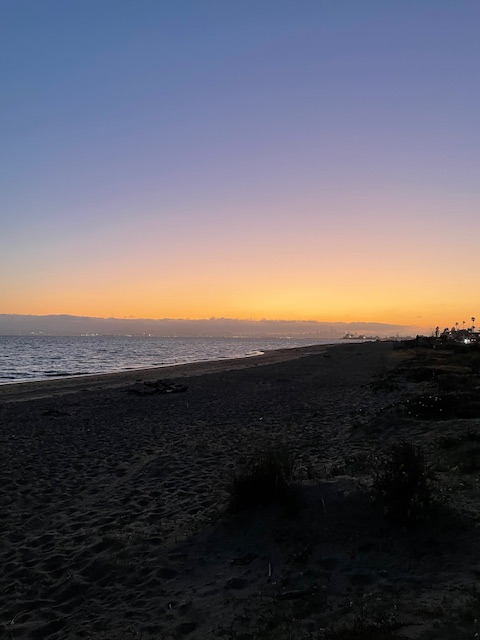
Backdrop to romantic walk along the beach, Alameda. We’d just spent the evening talking about Palestine, so naturally, it reminded me of Lake Tiberius.
That was April. Fast forward now to October. In late October, over 100 federal agents were sent to the Bay Area, staging at the US Coast Guard Base in Alameda for enforcement operations, just minutes from where I’d stayed with Kate. Reports then emerged in mid November of ICE operations in Oakland, followed by lockdowns at local schools. Defying the Bay Area stereotype, Alameda residents massed every day at the Coast Guard base, shouting their opposition to ICE. After a pause, the much-hyped enforcement action was canceled as abruptly as it had been declared.
Meanwhile, for months now, pro-Palestine protesters have gathered at the Port of Oakland to demand an end to military cargo shipments to Israel via the Port, invoking the Oakland dockworkers’ strike in the 1980s against apartheid South Africa as their precedent. Then as now, the Port Authority has served up legalistic arguments excusing their complicity in injustice. Then as now, the protesters have held their ground and taken the fight to the Port Authority’s Commission meetings. And there the matter stands.
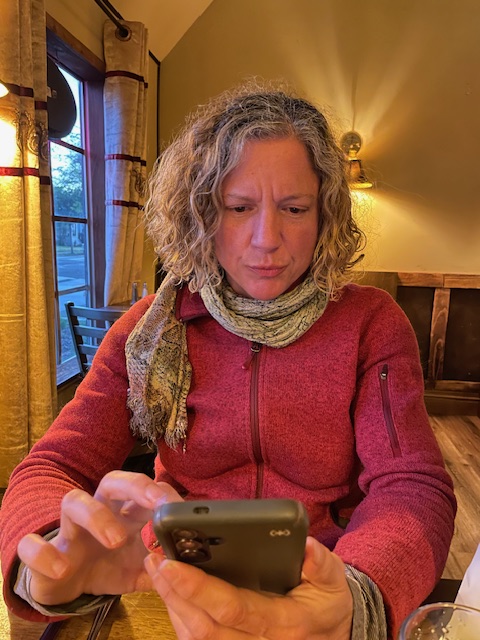
Cute girlfriend scrolling through phone as I mansplain the next topic
In other words, the political scene in the San Francisco Bay Area differs only in minor details from the one I’ve dealt with in Central Jersey. West Coast or East, ICE is out of control. West Coast or East, American arms manufacturers are facilitating a genocide with impunity. But anti-ICE and pro-Palestine activists have options and are using them, in some cases with success, in other cases with courage minus the promise of success. In either case, the idea of a quiet, apolitical life turns out to be as implausible a vision in Alameda as in Princeton. Disengagement is abdication, and abdication betokens its own loss of integrity. At a certain point, justice evaded becomes justice denied. The big questions are where and why. I hope to stir that pot a bit in 2026.
 Policy of Truth
“Roderick and Gary inconclusively pondering the dilemma.“
Oh, I assure you that I was pondering it conclusively. What Gary was doing I of course cannot say and will not venture to guess.
LikeLike
Come to think of it, you do have a conclusory look about you. What was the conclusion?
LikeLike
I don’t remember, but I’m sure it was brilliant.
LikeLike