In the five years since the Parkland shooting, I’ve read my fair share of books, reports, articles, and editorials regarding the charges made against Scot Peterson. Peterson, we’re told, was a coward, derelict in his duties, neglectful of the welfare of the children he was tasked with protecting, and, aside from Cruz himself, the fundamental cause of the carnage at Marjory Stoneman Douglas High School. Some of this material makes a valuable contribution in a narrowly limited way: it identifies facts relevant to reaching a verdict on Peterson’s actions. Read carefully, and taken cumulatively, I would say that at the very least, it exonerates Peterson of the criminal charges against him, and plausibly of all the others as well. But virtually none of it–literally none of the hundreds of pages I’ve read, the vast majority of the pages written on the subject–really drills down to ask the right questions, seek the right answers, or get the right answers. To read this literature is, for the most part, to drown in a sea of irrelevance. Continue reading
RESENTMENT, WRONGINGS, BEING REQUIRED NOT TO WRONG OTHERS (REPRISE, CORRECTION, CLARIFICATION)
(The following brings together themes from maybe half a dozen or more posts from the past two years or so, many associated with MTSP Zoom discussions of Thomas Scanlon’s *What We Owe to Each Other* and George Sher’s *Desert*. I do not claim consistency with prior posts. I hope this post constitutes progress in a kind of on-again off-again philosophical project. Interspersed Roman numerals indicate footnotes, text of which are below the main text.)
*****
I think this: it being appropriate for you to resent me for not telling you about the party constitutes my wronging you by not telling you about the party. (i, ii) Wrongings are different from moral wrongs. All wrongings are moral wrongs, but not all moral wrongs are wrongings. (iii) (Moral wrongs, on my telling, are actions that make observer-role indignation appropriate – and the main action that is like this is people wronging other people. Indignation is third-personal agent-directed anger, unlike resentment, which is second-personal agent-directed anger. (iv) )
So an action being a wronging (and likewise an action being morally wrong) is like a joke being funny or a person being admirable. For an item to have such a property is for it to have the (second-order) property of having some (first-order, probably descriptive) property or other that makes it appropriate to have some particular type of response in emotional attitude.
Coming from this framework, I want to ask and answer (at least schematically) two questions. First: what are the most general features of an action that make resentment appropriate (thereby constituting an action being a wronging)? Second: on this understanding of wrongings, why might we be required to refrain from wronging persons?
I Look at Life from Both Scythes Now
Kerouac, caffeinated:
I told Dean [= Neal Cassady] that when I was a kid and rode in cars I used to imagine I held a big scythe in my hand and cut down all the trees and posts and even sliced every hill that zoomed past the window. “Yes! Yes!” yelled Dean. “I used to do it too only different scythe – tell you why. Driving across the West with the long stretches my scythe had to be immeasurably longer and it had to curve over distant mountains, slicing off their tops, and reach another level to get at further mountains and at the same time clip off every post along the road, regular throbbing poles. …” (On the Road)
Kerouac, amphetaminated:
We were talking about the Great Scythes of our childhood, when I, riding in New England littleroads with boulders and posts and hills of vine all along, would, imaginary, cut it all down with my scythe as my father swept the car by; and he, Cody [= Neal Cassady], in the tragic red roads of Sunday afternoon in Eastern Colorado, when blackhatted men grimly drive the children, swept alongside the car either on foot or wielding from inside the car a gigantically and intricately built Scythe that not only snipped the close posts and sage or wheat but extended itself in a monstrous dream to horizon with all the massiveness of unbelievable realities like the Oakland Bay Bridge or the skeletal Swiftian frame of the Pentagon in Arlington, Virginia when they were raising the octagonal facewalls into place by longnecked celestial giraffe cranes, slow as the Bird of Paradisical Eternity raising the Great World Snake in its beak to the lost up, a scythe also so fantastic in its hinges that it could sweep over the flat plain, adjust itself to cut tablelands, rise a notch in the beyond and extend to horizons to cut mountain ranges entire while still managing in the little forefront blade to cut that bunchgrass into clouds of flying – We talked about this. (Visions of Cody)

Waking Up to “Woke Princeton”
If you do a Google search on the term “Woke Princeton,” you’ll find dozens of hits, in both the mainstream and conservative media, laboring to prove that Princeton University is a “woke” place dominated by “The Left.” So powerful is this dominance, it’s alleged, that Princeton’s beleagured conservatives are afraid to speak their minds on campus. The poor dears are obliged to creep their way through campus life, blending in with the ivy, habitually looking over their shoulders, fearful of cancellation or even physical assault, unable to exercise their rights of free speech, or to engage in authentic discussion of the contested issues of the day. Continue reading
The Parkland Trial (1): In Defense of Scot Peterson
Since 2018, I’ve written ten posts here questioning the mainstream narrative on the so-called Parkland shooting–that is, the shooting, by Nikolas Cruz, at Marjory Stoneman Douglas High School in Parkland, Florida on February 14, 2018.* The shooting left seventeen dead and seventeen injured. Cruz was arrested on the day of the shooting, charged with the murders, then tried and convicted, and eventually sentenced to life in prison. The shooting gave rise to a widely-publicized student movement in favor of gun control. Continue reading
Money Talks
Before I started working in health care revenue cycle management, I might have doubted my right to contest this bill. But I now know better, and hope to put others in the same position.

This is a bill for a fifteen minute telehealth session with a DO, a Doctor of Osteopathy. It doesn’t count the $30 co-pay I paid, or the payment for the prescription she wrote. And I’m not contesting the fee, contestable as it may be. What I’m contesting is Capital Health’s right to send me a bill at all, given that… Continue reading
All Normal on the American Front
Sometimes American foreign policy speaks for itself. From “Blinken to Talk to Saudis about Normalizing Ties with Israel,” The New York Times, June 6:
Secretary of State Antony J. Blinken said Monday that he planned to talk to Saudi leaders and other Gulf state officials this week during a visit to Saudi Arabia about the possibility of the kingdom normalizing ties with Israel. The Biden administration supports such a move, but it should not come at the expense of “progress between Israelis and Palestinians” and a two-state solution, he said.
“The United States has a real national security interest in promoting normalization between Israel and Saudi Arabia,” Mr. Blinken said at a conference of the American Israel Public Affairs Committee. “We believe we can and indeed we must play an integral role in advancing it. Now, we have no illusions that this can be done quickly or easily.”
Boxing Match
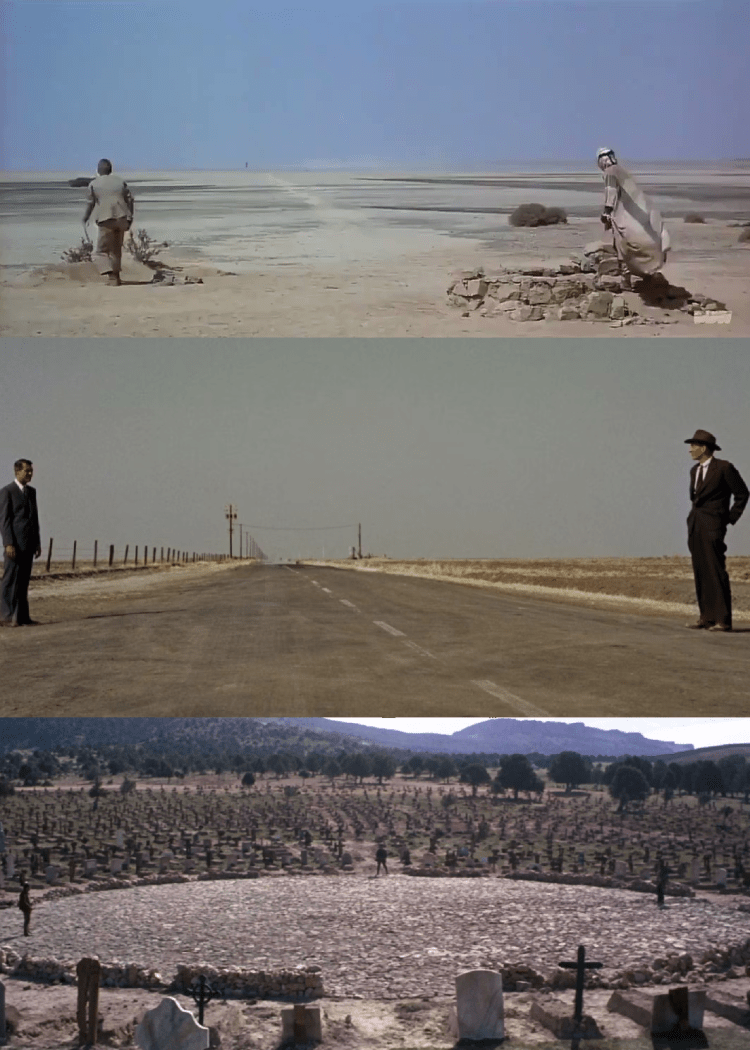
Back in the 90s there was a controversy, now happily long settled (and so perhaps unfamiliar to many of my younger readers), about “letterbox” versus “pan-and-scan” video formats. See, most movies by then were widescreen (and this had been so for decades), but television screens were still 4×3, which had been the dominant aspect ratio for theatrical movies when commercial television first became widespread – which meant that movies with a wider aspect ratio (which soon became the majority), when shown on television, either had to leave out whatever was happening at one or both sides if the screen, or else shift back and forth between them (the latter option being the origin of “pan and scan”), even if the original scene had been intended to be static. You can see how this mismatch between theatrical and televisual aspect ratios would ruin, for example, scenes like these three from Lawrence of Arabia, North by Northwest, and The Good, the Bad, and the Ugly, all of which could show one of the main characters in a scene only by completely eliminating another.
Greg Lukianoff on “Cancel Culture”
In a much quoted tweet, Greg Lukianoff, CEO of the Foundation for Individual Rights in Education (FIRE), has defined (“defined”) “cancel culture” as follows:
We define cancel culture as “the measurable uptick, since roughly 2014, of campaigns to get people fired, disinvited, deplatformed, or otherwise punished for speech that is — or *would be* — protected by the First Amendment.”
That’s from a tweet posted in 2022, but Lukianoff has repeated that “definition” many times since then. I’ve seen it in FIRE’s Facebook posts as recently as yesterday. Continue reading
John Davenport’s “The Democracy Amendments”
I’m very pleased to announce the publication, about two weeks ago, of PoT blogger John Davenport’s newest book, The Democracy Amendments: Constitutional Reforms to Save the United States (Anthem Press, 2023). I read and commented on the book in manuscript form, and thought it was spot-on. I agreed with virtually every one of John’s diagnoses and reforms; I only wonder how many of them will be taken seriously enough to be put in place, or even to find a place in public discussion. The book’s subtitle may seem hyperbolic, but isn’t: the United States really is a sinking ship, and it’s not an exaggeration to say that reforms like John’s are needed to keep it afloat. We probably need a lot more than that, but John’s reforms would be a good starting point.

 Policy of Truth