
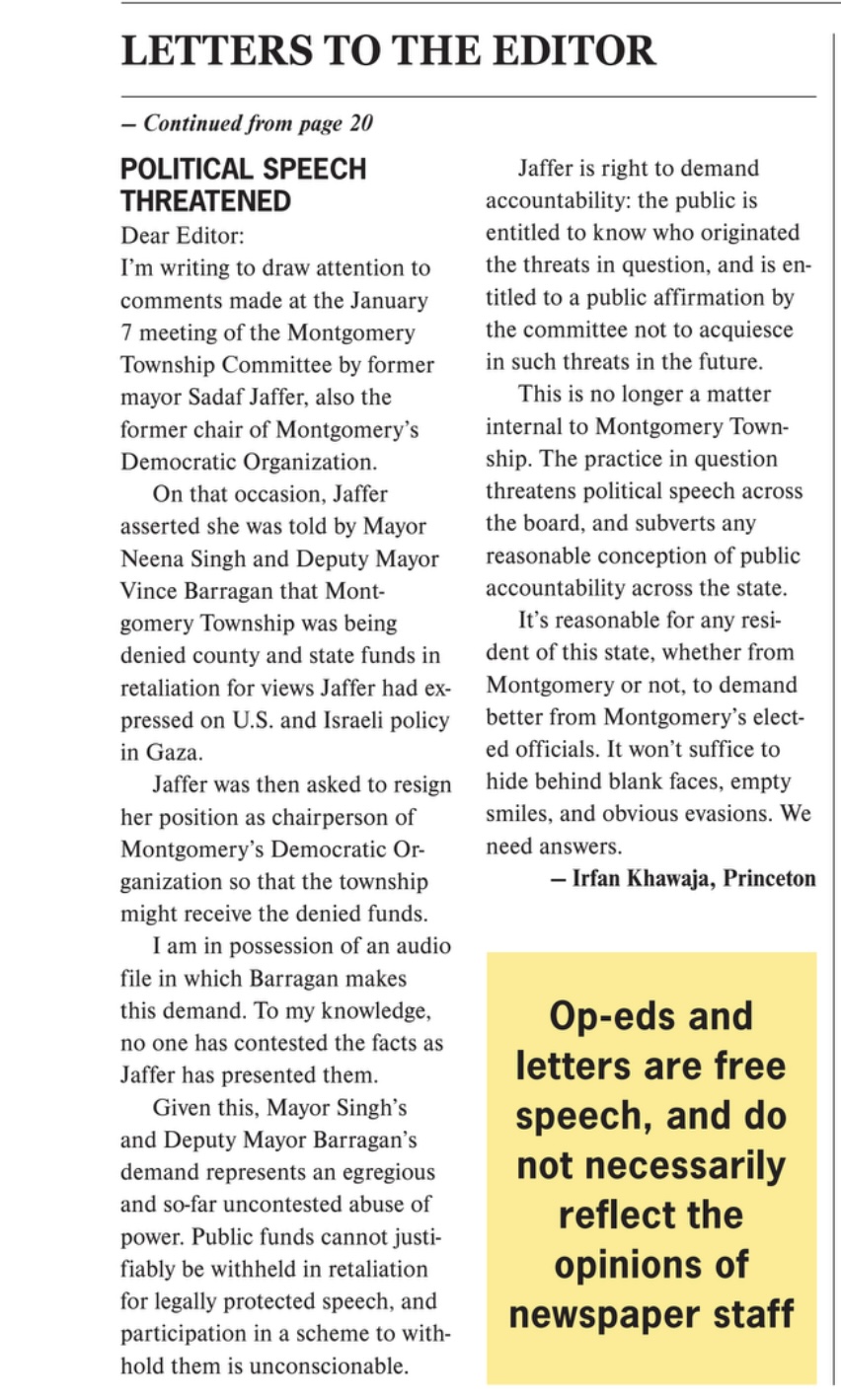
From the February edition. Click the right side thumbnail to enlarge it.
From the February edition. Click the right side thumbnail to enlarge it.
This is the statement I gave tonight on the issue of the kiosks at Princeton Council:
I’m here to speak about the replacement of the kiosks on Nassau St with electronic versions. I should say that I was unconvinced by the Council’s arguments for replacing the kiosks, and remain unconvinced, but my comment tonight is more query than statement.
In the debate over the kiosks back in 2024, Councilwoman Sacks was quoted in The Princeton Patch as saying: Continue reading
This is a letter to the editor of The Montgomery News–a monthly newspaper published in Montgomery, New Jersey–regarding the case of Sadaf Jaffer that was mentioned here a week ago. If printed, the letter will appear in the February issue. Ms Jaffer’s comment appears at minute 16:30 of this video.
Dear Editor:
I’m writing to draw attention to comments made at the January 7 meeting of the Montgomery Township Committee by former mayor Sadaf Jaffer, also the former chair of Montgomery’s Democratic Organization. Continue reading
This is a statement by Sadaf Jaffer, former Mayor of Montgomery Township, New Jersey, to the Montgomery Township Committee. I fully agree with her that “the public deserves clear answers and ethical leadership,” and urge others who agree to contact the Committee and make your views known. I’m pleased to say that Sadaf has agreed to be featured in a future edition of my Activist Interviews series, where I’m sure we’ll hear more about the backstory here. More soon.
Good evening. I am a former mayor of Montgomery Township, a former Assemblywoman, and a former chair of Montgomery’s Democratic Organization.
On multiple occasions over the past year, Mayor Neena Singh and Deputy Mayor Vince Barragan told me, and told others, that Montgomery Township was being denied county and state public funds because of my opposition to Israeli and U.S. policy in Gaza. Continue reading
Third Statement to Middlesex County Board of County Commissioners
75 Bayard St
New Brunswick, New Jersey
January 15, 2026
My name is Irfan Khawaja. I live in Princeton but work in Iselin. This is my third statement here on the matter of what was previously called the Immigrant Trust Act. As everyone knows, we’re in the home stretch toward passage of a version of the Act, but not there yet. To that end, I want to address some issues raised by the last meeting on that topic back on December 18. Continue reading
This is the first in an ongoing series of interviews I’ll be doing with a variety of activists and practitioners I’ve worked with or met over the years. Emanuelle Sippy was the head of Princeton University’s Alliance of Jewish Progressives during the Gaza Solidarity Encampment of the spring 2024, and both a forceful and articulate presence throughout. My interview with her was conducted May 4, 2025 at Terrace Club, Princeton University.
Q: You were brought up Jewish, the daughter of a Reform rabbi in Kentucky. What was that like? How would you describe the Jewish part of your upbringing, including your education? Continue reading
Politics and the Problematics of Fun
I started my “Stirring the POT” series earlier this year as a vehicle for announcements, but it gradually morphed into a series of ruminations on conferences I attended. The latter turned out to be the more interesting enterprise, so I’ll close out the year with a belated conference rumination. This past April, I went to San Francisco, at the invitation of Roderick Long and the Molinari Society, to be on an Author-Meets-Critics panel on Gary Chartier’s Christianity and the Nation State. It promised to be a good time, and it was. Continue reading
Coming Attractions in My Jihad Against Institutional Neutrality
Over the last year or so, I’ve written about two dozen posts here critiquing institutional neutrality, and given maybe a half dozen conference presentations on the subject. But in some ways, the criticisms I’ve made so far are peripheral to the fundamental problem with the doctrine. The fundamental problem is that it’s self-contradictory and self-subversive. This latter problem is so obvious, and so obviously fatal to the doctrine, that stating it threatens to trivialize the whole discussion about institutional neutrality: if the doctrine is self-contradictory, why discuss it? Good question. In any case, I might as well articulate the objection, if only to put it out there. Continue reading
Joshua Leifer’s “Conflictedly Connected” Liberal Zionist Center
The well-regarded left Zionist writer Joshua Leifer has a much fawned-over piece in Ha’aretz that’s been adopted in some quarters as the expression of profound wisdom. In it he argues that there’s a “conflictedly connected” Zionist quasi-left “majority” that’s been “drowned out” by the extremist voices of the “ultra-hawkish right” and the “anti-Zionist left.” If only this “conflictedly connected” majority could be liberated from the shackles placed on it by these twin extremists, the Golden Mean would prevail, and virtue would flourish on the topic of Israel and Palestine. Continue reading
“Viewpoint diversity” is the view that institutions of higher education ought to cultivate a wide range of perspectives on campus to ensure that inquiry on campus proceeds in an open and lively way. It may sound to some like a truism, but it’s meant as more than a truism. If taken in the latter way, it is by definition and intention a controversial doctrine. Continue reading
 Policy of Truth