You’ve got to love a country where the President commutes the death sentences of 37 death row inmates, is widely praised for it, makes a pious speech about why the other three have to get the shaft for “terrorism,” and then, without a pause, continues committing genocide abroad while winning adulation for that. The part of the country fixated on the first part of that sentence is incomprehensible to the part fixated on the second, and vice versa. The day when the second group becomes large enough to be a real worry to the first is the day that we’ll witness the beginning of the end of the United States of America in the name of something better. It’s only when you grasp that the second group unapologetically wants to hasten that day that you’ll understand what the dispute was about in the first place. But believe me, we do.
Category Archives: Fatwas
Secure Your Own Homeland
ICE showed up at my workplace today–or rather, ICE in the guise of DHS, “The Department of Homeland Security.” The agent flashed a badge and started asking about some people with Spanish names. Did I know anything about them? I had nothing to say.
The only thing I have for ICE or DHS–the only product I can promise–is wholehearted, undying hostility. I doubt they want to hear me talk about that. So there’s nothing to say. In any case, the Homeland they’re securing isn’t mine to worry about, and the land that I live in isn’t theirs to secure. Not a promising basis for a meeting of minds–the only kind that interests me.
I opened the door this time because I didn’t know who was ringing. Next time, as far as I’m concerned, they can stand there for as long as it takes to induce someone else to open the door. I’m not the doorman. So it won’t be me.
Pete Hegseth is (Half) Right
Everywhere one looks, commentators are aghast at Pete Hegseth, Donald Trump’s choice for Secretary of Defense. But as usual when it comes to defense matters, everyone is wasting their energies on the wrong questions. Hegseth has become notorious for his view that women should not play combat roles in the US military. This pointless red herring has now become the centerpiece of opposition to him. How could he believe such a thing? How could he say it? What kind of cretin rejects the universal belief that women should serve in combat roles in the US military? Continue reading
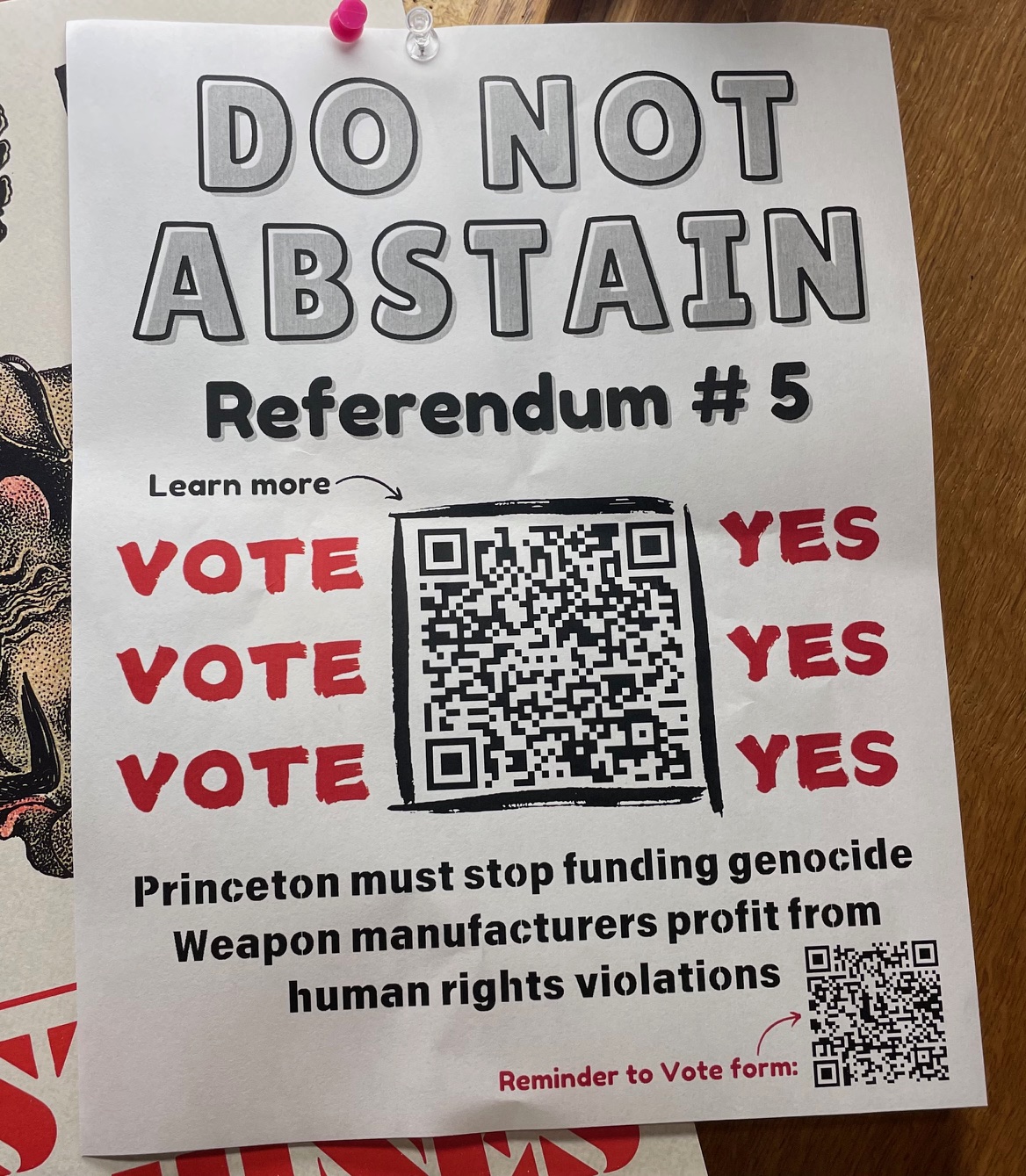
Princeton University USG Referendum Question #5: Divest
Referendum Question #5 of Princeton University’s forthcoming Undergraduate Student Government elections. Scroll down (you may have to click “download”) for a PDF with the wording of the referendum. Kudos to these students for the work they’ve done on this. If only I could vote on it, but I’m 33 years too late.
A Vote for Harris is a Vote for Genocide
For the last year, Kamala Harris’s more aggressive defenders have wielded a particular rhetorical weapon against Jill Stein voters like me: A vote for Stein is a vote for Trump. I’m a little late to the party in saying this, but there’s an obvious retort to them worth repeating ad nauseam: A vote for Harris is a vote for genocide. Call it Stein’s Maxim.
Stein’s Maxim retort has two advantages over theirs. For one, it hits a lot harder. For another, unlike theirs, it’s true.
Taken at face value, “A vote for Stein is a vote for Trump” is flat-out nonsense. A vote for X is a vote for X, not for someone else on the ballot. If I vote for X, and you accuse me of voting for Y, the obvious objection arises: if I had wanted Y to win, I could have voted directly for Y, yet I didn’t. So how could my voting for X be a vote for Y? It obviously can’t be an intended vote for Y. The only intended vote for Y is an actual vote for Y. Continue reading
صُمٌّ بُكْمٌ عُمْيٌ فَهُمْ لَا يَرْجِعُونَ
It’s sad that it takes a murtad to detect a kaffir, but here we are. Consider this post a fatwa for takfir–my second one aimed at this ludicrous individual. Any faith community that would own such a person deserves him. But a faith community that fails to repudiate him comes close to owning him by default.
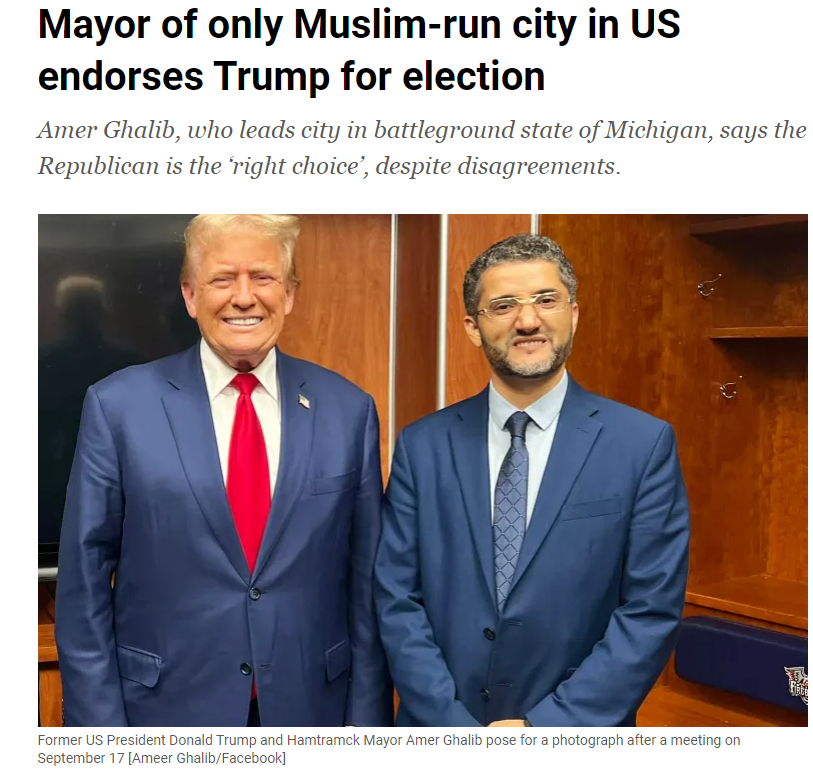

Bad enough to be a homophobe, but this is a person who prioritizes gay bashing over Gaza. There’s a separate post to be written on the problem of homophobia in the Islamic world, but I’ll save that for another day. Not much needs to be said here. Either you get it, or you don’t.
Continue readingNo One is to Advocate Anything Until I Blow This Whistle
The New York Times has a click-baitish headline about Hamas on the front page, except that unlike most click-bait headlines, this one happens both to be click-bait and true.
“Pro-Palestinian Group at Columbia Now Backs ‘Armed Resistance’ by Hamas”
It’s true. They do. Of course, at this point, a headline like that is a bit like one ca. 1943 that said:
“Pro-Jewish Group at Columbia Now Backs ‘Armed Resistance’ by Stalin’s Red Army”
Or, how about, ca. 1944: Continue reading
“Sick of the Bullshit”
It’s ordinarily a violation of the ethics of discourse to use the question-and-answer period of a talk to make a speech rather than ask a bona fide question. A question is a request for information. A request can, as a condition of its intelligibility, require a brief clarification or bit of context-setting, but there’s a difference between that and a speech.
However, most norms, no matter how stringent, have exceptions. What if, day after day–hundreds or thousands of times across a solid year–the spokesperson for a person in authority engages questioners in egregious, obvious bad faith? What if, day after day, he tells smirking lies about life and death matters, makes up random bullshit at will, and evades the meaning of obvious questions in order to serve up whole stinking, decaying schools of red herrings? What if his bosses are concealing complicity in mass murder, and are about to lead the country into an insane, ill-conceived war (the second one in the last few years), not just on behalf of their own country, but on behalf of a foreign country? Continue reading
Hell Is Empty and All the Administrators Are Here
Cass Sunstein has a Guest Essay in today’s New York Times that argues that the First Amendment is the key to the norms that govern free speech on campus: “Only the First Amendment Can Protect Students, Campuses, and Speech.” His point is that universities should either adhere to First Amendment jurisprudence or legislate and enforce some functional equivalent of it. The First Amendment is (on this reading) supposed to be a content-neutral protector of free speech, with exceptions that Sunstein duly enumerates in the latter half of the essay.
Some of what he says seems fine, and some of it seems wrongheaded, but I was struck by the insouciant sloppiness of this particular sentence:
In a class on Shakespeare, students and professors can be instructed by administrators to discuss Shakespeare, not the presidential election.
No, they can’t. That’s not how academic freedom works, not how Shakespeare works, and not how pedagogy works. Continue reading
Stand Up and Shout
The New York Times, making its journalistic contribution to the national circle jerk over Kamala Harris:
When protesters first interrupted Vice President Kamala Harris at a rally in Detroit on Wednesday evening, she smiled, with a gentle corrective. “I am speaking now.”
But as the disruption continued, her patience ran thin. “You know what?” Ms. Harris said, with the sudden force and resolve of a parent in the driver’s seat who has had it. “If you want Donald Trump to win, then say that. Otherwise, I’m speaking.”
As the crowd roared, Ms. Harris stayed silent, jaw set, eyes fixed.
We’ve listened to these people in respectful silence for long enough. We no longer owe criminals like Kamala Harris, Joe Biden, Donald Trump, or JD Vance any duty of civility, respect, or obeisance. We owe ourselves the self-respect that comes from active resistance to the evil they represent. Continue reading
 Policy of Truth