Scenes from Delaney Hall (5)
It’s a serious mistake to rely exclusively on the mainstream media for news of what’s happening at Delaney Hall. If you’re doing this, you’re being misled by omission: you’re systematically depriving yourself of information that’s relevant to getting a balanced picture of what’s happening there, or for passing a verdict on it.
To illustrate this, I want to work through a representative example of mainstream journalism, a June 4 article on Delaney Hall in The New York Times. My aim here is not to find fault with the author, or to condemn the article, but simply to point out as a matter of objective fact that whether fault is involved or not, the article systematically misleads the reader to the detriment of the protesters. It fails to supply necessary background context, fails to ask the right questions, fails to answer them, and misses salient points of detail. Again, my point is not primarily that the author should have included this or that, but simply that given what he excludes, he misleads, full stop. Why this is the case is a separate question. How it’s to be remedied, or whether it can be remedied within mainstream media at all, is also a separate question.
The title of the article is: “Rioting, Assault, Violating Curfew: The Charges ICE Protesters Face.” In some ways, the title is unobjectionable: it concisely identifies the topic that the author intends to discuss. The article tells us that as of June 4, about 90 protesters had been arrested on these charges, and proceeds to describe the status of the charges. Some of the information given redounds pretty obviously to the credit of the protesters, or at least the discredit of law enforcement, so it’s not as though the reporter is going out of his way to hide exculpatory evidence.
Notice, however, that in focusing on the charges against the protesters, the focus is on the misdeeds of the protesters. Because the charges against the protesters are the only charges around, the article seems to imply by default that the protesters are the ones obliged to answer for the violence that took place at Delaney Hall. Precisely because no one is in a position to bring charges against law enforcement, there’s no easy way of writing a comparable piece describing systematic rights violations against the protesters. The reason why you can’t write an article called “Police Brutality: The Charges Law Enforcement Faces,” is that whether they commit brutality or not, law enforcement enjoys qualified legal immunity from prosecution, and so, can’t face charges as readily as anyone else.
There’s more to it than that. The police control access to the scene in a way that protesters do not. Antagonize them, and you limit your own access. Beyond that, the task of reporting on police violence is just harder than reporting on criminal charges. Criminal charges are made in a formal way by the police. But to consider charges against law enforcement, you have to spend hours trawling through social media. That takes time that a reporter on deadline won’t have. So it’s understandable that the article ends up mentioning police malfeasance but not police violence; the focus is on protester violence, plus some exculpatory evidence. This leaves the impression that both sides were somewhat in the wrong. But it implies without ever arguing for it or proving it (or saying it) that the protesters are the ones who bear the burden of explanatory proof. It’s up to them to explain what happened.
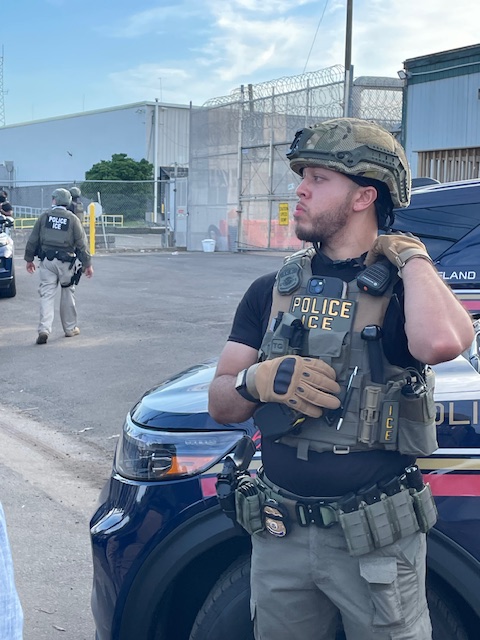
Surveying the crowd, Delaney Hall, May 27, 2026
Here’s the first paragraph of the article:
Over the course of two tense weeks outside the Delaney Hall immigration detention facility in Newark, protesters have periodically clashed with federal agents and New Jersey state troopers, and dozens of people have been arrested.
Strictly speaking, the verb “clash” denotes a symmetric relation: if X is clashing with Y, then Y is clashing with X. That seems neutral enough, but in ordinary English, we typically assume that the prior named party in a clash is either the initiator of the clash or the party most responsible for it. The phrase “protesters have periodically clashed…” then seems to suggest that the protesters either started the clashes or did the most of the clashing. The impression given is that every now and then, the protesters initiate a new clash, so that law enforcement is forced to respond to them. This suggests without argument that the protesters are the primary aggressors.
No evidence whatsoever is given for this claim, and no mention is made of the fact that it’s the exact opposite of what the protesters are saying. On the protesters’ account, law enforcement is clashing with them. On their view, law enforcement periodically attacks them; they’re the ones forced to respond, and when they do, they’re arrested as though they were the aggressors. It’s worth noting that at least obliquely, Mayor Baraka has come close to agreeing with this view. He hasn’t accused his police department of aggressing against the protesters per se. He issued a statement on June 8 with respect to events on June 7 saying that he was encouraged by an internal police investigation that seemed to show “that some of our officers were over aggressive and should be held accountable. It is imperative that all of our officers uphold the standards of professionalism and accountability under the consent decree.” (Thanks to Lisa Davis for drawing this statement to my attention.)
Obviously, I don’t mean to suggest that the author of an article published on June 4 should have reported the statements given by the mayor on June 8. I mean that if the mayor is implicitly accusing his own police department of using excessive force and possibly violating Newark’s consent decree with the federal government, it becomes plausible to believe the protesters’ claims that the police (and law enforcement generally) had been aggressing all along. I don’t propose to settle this issue right now. For examples of it, go to skeezix10, communalpress, radiojornaleranj, and weaponofmassproduction, all on Instagram. My point is simply that this article gives no indication there was a dispute out there requiring adjudication.
It’s of course possible that both things are true: it could be that sometimes the protesters initiate clashes, and sometimes law enforcement does. But the article doesn’t say that.
But there’s a deeper issue of context here, one I’ve tried to capture before in a somewhat whimsical dialogue on force I wrote five years ago, called “Missing the Battle for the Bullets.” Force is being initiated along two very different dimensions here: the micro and the macro. The micro violence is all taking place on Doremus Avenue, near Delaney Hall or in it. But the violence taking place there is an instance of macro-level violence taking place across the entire country. The violence taking place in and around Delaney Hall is not self-generated. It’s directed from Washington and part of a system. So the question of who is initiating force is in part a systemic matter: what system is initiating it?
It’s obvious that the only system that fits this description is the misnamed Department of Homeland Security (DHS). Neither the protesters nor the migrants can plausibly or even conceivably be accused, at a systemic level, of initiating force against anyone. Only DHS can. What is systematically omitted from the Times article is precisely the systemic level of analysis: it’s law enforcement and not the protesters or migrants who are part of a system that proposes to deport millions of people–one million per year–from the United States. That’s more than a mere “clash.” It’s a systematic commitment to state-sponsored mass expulsion facing down concerted popular resistance to the expulsion.
The article’s author may not like that phrasing. His editors may wish to avoid it. Perhaps it sounds excessively partisan or revolutionary or radical to them. But that doesn’t really matter. Their preferences on this count are irrelevant. It really is an objective fact that DHS is initiating force on a grand scale, and that neither the protesters nor the migrants either are or can initiate force on that scale.
What we’re facing, then, is an ethnic cleansing plus scattered popular resistance to it. When you report on an ethnic cleansing, you really have to face the fact that that’s what you’re reporting on. It doesn’t really matter that in all of your years reporting on Jersey, you’ve never seen an ethnic cleansing happen here before. If you were reporting California in 1942, you couldn’t claim that the internment of the Japanese-Americans to concentration camps wasn’t one because it had never happened before. So you can’t objectively say that what you’re facing right now isn’t an ethnic cleansing because such things only happen abroad, and never here. For one thing, we’ve had ethnic cleansings here. For another, there’s always a first time. The first time I was in a serious traffic accident, I was fully convinced I wouldn’t die because I’d never died before. I happened to be right, but “it can’t be happening, because it’s never happened before” is not a reliable route to truth. It’s material for a comedy skit, not the right method for reporting on a historic event.
To belabor the obvious, an ethnic cleansing can’t be reduced to a “clash” between two parties on Doremus Avenue, any more than World War I could have been reduced to a quarrel between Archbishop Ferdinand and Gavril Princeps. To do that is to distort reality, not to report it. And that’s what’s happened here.
It doesn’t matter, by the way, that DHS may happen to have the law on its side (to whatever extent it does). All ethnic cleansings are ultimately legalized by those engaged in them. The Trail of Tears wasn’t illegal. Andrew Jackson made sure of that. What matters is the degree and type of force involved against innocent parties, not the blackletter of the law.
People like to fixate on the worst excesses of the protesters, but to do this is to invert moral and epistemic priorities. If you added up every protester malfeasance since January 2025, the sum wouldn’t begin to compare with the force that DHS has used and proposes to use against the residents of this country. Whatever your evaluation of this fact, it can’t be ignored or dismissed.
There’s a lot of loose talk in right-wing circles about “paid protesters” and “organized chaos,” and “ringleaders” and the like. Such accusations are more confession or projection than anything else. No protester has ever proposed attacking a million ICE agents this year. But that is DHS’s stated goal for this year and every year following it into the indefinite future (see this as well). On no day in 2025 or 2026 have protesters attacked, much less deported, 1,200 DHS agents. Yet that is the average number of expulsions per day made by DHS. It’s now a respected view in moral and political philosophy that deportations, whether legal or not, are simply wrong (see for instance, 1, 2, 3, 4). But then DHS is morally responsible for profound wrongs on a mass scale. The Cato Institute’s David Bier has argued that legal immigration is nearly impossible. If something is “nearly impossible,” it’s not a reasonable expectation to make of anyone. Yet that is the expectation that DHS brags about imposing on the entire population, and uses as the basis for mass expulsion and family dissolution.
If you look closely at the views of those attacking the protests and the migrants, what it reduces to is the view that the protesters deserve no respect because the migrants themselves have no rights worth respecting. Machiavelli says that every regime returns to its founding event to revive its actuating principles (Discourses on Livy, III.1). The founding event of the regime sought by defenders of DHS’s deportation policies is the Dred Scot decision. Migrants, on this view, were never intended to be citizens because they are beings of an inferior order unfit to associate with us, fit only for expulsion.
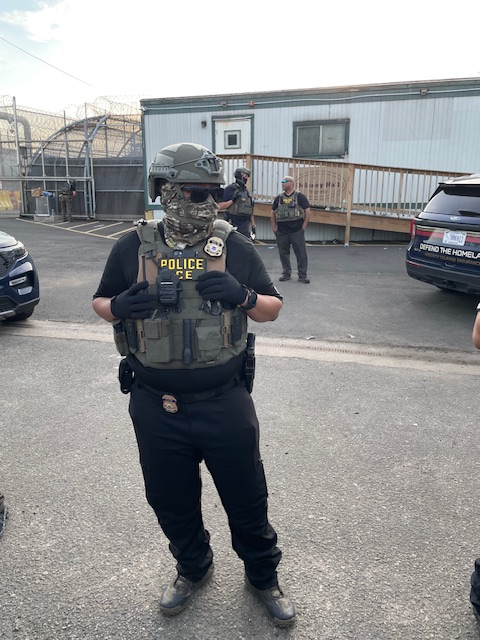
Agent Inscrutable on the case, Delaney Hall, May 27, 2026
My point is not so much that every article should mention all of these facts as that no reader should forget them. Pointillistic discussions of events on Doremus Avenue constrict our awareness and push necessary context into the background. But there’s no way to make sense of what’s happening there if you drop this context. If you fixate at random on this or that event that took place in Selma, Birmingham, or Jackson during the civil rights movement, or Johannesburg under apartheid, or Jenin under the Israeli occupation, you might well get lost in the welter of claims and counter-claims about who shot first and who threw a given rock, or whether a given bullet came before or after the throwing of a given Molotov cocktail. But the larger point is who is responsible for the fundamental injustice involved. And it’s very difficult to see how the Delaney Hall protesters could even conceivably fit that description. I invite anyone to try.
Skipping a paragraph:
Most of the arrests happened on Sunday after protesters violated a 9 p.m. curfew, which Newark’s mayor had declared after a fire was set on a roadway outside the facility.
Nowhere are we told what this “curfew” involved. As I’ve said in a separate post, the “curfew” was really a checkpoint that forced protesters at all hours to keep about a half mile’s distance from Delaney Hall. It is misleading to call this a “curfew” at all. A curfew is a regulation that demands that people be off the streets at a certain time. A checkpoint prohibits or regulates passage at all times of its operation. What was in operation was a checkpoint falsely masquerading as a curfew.
Also omitted is the legal basis of this “curfew,” and of the fact that no officer at the scene was able to cite it.
Skipping a few paragraphs:
Seventeen people arrested by Immigration and Customs Enforcement agents from May 26 through May 29 were charged with assaulting and impeding federal officers, including by punching, kicking and biting them, according to the Department of Homeland Security, ICE’s parent agency.
Though I can’t fault the author for this, it’s worth noting that this passage doesn’t tell us anything about the circumstances in which these officers were punched, kicked, or bitten, assuming they were. The reader might want to ask a prior question here: are there any circumstances in which it might be justified to do any of these things? The answer to that question depends on a yet prior question: do human beings have a right of self-defense even against law enforcement officers engaged in law enforcement? One possible answer, defended throughout the ages, is yes. If so, then if law enforcement’s actions amount to plain old criminality, it would be entirely justified to punch, kick, bite or even kill law enforcement officers.
I don’t mean to imply that the author is required to settle all of these issues in one news article. I mean that a reader who fails to clarify these issues in her own mind will be misled, and for whatever it’s worth, no mainstream reporter feels the need to supply the relevant background context. If we have a right of self-defense against wayward officers, then there obviously are circumstances in which we can resist them. Since they have weapons, and protesters generally don’t, resistance will mostly be restricted to punching, kicking, and biting.
Given this, to be told that protesters are charged with punching, kicking, and biting officers is uninformative. For one thing, the charge may be false. But even to the extent it’s true, unless we know the prior circumstances, we know nothing of importance. What has yet to be fully internalized in mainstream discourse (and journalism) is the fact that law enforcement officers are people, and when people aggress against the innocent, they forfeit any claim of protection against retaliatory violence. I’m fully aware that the law is more restrictive than this. But the law is not the only relevant consideration. The relevant consideration is the right of self-defense, a right whose contours we are capable of understanding in abstraction from law. (For a book length defense of this claim, see Jason Brennan’s When All Else Fails: The Ethics of Resistance to State Injustice.)
The issue is somewhat clouded by the mantra that protesters are obliged to accept the penalty for civil disobedience. But two things are worth mentioning here. One is that this mantra is more dogma than argued claim. Not everybody agrees with it. The second issue is that the mantra is highly indeterminate. The standard view is that a protester is obliged to accept the punishment for civil disobedience. But police activity in the field is not judicial punishment, so the mantra, whatever its status, has no application to it. It’s remarkable how little discussion there’s been on the degree to which protesters engaged in civil disobedience are permitted to resist law enforcement violence in the field, or even engage in defensive measures against it short of active resistance. If an officer aims a baton at the most sensitive part of your body, are you obliged to receive the full force of the blow without any attempt at shielding yourself?
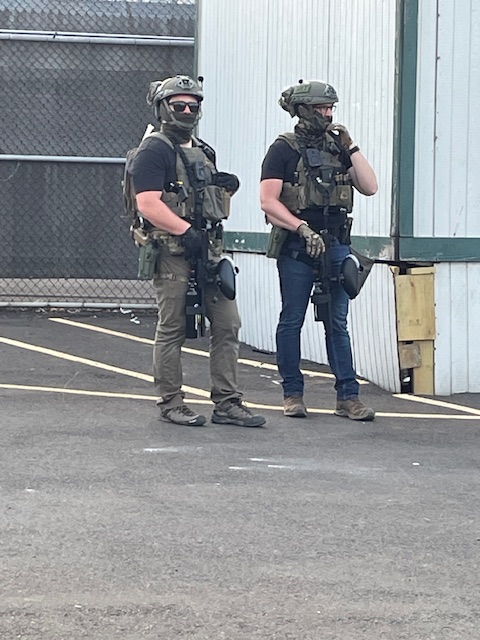
Locked, loaded, and labile: Delaney Hall’s finest, May 27, 2026
Listening to some savants, you’d get the impression that the answer is yes. But I have yet to see a semi-plausible argument for that claim; it strikes me as prima facie absurd. As we all remember, during the Childrens’ Crusade in Birmingham in May 1963, fire hoses were turned on protesters who happened to be protesting near a park, Kelly Ingram Park. Some of the protesters evaded the spray by hiding behind nearby trees. Should they have come out and faced the spray without regard to the bodily consequences? Should they have gotten extra punishment for hiding behind trees? I’d like to think that the answers are self-evident, but a minimum I think we can say that they’re contested.
Just to be totally clear: as someone who thinks that there are circumstances in which law enforcement officers can justifiably be killed, I am more than amenable to kicking, punching, and biting them when circumstances call for it. And having been to Delaney Hall and spent a fair bit of time poring over videos of events there, I think it’s more than an open question how law enforcement violence ought to be handled. Suffice it to say that if killing us is on the table, so is killing them.
I quote these next paragraphs, not because I dispute them, but because they drive home a point worth reflection:
Ben Van Meter, a lawyer for the public defender’s office, said that of the dozens of complaints he had examined, all had only boilerplate language listing the offenses said to be committed by the crowd collectively, without offering detail on what any individual is accused of doing. He said this left the cases against the protesters weak.
“The police have not made out the barest minimum of probable cause,” which requires listing both the specific behavior that constitutes an offense and evidence that the person charged was the one who committed it, Mr. Van Meter said. On Friday, the office moved to dismiss the charges against 45 of the people who were arrested Sunday night.
Skipping a paragraph:
The head of the public defender’s office, Jennifer Sellitti, said the people arrested on Sunday were held at the Essex County Correctional Facility for more than 24 hours, because the Newark police were slow to process them. Typically, she said, people charged with similar offenses are just issued a summons immediately and released. Those arrested on Sunday were given summonses and released on Monday night.
It can’t be an accident that the police “have not made out the barest minimum of probable cause” and then “were slow to process” the cases. The most plausible reading is that both things were deliberate. Consider what this means. At a time when the entire nation’s attention is riveted on Delaney Hall, when the Governor of New Jersey and Mayor of Newark (and many others) are professing support for the protesters’ cause, the police went out of their way to flip the bird at everyone. Neither the Governor nor her Attorney General nor the Mayor can afford to admit this, but the hard truth stares us in the face: the police are not in their control. It’s not clear they’re in anyone’s control. People describe the protesters as chaotic, but the facts suggest that it is law enforcement and not the protesters that are out of control. Mikie Sherrill, Jen Davenport, and Ras Baraka could all have temper tantrums in unison about police conduct, but the fact remains: they can’t control what the police actually do on Doremus Avenue.
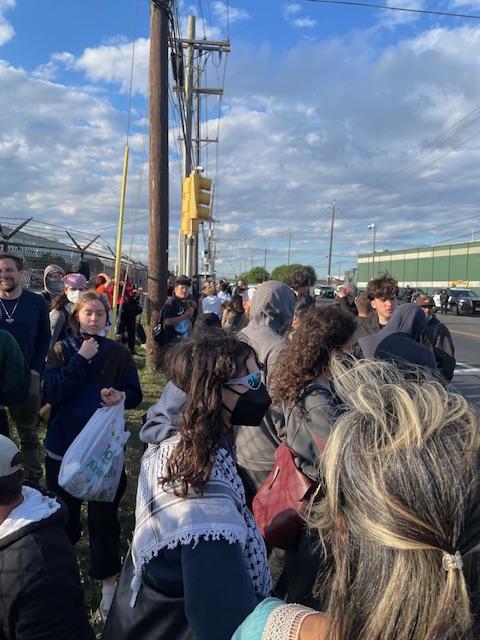
“You got plenty of room there!” Police officer characterization of this scene. Wilson/Doremus checkpoint, June 1, 2026
Permit me a digression. In 2020, I had an altercation with the Police Department in Washington Township, New Jersey. I happened at the time to know the then-Attorney General, Gurbir Grewal, who referred me in turn to Davenport, who took charge of my “case.” I don’t mean this as a criticism of either of them, but what struck me about Davenport’s intervention is how little it ended up accomplishing. She intervened in a conscientious, diligent way, but the police ended up doing what they wanted to, and I couldn’t rightly go back to her every time I felt unfairly dealt with by them. It could be that Davenport simply didn’t take my grievance seriously, and so, blew me off. But what occurred to me is that even if she had taken it with utmost seriousness, there was little she could or would do about it. The case didn’t matter enough to rise to the top (or anywhere near the top) of her agenda. Since it didn’t, there was just a presumption that whatever the cops wanted to do, they would do, and that was that.
So it is here. The more unruly protesters simply don’t matter much, politically speaking. If some of them are put in the hospital, most people will take for granted that that’s what happens to crazy people who “break the law.” This is why, if you go on right-wing sites, what you see are serial attempts to describe the protesters as “nut cases.” Like the migrants themselves, the protesters have to be dehumanized in order to be dealt with. The police unions, by contrast, do matter. Every other day, the police unions are sending missives to Trenton or Washington, begging for a free hand to crack some heads, just as they did in the Deep South ca. 1964 or Newark ca. 1967. Plus ca change, plus c’est la meme chose. So it’s politically naive to think that Sherrill, Davenport, or even Baraka are going to trouble themselves about the fine details of justice on Doremus Avenue. (It pains me to put Baraka in that sentence, but I think I have to.)
That means: either we get the facts right, or the facts fall through the cracks of history, potentially to be lost forever. People forget that there are disputes to this day about even the most apparently settled parts of the history of the civil rights movement. Even a history as magisterial and fine grained as Taylor Branch’s trilogy leaves a lot out. And people forget that the failure to settle the facts conclusively sometimes has unintended consequences. When I first started work on the 9/11 celebration rumors back in 2001 (1, 2, 3, 4), no one could possibly have predicted that those rumors would lead to the election, in the 2015-16 presidential campaign, of Donald Trump. But that’s what happened.
Next paragraph:
“Nobody should have been held for so long and just released on a summons,” Ms. Sellitti said. “That was unnecessary and really not something that happens very often.”
The Newark police did not immediately respond to a request for comment.
Let’s hope that they get a follow up.
Next few paragraphs:
New Jersey’s Democratic governor, Mikie Sherrill, joined protesters on Memorial Day after she said she was denied access to the center to see the conditions the detainees were being held in. “No matter what your immigration status is, you shouldn’t be treated with anything less than dignity in this country,” she said.
But after protesters threw objects, set fires and scuffled with the state police and the Newark police on Saturday, Ms. Sherrill called for calm. “Violent, chaotic clashes hurt everyone,” she said, adding that clashes “put the lives of both protesters and law enforcement in danger, they take the focus away from people inside Delaney Hall and their families, and they raise the temperature with ICE.”
The first sentence of the second paragraph seems to imply that calm was the default setting of the scene. Then, “protesters threw objects, set fires and scuffled.” In fact, no default setting has been established here at all. It could be that the protesters’ actions broke a prior peace, or that it was a response to prior aggression. The reporter’s formulation leaves both options open without settling between them. I would add that to the best of my knowledge, only one fire was set: a tire or tires were set on fire in the middle of Doremus Avenue. No structures were set alight, and no one seems to have been injured by the fire. I’m not making excuses for the fire-setting; I actually think it was a very bad idea. But there is a difference between “protesters…set fires” and “someone lit a tire on fire in the middle of Doremus Avenue.”
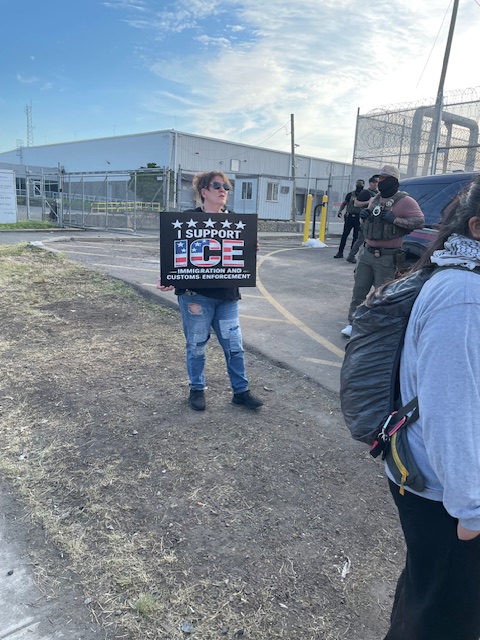
There’s always one, isn’t there? May 27, 2026
I should add, coming the other way around, that there are times when it’s perfectly legitimate to light tires on fire in a protest. It was a common practice in both apartheid South Africa and in the West Bank under the Israeli occupation. And there are circumstances in which it might be justified here, as well. “The fire next time,” as it were.
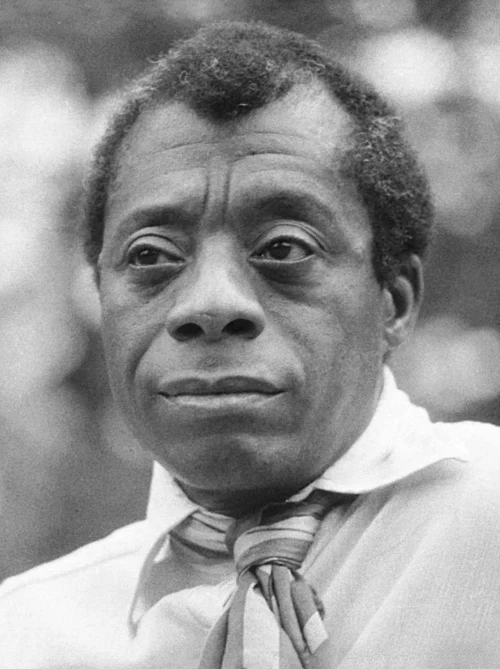
James Baldwin in 1969 (photo credit: Allan Warren, public domain)
Gov. Sherrill’s claim that “violent, chaotic clashes hurt everyone” seems to presupposes that protesters rather than law enforcement are the primary source of the violence and chaos. All I can say is that she is a long, long way from proving that claim. As for “the temperature,” the thing to say is that no protest has ever succeeded by dissipating its own energy. It was Martin Luther King Jr who implicitly challenged his followers to be thermostats rather than thermometers with respect to heat:
There was a time when the church was very powerful–in the time when the early Christians rejoiced at being deemed worthy to suffer for what they believed. In those days the church was not merely a thermometer that recorded the ideas and principles of popular opinion; it was a thermostat that transformed the mores of society. Whenever the early Christians entered a town, the people in power became disturbed and immediately sought to convict the Christians for being “disturbers of the peace” and “outside agitators.”‘ But the Christians pressed on, in the conviction that they were “a colony of heaven,” called to obey God rather than man. Small in number, they were big in commitment.
The implication here is that we should be turning the heat up, not down. If we’re to succeed, that’s where things have to go. Expect no less.
I encountered a huge number of glitches while posting this, and so, ended up doing a bunch of stylistic edits after posting. None of the edits change the substance of my claims.

