I wanted to note the passing of John Wilmerding (1938-2024), for many years the Christopher Binyon Sarofim Professor of American Art at Princeton University. He died on June 6 of this year at the age of 86.
I didn’t really know Wilmerding at all–never met him, never really took a class with him. He was the guest lecturer for the week-long section on American art in my college-level art history class, Art 100, “An Introduction to the History of Art”–the closest to physical contact I ever got. But more than anyone, I owe Wilmerding credit for my decades’- long love affair with American art, and in particular, American landscape and maritime painting of the mid- to late-nineteenth century. Continue reading →
I was once parodied on a YouTube video (by whom I don’t recall) as holding that “people who are right and people who are wrong are basically saying the same thing.” While I obviously wouldn’t endorse the claim in the form stated, the line does insightfully capture something about my approach – a suspicion of stark oppositions. Suspicion, not invariable rejection: sometimes one side of an opposition is just completely and uninterestingly wrong. But I’m regularly finding my way to angles from which supposedly stark oppositions can be seen as complicated or subverted by unexpected affinities – which is why, e.g., I was never fully satisfied, even at the height of my Randian period, with the cops-and-robbers approach to intellectual history that prevails in Randian (and not only Randian) circles, consigning all of e.g. Plato’s or Augustine’s or Hume’s or Kant’s or Hegel’s or Marx’s or Heidegger’s or Rawls’s writings to the Dustbin of Total and Irredeemable Worthlessness, rather than approaching them with the expectation that they might have something valuable to teach.
One of the most important pieces of advice I would give to young scholars beginning their intellectual journeys is not to structure their conceptual landscape so as to close themselves off from the opportunity to learn from both sides of supposedly unbridgeable gaps.
It’s customary to celebrate Independence Day in the United States by recalling the glories of the American Revolution, and hauling out the idols of our “civic religion” for worship–primarily the Declaration of Independence treated as Scripture, and tales of the Revolutionary War treated as hagiography. I don’t find the American Revolution a particularly glorious event, and find most celebratory discussions of our “civic religion” tiresome. So this Independence Day, I’d like to change the subject. There are other things about America worth celebrating and discussing: not its politics or military valor, but its art. It’s always been a question whether American art has ever managed to declare independence from its European forbears, and always been a fear that it hasn’t. Those questions generally go unasked on Independence Day, but maybe they shouldn’t. Continue reading →
I found myself thinking the other day of Peter Breughel the Younger’s 1564 painting, “The Procession to Calvary.” I used to teach it when I taught aesthetics in college. As is probably obvious, it’s a depiction of Christ’s being taken to be crucified. It reminds me of so many things happening now, and vice versa.
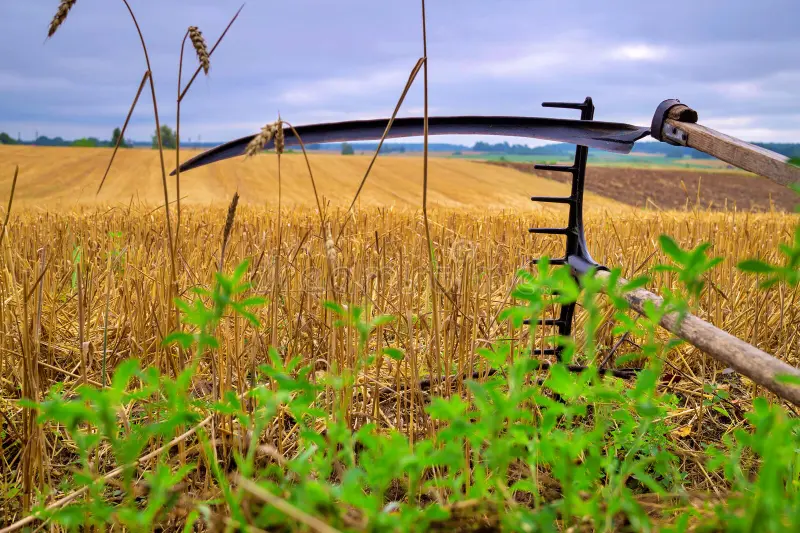
I told Dean [= Neal Cassady] that when I was a kid and rode in cars I used to imagine I held a big scythe in my hand and cut down all the trees and posts and even sliced every hill that zoomed past the window. “Yes! Yes!” yelled Dean. “I used to do it too only different scythe – tell you why. Driving across the West with the long stretches my scythe had to be immeasurably longer and it had to curve over distant mountains, slicing off their tops, and reach another level to get at further mountains and at the same time clip off every post along the road, regular throbbing poles. …” (On the Road)
Kerouac, amphetaminated:
We were talking about the Great Scythes of our childhood, when I, riding in New England littleroads with boulders and posts and hills of vine all along, would, imaginary, cut it all down with my scythe as my father swept the car by; and he, Cody [= Neal Cassady], in the tragic red roads of Sunday afternoon in Eastern Colorado, when blackhatted men grimly drive the children, swept alongside the car either on foot or wielding from inside the car a gigantically and intricately built Scythe that not only snipped the close posts and sage or wheat but extended itself in a monstrous dream to horizon with all the massiveness of unbelievable realities like the Oakland Bay Bridge or the skeletal Swiftian frame of the Pentagon in Arlington, Virginia when they were raising the octagonal facewalls into place by longnecked celestial giraffe cranes, slow as the Bird of Paradisical Eternity raising the Great World Snake in its beak to the lost up, a scythe also so fantastic in its hinges that it could sweep over the flat plain, adjust itself to cut tablelands, rise a notch in the beyond and extend to horizons to cut mountain ranges entire while still managing in the little forefront blade to cut that bunchgrass into clouds of flying – We talked about this. (Visions of Cody)
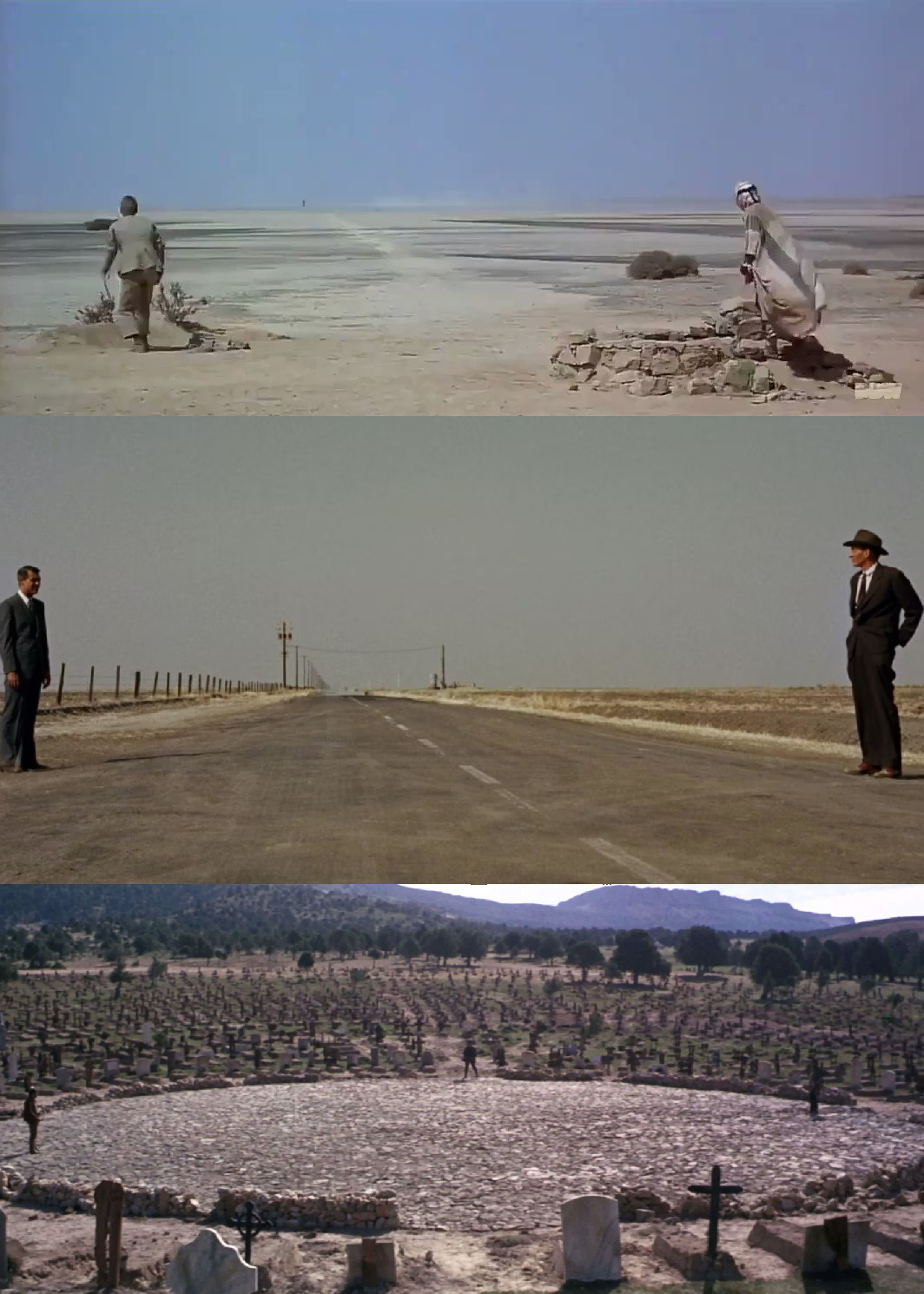
Back in the 90s there was a controversy, now happily long settled (and so perhaps unfamiliar to many of my younger readers), about “letterbox” versus “pan-and-scan” video formats. See, most movies by then were widescreen (and this had been so for decades), but television screens were still 4×3, which had been the dominant aspect ratio for theatrical movies when commercial television first became widespread – which meant that movies with a wider aspect ratio (which soon became the majority), when shown on television, either had to leave out whatever was happening at one or both sides if the screen, or else shift back and forth between them (the latter option being the origin of “pan and scan”), even if the original scene had been intended to be static. You can see how this mismatch between theatrical and televisual aspect ratios would ruin, for example, scenes like these three from Lawrence of Arabia,North by Northwest, and The Good, the Bad, and the Ugly, all of which could show one of the main characters in a scene only by completely eliminating another.
There’s a big debate at Princeton University about whether or not to take down the statue of John Witherspoon, the Revolutionary-era intellectual (and slaveowner), and namesake of actress Reese Witherspoon. Here’s a less controversial suggestion.
This essay contains spoilers throughout about John LeCarré’s novel, The Constant Gardener.
He tried to remember the phrases: pain Audible at noon, pain torturing itself, Pain killing pain on the very point of pain.
–Wallace Stevens, “Esthétique du Mal.”
When I was a young man, my life’s ambition was to join the U.S. Foreign Service and become a diplomat. Chastened by the first Gulf War (1990-91), which I opposed, I thought the better of my ambitions, and decided instead to become a dull but conscientious academic.
During my third and presumably final marriage (2018-2021), my wife Alison and I bought a small townhouse in rural New Jersey with a little garden plot out front. Alison had great hopes for the garden, and often expressed the wish that I would help her cultivate it. To her great sorrow and eventually mine, I never did. I was too busy being a dull but conscientious academic. Continue reading →
Is it legitimate to criticize someone’s physical appearance? I don’t mean: is it legitimate to have or even express personal preferences about someone’s physical appearance. I mean: is it legitimate to issue an objective verdict on someone for looking the way they do, e.g., criticizing the very structure of a person’s face for giving them the facial appearance they have? Continue reading →
I could belabor this case, but I’ll refrain. This New York Times article tells you what you need to know. A summary:
Erika López Prater, an adjunct professor at Hamline University, said she knew many Muslims have deeply held religious beliefs that prohibit depictions of the Prophet Muhammad. So last semester for a global art history class, she took many precautions before showing a 14th-century painting of Islam’s founder.
In the syllabus, she warned that images of holy figures, including the Prophet Muhammad and the Buddha, would be shown in the course. She asked students to contact her with any concerns, and she said no one did.
In class, she prepped students, telling them that in a few minutes, the painting would be displayed, in case anyone wanted to leave.
Then Dr. López Prater showed the image — and lost her teaching gig.


 Policy of Truth