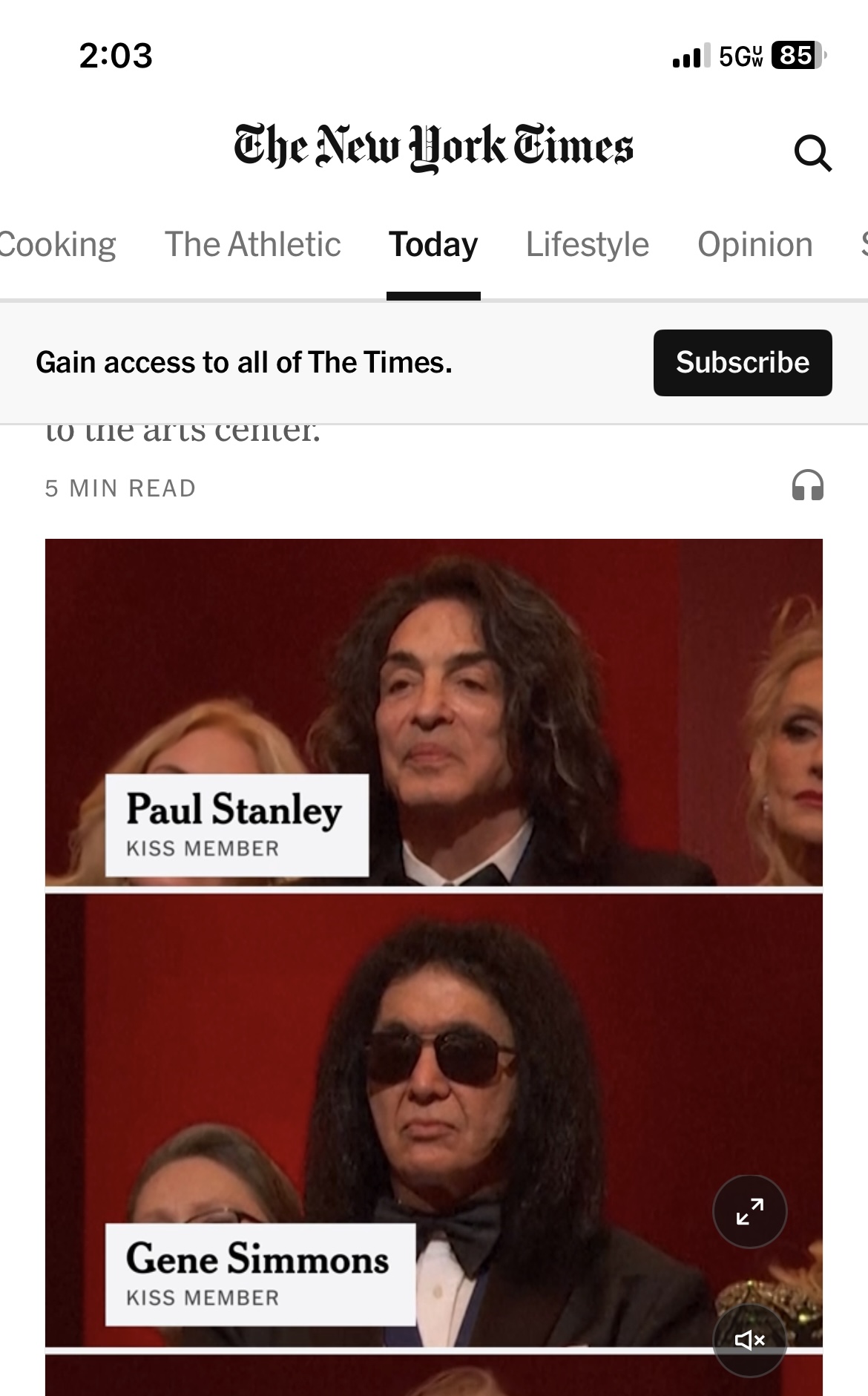
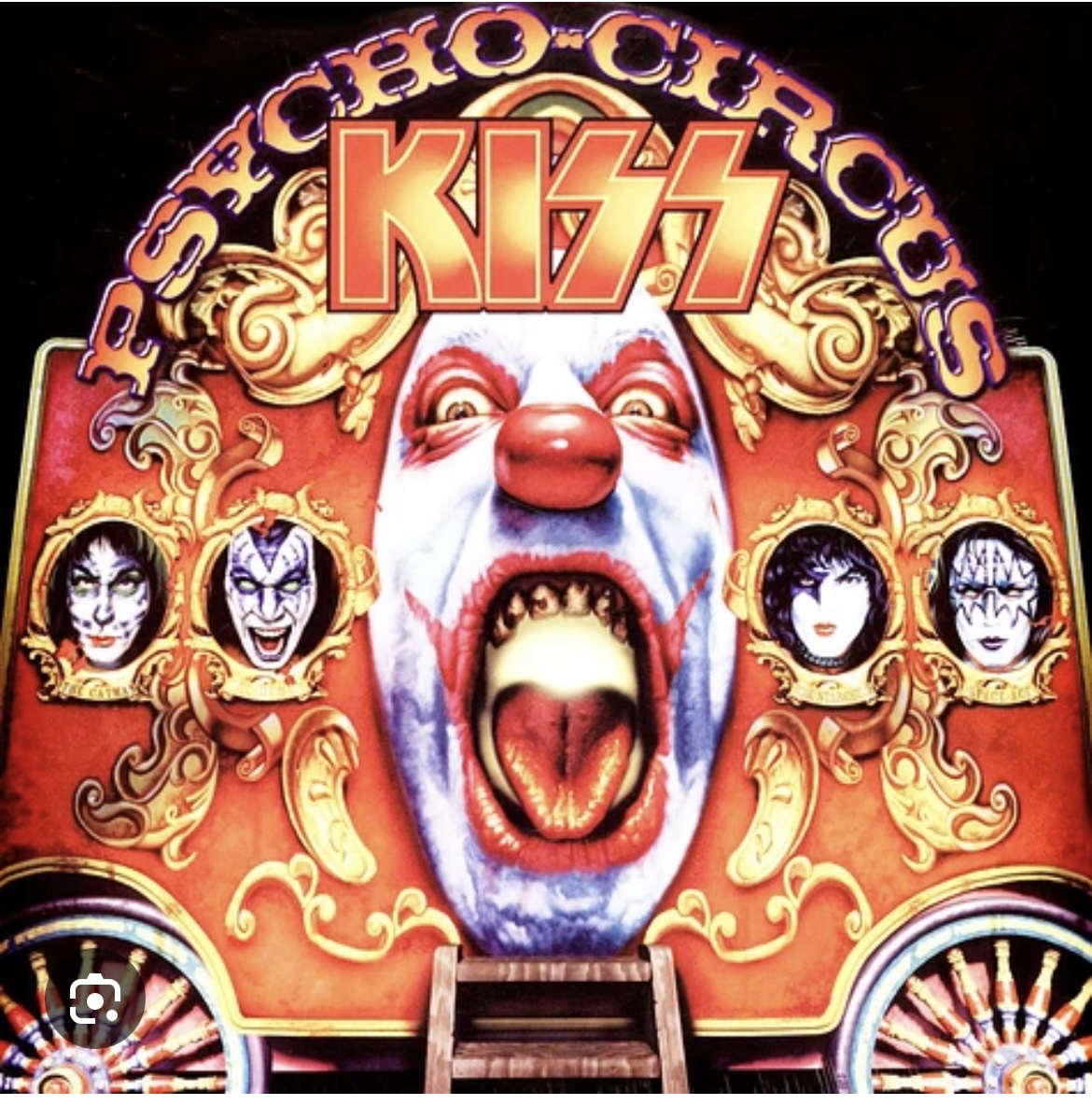
Follow these instructions precisely. As a preliminary precaution, first visit the bathroom. Then find coverage of the rock group KISS at the Kennedy Center Honors last night. Then listen in sequence to the songs “Psycho Circus,” and “Lick It Up,” and see if you can hold it together. Don’t skip the videos.
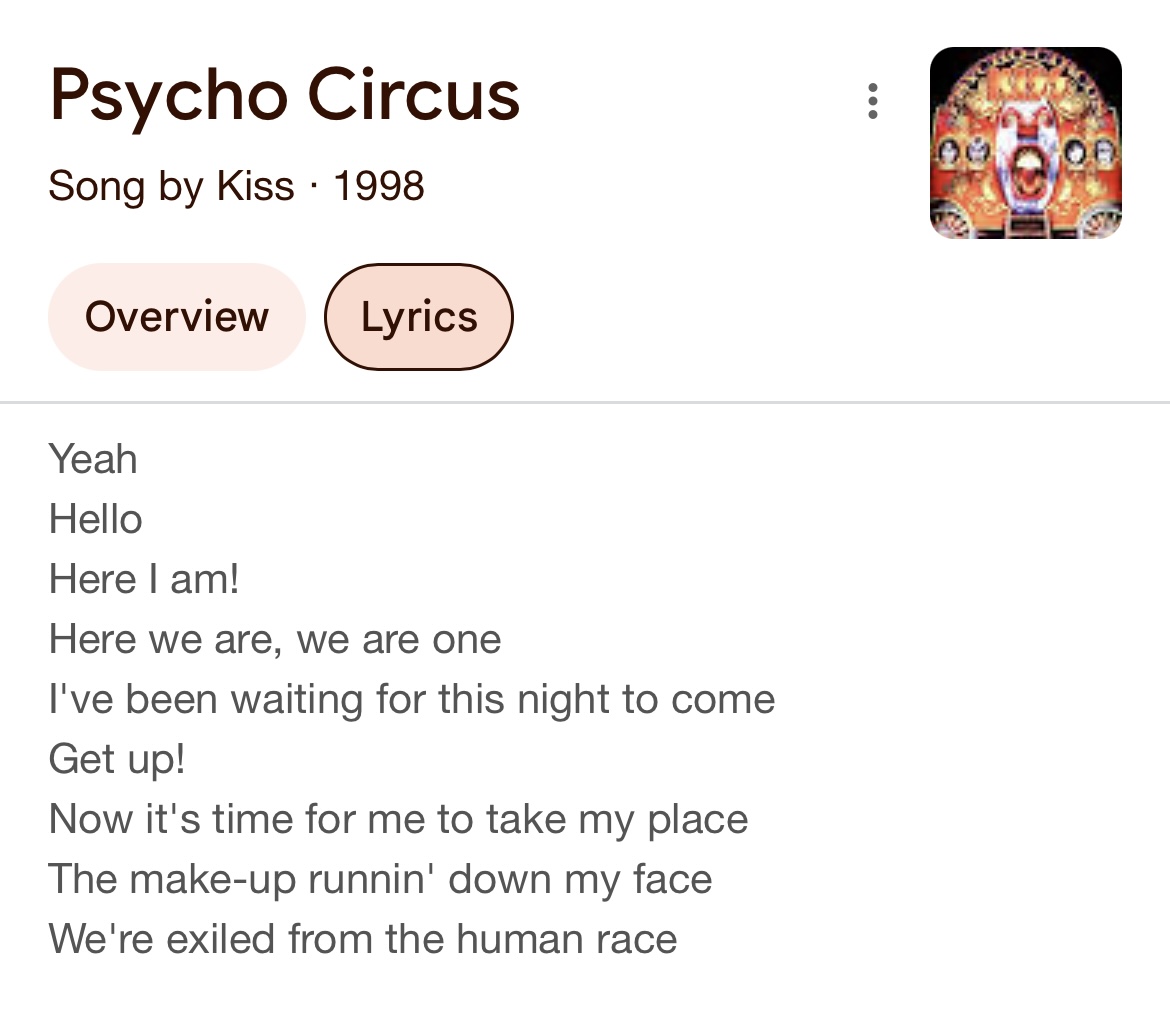
If it’s not immediately visible to you (you get different interfaces on different devices), make sure you click on the last screenshot, for the lyrics to “Psycho Circus”: “We’re exiled from the human race.” Hard to beat.
As my friend Nicky Reid puts it, “it’s funny that Ace Frehley, the only member of Kiss with any talent, decided to die instead of showing up to this thing.” For once, “Rest In Peace” actually means something.
I’m sitting on an Amtrak on my way home from Providence, Rhode Island. The guy sitting next to me, who works in marketing for a New York law firm, is reading the Greek text of Xenophon’s Anabasis “for fun.” I’m reading Flavius Josephus’s Jewish War, for leisure though not quite for fun. The woman to my right is reading Moby Dick; I hesitate to ask why, but she doesn’t look unhappy. Another woman just got on and sat next to us, reading Jenny Erpenbech’s Kairos. The two women are now having an animated literary conversation. It’s got to be one of the most literary rows on the train.
No STEM warriors in sight. No AI or ChatGPT, either. The demise of the humanities has been greatly exaggerated, at least on Amtrak train #149.
I just read that Ozzy Osbourne died at the age of 76. It seems a little absurd to go on about the death of an aged metal singer at a time like this, but almost any man’s death diminishes me, Ozzy’s included. So forgive me.
Ozzy was a mediocre singer, and the less said about his public persona, the better. But he was blessed to work with some great musicians, and together they wrote some immortal songs. Black Sabbath deserves a place in heaven for “War Pigs” all by itself, but “I Don’t Know,” “Over the Mountain,” “Flying High Again,” and “I Don’t Wanna Stop,” all make worthy contributions to the aesthetic education of man, and are all candidates for the musical equivalent of eternal life. Continue reading →
I read a few days ago that Alfred Brendel had died at the age of 94. To be honest, I was shocked that he was so recently alive. What was a guy like that doing alive at a time like this? I can’t so much confess to any personal sense of loss as a vague sense of bewilderment that Brendel and I ever inhabited the same world. It takes effort to convince oneself that Alfred Brendel and say, Ted Cruz were members of the same biological species and historical milieu. But it turns out they were.
I wanted to note the passing of John Wilmerding (1938-2024), for many years the Christopher Binyon Sarofim Professor of American Art at Princeton University. He died on June 6 of this year at the age of 86.
I didn’t really know Wilmerding at all–never met him, never really took a class with him. He was the guest lecturer for the week-long section on American art in my college-level art history class, Art 100, “An Introduction to the History of Art”–the closest to physical contact I ever got. But more than anyone, I owe Wilmerding credit for my decades’- long love affair with American art, and in particular, American landscape and maritime painting of the mid- to late-nineteenth century. Continue reading →
I was once parodied on a YouTube video (by whom I don’t recall) as holding that “people who are right and people who are wrong are basically saying the same thing.” While I obviously wouldn’t endorse the claim in the form stated, the line does insightfully capture something about my approach – a suspicion of stark oppositions. Suspicion, not invariable rejection: sometimes one side of an opposition is just completely and uninterestingly wrong. But I’m regularly finding my way to angles from which supposedly stark oppositions can be seen as complicated or subverted by unexpected affinities – which is why, e.g., I was never fully satisfied, even at the height of my Randian period, with the cops-and-robbers approach to intellectual history that prevails in Randian (and not only Randian) circles, consigning all of e.g. Plato’s or Augustine’s or Hume’s or Kant’s or Hegel’s or Marx’s or Heidegger’s or Rawls’s writings to the Dustbin of Total and Irredeemable Worthlessness, rather than approaching them with the expectation that they might have something valuable to teach.
One of the most important pieces of advice I would give to young scholars beginning their intellectual journeys is not to structure their conceptual landscape so as to close themselves off from the opportunity to learn from both sides of supposedly unbridgeable gaps.
It’s customary to celebrate Independence Day in the United States by recalling the glories of the American Revolution, and hauling out the idols of our “civic religion” for worship–primarily the Declaration of Independence treated as Scripture, and tales of the Revolutionary War treated as hagiography. I don’t find the American Revolution a particularly glorious event, and find most celebratory discussions of our “civic religion” tiresome. So this Independence Day, I’d like to change the subject. There are other things about America worth celebrating and discussing: not its politics or military valor, but its art. It’s always been a question whether American art has ever managed to declare independence from its European forbears, and always been a fear that it hasn’t. Those questions generally go unasked on Independence Day, but maybe they shouldn’t. Continue reading →
I found myself thinking the other day of Peter Breughel the Younger’s 1564 painting, “The Procession to Calvary.” I used to teach it when I taught aesthetics in college. As is probably obvious, it’s a depiction of Christ’s being taken to be crucified. It reminds me of so many things happening now, and vice versa.

 Policy of Truth