Am I the only person in the State of New Jersey who opposes both A1146 and S1292? The first bill claims to define “Islamophobia” and (in a very vague, very cagey way) treats crimes committed from Islamophobic motivations as hate crimes. The second bill does essentially the same for “anti-Semitism.” Both definitions are flawed. Beyond that, both pieces of legislation are unnecessary, and both are highly conducive to abuse. I split my time between a Muslim home in West Orange, and a Jewish one in Princeton. Each of my households has been on the receiving end of Islamophobia and anti-Semitism, respectively (as have I). I’m the last person to deny that these things exist. Yet both pieces of legislation strike me as an affront, not as a bona fide solution to any actual problem I face.
The most offensive feature of both pieces of legislation is this proviso, common to both:
A1146: Under the bill, the definition of Islamophobia in the bill would not include any criticism of any Muslim-majority country similar to that leveled against any other country.
S1292: Nothing in this section shall be construed to diminish or infringe upon any right to criticize the government of the State of Israel in a manner similar to that leveled against any other country.
The problem in both cases is the same. The criticisms one might level against Islamic states or Jewish ones are by definition not “similar to those leveled against any other country” precisely because the states themselves are not similar to other countries. They claim to be sui generis, and often are. So they deserve criticism appropriate to their claims and to the political realities that answer to them.
If one country, say Pakistan, invokes the Qur’an for its legitimacy and another doesn’t, partisans of Pakistan can’t complain when criticism of Pakistan involves directed and pointed criticism of the Qur’an when the other doesn’t. Why wouldn’t it? They’re the ones who brought the Qur’an up in the first place. To shut down criticism of the Qur’an in this instance is to shut down criticism of Pakistan itself. But Pakistan is a theocracy with a genocide in its past (cf. the East Pakistan War of 1971). If anything calls a state’s legitimacy into question, that does. So why should legislation give even the appearance of discouraging criticism of Pakistan’s legitimacy? What exactly is wrong with questioning the legitimacy of the Islamic Republic of Pakistan? Are we obliged to treat it. as a holy relic demanding veneration, on par with the shrine of Data Ganj Baksh?
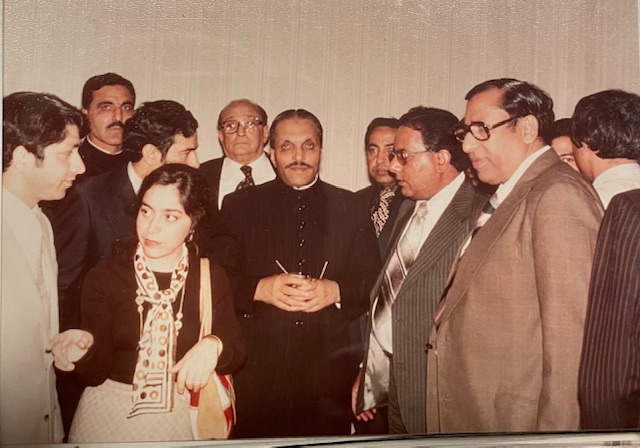
“Pakistan is like Israel, an ideological state. Take out Judaism from Israel and it will collapse like a house of cards. Take Islam out of Pakistan and make it a secular state; it would collapse.” –Zia ul Haq, pictured here in Islamabad ca. 1985, with my mother and father to his right
By the same reasoning: if a so-called Jewish State like Israel invokes the Hebrew Bible or “the Jewish tradition” for its legitimacy while another doesn’t, Zionists can’t complain when criticism of Israel involves criticism of the Bible or Judaism or both. To repeat the obvious: they’re the ones who brought those things up. To shut down criticism of the Bible/Judaism in cases where it’s invoked to legitimize Israel or Zionism is tantamount to shutting down criticism of Israel as such. Like Pakistan, Israel is an ethnocracy with a long history of aggression, ethnic cleansing, and most recently genocide to its credit. What’s wrong with questioning or flat-out denying its right to exist?
Lots of states have come in and then gone out of existence–the Austro-Hungarian Empire, along with the Ottoman, and British ones, East Germany, East Pakistan, apartheid South Africa, Czechoslovakia, the Soviet Union, etc. etc. etc. Lots of national groups not only don’t have states but aren’t allowed to get one–the Lakota Sioux, the Quebecois, the Basques, the Kurds, the Kashmiris, the Pathans, and of course, the Palestinians. There’s nothing racist about wondering whether Israel should meet the same fate as the nations mentioned in the first group. There’s nothing racist, either, about wondering why Jewish nationalism currently enjoys a moral standing not granted the people in the second. None of that is self-evident, and no law can make it so.
Criticism goes where it logically has to go, not in the direction that spares peoples’ feelings. If someone invokes “the Jewish tradition” to justify Israel, and I reject both, what exactly is wrong with my saying so? There’s more murder and rape in the Hebrew Bible than there is in the Qur’an–by a long shot. It’s certainly a debatable question what all that carnage is doing there. If it’s debatable, of course, it can be debated. Yet openly debating it is what S1292 treats as a prima facie racist act. And state-sponsored defamation is what it regards as respect for our rights.
If people of faith (Jewish, Christian, Muslim, Buddhist, Hindu, whatever) don’t want their religions scrutinized, they should seal their faiths up in the vault of private conscience and stop invoking them to legitimize things like wars, mass expulsions, and genocide. But no: the faithful seem to want things all ways at once. First they bring up their faith to defend the indefensible. Then they start crying when people point out that it is indefensible–crying yet harder when you point out that the very faith they’ve invoked is part of what makes things indefensible. Someone needs to tell the faithful that their feelings are not our fucking problem. But their nations, their ideologies, and their policies all too often are.
Tender feelings aside, it’s not the place of the government to claim to be the adjudicator-of-last resort of reasonability in political debates. We don’t need them to do the job that is properly ours to do, namely, to regulate the boundaries of reasonable speech. It’s not clear what special standing legislators or cops have to do that job, by the way. Yet the demands placed on them are utopian:
In reviewing, investigating, or deciding whether there has been a violation of any policy, law, or regulation prohibiting discriminatory acts under the civil or criminal laws of this State, a public official or law enforcement officer shall take into consideration the definition of Islamophobia contained in subsection a. of this section for the purposes of determining whether the alleged act was motivated by Islamophobia and discriminatory anti-Muslim intent.
Law enforcement? Or parapsychology? Predictably, no part of the law ensures that any of these public officials or law enforcement officers will have the slightest competence at doing what they’re tasked with doing, or that anyone will have the right to compensation if they get any of it wrong. As someone who spent a good fifteen years teaching critical thinking to budding police cadets (aka “Criminal Justice Majors”), I can say with confidence that the grounds for expecting either competence in the execution of this law, or compensation for error or malfeasance in its application, both approximate zero.
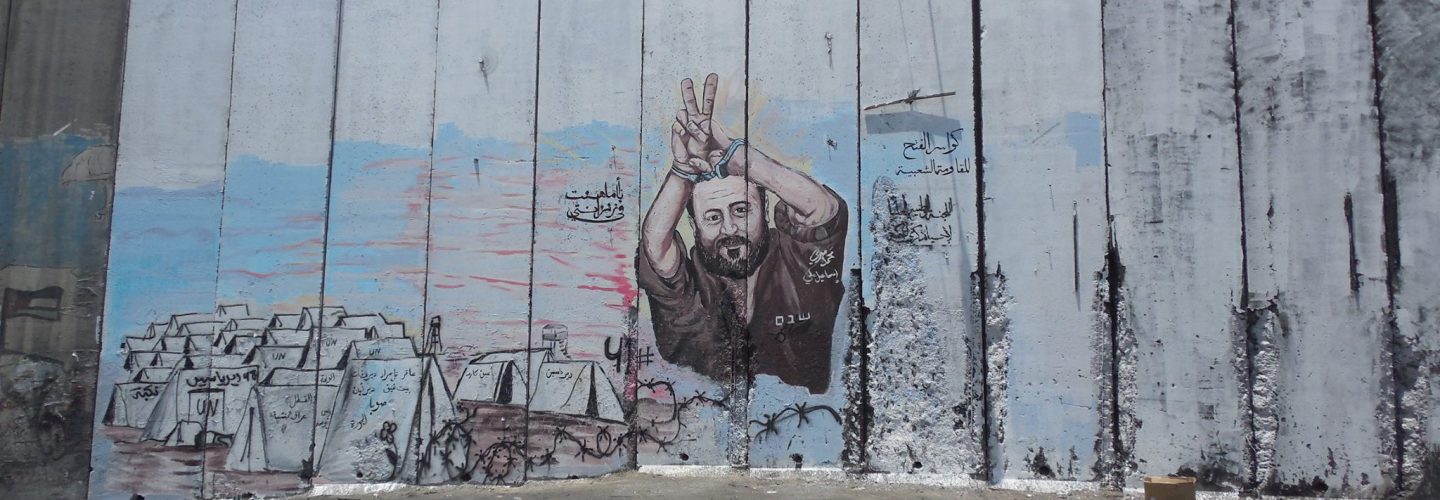
Is this mural anti-Semitic per S1292? More importantly, should we care? Marwan Barghouti, pictured on the Israeli wall in Abu Dis, Palestine (photo: Irfan Khawaja)
Personally, I don’t think that any sectarian state, whether Islamic (Pakistan, Afghanistan, Saudi Arabia, et al), Jewish (=Israel), or Christian (e.g., “Christian nationalist”), has any right to exist. The only “right” they have, if one wants to call it that, is to cease to exist as sectarian states and turn themselves into something else. If the State of New Jersey has a problem with that, I have a problem with it. The cleanest solution to both problems is to strike down both pieces of legislation.
While we’re at it, could we drop the pious fraud of pretending that it’s “racist” to attack someone’s religion? It isn’t. Religion consists of a set of beliefs. A belief is something you can affirm or deny. If one of your beliefs is that God exists and issued commands to you (in a Book written in a language foreign to you)–for instance, told you to found an Islamic republic on either side of India and get a couple million people killed in the process–well, that belief can legitimately come under criticism. Likewise, if you believe that you belong ineluctably to a “People” whose long-suffering existence underwrites the existence and legitimacy of an ethnocracy in historic Palestine–at the price of an ethnic cleansing or two–that, too, is a belief that you can reflectively affirm or deny, and so, is a legitimate object of criticism.
That you affirm or deny the relevant belief is not a matter of race, or even in the vicinity of race. It’s a matter of the credibility of the belief itself, and whatever you have to say in its defense that can persuade outsiders of its truth. If you fail or default at that–as often happens–then what you believe can be attacked without anyone’s having to lapse into “racism.” It doesn’t matter how ardently you believe whatever you believe, or how central it is to your “identity.” A lot of people believe a lot of things that are central to their identities, and don’t get special recognition under the law for it. It’s a lesson that both Jews and Muslims would do well to learn.
We don’t need the state to adjudicate our quarrels. We need it to protect our rights. A state that can’t do that competently has no business wandering into matters beyond it. It’s time to draw a line, and time to demand a halt. We should kill both of these pieces of legislation before they kill what’s left of political discourse.

