I can’t say that I’ve felt very much enthusiasm for the 250th anniversary of the founding of the United States, insofar as 1776 marks that date (and arguably, it doesn’t). It tells you all you need to know that I spent the Fourth of July under a tree in a nearby park, reading Machiavelli in hundred degree heat. But two of my friends wrote notable and interesting pieces commemorating the 250th, and did so in interestingly similar and dissimilar ways. Both are on Substack, and both are worth reading. My friend Bob Massie has a piece called “A New Birth of Freedom” on his Substack. And my friend Chris Sciabarra has one called “From America 200 to 250: A Personal Journey” on his.
Both are semi-autobiographical essays that celebrate the founding ideals of the American Revolution, and do so by way of reflections on the 200th anniversary of the founding back in 1976. Both describe the 1976 celebrations from roughly the same place: the Fourth of July celebrations that took place in New York City. Bob describes them from the World Trade Center, Chris from the Verrazano-Narrows Bridge. I was there, too: I watched the 1976 bicentennial celebrations as a seven-year-old from the cliffside backyard of a family friend in Weehawken, New Jersey. So I saw much the same spectacle as Bob and Chris did–at the same time, and essentially the same place.
The ideological story each of them tells is both similar to and different from the other. Bob is a liberal Democrat of 70s vintage; Chris is a “dialectical libertarian” of essentially 80s vintage. They both love America in different ways. You’ll have to read them both to see how they converge and diverge, but they end up doing both.
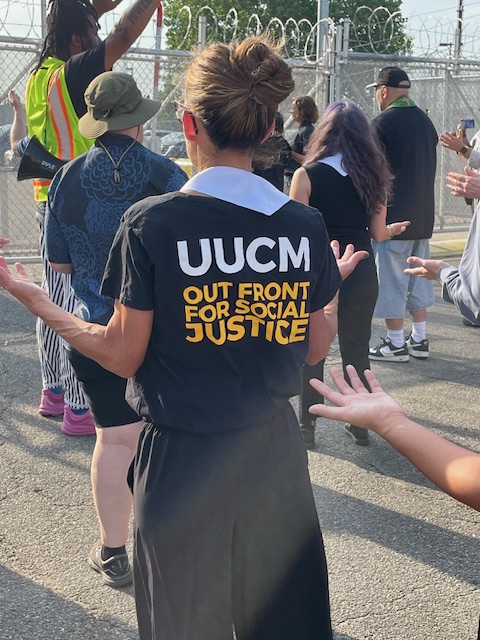
A member of the Unitarian Universalist Congregation of Montclair, Delaney Hall, Newark, New Jersey, June 29, 2026
Both pieces were nostalgic for me. Chris describes the New York City I remember from the 70s; Bob describes the ideological position I once took on the American founding. But nostalgic as they were, both take a celebratory position I can no longer adopt. America has a positive meaning for both of them that it no longer has for me. The alienation involved is nicely captured in Samuel Moyn’s “The Birthday Party No One Wants,” in The Yale Review. The “tradition of consecrating our origins is a spent force,” Moyn writes. It certainly is for me. The only part of the Revolution that really interests me is the part that most intellectuals ignore: the popular resistance to the British occupation of Boston. And the attractions there are more tactical than anything else. What interests me is how the Boston revolutionaries resisted, not why. I have my own why.
Though I agree with much that Moyn says, I would put things more acidly than he does. In saying this, I put present company–Bob, Chris, Moyn–aside. Present company aside, the people celebrating this thing don’t seem to have grasped that what they’re celebrating is a war: a group of middle class revolutionaries declared war against absolute monarchy, and fought that war to bloody victory. What seems farcical about twenty-first century invocations of the Revolutionary War is that while we face a threat at least on par with the British monarchy of 1776, talk of resistance is widely seen as crude, gauche, or embarrassing. Only “woke activists” do stuff like that. The “civilized” way of facing down the threat is to appeal to the courts, and invoke the legalistic glories of federalism. When that fails, I guess, the civilized thing to do is either to downplay the threat or surrender to it.
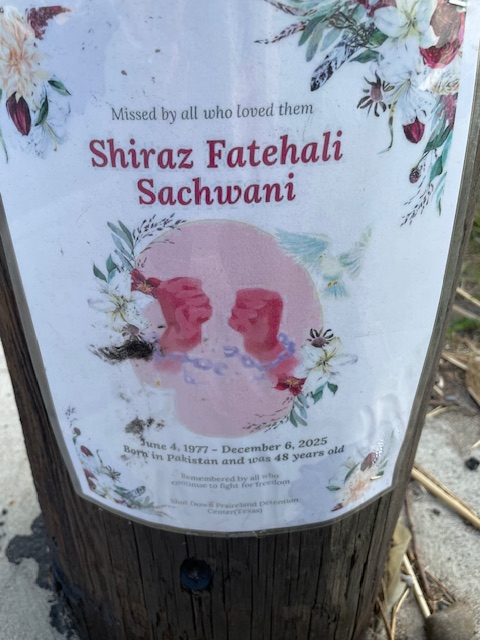
Outside Delaney Hall, June 29, 2026
The idea of instigating a revolutionary war over Trump’s DHS would occur to almost no one. But precisely for that reason, the invocation of the Revolution is hard to take seriously. What are we rebelling against, again? And how? The Revolution wasn’t a piece of litigation. The Declaration of Independence wasn’t a declaration of abstract commitment to abstract ideals in abstract resistance to abstract tyranny. It was about picking up weapons, pointing them at the shock troops of Empire, and pulling the trigger. If this isn’t your idea of the “ideals” of the American Revolution, you’re thinking of the wrong event. The ideals didn’t exist in some notional ether. Some ideals entail their own physical enactment. This one entailed killing people–lots of people.
But that’s not the lesson that contemporary American intellectuals have learned from the Revolutionary War: as far as they’re concerned, you can be a deskbound “revolutionary” by “explicating” revolutionary “ideals” without ever having to leave your seat. We live in a country whose intellectuals, particularly its academics, are embarrassed at the very idea of activism: even politically charged commencement speeches, and non-neutral presidential memos, are too much for them. They’re willing to “celebrate” the Revolution as long as it’s a party, and willing to enact it as long as it’s a podcast. Take the “ideals” any farther than that, in anything remotely resembling a practical direction, and they’re quick to demur.
If only it was possible to have a Revolution without war, resistance without blood, rebellion without incivility. Don’t get them wrong: wars against Russia, China, or Iran are one thing. Those are “threats,” even if no one has encountered a physical manifestation of the “threats” anywhere in or near the United States. When was the last time agents of Russia, China, or Iran abducted 10,000 people in five days off of the streets of this country? They haven’t. ICE has. But a war against ICE? Right here? At home? Where we’d actually have to see the corpses and bury them? Unacceptable. Horrific. Insane. I mean, so far, ICE has only killed people in dribs and drabs. Don’t we have to wait for a massacre before we consider physical resistance?

Across Doremus Avenue, June 29, 2026
I get it. I’m not eager for civil war, either. What I would say, however, is that if you’re not angry enough to kill an ICE agent, you’re not in a “revolutionary” mood. You’re daydreaming. That’s what the 250th anniversary of the Revolution looks like to me. It’s a gigantic national daydream, a cartoon version of revolution, an infant’s version of revolutionary war. The threats we face here at home are arguably bigger than the threats “the Founding Fathers” ever faced in 1776. But that’s not the impression we give, or the impression one gets. The impression one gets is that the dangers are contained, over there, happening to other people, basically legal and under control. Too bad none of that is true. Unfortunately, we are much bigger cowards than the Americans of the eighteenth century, much more easily intimidated by power, much more inured to obedience, much more wedded to our own subjugation, much more in the grips of word play, fantasy, and confabulation, much more addicted to creature comforts. There’s nothing to celebrate there, just a descent from self-respect into self-abnegation.
Neither Bob nor Chris would put things that way, I realize, but that’s the lesson I took from their essays. We’ve devolved to a place from which there is neither redemption nor return. We deserve what happens next.


Reminds me of Voltairine de Cleyre’s line:
“[T]he intention of the Revolutionists [was not] to make the Boston Tea Party Indians the one sacrosanct mob in all history, to be revered but never on any account to be imitated, but … that every American should know to what conditions the masses of people had been brought by the operation of certain institutions, by what means they had wrung out their liberties, and how those liberties had again and again been filched from them by the use of governmental force, fraud, and privilege. Not to breed security, laudation, complacent indolence, passive acquiescence in the acts of a government protected by the label ‘home-made,’ but to beget a wakeful jealousy, a never-ending watchfulness of rulers, a determination to squelch every attempt of those entrusted with power to encroach upon the sphere of individual action ….”
https://praxeology.net/VC-AAT.htm
In 1976 I was 12 and living in Idaho Falls. I watched the tall ships on tv, and sat on the banks of the Snake River watching the local fireworks. I was not very political; indeed in a test of general knowledge I scored high on most points but rather low on who-is-the-current-Secretary-of-State type questions. (I now know who the Secretary of State was in 1976: the war criminal SOB Henry Kissinger.) I had discovered neither philosophy nor libertarianism (of either left or right varieties).
LikeLiked by 2 people
I couldn’t have put it better. I wonder if we’ve become the prisoners of Nietzsche’s false trichotomy in The Use and Abuse of History for Life: the study of history (he says) is either monumental, or antiquarian, or critical. Monumental history supposedly guides action, but only by uncritically emulating The Great. Antiquarian history is a flight from the present into the past for its own sake (or for flight’s sake). And critical history is critique of the past, full stop.
So: Monumental history makes a monument of the past. Antiquarian history gets lost in it. Critical history critiques the past. But there’s no single perspective from which (on Nietzsche’s account) we view the past in a balanced way with a view to guiding action in the present.
So many academics seem to be antiquarians or at best “criticalists” about history. We can admire historical figures or achievements, or maybe criticize if that’s appropriate, but we can’t learn practical lessons or put them into action. The view seems to be: if historical knowledge (really, any practical knowledge) is deployed to some practical end, the result is inevitably a loss of objectivity. Am I exaggerating, or is that a recurring view?
What strikes me about this view is that it more or less begins with the axiom that Aristotelian phronesis is impossible. Interestingly, the view seems to apply to phronesis but not to techne. No one really disputes that we can apply technical knowledge with full objectivity. It’s phronesis that seems to defy objectivity, and with it, virtue, above all justice. I guess that’s how we get our share of Kissingers.
LikeLike
Take III (I’ve tried leaving a comment several times, and if this is a repeat… well, blame the interface!)
First, my friend, thanks for the shout-out. As you might imagine, I can find little to disagree with here. Nothing in my nostalgic look at the Bicentennial implies complacency with the current context. As you know, I’ve got a paper trail that goes back decades opposing the actions of the US government, and more recently, its actions abroad, and its war against immigrants, culture, LGBT+ peoples, trade, and its illiberal promotion of virulent nativism and white identity politics. And while Act I of my essay was an exercise in nostalgia (though not without a profound acknowledgment of the depths of despair we faced in the 1970s), Act II was a “hermeneutic” exploration of the ways in which the core principles of the Declaration of Independence, once detached from their authors, advocates, and initial context, have been appropriated in ways that the founders could have scarcely recognized: by abolitionists in the struggles against slavery; by blacks in the struggles against Jim Crow and apartheid; by women in the struggles for equality and bodily autonomy; by LGBT+ peoples in their struggles for liberty and liberation. And remember that that movement didn’t begin with litigation; it began with the Stonewall Riots. Moreover, as I pointed out, these core principles have been embraced as a legitimating framework by folks as diverse as Emma Goldman, Eugene V. Debs, Ho Chi Minh, Voltairine de Cleyre, and Benjamin Tucker.
From where I sit, you’re part of that diverse group. And while neither redemption nor return may be possible, revolutionary change is not impossible. My citation of Thomas Paine’s view that “[t]he strength and powers of despotism consist wholly in the fear of resisting it” carry much weight here. When so much is systemically stacked against us, it is understandable that neither of us could possibly be eager for a civil war. But while we may “deserve what happens next”, not even what happens next is written in stone. Onward …
LikeLiked by 1 person
You’re very welcome. As you say, we’re not disagreeing. Or at least agreeing more than we disagree. (And yes, the WordPress interface is a gigantic pain in the ass. Don’t get me started.)
I would underscore what I said in the post about excluding present company from my criticisms. That wasn’t just said pro forma. My criticisms really don’t apply to you (or Bob). In fact, your struggles with chronic illness are a template for my activism, a set of lessons I’ve learned from you and others in your situation.
A struggle against chronic illness is a lot like a struggle against injustice. In both cases, you’re struggling against forces much bigger than you, forces that can easily defeat you. And in both cases, you’re constantly having to face the fact of your mortality. The difference, of course, is that you can opt out of a struggle for justice, but not out of the struggle against chronic illness–except in the ultimate way, as my wife did.
Incidentally, Bob suffers from a chronic illness as well:
https://bobmassie.substack.com/p/the-view-from-the-chair
So the same dynamic informs his views.
I have the same admiration as you for the history and historical figures you cite, from the Declaration to Stonewall and so on. If there’s any difference there, it’s a kind of resigned pessimism about what happens next. I guess I have a somewhat “Byronic” view: we have to struggle as hard as we can, but in the full expectation that we’re going to lose.
It’s an ironic thing to say, in a way, since over the past year and a half, the migrant defense movement has won some impressive victories against DHS and ICE. We’ve faced DHS/ICE down in every city they’ve tried to take over, and at some level we’ve forced them out of every one, from Los Angeles to Chicago to DC. As a Jersey boy, I’m very proud of the Jersey part of this story. We integrated the efforts of legislators, lawyers, and street activists to shut DHS/ICE down in small, but cumulative ways. We won some real victories, and we continue to win some.
But I still feel a sense of doom. How long can we last against a government this big, this brutal, this shameless? The anti-war side of my activism is even more painful and depressing. No matter how hard we struggle, we seem to get nowhere.
Less than nowhere, I sometimes think. Even on the domestic front, some of what we’ve already lost is a bitter pill to swallow. Abortion rights are gone. Gay/trans rights are being eroded. Racial justice is being rolled back. The fragile progress of the last few decades has practically evaporated.
What hasn’t changed is the basic complacency of middle America, including its intellectuals. That’s the unkindest cut of all, maybe the thing that informs the bitter edge of my writing. When I look at the people who call themselves “liberals,” even in the broadest sense, I no longer assume they’re on my side or vice versa. For all I know, they’re accommodating themselves to MAGA. Hillary Clinton’s signing on the Trump’s Gaza plan is the perfect example.
So many have turned out to be like that. That’s what I meant by saying “we deserve what happens next.” Any polity that includes them deserves what happens next.
LikeLiked by 1 person
“the core principles of the Declaration of Independence … have been appropriated in ways that the founders could have scarcely recognized: by abolitionists in the struggles against slavery; by blacks in the struggles against Jim Crow and apartheid; by women in the struggles for equality and bodily autonomy; by LGBT+ peoples in their struggles for liberty and liberation ….”
A minor quibble: I don’t think all the founders would have been taken aback by all of these later appropriations. Admittedly I don’t know of any founders who expressed any sympathy for LGBT rights (although some, like Revolutionary military leader Friedrich von Steuben, were definitely gay themselves, and others, like Alexander Hamilton, have been suspected of bisexuality).
But certainly the idea that the principles of the Declaration posed a problem for slavery was widely recognised; Jefferson had even attempted to insert an antislavery passage into the Declaration (though one that rather implausibly and hypocritically treated the slave system as one imposed on the hapless colonists by the perfidious Brits). Jefferson’s attempts to combat slavery famously dwindled to pretty much nothing after that, apart from occasional remarks of the yes-it’s-awful, what-a-pity-we-can’t-do-anything-about-it-just-now variety; but other founders were more persistent in practical attempts to abolish slavery, including Franklin, Hamilton, Jay, Burr, and Laurens.
(I’m particularly fond of Abraham Bishop, the leader of the Jeffersonian faction in Connecticut, who defended the Haitian slave revolts at a time when even those founders who were firmly antislavery were recoiling in horror: “Have we already forgotten the animating sound, Liberty, or Death? – That sound has gone out into the world, and is rapidly extending to the ends of the earth. … Yet, as soon as the poor blacks [in Haiti], who have been oppressed beyond measure, who suffered, till cruelty itself cried out, It is enough, – who bore, till patience had done its perfect work, echoed Liberty or Death, we have been the first to assist in riveting their chains! … From us, the blacks had a right to expect effectual assistance. They are pursuing the principles, which we had taught them, and are now sealing with their blood, the rights of men; yet Americans are sending assistance to their enemies. … Every public transaction, and most private conversations have evinced a great zeal in favor of the whites, and one can hardly wish the blacks to be victorious, without exposing himself to censure, calumny and opprobious names. That conduct and language which, in 1775, would have a cost a man the loss of his liberty, will now, in 1791, be applauded. – But my argument for a contrary conduct and language is made up in the following manner. … The blacks are entitled to freedom, for we did not say, all white men are free, but all men are free.”)
Re Jim Crow and the like: although some founders (e.g. Jefferson), while in favour of abolition in principle (if “principle” is the word), thought that it was impossible for blacks and whites post-emancipation to live in the same society in conditions of civic equality, there were those who disagreed, with Bishop and Burr being among their number. Burr in particular fought not only to free the slaves, but to guarantee the freed slaves’ rights to vote, to testify against whites, and to intermarry with whites.
Although concern for the rights of women was much less prominent among the founders than concern for the rights of blacks (despite Abigail Adams’ famous plea to her husband John, when he was serving in the Continental Congress, to “remember the ladies, and be more generous and favorable to them than your ancestors; do not put such unlimited power into the hands of the husbands”), there were exceptions, the most notable being once again Aaron Burr, who favoured full legal equality between women and men. Burr was a fan of Mary Wollstonecraft’s Vindication of the Rights of Woman, and even carried her picture in a locket; and he raised and educated his daughter along feminist principles.
So the application of the principles of the Declaration to these issues did not entirely wait until after the founding generation(s).
LikeLiked by 1 person
You make very good points, Roderick. Though my essay centers on my ‘personal journey,’ it does discuss Jefferson’s antislavery passage, and points to some early advocates, such as Black Patriot James Forten, who sought to extend the Declaration’s principles to the enslaved. Excellent point too about Mary Wollstonecraft’s Vindication of the Rights of Woman, which was far ahead of its time.
So, you are correct that some of these issues were recognized even by the founders. The central theme in Act II of my essay was to view the Declaration as a hermeneutic text, by which the enunciated principles were extended beyond their initial context and appropriated by diverse readers in ways that were not fully anticipated—from blacks, women, and immigrants to Native Americans, LGBT+, and anti-colonial movements across the globe (something that Jefferson welcomed, while cognizant of reactionary forces seeking to “defeat their own rights and purposes.”)
LikeLike
I agree with most of what both of you have said, but I think that there’s no escaping the fact that the Declaration of Independence is a manifesto for politicide.
I think the implication of this passage is clear: if we are to be free and independent, the “Indian Savages” have to be subjugated or destroyed. To say that they have “excited domestic insurrections amongst us” is to say that the owe their allegiance to the United States right from the outset, consent or not. If they don’t consent to be governed by the US, they’re a problem. In fact, since the Indians sided with Britain, they start out as enemies of the United States unless proven innocent. And since their “known rule of warfare” is “undistinguished destruction,” it’s either them or us.
I don’t think this problem has ever satisfactorily been solved. It’s a very different problem than the ones you-two have so far mentioned. It’s not a matter of according equal rights to people within our polity, but of tolerating separate polities on the land mass of the United States as such. Though the US has signed treaties with Indian tribes, and tolerates a bit of tribal government, at a basic level, it rejects the idea of separate nations sharing sovereignty with the United States. I think that’s inherent in the conception of “independence” involved in the Declaration. The United States was meant to be independent not only of Britain, but of the Indian Nations (of all nations). The Revolution was a war against both Britain and its Indian allies. But whereas reconciliation was ultimately possible with Britain, it wasn’t possible with the Indian Nations. They had to be destroyed. Which is what happened. The seeds of that destruction are right there in the text.
This is why I have trouble signing on to the Declaration. What it says is: if you accept the sovereignty of the United States, your rights will be respected. But if you don’t, they won’t. In fact, if you don’t, you will be destroyed in the name of rights. For a long time, I finessed this issue. But after I spent time in Palestine and in Indian Country–in South Dakota–I found I couldn’t finesse it. Gordon Wood called the United States an “empire of liberty.” He had a point, but “empire” is where I hit Esc. An empire of liberty is not something worth having.
LikeLike
I appreciate and agree with everything you express here, Irfan, especially regarding the “Indian Savages” and the “empire of liberty.” I chose to focus on the central, core principle of the Declaration as something that has been appropriated, modified, extended, and reinterpreted in ways that have challenged the status quo, even the context of its initial signing.
I chose not to go through all the points of the Declaration purposely, because it would have required another essay entirely. But it’s not as if I ignored the inner contradictions at the founding of this country. As I stated in the essay, in the section, “Core Principles, Complex Realities”:
“First and foremost, whether we are addressing America in 1776 or America in 1976 or America in 2026, it is crucially important to acknowledge the gulf between the founding ideas of liberty and the fractured reality of American life. The profound flaws that were woven into the fabric of this country from its inception have seriously affected its development over time. Violence marked the beginnings of this country in more ways than one, from the institution of slavery, which affected a half-million black men, women, and children (approximately 20 percent of the colonial population) to the devastation of indigenous peoples. Some of the enslaved who were promised freedom fought on the side of the British, while others took up arms against them. Rival loyalties affected Native American tribes as well, since many feared American settler expansion. To make matters even more complicated, American rebels were at the center of a colonial struggle that engaged such European powers as Great Britain, France, Spain, and the Netherlands.”
In each of those four hyperlinked phrases, you will find ruthless critiques of the violence suffered by indigenous peoples in this country, as well as an exploration of complexities among tribes. To have explored these issues extensively would have turned an essay focused on “A Personal Journey” into something entirely different. But I didn’t want to have those issues go unnoticed or unmentioned.
LikeLike