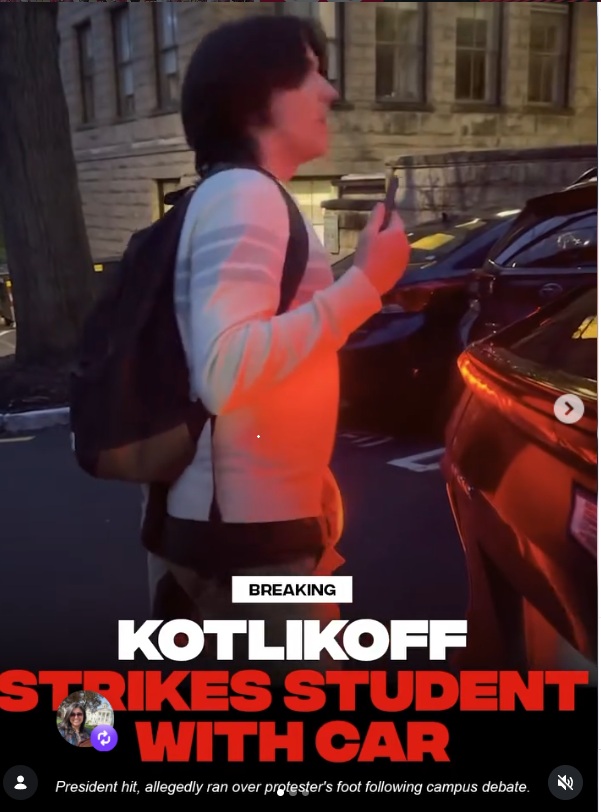
On April 30th of this year, a debate over Israel/Palestine took place at Cornell University, introduced and attended by Michael Kotlikoff, the President of the University. After the debate, Kotlikoff was followed from the venue to his car by students who asked him questions while filming him. Kotlikoff clearly didn’t want to talk to them, so he hurried to his car, and got in, closing the door. The students then surrounded the car on all three sides–the driver’s and passenger’s side as well as the rear of the vehicle–crowding fairly close to it, pressing their questions. Kotlikoff then backed up, hitting two students, and drove away. Neither student was seriously injured. Video of the event is widely available online, showing the event from various angles.
Kotlikoff didn’t stop after the collision. He didn’t get out of the car to determine out what had happened. And to the best of my knowledge, he didn’t report the incident to the police. He simply hit the students and fled the scene. It was students who called campus police and requested emergency medical services.
In stating the facts of the case, I’ve abstracted away from all disputed claims and interpretations. There is in fact no need to discuss any of them. The simple, incontrovertibly obvious fact is that Kotlikoff committed a crime on video, and should be arrested for it. He should not be investigated by an Ad Hoc University Committee, a PR maneuver, not a legal proceeding. He should be put under arrest by the law enforcement agency with jurisdiction over the parking lot in question, and charged with a crime, just as would happen to any ordinary non-university-presidential resident of this country.
Any person operating a motor vehicle who, knowing or having cause to know that personal injury has been caused to another person, due to an incident involving the motor vehicle operated by such person shall, before leaving the place where the said personal injury occurred, stop, exhibit his or her license and insurance identification card for such vehicle, when such card is required pursuant to articles six and eight of this chapter, and give his or her name, residence, including street and street number, insurance carrier and insurance identification information including but not limited to the number and effective dates of said individual’s insurance policy and license number, to the injured party, if practical, and also to a police officer, or in the event that no police officer is in the vicinity of the place of said injury, then, he or she shall report said incident as soon as physically able to the nearest police station or judicial officer.
Kotlikoff either knew or had cause to know that he had caused personal injury within the meaning of the statute. “Personal injury” is construed in the law broadly to include any involuntary contact between car and pedestrian that could cause physical injury, whether or not it actually did. If you had reason to believe that your car’s collision with a pedestrian hit the pedestrian and might have injured him, even slightly, those facts are sufficient for having cause to know that you caused personal injury and thereby give you a duty (at a minimum) to stop and determine what actually happened.
It’s obvious that Kotlikoff was in this situation, and obvious that he performed no part of the duty demanded of him by the law. It’s therefore obvious that Kotlikoff violated the law. Violation of the law is (as the law itself makes clear) a crime. So it’s obvious that Kotlikoff committed a crime. It’s also obvious that arrest is the appropriate response to a crime. So it’s obvious he should be arrested.
The defenses for not stopping after a collision are few and far between, mostly involving pleas of ignorance or danger. I won’t belabor the issue unless someone wants me to, but there really is no legally plausible argument for saying that Kotlikoff was too ignorant of his circumstances to have “cause to know that he had caused personal injury,” or that he was in any kind of physical danger whatsoever.
Regarding the issue of knowledge: The students were right behind Kotlikoff’s car. He knew they were there. He claims to have tried to avoid them, but he obviously backed into them. It’s simply impossible to fail to know that you’ve backed into a person directly in back of your car when you see that they are there, when you hit them, and when, on being hit, they start yelling about it.
Regarding the issue of danger: Minutes before the incident, Kotlikoff was filmed walking alongside the students in question, having a tense but utterly non-frightening conversation. There is no evidence whatsoever to suggest that the students exhibited any physical aggression toward him. Kotlikoff claims that they banged on his car. The claim is disputed, but even if true, banging on a car with one’s bare hands is not evidence that a person will physically harm a person. In any case, having watched several videos of the incident, I see no evidence of the banging Kotlikoff claims to have happened. What’s obvious is that the students wanted to talk to him, not that they wanted to beat him up. At this point, one could hardly blame them for re-thinking their options.
The plain fact is that Kotlikoff hit the students and drove away because he felt entitled to do so, not because he was ignorant of events, or afraid of harm, or had objective reason to expect harm. But the plain legal fact is that the duty to stop after an accident is a stringent one. This is how the New York State Driver’s Manual puts things:
If you are in a crash, you must stop. The level of damage does not matter. You must stop. It is a traffic violation to leave the scene of an incident, like a traffic crash that involves property damage. It is a criminal violation to leave the scene of an incident that involves a fatality or personal injury. Even if the crash involves only property damage, you must exchange information with other drivers involved. Give your name, address, driver license number, vehicle registration, and insurance information. This includes the insurance policy number and effective date. Give the information to the other drivers and police on the scene. You must show your insurance identification card if requested. If a parked vehicle or property different from a vehicle is damaged or if a domestic animal is injured, you must try to find the owner or notify the police.
“If you are in a crash, you must stop. The level of damage does not matter. You must stop.” How much clearer can it get?
It’s a criminal violation to leave the scene of an incident that involves personal injury. But any vehicular collision with a pedestrian causes personal injury by virtue of being one. It’s therefore a criminal violation to hit a pedestrian and leave the scene. That’s really all there is to it. There’s no need for an extended debate over Israel or Palestine, or whether students today genuinely believe in free speech and civil dialogue, or whether the students were truly debating Kotlikoff or harassing him etc. Those are all complex but subsidiary issues, but they’re all issues whose truth or falsity is irrelevant to the question of Kotlikoff’s legal liability. What Kotlikoff did is the essence of simplicity. He committed a crime on film in the apparent belief that, being an Ivy League university president, he could get away with it. Under the rule of law, he can’t get away with it. If the rule of law exists, he should not be allowed to get away with it. He should be arrested.
The threshold for arrest is probable cause. Probable cause is generally glossed as the fair probability, given the totality of the circumstances, that the suspect committed a specific infraction. It’s more than “fairly probable” that Kotlikoff left the scene of an accident in the sense described by the law. It’s patently obvious that he did, which is more than sufficient for arrest.
It’s well past time to stop treating university administrators as aristocrats beyond the reach or scope of ordinary law. They’re not aristocrats, and the United States is not an aristocracy. The AAA Foundation for Traffic Safety estimates that there are roughly 737,000 hit and run accidents in the United States every year (or were, in 2015). It’s plausibly estimated that between 5 and 10% of them are successfully prosecuted. It’s therefore safe to say that tens of thousands of people are arrested for this offense every year. This year, Michael Kotlikoff should be one of them. If you agree, feel free to contact the Cornell University Police Department and make the demand directly to them. It’s bad enough that a criminal runs the country. We can’t have criminals running the Ivy League.