The core idea of Hayek’s famous “The Use of Knowledge in Society” is the claim that prices act as signals that compress vast amounts of dispersed, rapidly-changing information into something that ground-level decisions-makers can use without knowing the underlying details. You don’t have to know anything about oil or gas production to know how much gasoline you can afford to put in your car, or how much driving you should do between paychecks, etc. Likewise, a gas station manager doesn’t have to know anything about geopolitics or warfare strategy or the Strait of Hormuz to know that a shortage is coming, and that he has to up the price of gas at his tank. The resulting reduction in epistemic burdens is supposed to be the great virtue of the free market pricing system.
Applied to the closure of the Strait of Hormuz, we get the following result. Iran’s closure of the Strait of Hormuz closes down close to 20% of global oil flow. No matter how many adjustments are made for this magnitude of reduction, there will be an across-the-board shortage of available oil, and a series of concomitant adverse results connected with this shortage. There’s also a series of intangible but real risks, involving phenomena inchoately out there, and potentially adverse, but hard to foresee.
No single actor has an Olympian vantage on all of the relevant facts (or their underlying explanations), but prices convey the gist of it. An increase in the price of oil per barrel, or of gasoline per gallon, encodes all of the relevant information by summarizing it in simple quantitative form. A change in price at the gas pump from, say, $3.00 before the Hormuz crisis to $3.50 during March, to $4.00 (or higher) throughout much of April summarizes, at a minimum: that there is a disruption in supply; that it is likely to be relatively severe and long-lasting; that there are no good work-arounds; and that any feasible work-arounds will involve their own costs. All of that is true, all of it is relevant, all of it useful. Fair enough.
Hayek
Here, however, is the problem. Since the “ceasefire,” the price of oil has dropped from highs of $120/barrel to just under $100/barrel, and the retail price of gas at the pump has dropped slightly as well, and is predicted to drop further. The drop involved is not big, more discernible for crude oil than for retail gasoline, but it is a drop. What information does it convey?
What it seems to convey is that the situation is improving. It suggests that the supply problem posed by the closure of the Strait of Hormuz is now finding its way toward a modest resolution. Or more cautiously, it suggests that there is some modest likelihood that the problem is finding its way toward resolution. Or yet more cautiously, it suggests that there is some modest likelihood that the problem is finding its way toward some modest resolution.
The problem is, there is no reason whatsoever to believe any of these things. The dip in prices preceded the peace talks in Pakistan. The peace talks (predictably) failed, and have led to Trump’s somewhat ludicrous threat of a naval blockade against the closure of the Strait. Those developments might well push prices back up by the time you read this during the week of April 13th. But the fact remains: though nothing of substance in the geostrategic situation changed, prices went down. Prices conveyed information as though something of substance had changed, when in fact nothing of substance did. Put another way, there was no reason for prices to go down from the peak they hit. The peak should have become a plateau, not a dip. But a dip is what we got.
The Islamabad peace talks are a confounding factor here, but they’re also a red herring. As a political matter, there was no reason for thinking that the talks would succeed, or that anything of economic significance would change with respect to the Strait. The Iranians have no motivation for opening the Strait unless their demands are met, and the Americans and Israelis seem unlikely (if that) to meet those demands. Since there is no viable military option for opening the Strait (see 1, 2, 3), there is no reason for thinking that it will be opened any time soon. Even if a military option is used, the option is likely to be so violent and chaotic as to produce a supply shock, not an easy opening or increased flow. Those possibilities all point to either a steady increase in prices or a plateau without a dip, not the dip we’ve seen. So the decrease in prices remains a mystery. It’s a mystery why it happened, and also a mystery what “dispersed information” it conveys.
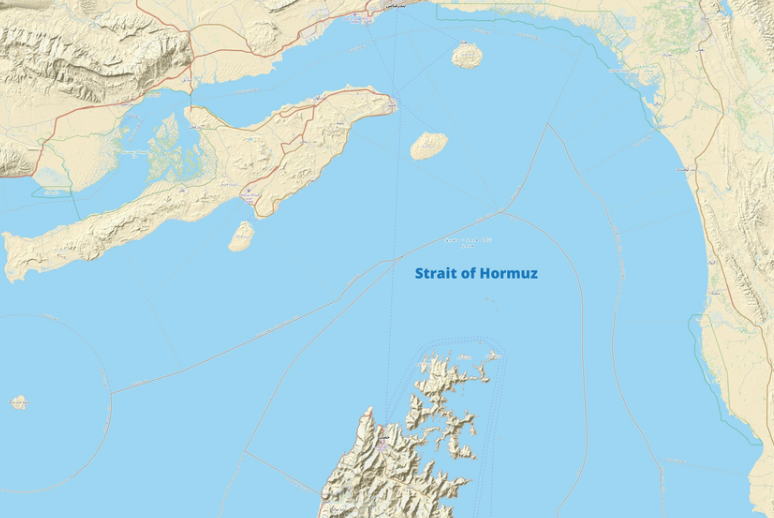
Hormuz
It’s hard to avoid the inference that all that the price decrease really conveys is wishful thinking and a susceptibility to believing whatever Donald Trump says or suggests. If the closure of the Strait suggested a decrease in supply, then the cease fire, the peace talks, and Trump’s rhetoric all gave the illusion that the Straits crisis would be resolved in a happy-ending way. The decrease in prices, then, doesn’t so much reflect “dispersed information,” as the illusion of information, where the illusion is controlled, not by dispersed information on the ground, but by propagandists in Washington and Jerusalem.
That, it seems to me, is a real objection to Hayek’s thesis. The thesis holds that prices reflect dispersed, decentralized information that no centralized government planner could have. It also claims to convey factual information without conveying the underlying causal structure of that information. The person-on-the-ground knows that something is the case, and that something is about to happen, without having to know anything about why. All that’s asked of him, or her, or us, is knowledge of the arithmetic of pricing and budgeting, nothing more: no knowledge of causes, whether material or otherwise, political or otherwise. No need for understanding. All of that is treated as dispensable, and regarded as reducible to dollars and cents.
The Strait crisis implies that, but also implies the reverse. Prices sometimes reflect facts that can be grasped in simple arithmetical terms, but sometimes also reflect the wishful thinking demanded by centralized planners in the Pentagon and the Kirya. If those planners want you to believe that a crisis is on its way to resolution, then if prices seem to confirm that, people come en masse to believe it, start to act as though it’s true, and thereby “confirm” to themselves that it must be true. Since prices are going down (it’s thought), a resolution of the Straits crisis must be on the horizon–even if we’re all sitting around in the fog with zero visibility of any horizon.
What Hayek missed is what Aristotle got (in Metaphysics I.5-6, in his critique of the Pythagoreans): grasping the world in simple arithmetical terms is a heuristic short-cut that bypasses the need for knowledge of how and why things work. Like all short-cuts, it can be misused, and once misused, can backfire. The epistemic equivalent of backfiring is delusion, which is what pricing can and often does become. Prices can convey information, but can also reproduce delusions. Prices by themselves don’t tell you which thing they’re doing. You have to figure that out.
That’s not what Hayek said, but it’s something that, writing in September 1945, he probably should have thought of. But if he didn’t say it or think of it, maybe it’s time that we did.
Thanks to Suleman Khawaja for the conversation that inspired this post.


The information included in prices also includes products of entrepreneurial error. This is usually regarded as part of the Hayekian theory.
LikeLiked by 1 person
OK, but why doesn’t defeat the whole point of the theory? Prices are supposed to perform a pragmatic function. They’re supposed to obviate the need for further inquiry beyond the face value-ish inferences you’d make if you thought they conveyed accurate information. If what they convey ranges from accurate information on the one hand to wild delusions on the other, and the wild delusions themselves range from the products of entrepreneurial error to the machinations of government (war) planners themselves, then prices don’t perform the pragmatic function that Hayek gives them. In some contexts, prices integrate dispersed information about real conditions. In other contexts, they convey the deliberate confabulations of capitalists, government bureaucrats, and the military-industrial complex. The epistemic agent still needs a way to distinguish between those cases. So prices aren’t the short-cut Hayek makes of them.
LikeLiked by 1 person
The Hayekian claim is that market competition will reduce the degree of error over time. Competition is a discovery process; it doesn’t happen instantaneously. Plus the process works worse, and systematically distorts the signals, to the extent that there’s authoritarian interference in the system, which is your bureaucrats, plutocrats, and military-industrial complex.
LikeLiked by 1 person
I can grant much of what you’re saying but still see a problem for the Hayekian thesis. One problem is that there is an unresolved ambiguity there. On the one hand, Hayek wants to say that pricing is a “discovery procedure.” On the other hand, he seems to want to say that prices are data. The first claim is misleading, the second is truistic, and Hayek doesn’t clearly distinguish between them.
The first claim is misleading because it’s misleading to talk about a discovery procedure that incorporates error. Even in contexts where error is part of some discovery process (like psychotherapy), it’s part of the discovery process because there is an explicit mechanism for weeding it out of the discovery process. In therapy, it’s catharsis or insight. But Hayek doesn’t seem to have any analogue to that.
The second claim is truistic because it’s obvious that prices tell you something about the world. The question is what.
By running these two things together, Hayek overstates what prices tell us and how. He makes them seem more reliably truth-tracking than they are, and gives the impression that they reduce our epistemic burdens much more than they do.
I don’t think it’s obvious that market competition really reduces the degree of error over time. What pricing does is to facilitate coordination in very local ways, regarding expectations closely related to pricing itself. Where demand is elastic, people make adjustments. So that’s what ends up counting as “success.” If error is being reduced here, it’s being reduced in a very narrow context. But that’s compatible with the systematic reproduction of lots of error nearby. Think of how many people treat the price mechanism as literal evidence of the “magic of the market,” where what they mean is that in “free markets,” impersonal processes are “deciding” things divorced from actual human agency. The operation of a price system doesn’t do anything to reduce errors like that.
If competition is a discovery process, you need to know where in a given process you are to discover anything through it. That means you have to introduce a broader explanatory and normative framework to make the right inferences from the prices you encounter. That’s not an indictment of the price system, but it’s definitely not what Hayek regards as the point he’s trying to make.
As I said to Joe, Hayek’s thesis works best on cases of simple textbook scarcity (and particularly in cases where demand is elastic). But once you start looking at real-world cases where politics influences prices in real but subtle ways, you get a signal-extraction problem. Prices send a signal, but the signal is surrounded by noise. If you don’t differentiate, you’re misled, as so often happens. The more you insist on Hayek’s point–that prices are an epistemic short-cut of some kind–the more vulnerable you become to the noise that can surround a price, and the less able to extract the right signal from it.
LikeLike
“But once you start looking at real-world cases where politics influences prices”
Again, the fact that political action distorts the informational benefits of the price system isn’t an objection to the theory, it’s one of the central claims of the theory.
LikeLike
I guess this is one of those classic disputes about whether something intended as a feature ends up being a bug, however it was intended. Microsoft Co-Pilot (the AI program) can’t be deleted from the most current version of Microsoft Word, and was designed not to be deleted. Microsoft wants Co-Pilot to be ubiquitous. But as someone who wants to write without distraction–without being followed everywhere by the Co-Pilot icon–I regard that as a bug.
Hayek wants to suggest that the price system has the informational benefits it has because it conveys the dispersed information necessary for market coordination in a simple quantitative form without the need for understanding of the deeper causal or normative context. You just look at the price, and you know what needs to be known in order to engage in market coordination.
But once you introduce all of the necessary caveats that later Hayekians have introduced, you realize that so many provisos have to be added to the original thesis that little of the original remains. Suppose that political action distorts the informational benefits of the price system. But now suppose that political action is ubiquitous and can often be subtle. Yes, theoretically, that fact by itself is not an objection to the theory. But it also tends to alter what Hayek took to be the prescriptive upshot of his thesis. Contrary to the suggestion of the whole essay, we can’t just read a prescription off of a price (which I think is what he wants to say). We now have to ask how politics “distorted” the price. And that requires causal-normative inquiry of a kind that contradicts the prescriptive upshot of “The Use of Knowledge” and limits it significant ways.
I think Hayekians want to say that market coordination is a thin sort of activity that requires a very thin sort of informational in-put. If tin is scarce, the price goes up, so setting aside inelasticity of demand, you know that you have to economize on tin. Likewise if gas prices go up, the conclusion is: drive less. But what this implies is that as a prescriptive matter, the thesis only really works if we make some very artificial assumptions (or restrict it very narrowly). When a price signal is narrowly tailored to some very narrow goal, you can extract the signal from the noise in such a way as to economize on your epistemic resources. But the minute that ceases to be the case, you face a signal extraction problem that complicates everything that Hayek says in “The Use of Knowledge” (without necessarily contradicting his basic thesis that prices convey dispersed information).
In other words, the moment you take a wider view to engage in some broader planning than “How do I get to this immediate goal before me?”, you face the problem of figuring out how to extract the signal conveyed by price from a huge amount of noise. You need a lot of background knowledge and a general framework of inquiry. “Stocks Hit Record High as Wall St Looks Beyond War,” is The New York Times’s headline for April 15. “Stocks Extend ‘Astonishing’ Rally as Middle East Tensions Ease Further,” says The Times on April 17. What conclusion should an investor draw? One view is that Wall Street is right: the war is over, and boom time is here. Another is that on this as on so many things, Wall Street inhabits a delusional dream world. Price is less a “discovery procedure” here than just another datum (alongside a million others) in a discovery procedure very different from the one Hayek describes.
I don’t dispute that Hayek or Hayekians could say, “Well, what else do you expect in a world where the State exists and is both meddlesome and ubiquitous?” But if that’s so, prices tell us much less than Hayek thought they could. If the State is meddlesome and ubiquitous, prices convey ubiquitously distorted information. It becomes a mystery what prices are telling us even in the most apparently straightforward cases, like residential real estate. Does the price of a house on Zillow reflect facts about supply and demand, or facts about the Master Plan of the municipality it’s in? In the latter case, the price reflects facts about central planning. But then the price system can’t be an alternative to central planning, which is how Hayek presents it. In practice, problems like these end up becoming an objection to the original thesis.
LikeLike
I still don’t see how it’s an objection. “If the State is meddlesome and ubiquitous, prices convey ubiquitously distorted information” is a perfectly Hayekian thought. I guess it’s an objection to the kind of vulgar-libertarian move that treats the benefits of free competition as a case for the status quo, but it sounds like you want a broader target.
LikeLike
Everything that Roderick said, and to simply add that Hayek’s argument is that this imperfect process is far superior to the entirely centrally planned alternative.
Hence the joke that if there ever were a global communist revolution, it would be best to let Hong Kong remain free so that the planners could have an accurate set of prices to structure their plans.
LikeLike
Attack of the Biehlosopher! My point isn’t that we should establish socialism or that the price system is a bad thing, but that Hayek’s argument is both a little over-hyped and a little unclear. There’s a trade-off between the simplicity of the signaling function that prices are supposed to have, and the epistemic power that Hayek attributes to them. Hayek wants to suggest that prices convey a lot of signal in a simple, transparent, quantitative way. I grant that that works for some things. If the price of tin goes up, market actors economize on tin. But once you get to more complex examples, you have to extract a usable signal from a lot of noise. Does a drop in the price of oil signal that the supply problem is about to ease? Or does it just signal that lots of traders can all be in the grips of the same delusion? Well, it can’t legitimately signal both. But in practice it does. You don’t have to accept socialism to think that prices aren’t the discovery process Hayek made of them.
It also doesn’t help Hayek to say that well, prices incorporate both rational and irrational expectations. I’m the last to dispute that. But the problem is, if that’s true, they can’t economize on conveying accurate information to market actors. Market actors are left having to sift the sense from the nonsense reflected by the price.
Take any market where the price is subtly but ubiquitously affected by central planners (like any market connected to warfare). In markets like that, prices will reflect supply and demand in relation to the manipulations of central planners. But if that’s so, Hayek’s sharp distinction between a free market price system and central planning breaks down.
Even aside from something as exotic as warfare, pricing often takes place within some centrally planned system. Just think of ordinary real estate, which takes place within the context of municipal planning. Coordination takes place in the real estate market, but it does so alongside “Master Plans” and Planning Boards etc.. The price reflects central planning but still facilitates coordination in the weak sense Hayek had in mind. The problem is, that isn’t what he said, or meant.
No matter how you slice it–no matter how friendly you are to free markets, or hostile to socialism–I think Hayek has a problem here.
LikeLike