Back in February 2025, I wrote a post here in which I took issue with the trend among physicians of objecting to the use of the word “provider” for physician. Physicians object to that term because they find the “provider” terminology disrespectful and status-diminishing, but my claim was that the objection is itself just an expression of physicians’ narcissism, elitism, and political naivete. Like it or not, physicians are providers and have to get used to being described as team players in a joint enterprise rather than as solo practitioners engaged in some quasi-Romantic quest.
Some readers agreed, but others disagreed. Of those who disagreed, some thought I was exaggerating physician elitism, while others thought I was blind to the fact that “provider” talk is an invention of insurance companies, designed to promote their agenda. Respondeo: I don’t think I was exaggerating, and don’t think the latter objection really rebuts what I said. But I agree that more can be said.
If you want an indication of why I don’t think I was exaggerating, here’s a post I saw on LinkedIn the other day. The author, a surgeon and attorney, is the CEO of a major physician practice in California, and the Division Chief of the Department of Otolaryngology and Facial Trauma at San Joaquin General Hospital in San Joaquin County, California. Last I checked, his post had received some 67 comments, largely from physicians, almost all of them positive. Here’s the post in its entirety:
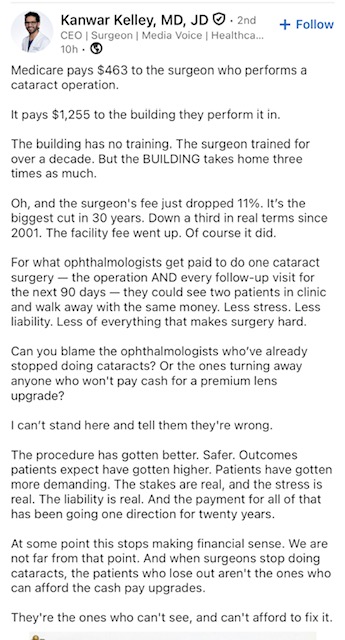
First let’s clarify the nature of the complaint. Narrowly understood, the complaint concerns Medicare reimbursements for cataracts, but the more general point concerns Medicare reimbursement for surgical procedures as such. Since CMS is a trend setter in health care, the underlying point really applies to third-party reimbursement for medical procedures as such.
Medicare (we’re told) pays the surgeon $463 per cataract, and pays “the building” $1,255. The objection is not that the sum of the two figures, $1,718, is too low, but that the ratio involved, 463:1255, is lop-sided. In other words, only 34% of the total fee goes to the physician, whereas 66% goes to “the building.” Presumably, progress would be made if we changed the 34% paid to the physician to something like 40% or 50% or even 60%. In other words, the surgeon should not be getting $463/case but something more like $600, $700, $800 or even $900/case. In the ideal world, I guess, the ratio would be reversed altogether: the surgeon would be paid $1,255 and “the building” $463. Notice that this change could be made even if the aggregate payment stayed the same. The issue, to repeat, is not that $1,718 is too little, but that 34% of any reimbursement is unfair, at least if we’re talking surgery, and you’re the surgeon.

The key to understanding the fallacy–and elitism–involved in this post is to unpack the metaphor of “paying the building.” The implication seems to be that Medicare is paying 66% of the reimbursement to a building, an inanimate object. And it seems at first absurd that 66% of a fee should go to an inanimate object that’s put no effort into doing the procedure, while only 34% of the fee goes to the hard-working person who’s put so much skilled effort into the case, not just in the OR suite during the procedure but en route to that destination, starting in med school, or even pre-med or before. There’s a real sense in which this physician seems to be saying that ophthalmologists should be paid more per cataract case than $463 because they took (and presumably aced) organic chemistry back in high school, and biochemistry in college, and gross anatomy during their first semester of med school. That was hard work however long ago it took place, making payment in kind a fair demand today.
I asked someone outside of health care what she thought “paying the building” referred to in this context. She naively gave me a list of costs associated with inanimate objects: the building itself and the equipment within it. That’s not an unreasonable guess, and not precisely wrong, but it’s highly misleading. Maybe a quarter of the cost goes to paying things like the facility itself, equipment, and utilities. A good 75% of the rest goes elsewhere. It’s telling that the author elicits his readers’ sense of righteous indignation without making any effort to itemize the actual costs involved, particularly the costs beyond specifically building-related ones. My guess is that he’s relying on and exploiting the naivete involved in responses like my friend’s.

In fact, as in higher education, the largest fixed costs involved in “payment to the building” are labor costs. What the author has done is to equate the labor of the entire surgical services staff minus himself with an inanimate object, the building, and turned this into an occasion for righteous indignation at their expense. Having done so, he’s then wondered out loud about the supposed unfairness of the surgeon’s receiving “only” 34% of the Medicare reimbursement while dozens of other people divide up the remaining 66%. In other words, his complaint is: Why is the surgeon receiving a mere $463 of the reimbursement while the several dozen other people involved in the case are receiving a whopping $1,255? Wouldn’t fairness better be served by the surgeon’s receiving, say, $600 or $700 or $800 while the other several dozen people received $1,118 or or $1,018 or $918? To which the only appropriate answer is, not really.
The underlying assumption is that the surgeon is the Prime Mover Unmoved of the entire case, whereas the rest of the staff consists of inanimate objects that make no appreciable contribution to the case at all. Like a mere building, they just sit there, mute, passive, and inactive–at most looking pretty–not doing much of anything, much less anything that deserves any significant part of the reimbursement. At no point does it cross the author’s mind that if $463 is too low a reimbursement for one person, surely $1,255 is far too low for several dozen. It’s as though the several dozen others were merely rentiers cashing in on income that belongs to the single bona fide producer involved.
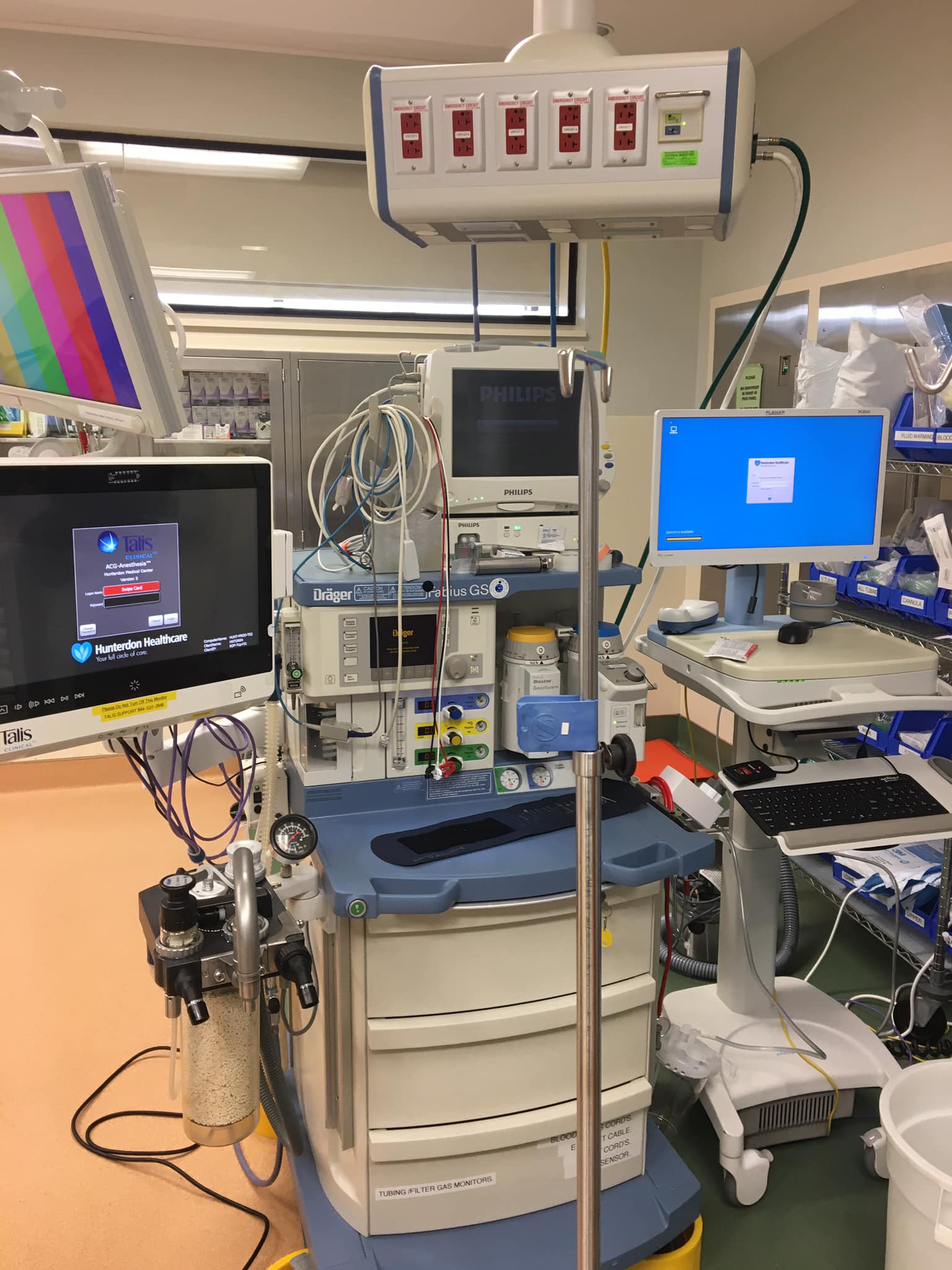
Even if we make the ridiculously unrealistic assumption that only one dozen other people are involved in the case, and that all twelve of them will be splitting the reimbursement equally, the surgeon is receiving a reimbursement that’s roughly four times greater than any one of theirs. If he can complain about a reimbursement of $4x, surely they can complain about a reimbursement of $x. But if they can complain about a reimbursement of $x, they have even greater grounds for complaining about someone who’s saying that they should receive less so that he can receive more.
In the real world, far more than a dozen people work a case, and they don’t come close to dividing the non-surgeon’s portion of the reimbursement evenly, or anywhere near that. Here’s a generic, very conservative list of the personnel involved in a surgical case:
Anesthesiology
Nursing
Surgical technicians
Sterile processing staff
Pharmacy staff
Infection control
Cleaning and environmental services (EVS)
Scheduling staff
Billing personnel/denials management
Regulatory compliance
IT
That’s eleven categories of worker, but there’s likely to be more than one worker in each category. So it’s reasonable to think in terms of several dozen workers, not one dozen or even two.
And some of these workers are being paid peanuts. If the surgeon is making $463 per case, it’s entirely reasonable to think that each EVS worker will be making something like $4.63 for the same case. It’s not progress, all things considered, for the physician to push his reimbursement from $463 to say, $700/case with the result that EVS is pushed from $4.63 to well below $4. If the complaint is that at $463/case the surgeon has to make up for lost revenue by doubling up on volume, the same, after all, will be true of EVS. But if the surgeon gains on revenue at the expense of the EVS worker, the latter is having to double up on volume in order to get the surgeon paid a higher rate.
You don’t have to be a Marxist to see the exploitation there. And though EVS is at the bottom of the hierarchy of Surgical Services, the same general principle applies to some degree at higher levels as well. The surgeon can’t legitimately demand more by equating the scrub nurse with “the building,” and insisting, implicitly, that the increase in his cut come at her expense. But that’s what’s happening here, and ironically enough, happening in the name of fairness.
Here’s a list of the non-personnel drivers of cost:
Operating room space
Surgical equipment
Disposable supplies
Medications used during the procedure
Utilities and electricity
Malpractice insurance for the facility
Building maintenance
Rent or mortgage
Depreciation on equipment
Administrative overhead
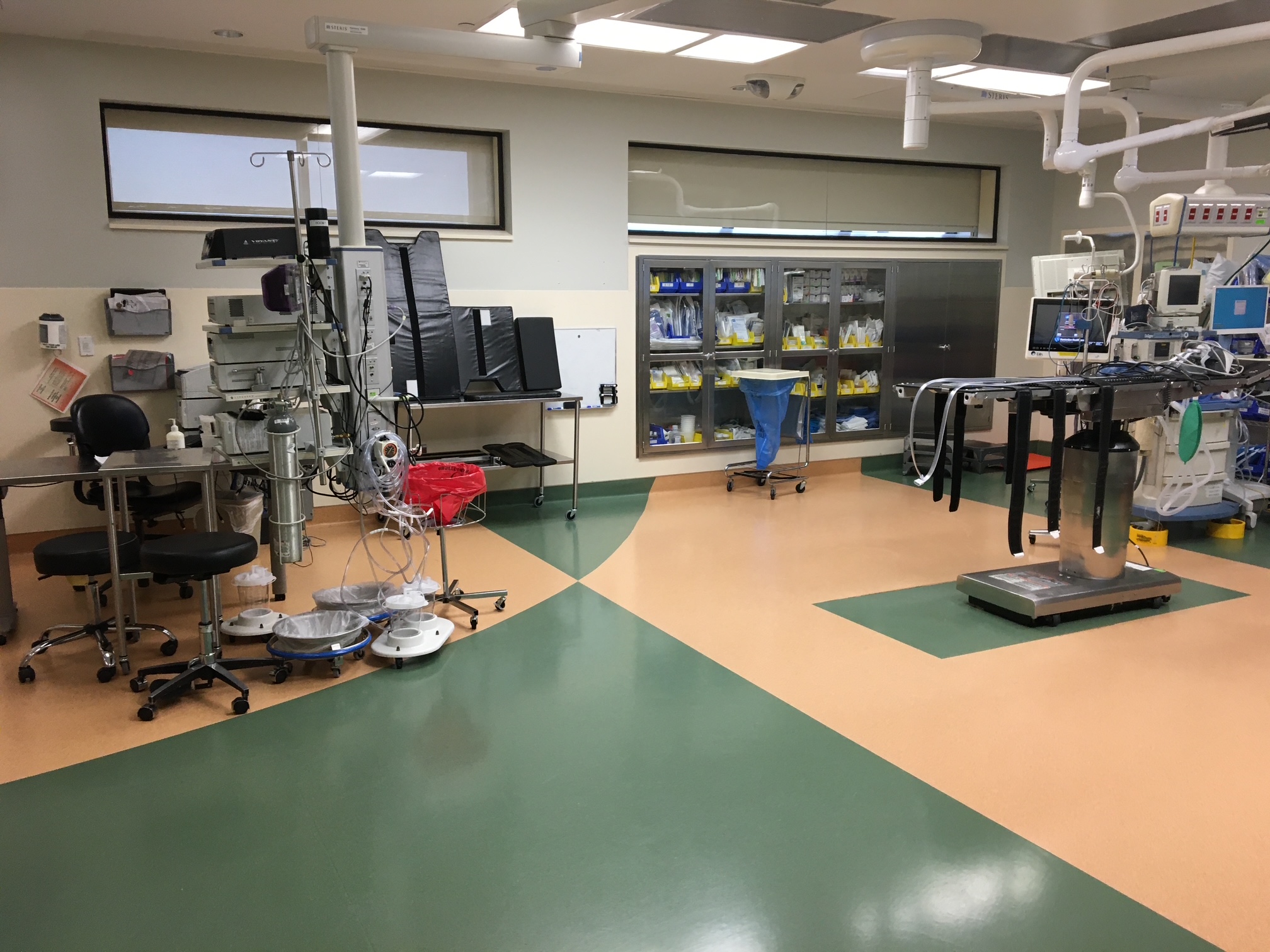
You could say that this part of the reimbursement really is going “to the building,” but it should also be clear that all of these things need to be paid for, that all are expensive, and that none is dispensable. You could be Harvey Cushing, Michael DeBakey, or Victor Parsonnet for all it mattered, but subtract the equipment or supplies or medications from the OR suite, and you might as well be doing surgery in Gaza.
I’m agnostic on the issue of Medicare reimbursement rates as such. I don’t doubt that there’s a case to be made that reimbursement rates should be higher. But that’s compatible with saying that even at the higher rate, the physician should get no more than 34% of the payment. What should not be happening is that physician reimbursements should be increasing at the expense of non-physician personnel simply because physicians regard them as dispensable. But that’s what this physician seems to believe, as implicitly does his amen-corner on LinkedIn.
A surgical case is not reducible to what happens in the time between the surgeon’s stepping into the OR suite and his leaving for the next case. The case begins well before that and ends well after. If every surgical case began when the surgeon walked in, every surgery would begin before the patient was sedated–and would likely end in iatrogenesis. If every surgical case ended when the surgeon left the suite, the issue of reimbursement would become moot: billing and denial management are, after all, part of the case; cut them out, and no one gets paid for anything. Yes, the surgeon is crucial, but no, he’s not the whole case. There are people at either end of the case that matter to the case, and deserve a substantial part of the reimbursement.

I’m not a sociologist, so I can’t tell you exactly how common this surgeon’s views are. I can only tell you that having spent a lifetime around surgeons and having worked in an OR, I’ve encountered such views often enough to find them a recurring phenomenon. Too many surgeons (not all, of course) regard themselves as the center of some imaginary universe of their own, and relegate everyone else on the case to a netherworld of relative insignificance. At any rate, when a surgeon equates the rest of the surgical staff with “the building”and complains that they’re being paid too much because his efforts matter and theirs don’t, we have a textbook case of the professional narcissism and elitism I was referring to in my earlier post.
We also have a case of the same naivete at work. Say what you want about CMS, but unlike this physician, they know how a facility charge is itemized, and know better than to be fooled by rhetoric that equates “payment to the building” with payment for services rendered by a couple dozen hospital workers. Demanding higher physician reimbursement on the grounds claimed by this surgeon is not a rhetorical strategy calculated to work with them or work beyond LinkedIn. But LinkedIn isn’t where the decisions are made, CMS is. Things won’t change until physicians figure that out. But they won’t figure that out until they realize that they’re not the solo practitioners so many of them imagine themselves to be. They’re team players in a team effort. They win if the team wins, and they lose that way, too.
Thanks to Hilary Persky, whose views I solicited and then described as naive, uniformed, and misleading. Thanks also to Jill Delston and to Hilary for feedback on the earlier post.
 Policy of Truth