I had a conversation the other day with a friend who just started law school at Columbia. This person told me that on the first day of orientation, the first-year law students were visited by officials from Columbia’s so-called Office of Institutional Equity (OIE). According to OIE, the chant “From the River to the Sea, Palestine Will be Free,” is presumptively to be understood as advocacy of genocide, as discrimination against Jews, and therefore as a violation of Title VI. Anyone who chants it thereby becomes a candidate for reprimand, suspension, and/or expulsion. So they were instructed not to chant it. A couple of things can be said about this, I think.
One is that I personally regard it as an open and debatable question whether the staff from OIE should be shot. There’s really no way to understand the prohibition that they’re enforcing here except as an active, if indirect, contribution to Israel’s genocidal war effort. If so, it is at least arguable that in doing so, they turn themselves into functionaries for the Israeli military. If so, they are combatants, and under that description, candidates for being shot at by other combatants. And if you’re a candidate for being shot at, you’re a candidate for being shot. Certainly, that’s the in bello rule that Israel itself has adopted, and if Israel can do it, it’s arguable that others can.
Or so I think. These are all conditional claims, and I’m more interested in affirming the conditionals than in affirming either the antecedents or the consequents. But I think any good faith advocate of “viewpoint diversity” would have to concede that I have a point here. I should add that I myself am not a combatant in any war and have no desire to be one. Nor am I giving anyone advice about what to do. I’m just clarifying what’s up for debate.
Notice that I say that good faith advocates of viewpoint diversity would have to concede that I have a point. Bad faith ones would, I’m sure, recoil in horror from my claims, and some might even demand its withdrawal. But anyone recoiling in horror at this point has to explain why. Military affairs are discussion-worthy, and targeting is a venerable topic in that domain. Any student of international relations will have spent time studying mutual assured destruction in nuclear warfare, as I once did. The idea is that possessors of nuclear weapons deter other possessors by targeting their assets with destruction, including their civilian populations and infrastructure, on the premise that a first-strike means destruction for the initiator (along with just about everyone else).
No one makes any pretense in these discussions that mutual assured destruction satisfies the Principle of Double Effect, or civilian immunity, or proportionality or anything else. The focus, particularly in discussions of counter-value targeting, is elsewhere. It’s taken for granted that we’re targeting innocent civilians; it’s taken for granted that we have to. Discussion proceeds from those assumptions. “The targeting of civilian populations,” writes Richard J. Samuels, an expert in the field, “is associated with the condition of mutually assured destruction in that it destroys vulnerable “soft” targets and can wipe out entire populations.” This doesn’t much like moralistic hand-wringing to me.
Maybe deterrence theory is all wrongheaded, but it’s certainly regarded as discussion-worthy; you can’t just say “This is so very wrong,” wring your hands, and be regarded as a viable interlocutor. When I learned deterrence theory as a prospective foreign service officer at Princeton, we were taught counter-value theory in a coldly clinical spirit, as yet another exercise in applied game theory, and no one was allowed to make any moralistic fuss about it. You got scolded if you did. If you can’t make a fuss about Multiple Independently Targetable Re-Entry Vehicles with Nuclear Warheads, you shouldn’t make a fuss about racking a 9 mm Glock, pointing it at the various personnel of Columbia’s OIE, and pulling the trigger. Right?
Right. So here is the question: why is it OK to discuss the total destruction of the world, but not the assassination of the members of Columbia’s OIE? Even on purely consequentialist grounds, it seems uncontroversial to me to say that far more good would likely be done, all things considered, if we dropped a bomb on the OIE (or honestly, on Columbia itself) than if we responded to a nuclear first-strike as mutual assured destruction dictates. This seems like one of the easier questions in any consequentialist problem set. And yet, that’s not typically the way it’s received. I stand under some threat of a visit from the police for writing this post. But I would stand under none if I wrote one in favor of counter-value theory.
Which brings me to my last point. Consider the people who regard themselves as the good faith advocates of viewpoint diversity nowadays, Heterodox Academy among them. I don’t see these people granting viewpoint diversity to Hamas, Islamic Jihad, or the PFLP, or asking whether maybe these guys had a point when they attacked Israel on October 7. I don’t see them adopting the Russian point of view on the Russian invasion of Ukraine, and asking whether Putin had a point, either. They seem to be taking for granted that these viewpoints are off the table, and assuming that viewpoint diversity is to be sought elsewhere. I don’t see why. I’d rather discuss the views of Hamas or Putin than half the things that are au courant today.
For all of their talk about “viewpoint diversity,” how exercised are they, really, by restrictions on viewpoint diversity of the sort typified by Columbia and aimed ubiquitously at pro-Palestine activists like me and my BDS buddies? I don’t mean to suggest that they’ve said nothing. What I mean is that what they’ve said has obviously been said in a minimalist and pro forma spirit to ward off unwanted criticisms of hypocrisy or double standards. But their heart isn’t in it. They really don’t like us, and secretly seem to wish that we would either self-destruct and die, or failing that, suffer the same fate as the last 200 Palestinian journalists. What exercises them is wokeness, and alternatives to it.
Hamas is neither woke nor an alternative to wokeness. Hamas’s ethos comes from a different moral universe altogether. I would know, because unlike, say, Jonathan Haidt, I’ve actually spent time with some of its members, and had hours-long conversations with them. That’s viewpoint diversity: studying stuff that’s completely outside your ken, not studying the other side in an irrelevant pseudo-debate that you’ve confected for lack of anything better to discuss.
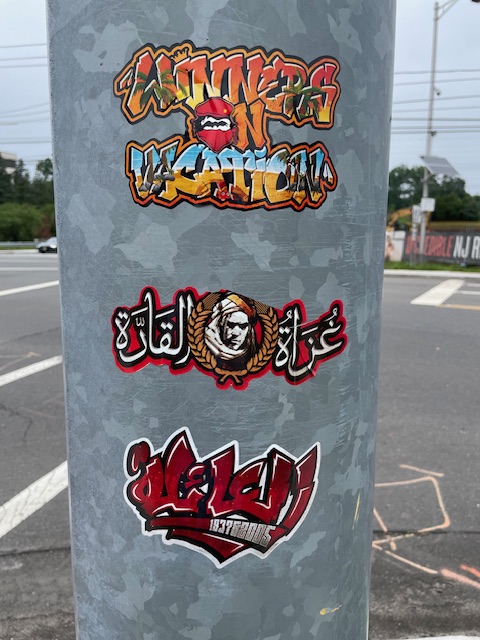
Open AI refused to generate an image for this post, flagging its content, so here is a Moroccan gang sticker I saw that says “From Gaza to Al Qaeda.” Talk about viewpoint diversity!
What’s equally obvious is that the contemporary advocates of viewpoint diversity are not particularly concerned about the restrictions we pro-Palestine activists face, precisely because they don’t face them and never will. They know that what affects us doesn’t affect their self-selected membership. I was at Heterodox Academy’s conference two months ago. I was probably the only pro-Palestine person there, and surely the only explicit defender of Gaza Solidarity Encampment. My presentation was the only frontal attack on institutional neutrality at the whole conference–the only one out dozens of sessions, and hundreds of presenters. Not one of their sessions focused on the specifically Zionist threat to academic freedom, and not one focused on the imperative to avoid complicity in Israel’s genocide.
It would in fact have been jarring even to speak about a “Zionist threat to academic freedom” at that conference. Even mentioning such a thing would have smacked of “anti-Semitism” to this supposedly anti-identity-politics bunch, and might well have reminded them of the Protocols of the Elders of Zion (whether they’d read it or not). But the Zionist threat to free speech was the $64 million elephant in the room, or however that phrase goes. It’s not as though Columbia’s OIE is hunting down partisans of Heterodox Academy. I wouldn’t be surprised to find partisans of Heterodox Academy within Columbia’s OIE.
Imagine yourself at an academic conference while a genocide is taking place in Gaza and a war is being waged on Iran–as your own country spirals into fascism–where everyone around you is desperately trying to pretend that the biggest problem higher education faces is the threat of “wokeness” and DEI Statements. What the fuck is this? Do you laugh or do you cry? Granted, no one criticized Gaza Solidarity Encampment within my hearing. My keffiyeh was like a visual leper’s bell that told them when to change the subject. But that omission itself spoke to the air of pretense and unreality. The people most in dread of Gaza Solidarity Encampment couldn’t bring themselves to mention it in the presence of the one guy who was at Gaza Solidarity Encampment. What they wanted was a reprieve from Gaza, not a confrontation with it.
I’m not saying that Heterodox Academy should add more pro-Palestine people or critics of institutional neutrality to their membership or their conference, or that they should start to sell a Heterodox Academy brand of keffiyehs, or even throw together some panels on the Zionist threat to academic freedom or the imperative to avoid complicity. It’s their organization, and they can run it however they want. I have no particular desire to become a member, and am not demanding equal time at their events, or anything like it.
What I’m saying is that they should dispense with the charade of viewpoint diversity and the phony posture of neutrality they seem so anxious to half-assume. They should be honest with themselves and with their audience about who and what they are and what they stand for. They are political centrists who profess to be equally alarmed at what they regard as the equally unreasonable extremes of Left and Right. Trump and wokeness are threats of equal magnitude to them. Genocide is a taboo word. Anti-Semitism is the radix malorum, whether they can define it or not, and more so if they can’t.
Their entire conception of “viewpoint diversity” is structured by the assumption that throughout the 2010’s, things tilted too far to the Left, but now, under Trump, things are tilting maybe (just maybe) a little bit too far to the Right. I don’t agree with that viewpoint, but many people do, and it is, I suppose, debatable in the way that many arcane academic things are. But it is not “neutral” and does not sit on some neutral baseline for reasonable discussion. Centrism is not neutrality or impartiality, but a kind of partisanship–a delusional kind that wants to pretend that it isn’t one, but a kind nonetheless.
Why not face it? Heterodox Academy’s conception of institutional neutrality is simply an attempt to make the academic world safe for centrists like themselves. That doesn’t (and didn’t) make the academic world safe for unapologetic extremists like me, or anyone with views like mine. It doesn’t have to, but since it obviously doesn’t, they should drop the pretense that they’re defending academic freedom “from nowhere,” and just come clean about what they’re doing.
There is nothing literally neutral about the Lukianoff-Haidt thesis that higher education labored under a left-wing monopoly during the 2010s and requires remediation for it now. I was an academic at a dozen+ institutions on two continents and three US states from 1994-2020, and sorry, but the account I read in Lukianoff-Haidt’s Coddling of the American Mind (the Bible of the “viewpoint diversity” crowd) doesn’t tally with my experience at all. At no point in my career did I experience the supposed “leftist monopoly” that they regard as axiomatic or proven by their book–including when I was myself a member of the Right and reliably voted Republican, or was a garden-variety Democrat and voted for centrists. I simply don’t buy their story, never did, and don’t see why anyone should.
So is it time to bomb Columbia University? I don’t know. I could go either way. I have friends there, for one thing, so I worry about collateral damage. Besides, Alison and I occasionally spent time in Harlem and Morningside Heights, so I have fond memories of the place that might be wrecked by reckless or indiscriminate bombing. And yet there is a bona fide case to be made in favor of it. Maybe someone at Columbia can invite me to give a talk? In the name of viewpoint diversity, no less. Don’t worry, I won’t be armed. I don’t even own a gun. My mouth has been trouble enough for me. Invite me to explain myself, O Columbia, and I’ll show you exactly what I mean.
 Policy of Truth