This post was written by Princeton Alumni for Palestine, of which I’m a member. The piece was rejected for publication in both The Daily Princetonian and Princeton Alumni Weekly. I’ll be posting a separate post on this topic, in my own name, in the near future.–IK
To understand why students had to disrupt Naftali Bennett’s visit to Princeton on April 7th, it’s important to recenter ourselves on the ongoing events abroad. Hamas and Israel at last reached a ceasefire earlier this year which was recently unilaterally broken by Israel, which resumed its genocidal campaign. Full stop. Well over 50,000 deaths have been recorded, of whom 15,000 are children. These figures are a “clean” report. Yet according to the Lancet, the death toll is likely to be in the hundreds of thousands. Anyone who does a cursory search of the images from Gaza will find evidence of the deeply horrid violence that Israel has been enacting on innocent civilians, journalists, medics, UN aid workers and children. And let us not forget that these weapons are supplied with our tax dollars.

The April 7 protest. Photo: Irfan Khawaja
The reason it’s fundamental to preface this piece with the above (which to some of you may be redundant or boring and to others incite outrage) is that Bennett’s invitation to speak is much more than just an act of “open dialogue” as Rabbi Steinlauf called it in an interview. Ultranationalist Naftali Bennett, a former prime minister and minister of defense of Israel, enacted policies that deepened genocidal currents. He is even further right than Netanyahu, who currently has an ICC-issued warrant for his arrest. Even those who believe in the myth of a two-state solution will gawk at how Bennett opposes the creation of a Palestinian state. And during this latest genocide, he has repeatedly called for blocking of electricity, water and humanitarian aid.
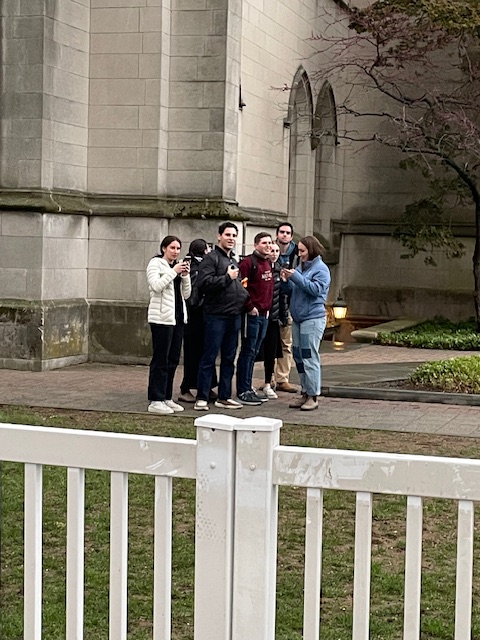
Pro-Israel counter-protesters. Photo: Irfan Khawaja
Bennett also has a personal hand in the slaughter of civilians. In 1996, as a commando leader, Bennett committed the Qana massacre in a UN compound that killed 106 innocent civilians. This is a war crime that he is yet to be held accountable for. Bennett’s history is littered with terrible acts and statements that are well known. And Bennett is not the first proponent of ethnic cleansing that Princeton has invited. In 1988, pro-genocide Meir Kahane was invited to speak. In 2012, Princeton invited another former prime minister Ehud Olmert who once stated: “We firmly stand by the historic right of the people of Israel to the entire Land of Israel.”
But let’s quote Naftali Bennett’s response to a disruptor at the April 7th event at Princeton: “Instead of whining for the past 80 years and building your own future, you have focused on killing the Jews. It’s time the Palestinians stopped whining.” How can someone simultaneously hold the position that they will not allow for a Palestinian state and to tell Palestinians to stop whining? Perhaps because he, and many others in the current Israeli apartheid government, have in mind a 1-state solution, where Zionist ideology is supreme.

Anti-Zionist protesters. Photo: Irfan Khawaja
Bennett has been doing the rounds at universities in preparation for a PM-run once again. At Columbia, students were arrested for protesting his invitation. Meanwhile pro-Palestinian student activists, including Mahmoud Khalil, are being abducted for voicing their opinions without a single condemnation from President Eisgruber. On April 7th, the president of SJP, Azhar, told the press that her best friend’s 14 year old brother, American-Palestinian Amer Rabee, was shot and killed in the West Bank the prior day. Ultimately, the established academic institutions are privileging Bennett’s ”free speech” and legacy of violence over the voices of their students. I suppose that Princeton’s motto should be: prestige above all, even if blood soaked.
And now you can begin to understand why students had to lead the way to disrupt Bennett. His words represent real policies and actions that commit brutal violence. His presence on campus makes students unsafe. Allowing tense Shin Bet or Mossad agents on our campus is unthinkable. And despite that, students were brave in carrying out their duties, not to allow a war criminal on their campus. His presence on campus is not open dialogue. Speech is free so long as it remains speech. But speech that expresses violent domination starts to take on much more sinister qualities: propaganda and the justification of genocide.
If there should be any investigation of hate speech on Princeton’s campus, it should begin with Naftali Bennett’s deeply racist characterization of Palestinians as a bloodthirsty people.
Rabbi Steinlauf and the Princeton administration should know better than to invite a mass murderer to campus.
 Policy of Truth