Princeton’s Silence Is Our Weapon
I’m happy to report that Princeton University’s undergraduate student Referendum #5 has passed by a margin of 68% to 32%. A referendum has to win at least 65% of the vote to pass, so this one did. The referendum calls on the University to disclose and divest all direct and indirect holdings in companies involved in weapons development, manufacturing, or trade, giving first priority to disclosing and divesting direct holdings in Boeing, Lockheed Martin, Northrop Grumman, RTX (formerly Raytheon), and General Dynamics, weapons manufacturers with documented ties to human rights violations. It also calls on the university to increase communication and accountability on socially responsible investments with the student body and campus community.
The phrase “disclose and divest” is there because the University systematically refuses to disclose the nature of its investments. It’s a known fact that the University has in the past invested in weapons manufacture (as per the text of Referendum 5), and also a known fact that it maintains extensive contacts with both the American and Israeli military-industrial complexes (as illustrated by the extremely cozy reception on campus given to Eric Schmidt, former CEO of Google, a member of both). But the details remain unknown by design.
The unknowns shouldn’t be exaggerated, though. The existence of some connection or other is a little difficult to deny. Consider one micro-example: Google’s Schmidt has just co-published an article in Foreign Affairs with General Mark Milley, the latter having been recently installed as a Visiting Professor at Princeton’s School of Public and International Affairs. The article essentially makes an advertising pitch for a grand partnership between industry, academia, and the military, to be put at the service of the grand strategies of the US and Israel, among other things. “America Isn’t Ready for the Wars of the Future,” they tell us. Obviously, no AI has been developed to question the imperative to keep finding new wars to fight.
Conveniently enough, Schmidt showed up at Princeton about a week ago to make an in-person advertising pitch for a recent co-authored book about AI that coincides with the university’s own AI initiative, Genesis: Artificial Intelligence, Hope, and the Human Future. Turns out that the book’s principal author is Henry Kissinger. Because who else would you turn to for posthumous thoughts on hope and the human future than America’s pre-eminent war criminal? Asked about military matters by divestment activists at the talk, Schmidt side-stepped. Generally side-stepped but not hard to discover is the fact that Schmidt is chair of the Special Competitive Studies Project, an explicitly military venture, whose principals essentially spend their days looking for people (or whole populations) to kill with the newest technologies on the market.
Around this same time, an undergraduate opponent of Referendum 5 took to the student paper to make an unintentionally revealing set of disclosures.
This past summer, I witnessed firsthand how defense companies support our democratic allies. I interned at Palantir Technologies — a company that designs software to aid in combat, among other initiatives. Like many of my peers at Princeton who work at similar companies, I was drawn to Palantir’s mission-driven ethos. Although I worked on healthcare infrastructure for civil servants, I had the chance to witness Palantir’s extraordinary efforts to support Ukraine in its resistance against Putin’s aggression.
In other words, Princeton is set up to treat involvement in the defense industries as a totally normal, uncontroversial, indeed unquestionable matter. Students regularly intern at firms that design military hardware or software. Even if they don’t work directly on military matters, they are confirmed in their belief that there’s nothing wrong with doing so: it’s all just national “defense” aimed at bolstering our national security. If they don’t work on combat software one summer, they’ll do it the next, or after they graduate. One day they’re assisting the proxy war in Ukraine, the next they’re assisting the genocide in Palestine. Who could object? Only a defender of Putin or Hamas. The last day of Gaza Solidarity Encampment, Princeton, April 2024
Full disclosure: when I taught at Princeton in the early 2000s, I myself thoughtlessly wrote letters of recommendation for students looking to intern at George W. Bush’s White House, State Department, and Pentagon, heedless of what they were doing there, just as I wrote letters at Felician (a Military-Friendly School) for students heading to various branches of the military. I then taught my share of broken veterans once they came back.
But forget letters and fraught encounters during office hours. In the mid-90s, I worked for Raytheon at the Carnegie Center office park, just outside of Princeton, two miles east of campus. Granted, I worked on electrical co-generation, but I worked for one of America’s premier defense contractors. Right now, I work in revenue cycle management for health care, but I work for a company whose majority equity stakeholder is the Carlyle Group. Carlyle’s Aerospace and Government Services vertical is all about killing people. So I know the drill: I know firsthand the blindness that normalizes and keeps our war machine going and comfortably ensconced in higher education. I know the blindness that induces Americans to think that Hamas uses civilians as human shields but American defense industries don’t. But I also know that blindness is what it is.
The task of documenting the exact degree of the University’s involvement in the US-Israeli military-industrial complex, particularly given the obstacles it’s presented to doing so, is in one sense a task for experts in intelligence gathering, not students or amateurs. Princeton University has an endowment of some $34 billion, the size of the GDP of a small country. And its financial and other entanglements with the military-industrial complex go well beyond its endowment. Given its explicit, official commitment to concealment, the details of its investment portfolio and other involvements can, by design, only be uncovered by the equivalent of a hostile intelligence service or perhaps a Julian Assange or Edward Snowden. But those very examples underscore the potential for discovery. No one could possibly have dreamed up the contents of Wikileaks or the Snowden revelations until they found their way to the public domain. Once they did, they were game changers. If only there was a Chelsea Manning or Edward Snowden or Reality Winner to do the job on Princeton. If only.
Ought implies can, however. We can’t expect students or amateurs to function like Julian Assange or a professional intelligence service. We also can’t pretend that because we lack omniscience, we know nothing. It’s not plausible to think that the University is refusing to disclose the nature of its investments in the military-industrial complex despite lacking any. It obviously has no scruples about investing in weapons per se. And the companies named in the referendum would be lucrative options.
If Princeton has developed otherwise invisible scruples about investments in weapons manufacture, it can re-assure its critics by saying so. If it really doesn’t have any such investments, no harm can be done in truthfully saying so. What it can’t legitimately do is take refuge in concealment, evade the fact that circumstantial evidence indicates that it is invested in the military-industrial complex, and then pretend that no issue of complicity arises because it has left us all in a carefully contrived state of quasi-ignorance. Arguably, though, that is its basic strategy.
Historical considerations are relevant here. It’s worth remembering that the University has in the past played a similar game when it was invested in highly problematic ventures, e.g., in the case of its investments in apartheid South Africa. As Robert Kinloch Massie puts it in his authoritative account of divestment from South Africa, applied specifically to Princeton: “The tactic most favored by university officials when confronted with student protests was the sidestep.”* So the demand to disclose and divest from weapons manufacturers is continuous with past concerns and past demands, however much stonewalling, resistance, and evasion it’s now encountering. All of that is par for the course. But the university’s institutionalized preference for evasion can in principle be overcome. The university has in the past dissociated from “companies complicit in genocide in the Darfur region of western Sudan,” and “dissociated from segments of the fossil fuel industry” after a concerted campaign to induce it to do so. It should be able to muster up the moral initiative to do so again.
 The heyday of Gaza Solidarity Encampment Princeton, April 2024
American universities’ relationship to the US-Israeli military industrial complex is a little bit like its relationship to NCAA athletics: gigantic, systematic, ubiquitous, grotesque, institution-warping, ferociously defended, but fundamentally normalized. It has grown over time, fundamentally uncontested. When contested, each institution’s defenders have circled the wagons, mustered up a series of manipulative but fundamentally fallacious arguments, and pressed on. We now inhabit an academic milieu in which either you take NCAA athletics and university weapons investments for granted, or else you are the outsider and interloper bent on destroying the “neutrality” and “institutional restraint” that these things are taken to represent. Football stadiums, tailgates, Defense Department contracts, and investments in high tech weaponry are now uncontroversially considered to be core components of the University’s Mission. A commitment to disclosure and justice is not. Those things are “activism,” and activism (on the conception that reigns in certain circles) violates the ideals for which higher education stands.
What is this alternative, “neutralist” conception of higher education? Once you strip away the rhetorical smokescreen, what it amounts to is the claim that academia is an amoral money-making, research-producing enterprise, committed on principle to concealment, committed on principle to an Eichmann-like conception of compartmentalization and moral indifference, committed on principle to supplying the munitions for a genocide, pretending it isn’t, and arresting anyone who resists the charade. Put this starkly, I’m almost glad I got thrown out of it. But the glee just conceals the sorrow that we’ve come to this.
I don’t know whether it’s sad or amusing that the very universities that take such pride in the part they played in the American Revolution now take pride in the services they provide to the forces of political reaction. The American Founders, many of them educated in the Ivy League, managed to combine a rigorous commitment to academic inquiry with an activist commitment to justice. They were unapologetic practitioners of boycott, divestment, sanctions, cancellation, and doxxing and eager to go to war over what in retrospect should strike us as relatively trivial grievances.
The catalyst for the American Revolution was the British occupation of Boston, a militarily anemic affair of some seventeen months, prompted by the Stamp Act and the Declaratory Act, and punctuated by the Boston “Massacre.” The Israeli equivalents of the Stamp Act and Declaratory Act have been going on now in Palestine at an exponentially higher level of intensity for six decades. Much larger equivalents of the Boston Massacre (which killed five people) have taken place virtually every day in Gaza for the last 400+ days. Yet academic quietists have the audacity to tell us that activism subverts the specifically academic mission of the university. In fact, academic activists made this country. The American Revolution was an activist affair. If you want to repudiate campus activism, start by repudiating that. If activism destroys universities, the American Revolution should have sounded the death knell of American higher education 240 years ago. Does anyone believe that it did?
I deal every day with activists at Princeton and Rutgers. The ill-informed characterizations I read about them are a blatant, egregious, calculated fraud. Campus activists, we’re told by these armchair sociologists, are rabid, anti-intellectual, mushy-headed humanities students bent on mindless activism at the expense of rigorous academic work.
No they’re not. The activists I’ve met (and work with)—undergrads, grad students, post-docs–are the best students I’ve encountered in the quarter century I spent in the academy. They are smart, earnest, and dedicated, an unusual blend of realism and idealism. They come from every discipline studied at the university—classics, psychology, and political science, as well as geology, biochemistry, and engineering. They come from every demographic, as well—Jews, Christians, Muslims, atheists; Americans and foreigners; blue-bloods and underclass; queers and straights; and everything in between. They are as committed to their academic careers as they are to justice, and see the two things, with good justification, as fundamentally inter-connected. They are, as far as I’m concerned, one of the few bright spots in the darkness represented by contemporary higher education, which is more than can be said of many of their elders, and above all, their critics.
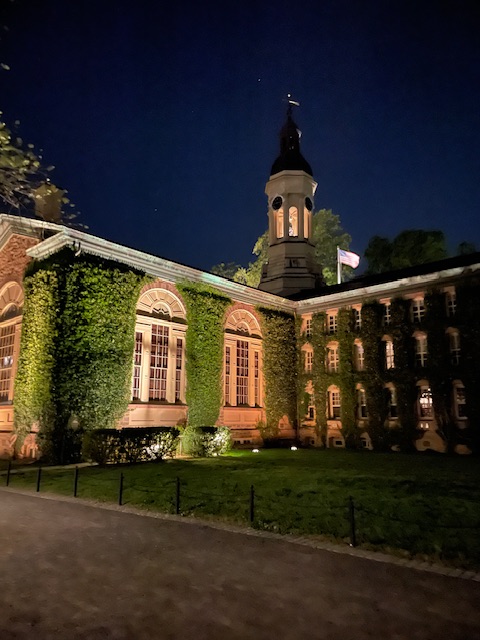 Nassau Hall by night, April 2024
The universities are among the last sanctuaries of justice left in this country. As they go, we go. Remember that when you criticize the activism that takes place there. Once it’s wiped out, what will take its place, and where? The people in the forefront of the attacks on campus activism either have no answer to that question, or have an answer that leads us by design to the abyss. Unless that’s your preferred destination, we can’t wait for salvation by constitutional convention or angelic intervention. We’ve spent two years being brought to the brink of nuclear war in Ukraine, and one year watching a genocide in progress in Palestine. The machinery of mass deportation is being set up and readied for action. The least we can do is to avoid complicity in the evils that our ruling class brings about.
The people who currently dominate higher education are indistinguishable in function from the British troops that occupied Nassau Hall during the Battle of Princeton: like those troops, Princeton’s administrators are genteel but amoral functionaries of power, aristocrats dedicated to the rationalizations that make hierarchy and reaction a political reality. The American revolutionaries famously drove the British from Princeton by cannon fire. I’m not proposing anything quite that violent, just questions seeking answers, driven by persistence, and fueled by outrage. The university’s administration can evade what we ask, but the ensuing silence makes its own noise.
In short, the University’s silence is a weapon to be used against it, and Referendum 5 is a first battle in a long war to be fought to full victory. Expect more.
* Massie is in fact a Princeton alum, Class of 1978. The quotation in the text comes from p. 251 of Loosing the Bonds. Massie’s account is usefully compared with the carefully exculpatory account in Nancy Weiss Malkiel’s Changing the Game: William G. Bowen and the Challenges of Higher Education, pp. 214-223: “While he did not completely defuse the issue, [President Bowen] succeeded in keeping the lid on, at holding the institution together at a time when South Africa caused so many colleges and universities to blow up” (p. 223). Note the assumption that divestment from apartheid South Africa would somehow have destroyed the university, a claim for which Malkiel provides zero evidence, and which also has zero plausibility. Contrary to common belief, the university never fully divested from South Africa, preferring instead to take half-measures while letting the clock run out on apartheid. The rhetorical strategy was instead to confabulate a threat of self-destruction from divestment which required indefinite procrastination.
 Policy of Truth
J. R. R. TOLKIEN: So I’m going to introduce crystal balls into my story that seem as though they’ll be useful to the good guys by facilitating the telepathic and/or clairvoyant acquisition of various sorts of information but actually are being manipulated by an evil authoritarian warmonger Dark Lord to deceive the users with misleading and one-sided information. And my name for such a device shall be … “palantir.”
PALANTIR TECHNOLOGIES: We are totally going to name our military software company after those thangs.
LikeLike
Not just a literary device:
https://en.wikipedia.org/wiki/Palantir_Technologies#:~:text=The%20company's%20name%20is%20derived,other%20parts%20of%20the%20world.
My favorite thing about all this is that for the last year, we’ve heard endless rhetoric about how it’s OK to bomb hospitals because Hamas is operating inside them. No actual evidence of Hamas presence is ever required to rationalize these attacks. It’s considered sufficient just to assert over and over that Hamas operates “in hospitals.” That’s enough to destroy any particular hospital. If Hamas ex hypothesi operates in hospitals, then Hamas actually operates in every hospital.
Now consider Palantir. Here is Wikipedia describing Palantir in Israel:
Same article describing its relationship to ICE:
As the first paragraph suggests, Palantir has a contract with NHS in the UK. It also has contracts in the US with Babylon Health, the NIH, the CDC, the FDA, and the VA. In other words, Palantir is a military outfit but also a health care outfit. How then does it differ from the allegations about Hamas, except that unlike Hamas, Palantir’s connection to the health care system is eminently demonstrable? If Kamal Adwan Hospital is a Hamas front organization, how are the NIH, CDC, FDA, and VA not front organizations for the US military? If Kamal Adwan Hospital can be bombed and destroyed with impunity, why can’t Walter Reed Army Medical Center, or any NIH, CDC, or FDA facility? If Palantir is recruiting out of Princeton University, why doesn’t that make Princeton University a military target? And every other university doing the same thing?
The Lord of the Rings reference seems hyperbolic until you actually look at what these people are doing. Palantir Technologies really is like something out of Lord of the Rings. I have to wonder whether its founders actually intended the implication you make.
As the Sex Pistols put it, “all crimes are paid”:
RevenueUS$2.23 billion (2023)
Operating income US$120 million (2023)
Net income US$217 million (2023)
Total assets US$4.52 billion (2023)
Total equity US$3.56 billion (2023)
Though it didn’t come out in the cut and paste, there’s a green triangle next to all those indicators. All of them are going up.
LikeLike
Gary and I had dinner with one of the founders of Palantir in 2010. Though I don’t think I knew about the Palantir connection then, I just knew about PayPal.
LikeLike
You should invite him to the Author Meets Critics event on Gary’s book this spring! Christianity, Palantir, and the Nation-State: A Study in Political Psychopathology.
LikeLike
I think his interest in libertarian scholarship has undergone something of a decline over the past decade.
LikeLike
Pingback: Divestment and Complicity | Policy of Truth