Tag Archives: warfare
Goya’s “Lucha Con Palos” (1820-23)
Francisco Goya, “Fight with Cudgels,” (1820-23)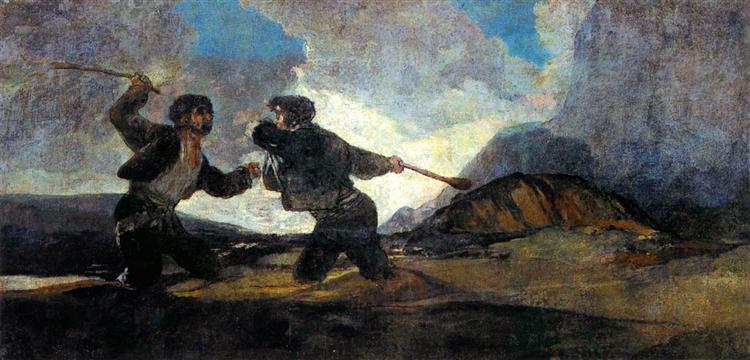
Those Who Forget the Past
“Starve away.”–Randy Fine
“We must be able to will that a maxim of our action become a universal law: this is the canon of moral appraisal of action in general.” —Immanuel Kant
“The Jews, unable to leave the City, were deprived of all hope of survival. The famine became more intense and devoured whole houses and families. The roofs were covered with women and babies too weak to stand, the streets full of old men already dead. Young men and boys, swollen with hunger, haunted the squares like ghosts and fell wherever faintness overcame them. To bury their kinfolk was beyond the strength of the sick, and those who were fit shirked the task because of the number of the dead and uncertainty about their own fate; for many while burying others fell dead themselves, and many set out for their graves before their hour struck.” Continue reading
Loyalty and Academic Freedom
The case of Jonathan A. C. Brown
A friend is circulating an Open Letter to Interim President Robert Groves of Georgetown University in defense of Professor Jonathan A.C. Brown, the Alwaleed bin Talal chair of Islamic Civilisation in the School of Foreign Service. Apparently, during the recent US-Israel-Iran war, Brown made this comment on X:
“I’m not an expert, but I assume Iran could still get a bomb easily. I hope Iran does some symbolic strike on a base, then everyone stops,” Brown wrote on X.
Brown has tenure and a chaired professorship at Georgetown, but apparently the comment was regarded as frightening enough to call for his suspension. The President forced Brown to delete the tweet, and he’s now been suspended. He’s also been removed as chair of his department, which I believe was intended as punishment. Continue reading
Walzer on Rules, Crime, and War
In an argument on the (supposed) logical distinction between jus ad bellum and jus in bello, Michael Walzer argues that war is different from criminality because while war is an activity governed by rules and conventions, criminality is not:
The crucial point is that there are rules of war, though there are no rules of robbery (or rape or murder). The moral equality of the battlefield distinguishes combat from domestic crime (Just and Unjust Wars, p. 128).
Even apart from questions about the logic of this argument–whether Walzer’s intended conclusion follows from the premises–his main premise strikes me as obviously false. There certainly are “rules of robbery.” The basic rule of a robbery is: if you hand over your valuables, you’ll be allowed to live; if not, not. This is an unjust rule, but it’s certainly a rule. The rule can of course be violated; it would be naive in a given case to expect strict adherence to it. But I think it’s unquestionably “the rule of robbery.” Continue reading
Who Was Killed at Pahalgam?
With no provision but an open face
Along the straits of fear
–Led Zeppelin, “Kashmir”
There’s a phenomenon in journalism that I call iterated small-scale error. Take any well-known event. Look carefully at the journalistic consensus that’s formed around it. Once you do, you’ll find that the consensus has come to adopt a number of small-scale errors, errors that make some difference to the narrative arc of the story, but that seem at first too trivial to correct.
Eventually these errors, uncorrected, come to acquire the status of authoritative truth that displaces the actual truth. Iterated over months or years, they come to be widely accepted. Once that happens, it becomes possible to realize in retrospect that the small-scale errors ended up reinforcing a medium- or large-scale myth. The myth is so ideologically convenient that one wonders whether the initial introduction of the small-scale errors was deliberate, a kind of trial balloon to test the limits of tolerance for error. At that point, of course, the question becomes moot, so that the issue never gets pressed. Those who do press it are dismissed as unhinged conspiracy theorists. Then, everyone moves on. Continue reading
The Kids Are Alright
No, you really don’t “have to” take sides in the war (if that’s what it ends up being) between India and Pakistan. I’m an ethnic Kashmiri, and have no shortage of things to say about recent events, but ultimately, I think this kid Kaif not only gets things right, but deserves a Moral Equanimity award for what he says here.
Continue readingWhy Princeton students disrupted Naftali Bennett
This post was written by Princeton Alumni for Palestine, of which I’m a member. The piece was rejected for publication in both The Daily Princetonian and Princeton Alumni Weekly. I’ll be posting a separate post on this topic, in my own name, in the near future.–IK
To understand why students had to disrupt Naftali Bennett’s visit to Princeton on April 7th, it’s important to recenter ourselves on the ongoing events abroad. Hamas and Israel at last reached a ceasefire earlier this year which was recently unilaterally broken by Israel, which resumed its genocidal campaign. Full stop. Well over 50,000 deaths have been recorded, of whom 15,000 are children. These figures are a “clean” report. Yet according to the Lancet, the death toll is likely to be in the hundreds of thousands. Anyone who does a cursory search of the images from Gaza will find evidence of the deeply horrid violence that Israel has been enacting on innocent civilians, journalists, medics, UN aid workers and children. And let us not forget that these weapons are supplied with our tax dollars. Continue reading
PFS on Yechiel Leiter: A Response
I subscribe to an email list owned by a group called Princetonians for Free Speech (PFS), which just today put out an open letter to Christopher Eisgruber, President of Princeton University, in advance of tomorrow’s speech by Yechiel Leiter, Israel’s ambassador to the United States. I don’t ordinarily feel the need to respond to statements by PFS, but in this case, a brief comment is in order. Continue reading
Naftali Bennett at Princeton
What follows are screenshots of a long message from the Instagram page of Students for Justice in Palestine (SJP) of Princeton University (with the Princeton/Palestine Liberation Coalition and SJP’s national and state affiliates), regarding the forthcoming visit to campus on April 7th of Naftali Bennett. I’ll write up a longer comment this weekend, but for now, suffice it to say that I agree with SJP, and wanted to amplify its message. If you click the first thumbnail to enlarge, you should be able to click directly through the whole series. Otherwise, click each thumbnail to enlarge, reading them left to right across the page.
 Policy of Truth