Chris D’Amato, Migrant Rights, and the Exploitation of Anti-Semitism
I mentioned the campaign for an Immigrant Trust Resolution in Clifton a few weeks ago. Unfortunately, I had a scheduling conflict and had to miss the follow-up meeting yesterday. Below the fold is a depressing report from my friend Jeff Hoey, a Clifton resident who’s been leading the campaign. It’s a perfect example of the cynicism that masquerades as philo-Semitism nowadays–and also the right-wing virtue-signaling that passes itself off as “anti-woke.” I encountered a similar phenomenon when I spoke last week in West Orange, which I’ll describe here in the near future. It’s obviously a trend. Continue reading
Tag Archives: Palestine
Disarming Candor
Donald Trump, on the disarmament of Hamas:
They’re going to disarm because they said they were going to disarm. If they don’t disarm, we will disarm them.
Asked how he will do that, Trump responded:
I don’t have to explain that to you. And I spoke to Hamas, and they said, “Yes, sir, we’re going to disarm.”
Stirring the POT (4)
Peace and Justice in Swarthmore
I’m at the Peace and Justice Studies Association (PJSA) conference at Swarthmore College in Pennsylvania. Having a great time. Wish you were here.
Swarthmore is practically a caricature of an old school liberal arts college, half institution of higher education, half feudal estate. It’s hard not to love, but then, I myself am half academic and half landlord–an erstwhile academic with a last name that means “landlord.” So it’s easy enough for me to fantasize having a tenure-stream job here, taking sanctuary from the world amidst the ivy, the wildflowers, the curious, well-heeled students, and the crenellated towers of stone. I didn’t see any administrators, either. Maybe there aren’t any? Continue reading
Against Palestinian Disarmament
I’m not one to give anyone specifically military advice, and I have neither the time nor the inclination to comment on the fraud of Trump’s Gaza peace plan. Only one thing really needs to be said, and said at top volume: under no circumstances should any Palestinian militant group disarm for anyone or anything. That goes for Hamas, Islamic Jihad, the PFLP, the Lion’s Den, and anyone else with a weapon and the will to use it. Do not disarm. Do NOT disarm. To disarm is to commit mass suicide by placing yourself in the hands of confirmed liars and psychopaths. Things are bad, but nothing could be worse than that.
Continue readingRobert Massie at Princeton
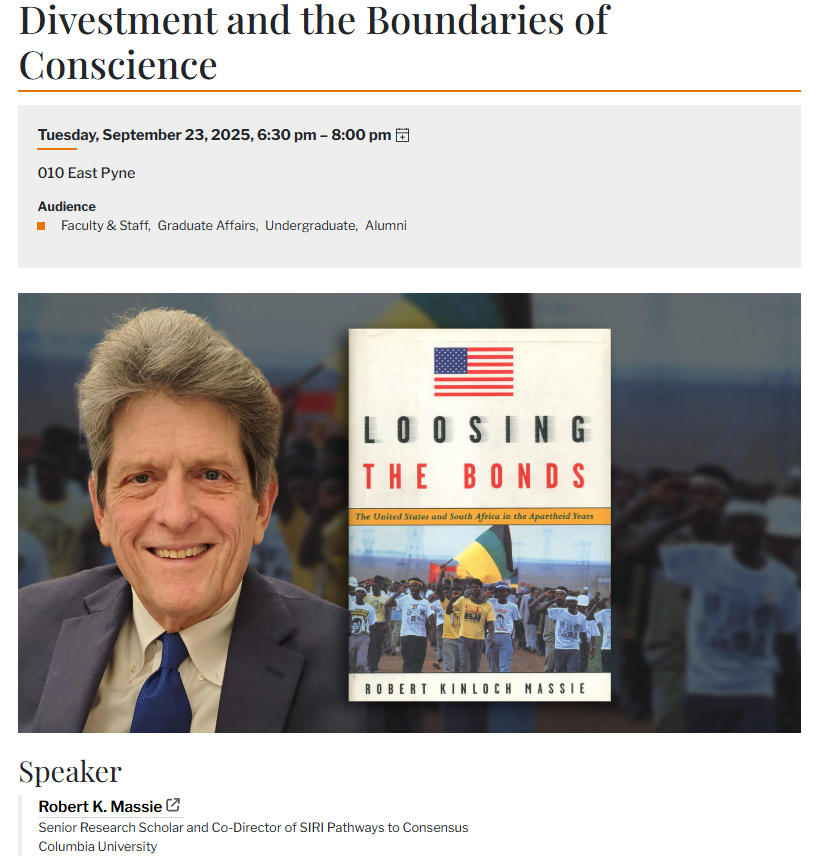
“Divestment and the Boundaries of Conscience”
As regular readers of this blog know, I’ve been involved since 2024 in the campaign to induce Princeton University to divest its holdings, not just from Israel, but from arms manufacture and military affairs as such.
It was about a year ago that I got it into my head to get Robert K. Massie IV involved in our efforts. Massie is one of the architects and chroniclers of the decades-long campaign to divest from apartheid South Africa; I’d first encountered his book Loosing the Bonds twenty years ago, and been impressed by the rigor of his argument, as well as by the wealth of detail and moral passion he brought to the subject. Continue reading
Navy Copter Down
Mikie Sherrill’s defenders are now doubling down on her Naval Academy issue. It isn’t enough for them to say that what she did was wrong, but a long time ago, which might be sufficient. They need to double down because they perceive, correctly, that something larger is at stake. They’re right, but not in the way they think.
Continue readingMorituri Te Salutant
I woke up this morning to find an email from one of my best friends in Palestine, someone who lives in a small village in the South Hebron Hills. I’ve excerpted it below, deleting personal names, and omitting place names and other particulars, and corrected the grammar of one sentence for clarity. It’s in English, but I’ve provided a tl; dr translation just after the block quote. The word “football” refers throughout to soccer. Continue reading
Is It Time to Bomb Columbia University?
I had a conversation the other day with a friend who just started law school at Columbia. This person told me that on the first day of orientation, the first-year law students were visited by officials from Columbia’s so-called Office of Institutional Equity (OIE). According to OIE, the chant “From the River to the Sea, Palestine Will be Free,” is presumptively to be understood as advocacy of genocide, as discrimination against Jews, and therefore as a violation of Title VI. Anyone who chants it thereby becomes a candidate for reprimand, suspension, and/or expulsion. So they were instructed not to chant it. A couple of things can be said about this, I think. Continue reading
“Divestment and the Boundaries of Conscience”
Dreams of Death
I dreamt last night of my late wife, Alison. I didn’t see or hear her, and I was in a mostly unfamiliar place, but her presence was unmistakable. I knew that we were somewhere in Washington Heights near the George Washington Bridge, where we used to live. We were dating in the dream, not yet married, and it was late, so I’d decided to go back home. For some reason, I had to go across the street to a pay phone to call an Uber. It was midnight, but paradoxically enough both bright as noon and dark enough to obscure the way. I called the Uber guy, who was hard to hear, but he said he was coming, and there the dream ended. Continue reading
 Policy of Truth