I’m not one to give anyone specifically military advice, and I have neither the time nor the inclination to comment on the fraud of Trump’s Gaza peace plan. Only one thing really needs to be said, and said at top volume: under no circumstances should any Palestinian militant group disarm for anyone or anything. That goes for Hamas, Islamic Jihad, the PFLP, the Lion’s Den, and anyone else with a weapon and the will to use it. Do not disarm. Do NOT disarm. To disarm is to commit mass suicide by placing yourself in the hands of confirmed liars and psychopaths. Things are bad, but nothing could be worse than that.
Continue readingTag Archives: Israel
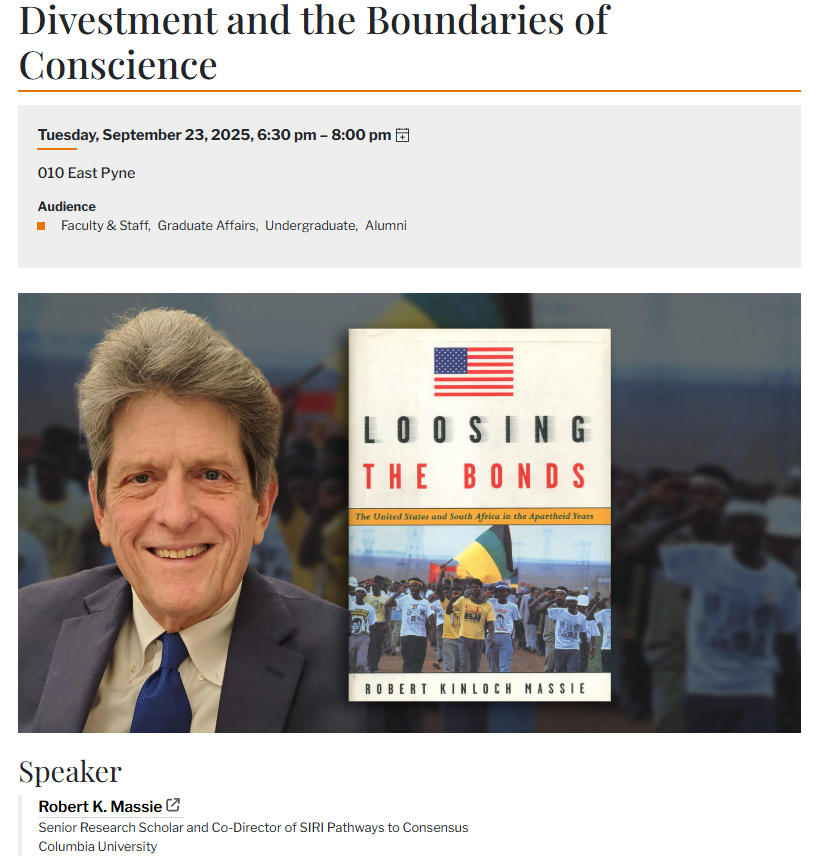
Robert Massie at Princeton
“Divestment and the Boundaries of Conscience”
As regular readers of this blog know, I’ve been involved since 2024 in the campaign to induce Princeton University to divest its holdings, not just from Israel, but from arms manufacture and military affairs as such.
It was about a year ago that I got it into my head to get Robert K. Massie IV involved in our efforts. Massie is one of the architects and chroniclers of the decades-long campaign to divest from apartheid South Africa; I’d first encountered his book Loosing the Bonds twenty years ago, and been impressed by the rigor of his argument, as well as by the wealth of detail and moral passion he brought to the subject. Continue reading
Navy Copter Down
Mikie Sherrill’s defenders are now doubling down on her Naval Academy issue. It isn’t enough for them to say that what she did was wrong, but a long time ago, which might be sufficient. They need to double down because they perceive, correctly, that something larger is at stake. They’re right, but not in the way they think.
Continue readingMorituri Te Salutant
I woke up this morning to find an email from one of my best friends in Palestine, someone who lives in a small village in the South Hebron Hills. I’ve excerpted it below, deleting personal names, and omitting place names and other particulars, and corrected the grammar of one sentence for clarity. It’s in English, but I’ve provided a tl; dr translation just after the block quote. The word “football” refers throughout to soccer. Continue reading
Is It Time to Bomb Columbia University?
I had a conversation the other day with a friend who just started law school at Columbia. This person told me that on the first day of orientation, the first-year law students were visited by officials from Columbia’s so-called Office of Institutional Equity (OIE). According to OIE, the chant “From the River to the Sea, Palestine Will be Free,” is presumptively to be understood as advocacy of genocide, as discrimination against Jews, and therefore as a violation of Title VI. Anyone who chants it thereby becomes a candidate for reprimand, suspension, and/or expulsion. So they were instructed not to chant it. A couple of things can be said about this, I think. Continue reading
“Divestment and the Boundaries of Conscience”
Dreams of Death
I dreamt last night of my late wife, Alison. I didn’t see or hear her, and I was in a mostly unfamiliar place, but her presence was unmistakable. I knew that we were somewhere in Washington Heights near the George Washington Bridge, where we used to live. We were dating in the dream, not yet married, and it was late, so I’d decided to go back home. For some reason, I had to go across the street to a pay phone to call an Uber. It was midnight, but paradoxically enough both bright as noon and dark enough to obscure the way. I called the Uber guy, who was hard to hear, but he said he was coming, and there the dream ended. Continue reading
Those Who Forget the Past
“Starve away.”–Randy Fine
“We must be able to will that a maxim of our action become a universal law: this is the canon of moral appraisal of action in general.” —Immanuel Kant
“The Jews, unable to leave the City, were deprived of all hope of survival. The famine became more intense and devoured whole houses and families. The roofs were covered with women and babies too weak to stand, the streets full of old men already dead. Young men and boys, swollen with hunger, haunted the squares like ghosts and fell wherever faintness overcame them. To bury their kinfolk was beyond the strength of the sick, and those who were fit shirked the task because of the number of the dead and uncertainty about their own fate; for many while burying others fell dead themselves, and many set out for their graves before their hour struck.” Continue reading
The Final Solution Is Here
I am, as I write this, sitting in a quiet air-conditioned room in a comfortable, modern library. The window to my right looks out on a bright, sunlit plaza. The plaza hosts a series of high end restaurants, each of which is set up for outdoor dining, with umbrellas to ward off the sun and heaters to keep out the chill. There are maybe a couple of dozen people out there enjoying the warmth of the evening. In observing this scene, a non sequitur of a thought occurs to me. Five thousand seven hundred miles away, a genocide is taking place. People are being starved, shot, and bombed to death with obscene abandon. The contrast is so stark as to be surreal. And yet it’s real. Continue reading
Loyalty and Academic Freedom
The case of Jonathan A. C. Brown
A friend is circulating an Open Letter to Interim President Robert Groves of Georgetown University in defense of Professor Jonathan A.C. Brown, the Alwaleed bin Talal chair of Islamic Civilisation in the School of Foreign Service. Apparently, during the recent US-Israel-Iran war, Brown made this comment on X:
“I’m not an expert, but I assume Iran could still get a bomb easily. I hope Iran does some symbolic strike on a base, then everyone stops,” Brown wrote on X.
Brown has tenure and a chaired professorship at Georgetown, but apparently the comment was regarded as frightening enough to call for his suspension. The President forced Brown to delete the tweet, and he’s now been suspended. He’s also been removed as chair of his department, which I believe was intended as punishment. Continue reading
 Policy of Truth