When I was in Palestine last summer, I mentioned that I was going to be spending some time visiting Jewish settlements in the West Bank. I ended up doing less of that than I had planned. And though I did some, I never got the chance to write about it here. Since then, I’ve just let the experience fester in some dark corner of my brain, watching the “third intifada” from afar with that experience in mind. Part of the reason for failing to write was, as usual, lack of time. But part of it was that I met people out there who knew more than me, had spent more time there than me, and were likely to do a better job than me at saying what needed to be said.
Tag Archives: Israel
Contingency, Irony, and Brutality: Richard Rorty in Israel
As the years went by, and we both left Princeton, I am afraid the incipient intellectual and emotional gulf between us got wider, especially after what I saw as Dick’s turn toward ultra-nationalism with the publication of Constructing Our Country. Dick had always been and remained to the end of his life a “liberal” (in the American sense, i.e., a “Social Democrat”): a defender of civil liberties and of the extension of a full set of civic rights to all, a vocal supporter of the labor unions and of programs to improve the conditions of the poor, an enemy of racism, cruelty, arbitrary authority, and social exclusion.
Problems from Locke
I can’t be the first one to have spotted this, but I’m teaching Locke tomorrow, and on my nth reading of Second Treatise chapter 5, it suddenly occurs to me that the assumption commonly attributed to Locke as the starting point of his discussion of property in the Second Treatise is much more puzzling than I had previously realized. Locke says that revelation makes clear that God gave the world “to mankind in common.” But how can that be, if God gave the Promised Land to Israel?
A Teenager Shall Lead Them
I’ve written before about the resort to force and intimidation in discussions of Palestinian-Israeli issues, but here’s an outrageous case– and one that hits close to home. From The New York Times, “Tweets About Israel Land New Jersey Student in Principal’s Office“:
A New Jersey high school student found herself in a social media storm on Wednesday after she live-tweeted and apparently secretly recorded a trip to her principal’s office.
She said administrators warned her that her comments about Israel and a fellow student on Twitter might have violated a state law against bullying.
The student, Bethany Koval, a 16-year-old Israeli Jew, said she had been reprimanded by administrators at Fair Lawn High School in Bergen County for a tweet that contained a string of expletives directed at Israel and expressed happiness that a pro-Israel classmate had unfollowed her Twitter account.
New Jersey has some of the toughest anti-bullying laws in the nation. After the suicide of a Rutgers University freshman, Tyler Clementi, in 2010, it passed the Anti-Bullying Bill of Rights, a far-reaching law with stiff penalties for educators who do not sufficiently respond to complaints of harassment or intimidation.
Read the whole thing for a fuller account of the story. Here’s a January 7 story from the Bergen Record, and here’s a January 8 story from the same place. Muftah reproduces some of the tweets involved. (Unfortunately, Koval’s Twitter feed is no longer operating in the public domain.) Fair Lawn, by the way, is just a few towns west of Lodi, where I teach.
Setting aside whatever narrowly legalistic insanities may reside within the various “anti-bullying” statutes, this is not a morally complex matter. A high school student tweets her political views about Israel. Some of what she says contains profanity. Some is sympathetic to, or appeasing of, Hamas. Some of her peers don’t like what she says. She gets some verbal flak from some of them. One “unfollows” her Twitter account. She doesn’t reveal the “unfollower’s” name in public, but reveals it to someone privately.
I Swear, I Saw a Video of Dozens of Them Celebrating the Tragedy
A celebration “rumor” that turns out to be undeniable for a change. Here’s The New York Times, if you prefer getting the story from the mainstream media.
For the record, I regard what’s depicted in the video as free speech, and reject the idea that it involves (or should be regarded as involving) “incitement” in any legally actionable sense. Let them dance.
I guess this gives new meaning to that old line from Billy Idol: “Hey little sister–what have you done?” It’s a nice day to start again.
Fernando Teson on the Palestinian State
Fernando Teson’s opening gambit on a discussion of the two-state solution to the Israel-Palestine dispute:
Almost everyone has by now accepted the two-state solution for the Israeli-Palestinian dispute.
I wasn’t aware of that. Evidence, please?
While we wait for Teson’s response, feel free to read the Wikipedia entry on the One-state Solution at your leisure. It doesn’t seem to cohere with his claim.
If the wait is long enough, you can also read through Reason Papers’s 2012 symposium on Sari Nusseibeh’s version of the one state solution from his book, What Is a Palestinian State Worth? (Note: The RP link goes to a long PDF that requires lots of scrolling down. You can also access the symposium this way, if you find it more convenient.)
As PoT readers know, I spent two months in Palestine this summer teaching at Al Quds University. My experience doesn’t cohere with Teson’s off-the-cuff claim any more than the Wikipedia entry does. And don’t make me haul out back issues of the Journal of Palestine Studies, please. Because you know what will happen if I do?
Postscript, 10 pm: I wonder whether Professor Teson could explain in mathematical terms how majorities of 63% of Israelis and 53% of Palestinians amount to “almost everyone.” Do 37% of Israelis and 47% of Palestinians = no one? Feel free, Professor, to use scratch paper and show your work.
If Israelis and Palestinians don’t count, what about retired American diplomats in far-out radical publications like U.S. News and World Report? I mean, the one-state solution is so marginal an idea that it’s being discussed at conferences at obscure places like Harvard.
Oh, not pro-Israel enough for you, huh? Well, then, how about the current Israeli administration? Or Caroline Glick?
Oh wait, too far to the right for you, huh? Well, then, let’s make a left turn. Wrong part of the left? You could always talk to the nice folks at Dissent. They were “rethinking” things five years ago.
While we’re turning left, why not talk to some Arabs along the way? Like this one.
You want a cross-section of ethnicities? Try this. Not that I want to overdo things….
#OpenGaza: Trauma and Hope, First Hand
Just a shout-out to anyone in the north Jersey area interested in attending this event, #OpenGaza: Trauma and Hope, First Hand, taking place this Tuesday, October 27, 8-10 pm at the Palestinian American Community Center of Clifton, New Jersey, 388 Lakeview Ave., Clifton, New Jersey 07011. Speakers include Dr. Yasser Abu-Jamei, Executive Director of the Gaza Community Mental Health Programme, and Ran Goldstein, Executive Director of Physicians for Human Rights, Israel. The event is free. I’ll be there, and easy enough to pick out of the crowd–the fiftyish woman with stylish glasses, suave, oddly masculine looks, and black nail polish. (ht: Mondoweiss)
By coincidence, last month I spent a weekend “conferencing” with Izzeldine Abouelaish, founder of Daughters for Life and author of I Shall Not Hate: A Gaza Doctor’s Journey. Izzeldine, whose daughters and niece were killed in 2009 by Israeli rocket fire in Gaza, is one of those supposedly mythical Palestinians committed to peace despite having endured trauma at Israeli hands. More on Izzeldine’s book once I finish it; for now, I just couldn’t resist mentioning the coincidence of “two-doctors-from-Gaza-with-messages-of-hope-amidst-trauma.”
Mention Gaza to the average American news junkie, and the immediate association is “Hamas” and “Islamist fanaticism.” Not that those things don’t exist, but there are more things in Palestine than are dreamt up by such stereotypes, and I’d like to think that events like the PACC talk and like Izzeldine’s book and foundation will eventually break the reflexive associations of “Palestinian” with “wild-eyed religious psychopath” and replace them with something more respectful of reality. The audacity of hope, to borrow a phrase.
Postcards from Abu Dis (11): Transcendental Questions, West Bank Edition
When you live in the West Bank, you get hyper-sensitive about license plates: yellow plates are Israeli, green plates are Palestinian; yellow plates can go anywhere in Israel or the West Bank (except, in theory, to parts of Area A); green plates are confined to designated parts of the West Bank (e.g., places reserved for the military or Israeli settlers).
I just saw a car on the main street of Eizariyah here in the West Bank (Area B) with Virginia license plates.
How is that possible? And for legal purposes, would it count as a yellow or a green plate?
I have no idea how to answer the first question, but here’s a guess at the second: if license plates follow passports, I’m guessing a Virginia license plate counts as yellow. As an American passport holder with a valid visa, I can go places in the West Bank that Palestinians can’t, including Israeli settlements and militarized zones designated off-limits to Palestinians (e.g., H2 in Hebron). If Virginia plates are treated as equivalent to an American passport (plus visa), the same would be true of them.
My speculation here rests, of course, on the debatable assumption that the presence of the car with the Virginia license plate is legal–an assumption confounded by the fact that the town of Eizariyah is effectively a Lockean State of Nature without laws or law enforcement of any discernible sort. The only “exception” to that rule is the presence of an Israeli military base on the outskirts of town, between Eizariyah and the settlement of Ma’ale Adumim. But it’s not really an exception at all: the Israeli military presence serves as militarized backdrop to life here; it isn’t here for purposes of everyday policing, much less to deal with traffic violations. It’s mostly here to intimidate Eizariyah and environs, and protect Ma’ale Adumim.
That said, unless someone bought a car here and just randomly stuck a Virginia license plate on it (odd but possible), to get it here, the owner would have to ship the car from Virginia to a border crossing controlled by the State of Israel. I can see why someone might want to do that; what I can’t see is why the State of Israel would allow it.

That’s not the sort of Virginia plate I saw, but it does raise the question: if you can drive a car with Virginia plates in the West Bank, how about one with a plate like that? Granted, the State of Virginia has ordered that car owners with Stars and Bars license plates trade them in within about three months (120 days since the original ruling). But that still leaves time to ship one’s car here and drive it around for a few months as a test case. I’d love to see how that works, if only I could be around for it.
Postcards from Abu Dis (10): Americans, Settlements, and Civil Rights
I’ve been away from the blog for awhile, partly because I’ve been traveling a lot, and partly because I’m at work on a presentation I’m giving this week at AQU’s Centre for Jerusalem Studies on American attitudes toward the Palestinian narrative. It’s called “Turning Up the Volume: Why Americans Have Trouble Hearing the Palestinian Narrative.”
The basic idea is this: Americans have trouble hearing the Palestinian narrative because given the way Palestinians make their case, every argument in defense of Palestinian rights can, by disputing certain factual premises, be re-cast as an argument that either proves Palestinian aggression against Jews, or proves a false Palestinian accusation of aggression by Jews.
For instance, if Jewish settlement activity is based on theft of Palestinian land, then of course, settlements are a matter of Jewish aggression against Palestinians. But if settlement activity is simply a matter of voluntary Jewish purchase of voluntarily-sold Palestinian property, then Palestinian opposition to Jewish settlement seems like a form of xenophobia, hysteria, or racism. The factual issues–theft or purchase?–often seem undecidable from several thousand miles’ distance. For that reason, some Americans simply lapse into agnosticism about the rights and wrongs of the conflict. But others insist on having a view despite the apparent inaccessibility of the relevant facts, going by what they regard as the most plausible moral hypothesis. For contingent historical reasons, Americans tend to find Zionist-Israeli claims more plausible than Palestinian ones.
The “contingent historical reasons” have to do with the rhetoric and strategies of the moderate wing of the U.S. Civil Rights Movement (i.e., the wing led by Martin Luther King, Jr.) For better or worse, American moral sensibilities about racial matters are structured by the history and moral assumptions of the King-led camp of the Civil Rights Movement. Given those sensibilities, any political argument bearing a fundamental similarity to the (moderate) camp of the Civil Rights Movement has an edge over any argument that doesn’t.
Now, the King-led camp of the Civil Rights Movement was integrationist rather than segregationist or separatist in its strategies and basic assumptions: it argued that blacks should actively strive to integrate into white society; it rejected both the white segregationist argument in favor of “separate but equal” barriers to integration, and the black separationist argument in favor of a separate nation for blacks. As it happens, Zionist-Israeli arguments tend to sound integrationist to American ears; meanwhile, the Palestinian narrative sounds either segregationist or separatist. Since Americans shy away from segregation or separatism, they opt for the Zionist-Israeli narrative.
For an example of my thesis, consider this 2009 story from The New York Times about the establishment (with conspicuous American support) of the Jewish settlement of Nof Zion within the Palestinian neighborhood of Jabl Muqabber in East Jerusalem. As it happens, I visited Jabl Muqabber/Nof Zion a few days ago; the Palestinian guide I was with took great offense at the presence of the settlers of Nof Zion, and called the settlement’s existence a “provocation.” Here’s how the Times describes it:
Nof Zion, a private Jewish project, is in Jebel Mukaber, a Palestinian Arab neighborhood of East Jerusalem, in territory Israel captured from Jordan in the 1967 war. Israel claims sovereignty over all Jerusalem; the Palestinians demand the eastern part as the capital of a future state.
Even within Israel, the idea of Jews moving into predominantly Arab neighborhoods of Jerusalem stirs heated debate. Two well-known Israeli families refused City Hall’s offer to name the street leading to Nof Zion for their deceased relatives, according to the local Jerusalem press.
But illustrating the complexity of the Jerusalem conundrum, others argue that Jews, Christians and Muslims should be able to live wherever they like. Not allowing Jews to live in certain neighborhoods of the city “is segregation,” said Mr. Hikind, a Democrat who represents several heavily Orthodox Jewish neighborhoods in Brooklyn.
With new tensions surfacing between the Obama administration and Israel over building in contested parts of Jerusalem, the city’s character and future remain central motifs in the stalled Israeli-Palestinian peace talks.
The cornerstone-laying ceremony at Nof Zion took place a day after the Israeli authorities moved ahead with plans for the expansion of Gilo, a Jewish residential district in south Jerusalem also on land captured in the 1967 war. The plans for 900 more housing units drew a sharp rebuke from the White House.
The first paragraph describes Nof Zion as a private project, then goes on to say that Israel claims sovereignty over all of Jerusalem, while Palestinians claim sovereignty over East Jerusalem. The implication seems to be that Nof Zion’s ownership status varies with the sovereignty of the political entity in control of the relevant part of Jerusalem; since the political status of the city is disputed, it follows that the ownership status of property claims within the city must likewise be disputed.
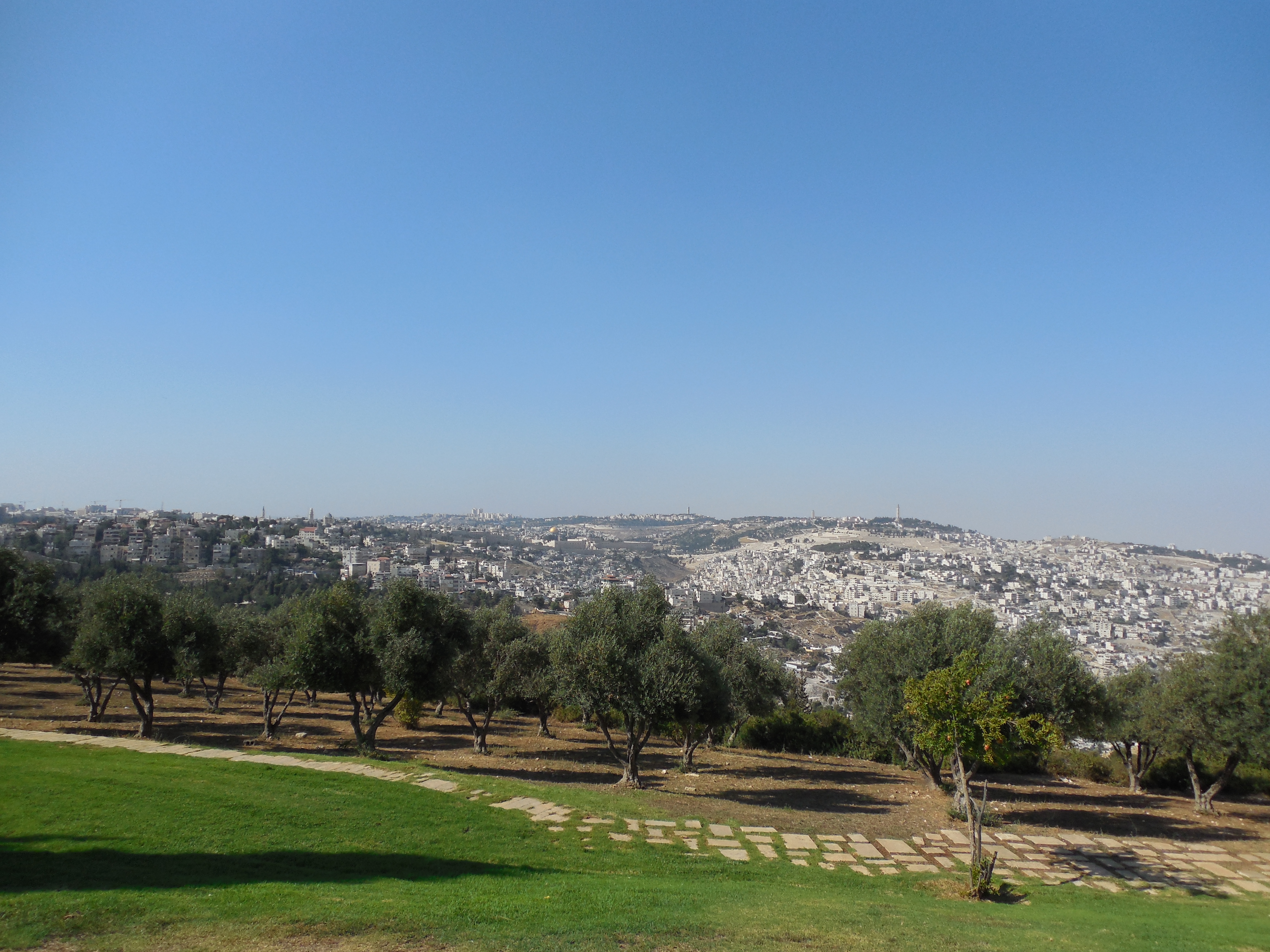
East Jerusalem viewed from the southwest (Haas Promenade)
But if Nof Zion is a genuinely private project on legitimately-bought land, what difference does it make who has sovereignty over Jerusalem? If Nof Zion is legitimately bought, then Nof Zion would seem to belong to its rightful owners–Nof Zion–regardless of who rules, runs, or governs the city. Of course, if it’s not on legitimately-bought land, it likewise makes no difference who has sovereignty over Jerusalem; in that case, morally speaking, Nof Zion doesn’t belong to Nof Zion at all, and ought to be given back to its rightful owners, whoever they happen to be, and whoever is in charge of the city.
In other words, sovereignty is a distraction from the relevant issue. The relevant issue is ownership, and specifically, what Robert Nozick calls “justice in transfer of holdings” (Anarchy, State, and Utopia, pp. 150-51). If the transfer of ownership to Nof Zion is morally illegitimate, then regardless of its specifically legal status, it ought to revert to its rightful owners. This would be a clear case of applying what Nozick calls “rectification of injustice in holdings” (p. 152). It seems to me that the literature on Nozick ignores cases like this, intermediate between ordinary cases of reparation for ordinary theft, and massive expropriations in the distant past.
The second paragraph tells us that the idea of Jews moving into predominantly Arab neighborhoods stirs heated debate. Why? Is it because Arabs simply don’t like Jews, or is it because Arabs fear that the apparently innocuous act of moving into the neighborhood betokens something more sinister, like a coercive take-over? While we’re at it, does the converse hold? In other words, does the idea of Arabs moving into Jewish neighborhoods stir debate? If so, what’s the upshot?
In my experience, settlers insist that Arab opposition to Jewish in-migration is simply a matter of xenophobia or racism. Meanwhile, Palestinians don’t explicitly or effectively argue that Jewish in-migration is a Trojan Horse for house demolitions or coercive territorial capture; they focus instead on the supposed “provocation” of a Jewish presence in an Arab neighborhood as such. But this appeal to “provocation” is a very weak argument, and one almost designed to offend American ears: it simply assumes without further explanation that a Jewish presence in an Arab neighborhood is a provocation, qua Jewish, without explaining what’s provocative about such a presence. It’s as though someone were to describe white peoples’ (or immigrants’) moving into a predominantly black neighborhood as a “provocation” simply because they were the “wrong” race.
In fairness to Palestinians, arguments of the “Trojan Horse” form tend to be dismissed by American audiences a priori as paranoid or anti-Semitic conspiracy theorizing, even when there is good evidence for them, and even when Americans themselves use such arguments in other contexts. So it becomes easy to see why Palestinians tend to be vague at the crucial argumentative moment. But the fact remains: the vagueness drastically weakens their argument.

Demolished Palestinian home, Ras al Amud, East Jerusalem
As for the third paragraph, is Hikind right to think that not allowing Jews to live in Jabl Muqabber is “segregation”? If so, would it then follow that not allowing Palestinians–whether of Israeli citizenship, Jerusalem residence, or West Bank/Gaza residence–to live in Jewish settlements is also segregation? He doesn’t get around to that issue here, and I doubt he ever has. If I had the money, I wouldn’t mind buying an apartment in Ma’ale Adumim. But could I? And invite my Palestinian friends over to hang out and swim in the community pool? Rest assured that there’s no community pool here in Abu Dis or in any nearby Palestinian town.
While I’m on the topic of water, I guess it’s worth adding that the aquifer under Abu Dis is under Israeli, not Palestinian control: “An estimated four-fifths of the water [in the West Bank aquifers] is used by Israel, much of it is piped back to West Bank settlements. Many West Bank Palestinians, however, must rely on wells” (Charles D. Smith, Palestine and the Arab-Israeli Conflict: A History with Documents, 8th ed., p. 511, Map 11.4.) Does that pattern of water use involve segregation or discrimination? I think so.
Anyway, back to land: In my experience, those who defend the settlement enterprise are very reluctant to consider the possibility of Arab residence in Jewish settlements–even when they complain that Arab reluctance to allow Jewish settlements in Arab neighborhoods is “segregation.” Meanwhile, Palestinians regard the idea of applying for residence in a Jewish settlement as either a quixotic waste of time or as something akin to treason, the ethno-nationalist equivalent of a scab’s working for management during a strike. The pro-settlement claim strikes me as hypocritical; the Palestinian nationalist claim strikes me as self-defeating.*
In any case, the general point should be clear: American interpretations of the Israeli settlement enterprise are, for better or worse, steeped in assumptions drawn from the theory and practice of the U.S. Civil Rights Movement. But neither side’s views map easily onto the integrationist template formulated by that movement. My point is that, rhetorically, Zionist-Israeli arguments sound–and are made to sound–as though they do. That fact accounts for why Americans find Zionist-Israeli arguments more plausible than their Palestinian counter-parts, especially when the facts that would decide a controversy are complex or difficult to access.*
A query for PoT readers, especially American ones: Just off the top of your head, do you regard the Jewish settlement enterprise as fundamentally just or as fundamentally unjust? If unjust, what’s wrong with it? If just, why is it mistakenly thought to be wrong?
Postscript: As it happens, Nof Zion is clearly visible from my side of the separation wall in Abu Dis. I’d take a photo and upload it here, but my camera lacks a telephoto lens, so I’m not sure the relevant details will come out.
*For clarity’s sake, I added a few sentences to each of these paragraphs after the initial posting.
Postcards from Abu Dis (9): Checking Out the Checkpoints
I had my first run-in at an Israeli checkpoint yesterday, only the second pedestrian checkpoint I’ve gone through in the last six weeks.
Prior to this, most of the checkpoints I’d gone through were vehicular, and little of note had happened at them. I was held for two hours at the airport, which was an improvement on my last visit here, when I was held for five. I encountered one “flying checkpoint” on my first night here on the road between Ma’ale Adumim and Al Eizariyah, but after a ten minute wait, we were waved through. My seatmate on the 263 bus to Jerusalem was detained one morning at the Ma’ale Adumim checkpoint, but hey, I wasn’t, so the trip was basically uneventful. I was briefly accosted and questioned by a security guard for standing too long in front of the Jerusalem District Courthouse (where the Abu Khdeir trial is taking place), but after convincing him that I was harmless, he walked away, whereupon I decided to confirm his opinion by walking away myself. In an irritating sequence of events, I was falsely told one night by a police officer in the Old City that a certain walkway was closed when it wasn’t; he forced me to take a left turn that I didn’t want to take, after which I managed to get lost. But on reflection, I decided he’d done me a favor, because the hour was late, and I didn’t need to be in the Old City at that hour anyway.
And that was it. All was well even if it hadn’t quite ended well.
Yesterday, I finally had occasion to go through the Har Hazeitim checkpoint I mentioned a few weeks ago. Honestly, the only way to describe my experience there is to say that the people staffing that checkpoint around 7:30 pm on Sunday night were the most consummate assholes I’ve dealt with in a long time—and by far the biggest assholes I’ve met in Israel or Palestine in the last six weeks. If Palestinians routinely get treated at these checkpoints the way I was treated last night at Har Hazeitim, it really is no wonder that they lash out as often as they do. Anybody would, especially if they got the sense that the mistreatment would persist into the indefinite future, and that it seemed to be getting progressively worse. I’m morbidly curious what happens to one’s psyche if one goes through checkpoints like that on a regular basis, so in a spirit of inductive inquiry modeled on Mill’s Methods, I’ve decided to go through that checkpoint as often as I can over the next few weeks that I’m here, just to see what happens to me. I’ll be sure to tell you.
For now, I guess I’d describe the experience as roughly what would happen if you put a bunch of college-aged kids safely behind bomb-proof glass, then gave them the power to run a version of the Milgram Experiment every day, thousands of times a day, and then crossed the Milgram Experiment with a game of Donkey Kong in which instead of Donkey Kong, the protagonist of the game was a human being, typically a Palestinian. A real barrel of laughs. I guess it was for them, because they spent the duration of my visit to the checkpoint laughing at me.
I’ve noticed that Israeli Border Police have a certain hand gesture that I think of as the “mosquito gesture.” When they don’t want to deal with you, they wave you away with this contemptuous wave of the hand–what you or I would do to swat away a mosquito. The sign language says: “go away,” or more expansively, “go away, you piece of shit.” The next time I get that gesture, I intend to do it back. If questioned, I intend to describe it as an act of assimilation into Israeli society: I’ve seen the gesture so often that I thought I’d blend in and imitate it. Judging from the frequency with which it’s used, it must mean something like “mazel tov.” What could be nicer?
Seriously, I’m curious to see what happens. Stay tuned.
Postscript, July 16, 2015: I just discovered this great website and organization, Women Against the Occupation and for Human Rights, with individualized reports on each of the checkpoints. So many checkpoints, so little time!
Here’s the report on the Mount of Olives checkpoint described in the post above.
Here’s Anata/Shu’afat checkpoint; the report includes a few others, like Az-Zaim, which I’ve gone through about a dozen times on this trip. It looks different nowadays than it does in the photos here.*
Here’s Abu Dis, where I’m currently living; unfortunately, the photos of the place are somewhat dated. Perhaps I should donate some of my own? I’m a little baffled by the references to Cliff Hotel from this website; I’ve heard it mentioned by locals as well.
It’s always painful to see this gem of Jerusalem architecture in its present state — smashed windows, broken walls, filth everywhere, and now surrounded by a fence. Nobody came to stop us when we crossed the gate into the settlement area. There was someone in the booth, but he didn’t bother. The signs proclaimed “forbidden, forbidden” — and “dangerous”.
I’ve lived here for six weeks, and despite looking for it, I can’t find it. The report above is from February 2014; is the hotel gone?
This report from Bethlehem took place about an hour before I happened to visit the same exact checkpoint (I visited July 10 around 9:30 am). Things were hectic but not violent while I was there, but I was only there for about fifteen or twenty minutes. I was also farther away from the checkpoint itself than those writing the report. I don’t know how they managed to get as close as they did.
Here’s reporting from Hebron, a hell-hole I’ll describe in a forthcoming post, having recently visited there (I’ve uploaded some photos of Hebron to the header).
Container Checkpoint at Wadi Nar is fast becoming my favorite checkpoint in the whole Occupied Territories. I was going to try walking through (it’s walking distance from where I live) but a friend told me that doing so was a good way to get shot, so I decided against it. It’s also a good way to get bitten, as the soldiers at that checkpoint have befriended some aggressive stray dogs, feeding them, but taking no responsibility for their (the dogs’) behavior –a good deterrent against overly curious American tourists out for a stroll. WOHR describes Container Checkpoint as “a god-forsaken checkpoint rarely visited by our shifts.” Yes and no: it’s actually about 200 yards from the rather pleasant village of Sawahirya, so it’s not that out of the way. As for “rarely visited,” it’s a hell of a walk from where I live, but I don’t mind making the trip.
*Correction, July 18, 2015: I corrected a mistake in the original version of this sentence: having now gone through the (various) Shufaat/Anata and Az Zaim checkpoints, I now realize that there are at least three different checkpoints involved here. By “Az Zaim” checkpoint,” I mean the one on Route 1 directly after Ma’ale Adumim and before the Mount Scopus campus of Hebrew University.
 Policy of Truth