Between January and March of 2020, I wrote a 24-part series condemning the idea of war with Iran. I then reluctantly added a 25th part last April. I’m not going to repeat any part of that performance now. If you want to read it, click the “War with Iran” tag. Suffice it to say that I knew this day was coming, did my inept share of tilting at windmills about it, and now it’s here.
Continue readingTag Archives: Gaza
Against Trespass
“The conflict over Palestine is unusual in many different ways, principally of course because Palestine is not an ordinary place.”
–Edward Said, “Introduction,” Blaming the Victims: Spurious Scholarship and the Palestinian Question, p. 1.
“Direct action,” in activist parlance, is a form of public protest to induce some party to meet one’s demands–a demonstration, a sit-in, a disruption. Some direct actions (not all, obviously) involve trespass of some kind. What counts as trespass in any given context, particularly a university campus, can often be a confused and confusing affair. So I’m restricting attention in this post to the cases in which it’s clear that a given action commits trespass (is “trespassory”). Given all that, I want to make a case that pro-Palestine activists should stop engaging in direct actions that involve trespass. But first, a few clarifications. Continue reading
Mass Death by Starvation
I once had to go a week without food. It weakened me and made me ill, but didn’t kill me or come close. It actually takes a long time to die of starvation, at least if you have water and shelter, as I did. If hundreds or thousands of people begin to starve to death, it’s because people are bent on killing them that way.
That’s what Israel is doing in Gaza, and has been for months, or years, or decades, depending on how you look at it. Most proximately, it has intentionally violated a ceasefire to which it agreed in order intentionally to starve the population of Gaza to death.
Continue readingWhy Princeton students disrupted Naftali Bennett
This post was written by Princeton Alumni for Palestine, of which I’m a member. The piece was rejected for publication in both The Daily Princetonian and Princeton Alumni Weekly. I’ll be posting a separate post on this topic, in my own name, in the near future.–IK
To understand why students had to disrupt Naftali Bennett’s visit to Princeton on April 7th, it’s important to recenter ourselves on the ongoing events abroad. Hamas and Israel at last reached a ceasefire earlier this year which was recently unilaterally broken by Israel, which resumed its genocidal campaign. Full stop. Well over 50,000 deaths have been recorded, of whom 15,000 are children. These figures are a “clean” report. Yet according to the Lancet, the death toll is likely to be in the hundreds of thousands. Anyone who does a cursory search of the images from Gaza will find evidence of the deeply horrid violence that Israel has been enacting on innocent civilians, journalists, medics, UN aid workers and children. And let us not forget that these weapons are supplied with our tax dollars. Continue reading
Gaza: Tod Macht Frei
Some friends of mine associated with Jewish Voice for Peace of North Jersey (along with Peace Action and Pax Christi) have taken out a paid ad in the Star-Ledger this morning (Newark, New Jersey), condemning Israel’s violation of the ceasefire agreement signed January 17th (see below, under the fold). You might not, by reading legacy (“mainstream”) media, have grasped the blatantly obvious fact that Israel had violated the ceasefire, but if you hadn’t, here’s a primer by Jonah Valdez at The Intercept. Continue reading
In Your Darkness, We Shall See the Darkness
Columbia’s Capitulation
In Lumine Tuo Videbimus Lumen
–“In Your Light, We Shall See the Light,” Columbia University’s motto
Of all the pathetic abdications of moral responsibility and expressions of cowardice I managed to see during the quarter century I spent in academia, few approximate Columbia University’s abject surrender to the Trump Administration the other day. I won’t bother belaboring the details, which you can read almost anywhere. As former Columbia law professor Katherine Franke aptly put it, this is a case in which the victim of a ransom note has not just capitulated to the demands of the ransomers but given them what they hadn’t asked for, in return for less than nothing. But if you stand back from the welter of detail, there are a few lessons here worth learning, and worth articulating. Continue reading
In Defense of Mahmoud Khalil
Letter from a Palestinian Political Prisoner in Louisiana March 18, 2025
My name is Mahmoud Khalil and I am a political prisoner. I am writing to you from a detention facility in Louisiana where I wake to cold mornings and spend long days bearing witness to the quiet injustices underway against a great many people precluded from the protections of the law. Continue reading
Let Them Eat Each Other
A couple of weeks ago, I wrote a post here called “Academic Hiring and Genocide,” in which I argued that genocidaires should, at the very least, be excluded from academic life, but ideally should be excluded from gainful employment itself. Whatever anyone thought of the argument, readers might have wondered about its practical relevance. “So Khawaja’s calling for the on-campus cancellation of ‘genocidaires’. Interesting vendetta, but how many genocidaires are there, anyway? And how many are actively seeking employment right now, including academic employment?” The New York Times reports that the “Defense Department [Is] to Cut Over 5,000” workers due to the Musk-Trump rampage against the “Deep State.” Could I possibly have meant them? Take a wild guess. Continue reading
Nowhere to Hide
About a month ago, I described an unwelcome encounter I’d had at work with the Department of Homeland Security (ICE). Today I had one with the Israeli authorities–while sitting at a desk in Iselin, New Jersey.
A friend of mine, along with his wife and several small children, is literally going hungry in the West Bank, has had nothing to eat for days. They’ve been fully locked down since 2023: no work, no money, nowhere to go. The army is in their village every day, smashes into their house every now and then. The world a mile outside of their village is a shooting gallery where violent death lurks around every corner. The IDF told them flat out to leave now or die later. They’ve opted for “die later.” Continue reading
The “Ceasefire” Fraud
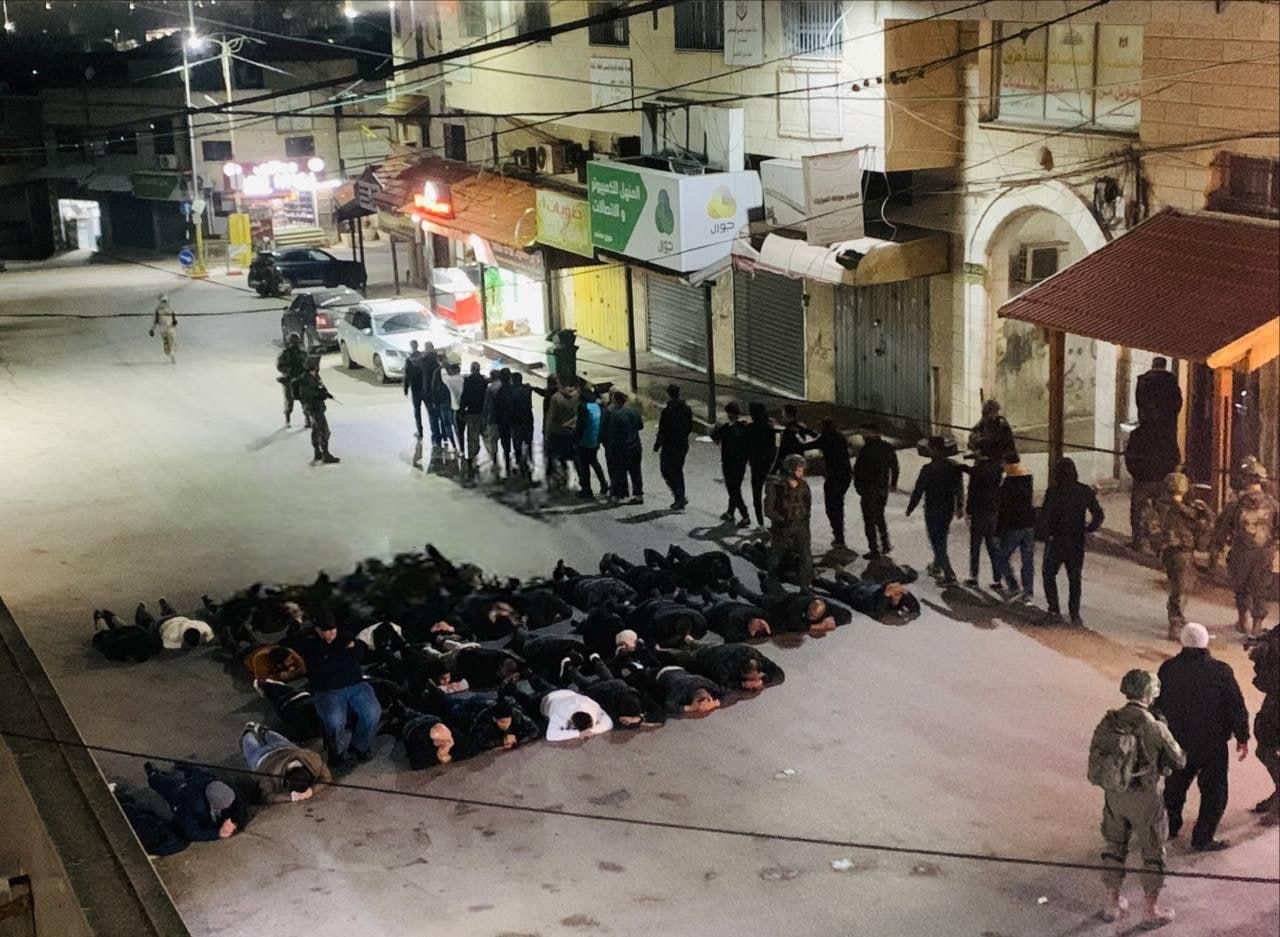
This is what the vaunted “ceasefire” actually looks like in the West Bank: disarm the population, box them in, round them up, incarcerate them en masse. The occupation has quietly swept dozens into jail, and settlers have set fire to the village of Sinjil. Not a shot fired, though.
Continue reading Policy of Truth