Institutional neutrality is the doctrine that institutions like universities should refrain from issuing public comment on matters of public controversy. As I’ve argued here at PoT (and elsewhere), one canonical exception to neutrality is institutional self-defense: a university is obliged to speak up when the university itself comes under attack. Predictably, we now have yet another exception to add to the list: the Charlie Kirk Exception. This exception asserts that when a famous right-wing loudmouth is shot on a university campus, all institutions hitherto bound by solemn pledges of institutional neutrality are obliged to carve out a special dispensation to condemn the act. Continue reading
Tag Archives: art
Goya’s “Lucha Con Palos” (1820-23)
Francisco Goya, “Fight with Cudgels,” (1820-23)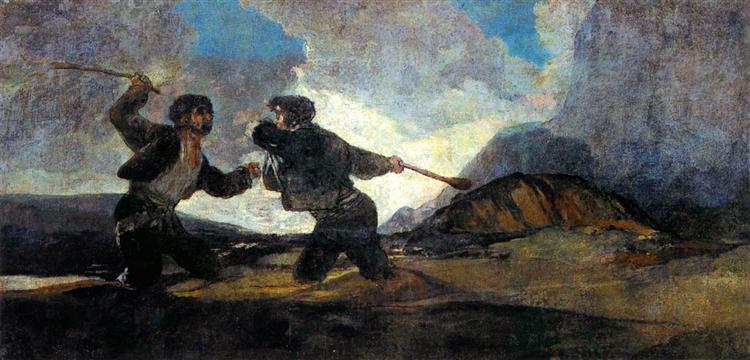
Death Camps and Torture Chambers
An Addendum on Institutional Neutrality
I wanted to add a sort of postscript to my March 17 post on institutional neutrality, meant to clarify an inference that is slightly (but only slightly) more complicated than I made it in the original post. The post was already somewhat long, and I didn’t want to burden it with over-complications by addressing every possible objection, or chasing down every twist and turn in the argument. But I also don’t want to burden it with misunderstandings.
American Light
I wanted to note the passing of John Wilmerding (1938-2024), for many years the Christopher Binyon Sarofim Professor of American Art at Princeton University. He died on June 6 of this year at the age of 86.
I didn’t really know Wilmerding at all–never met him, never really took a class with him. He was the guest lecturer for the week-long section on American art in my college-level art history class, Art 100, “An Introduction to the History of Art”–the closest to physical contact I ever got. But more than anyone, I owe Wilmerding credit for my decades’- long love affair with American art, and in particular, American landscape and maritime painting of the mid- to late-nineteenth century. Continue reading
Democratic Vistas
It’s customary to celebrate Independence Day in the United States by recalling the glories of the American Revolution, and hauling out the idols of our “civic religion” for worship–primarily the Declaration of Independence treated as Scripture, and tales of the Revolutionary War treated as hagiography. I don’t find the American Revolution a particularly glorious event, and find most celebratory discussions of our “civic religion” tiresome. So this Independence Day, I’d like to change the subject. There are other things about America worth celebrating and discussing: not its politics or military valor, but its art. It’s always been a question whether American art has ever managed to declare independence from its European forbears, and always been a fear that it hasn’t. Those questions generally go unasked on Independence Day, but maybe they shouldn’t. Continue reading
To Calvary and Back
I found myself thinking the other day of Peter Breughel the Younger’s 1564 painting, “The Procession to Calvary.” I used to teach it when I taught aesthetics in college. As is probably obvious, it’s a depiction of Christ’s being taken to be crucified. It reminds me of so many things happening now, and vice versa.

Our Ding-a-Ling

There’s a big debate at Princeton University about whether or not to take down the statue of John Witherspoon, the Revolutionary-era intellectual (and slaveowner), and namesake of actress Reese Witherspoon. Here’s a less controversial suggestion.
Continue readingErika López Prater and the Assault on Academic Freedom
I could belabor this case, but I’ll refrain. This New York Times article tells you what you need to know. A summary:
Erika López Prater, an adjunct professor at Hamline University, said she knew many Muslims have deeply held religious beliefs that prohibit depictions of the Prophet Muhammad. So last semester for a global art history class, she took many precautions before showing a 14th-century painting of Islam’s founder.
In the syllabus, she warned that images of holy figures, including the Prophet Muhammad and the Buddha, would be shown in the course. She asked students to contact her with any concerns, and she said no one did.
In class, she prepped students, telling them that in a few minutes, the painting would be displayed, in case anyone wanted to leave.
Then Dr. López Prater showed the image — and lost her teaching gig.
 Policy of Truth