The Epistemology of Mass Death

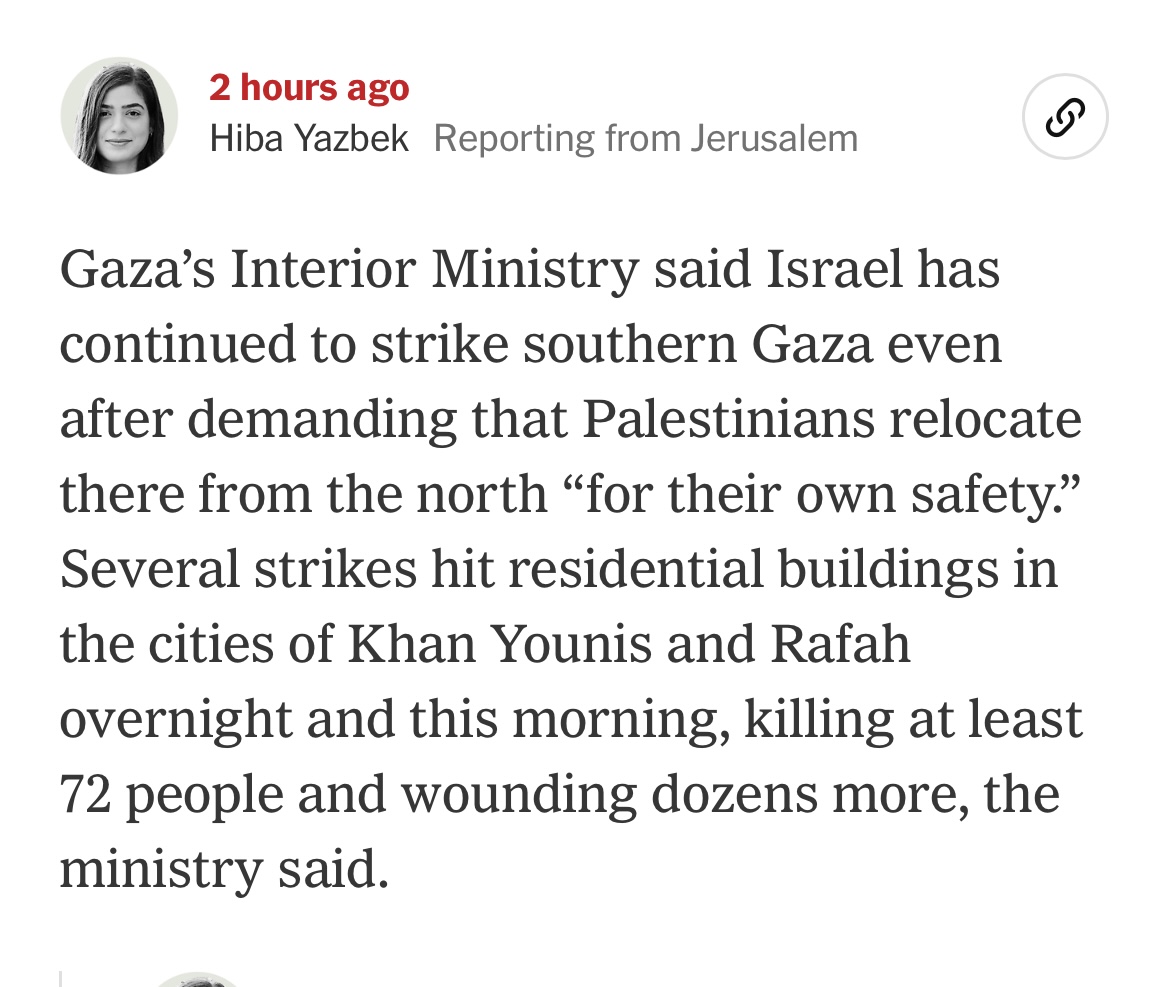
Does the item below reflect a good faith attempt to avoid civilian casualties, or does it express a cynical, murderous attempt to demand the impossible, then set up a pretext for the mass killing of large swatches of north Gaza (in principle all of it)–and as much of south Gaza as Israel chooses to hit, while demanding that the northern population flee there?

To belabor the obvious: both hypotheses are in play, as are all of the ones intermediate between them. Strictly speaking, the evidence neither rules in nor rules out either hypothesis. But no impartial observer could say that American political discourse is structured by the preceding fact. The obvious, ubiquitous epistemic imperative appears to be: rule out the latter, “pretext-for-mass-killing” hypothesis a priori, on pain of being labeled a terrorist-sympathizer, an anti-Semite, or a traitor. Why? Are we not permitted even ex hypothesi to consider the ascription of malign motives to Israel? In that case, I guess I’m not interested in getting anyone’s permission before I do.

Continue reading →
good-for, well-being and agent-relative value

Is a kind of value associated specifically with there being reason (not shared with others) for one to desire/value and promote/secure one’s well-being (or particular elements of it)? If so, how should we characterize it?

One natural suggestion is this: X’s well-being is valuable to X. The value here would be agent-relative, as distinct from value simpliciter (or agent-neutral value).

Against this suggestion, it is pointed out that the value language we generally use here is the language of good-for. For example, there is reason (not shared by others) for X to secure that-P because that-P is good for X. And we don’t generally use the language of valuable-to or valuable-relative-to. Of course, this does not preclude the concept (and property) of agent-relative value being required for philosophical theory, for descriptive and explanatory virtue or adequacy. The point, I think, is meant to set up a kind of burden of proof.

Continue reading →

The Grating Roar

Come to the window, sweet is the night-air!
Only, from the long line of spray
Where the sea meets the moon-blanched land,
Listen! you hear the grating roar
Of pebbles which the waves draw back, and fling,
At their return, up the high strand,
Begin, and cease, and then again begin,
With tremulous cadence slow, and bring
The eternal note of sadness in.

–Matthew Arnold, “Dover Beach“


I was texting today with a friend in the West Bank. I ranted awhile about The Situation. He made no effort to join in. Finally, he said:

I promise you to be peaceful and to teach my people that.

It seemed to come from out of nowhere, but maybe that’s because I’d been monopolizing the conversation. I told him that peace was best, but that we all have a right to defend ourselves. He didn’t respond. An hour after that, he sent me videos of the Israeli military invading his village, driving vehicles with proud Stars of David flags affixed to them, smashing down doors, doing house-to-house searches, etc. etc. Injunctions to peaceful non-violence seem anemic in this context; invocations of the right to self-defense, futile. Continue reading →

‘…A Place Where No Human Being Can Exist’

‘Gaza must become a place where no human being can exist…’ —Major General Giora Eiland, Israel Defense Forces

He neglected to add that it’s a place that few human beings can escape, either. The obvious answer to the question, “Was there anywhere safe to go?” was always “no.” The real question is why people who knew that, and planned for it, ordered people into danger anyway. But they did.

Disposable Villains

No one to play soldier now, no one to pretend
–Metallica, “Disposable Heroes” 

Having read maybe scores of articles on the ongoing disaster in Israel and Palestine, I want to hold off indefinitely on offering up any commentary, and restrict any posts I write to news items with distinctive informational value, particularly items describing events that are not being reported in the mainstream media. These two are from +972 Magazine, “an independent, online, nonprofit magazine run by a group of Palestinian and Israeli journalists.”  Continue reading →

A Plea for Ceasefire and Hostage Exchange

I posted this on my Facebook page this past Tuesday (slightly reworded here). It’ll be my last post on October 7 here at PoT as well, at least for awhile. I’d prefer to take some time and process the event before I say very much more.

I’m getting off of Facebook for awhile. It’s a cesspool at the moment, and I’m sick of it.

Just to clarify my own views before anyone decides to put any in my mouth while I’m gone: I do not accept the legitimacy of the 10/7 Hamas attack on Israel. I believe in a right of self-defense and of resistance, but I don’t regard this attack as an instance of those things. I know enough about suicidal behavior to recognize it when I see it. This is an enactment of murder-suicide. It’s not liberation. There is nothing here to valorize. If you feel differently, feel free. But don’t expect my support. It’s not forthcoming. Continue reading →

fitting attitudes and the (non-instrumental, agent-relative) value in pleasure itself

Pleasure itself is good. In particular, (a) if X has a pleasant or enjoyable experience, this is inherently good for X in that it is part of (not just something that promotes) X’s well-being and (b) X’s pleasant or enjoyable experience is inherently or non-instrumentally good or valuable to X (the experience is non-instrumentally agent-relatively valuable). Though we do not typically make the distinction between [a] and [b] clear, it can be teased out from a competent language-user.

Continue reading →

Apocalypse Now

This morning’s Hamas attack on southern Israel is being portrayed, predictably, as an initiatory act of aggression by Hamas, and a total bolt from the blue. It’s no such thing. The situation in Gaza has been decades in the making. Israel conquered Gaza in an act of aggression in 1967, occupied it, settled it, de-developed it, then abandoned its settlements there, falsely to proclaim its occupation of Gaza to have ended. Since then Israel has besieged Gaza, bombed it, raided it, and murdered and maimed its inhabitants at will. No one should venture comment on the situation in Gaza without engaging with the authoritative work of writers like Amira Haas, Sara Roy, and Norman Finkelstein, of human rights organizations like B’Tselem, or before viewing films like “Tears of Gaza,” which depicts ordinary life there. And this is to set aside the treatment of Golan, East Jerusalem, and the West Bank.  Continue reading →