Boxing Match

Back in the 90s there was a controversy, now happily long settled (and so perhaps unfamiliar to many of my younger readers), about “letterbox” versus “pan-and-scan” video formats. See, most movies by then were widescreen (and this had been so for decades), but television screens were still 4×3, which had been the dominant aspect ratio for theatrical movies when commercial television first became widespread – which meant that movies with a wider aspect ratio (which soon became the majority), when shown on television, either had to leave out whatever was happening at one or both sides if the screen, or else shift back and forth between them (the latter option being the origin of “pan and scan”), even if the original scene had been intended to be static. You can see how this mismatch between theatrical and televisual aspect ratios would ruin, for example, scenes like these three from Lawrence of Arabia, North by Northwest, and The Good, the Bad, and the Ugly, all of which could show one of the main characters in a scene only by completely eliminating another.

letterbox-3imaj

Continue reading

Greg Lukianoff on “Cancel Culture”

In a much quoted tweet, Greg Lukianoff, CEO of the Foundation for Individual Rights in Education (FIRE), has defined (“defined”) “cancel culture” as follows:

We define cancel culture as “the measurable uptick, since roughly 2014, of campaigns to get people fired, disinvited, deplatformed, or otherwise punished for speech that is — or *would be* — protected by the First Amendment.”

That’s from a tweet posted in 2022, but Lukianoff has repeated that “definition” many times since then. I’ve seen it in FIRE’s Facebook posts as recently as yesterday. Continue reading

John Davenport’s “The Democracy Amendments”

I’m very pleased to announce the publication, about two weeks ago, of PoT blogger John Davenport’s newest book, The Democracy Amendments: Constitutional Reforms to Save the United States (Anthem Press, 2023). I read and commented on the book in manuscript form, and thought it was spot-on. I agreed with virtually every one of John’s diagnoses and reforms; I only wonder how many of them will be taken seriously enough to be put in place, or even to find a place in public discussion. The book’s subtitle may seem hyperbolic, but isn’t: the United States really is a sinking ship, and it’s not an exaggeration to say that reforms like John’s are needed to keep it afloat. We probably need a lot more than that, but John’s reforms would be a good starting point.

Continue reading

“All Aboard!”

I asked a bunch of New Jersey state legislators–Andrew Zwicker, Roy Freiman, and Mitchelle Drulis–where they stood on S.1923, which “[p]rohibits investment of pension and annuity funds by [the] State in companies that boycott Israel or Israeli businesses,” and A.3882, which establishes the State’s official definition of anti-Semitism. I also asked each of them for an explanation of why they hold the view they hold. Never got an answer from any of the three, so I’ve decided to return the favor in the upcoming primary election by voting against them, even if they’re the only choices on the ballot. Hard to vote for people who insist on turning the state legislature into a forum for the defense of an apartheid state, but can’t be bothered to explain what they’re doing or why. Continue reading

WHEN A SOCIETY OUGHT TO BE SOME WAY

What does it mean to say that a certain institutional arrangement P in some society S ought (or is morally required) to be? Maybe that comes to this: S is required to come up with and implement a plan to achieve S. And perhaps that, in turn, comes to something like this: each individual and collective agent in society is required to make reasonable efforts, relative to role or position, to promote S (all of us collectively) coming up with and implementing a plan to achieve P. Different agents in different roles would have different more-specific requirements.

Is this kind of analysis standard? What are the alternatives?

If this analysis, or something very much like it, is right, there would seem to be some important results that I don’t think are always acknowledged in discussions of justice with regard to the basic structure of a society.

Continue reading

The Most Dangerous Game

For a moment the general did not reply; he was smiling his curious red-lipped smile. Then he said slowly, “No. You are wrong, sir. The Cape buffalo is not the most dangerous big game.” He sipped his wine. “Here in my preserve on this island,” he said in the same slow tone, “I hunt more dangerous game.”

–Richard Connell, “The Most Dangerous Game

Anyone who favors intervention in the war in Ukraine owes it to themselves to read about the emerging consensus on nuclear war over Ukraine. A year ago, anyone who brought the subject up was dismissed as a pacifist, a scare-monger, a defeatist, or a crank. Now, a little over a year later, the idea of nuclear war is being normalized in military circles in both the United States and in Russia. Sober, respectable, mainstream strategists are now beginning to speak and write as though nuclear war was just another one of those things that’s headed our way, and will just take a bit of getting used to. Continue reading

HOW EXTREME UNLIKELIHOOD MIGHT BLOCK REQUIREMENT SPECIFICALLY

Suppose that general normative requirement works like this: if X is generally required to A, this is partially constituted by X’s not-A-ing options in her choice situations starting out with a very high negative valence (that generally swamps any negative valence of the not-A-ing options). Now suppose that, in particular choice situation S, it is super-unlikely that X will pull off A-ing. In such a case, the relevant option is really her attempting to A. But also any attempt to A is almost certain to come to her not-A-ing. It seems plausible, then, that all of X’s options in S have nearly the same magnitude of highly negative valence. So there is not, as there would normally be, some huge “valence gap” between (token) A-ing and (token) not-A-ing. There is no normative “swamping” to leave A-ing as the far-and-away best option. And so, despite being under a general requirement to A, X is not, in S, required to A (realize this token of A-ing). 

Continue reading

THE OUGHT-DEFEATING WORK OF UNLIKELIHOOD?

Having reread David Estlund’s “Human Nature and the Limits (If Any) of Political Philosophy” (2011) – I had read it or similar material from Estlund years ago – I have some thoughts. Here is one. (For a variety of more shooting-from-the-hip points, of varying quality and level of present endorsement, see David Potts’ more-comprehensive critique Estlund’s article and specifically my comments there (Estlund’s Defense of Ideal Political Theory).)

*****

If agent X being unable to perform action (or carry out plan) A entails that it is not the case that X ought to perform A, why is this? This answer seems plausible: because this rules out A-ing as an option for X in her deliberation and decision-making. If this is right, then why suppose that only the ability/inability binary is relevant? Why not a cut-off in a relevant scalar quantity? Specifically: perhaps if it is unlikely-enough that X will pull off A (maybe or maybe not due to relevant deficits in X’s internal, psychological abilities), then A-ing is not an option for X — and so it is not the case that X ought to A.

Continue reading

“If You Could Read My Mind, Babe”

~AI Facilitating Mind-Reading

This could become a way for paralyzed people to communicate. It might become a way for the government to get information from people (and obviate attempts to get information by torture). At present the system requires not only our general knowledge of where things are typically thought in the brain, but knowledge of the brain operations of the specific individual, and this latter requires about 16 hours of investigation of the subject individual before successful mind reading.

If this system could overcome that arduous preliminary learning and if the system could be shrunken down to the size of a skull cap, perhaps hats would come back into fashion. A dating service might offer the hats to be worn for users of the dating service. It might be a sport to go on dates with these hats in which you get the low-down of what your date is really thinking about.

When x-rays were first discovered, the newspapers entertained the possible future in which people could walk down the street wearing glasses through which you could see the bodies underneath the clothes. But that was a very long time ago, and nothing like peeping glasses has eventuated so far as I know.

The Writing Not on the Wall

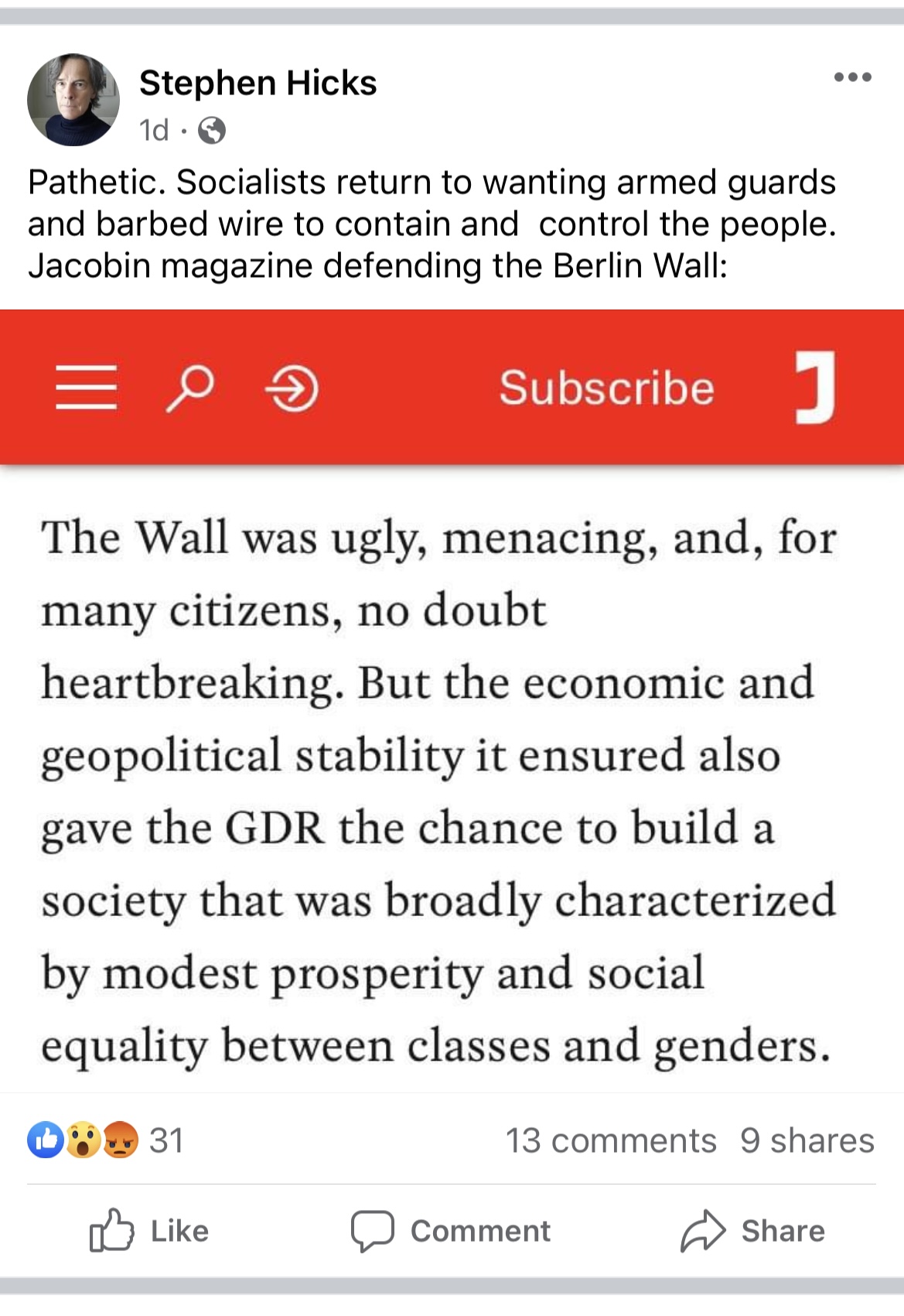
Note: I’m going to leave this post as is, but I intend to re-write it and re-post it this weekend. All of the relevant information is here, but it was recorded as I learned new facts in real time. As a result, some information is in the original post and some is in the comments, making it hard for the average reader to follow. My bottom line view: Hicks is flat-out lying, Freiman is grandstanding in an intellectually dishonest way, and Balhorn’s view is as unjustifiable as I said it was, for just the reasons I gave. 

It’s kind of sad that neither party to the dialogue of the deaf below–Stephen Hicks or Jacobin–shows much awareness of the fact that an “ugly, menacing,” and for many non-citizens “no doubt heartbreaking” wall has stood for 20+ years between Israel and Occupied Palestine, with armed guards and barbed wire, intended precisely to contain and control people.*

wall

Continue reading