Most years, on 9/11, I’ve brought this post back up to the top and re-posted it. I want to do something different this time. I want to give a brief (or semi-brief) answer to one of the most pressing questions that arises on 9/11: why do Americans not learn from history? Or to narrow it a bit: why do Americans learn nothing from the military history of their own country? Continue reading
Mistah Kirk, He Dead
I’m sitting here eating a nice vegan meal, reading Livy. I just heard that somebody killed Charlie Kirk, another fascist nobody in this rapidly disintegrating country. We can’t keep track of how many fucking wars or proxy wars we’re in, or how many innocent people we’ve killed or sent to concentration camps in a week, but here come the hand-wringers and cry-babies on command, from Trump to Newsom to Obama, gnashing their teeth and virtue signaling over the least consequential death in America today.
Continue readingKiosks and Cowardice
I wrote this in May, but forgot to post it. I happened to notice it today while cleaning out old files. It seems a fitting start to the academic year.
In Princeton, where I live, there are two kiosks on Nassau Street, the main drag, on which people put up up flyers of various sorts, sometimes announcements of cultural events, sometimes flyers of a more political nature. Most but not all of the political flyers tend to the left of the political spectrum, and some of these target either the municipality or the University. The kiosks are deeply resented by elites at both institutions, who regard them, with predictable hauteur, as “eyesores.” Despite determined public opposition, the local town council has voted to demolish the kiosks and replace them with something that it can (in the words of one proponent) “control.”
They’re still there for now. The stated rule governing them is that flyers are taken down on the first of every month. Today is the 22nd of May. And yet, as I walked through town this morning and then this evening, I found all of the flyers systematically taken down on both kiosks. Continue reading
Start Spreading the News
Current status: paying $70 to take an Uber to work, care of a well-dressed driver named Roberto who’s blaring Sinatra in my ear. Feel like I’m en route to another meeting with Batista over the Castro/Che problem, but no, just another day of DRG Downgrade appeals with assorted hospital clients, paying top dollar to get paid.
“I’m gonna make a brand new start of it—Metropark, Metropark.”
Somebody kill me.
Is It Time to Bomb Columbia University?
I had a conversation the other day with a friend who just started law school at Columbia. This person told me that on the first day of orientation, the first-year law students were visited by officials from Columbia’s so-called Office of Institutional Equity (OIE). According to OIE, the chant “From the River to the Sea, Palestine Will be Free,” is presumptively to be understood as advocacy of genocide, as discrimination against Jews, and therefore as a violation of Title VI. Anyone who chants it thereby becomes a candidate for reprimand, suspension, and/or expulsion. So they were instructed not to chant it. A couple of things can be said about this, I think. Continue reading
The Mikie Sherrill Sweatbox
I saw this on Facebook just now. The “her” is Mikie Sherrill, Democratic candidate for Governor of New Jersey. To my regret, I volunteered for her 2017-2018 campaign for Congress (along with Chelsea Handler and a bunch of other idiots), and avidly promoted her here at PoT.

It reminds me of a scene in Jean-Claude Van Damme’s 1990 film, “Lionheart.” Legionnaire Lyon Gauthier is a lowly private in the French Legion, stationed in North Africa, whose brother has just been put in the hospital by a gang attack in LA. (Naturally, the family doesn’t have health insurance.) On receiving this news, Gauthier tells his Nazi commanding officer that he “needs” to see his brother in LA. The officer responds:
You need what I tell you you need. And right now, I think you need two weeks’ hard labor.
That’s what voting for Mikie Sherrill is like, except that she’d be governor for four years, not two weeks. Continue reading
“Not the Time for Cowardice”
Statement of Sadaf Jaffer in support of a municipal resolution supporting the Immigrant Trust Act, Montgomery (NJ) Town Council, Sept. 4.
Good evening,
As a former mayor and state legislator, I urge you to pass a resolution supporting the Immigrant Trust Act and to do everything in your power to ensure that our state assemblymembers Roy Freiman and Mitchelle Drulis cosponsor it as well. Continue reading
Statement to Montgomery Town Council
Montgomery Town Council
Sept. 4, 2025, 7 pm
100 Community Dr, Skillman, New Jersey
Hi, my name is Irfan Khawaja. I live in Princeton, but spend a fair bit of time here in Montgomery. I’m here to speak in favor of Montgomery’s passing a municipal-level resolution in favor of the Immigrant Trust Act, just as we’ve recently done in Princeton, and has been done in more than a dozen municipalities across the state. Continue reading
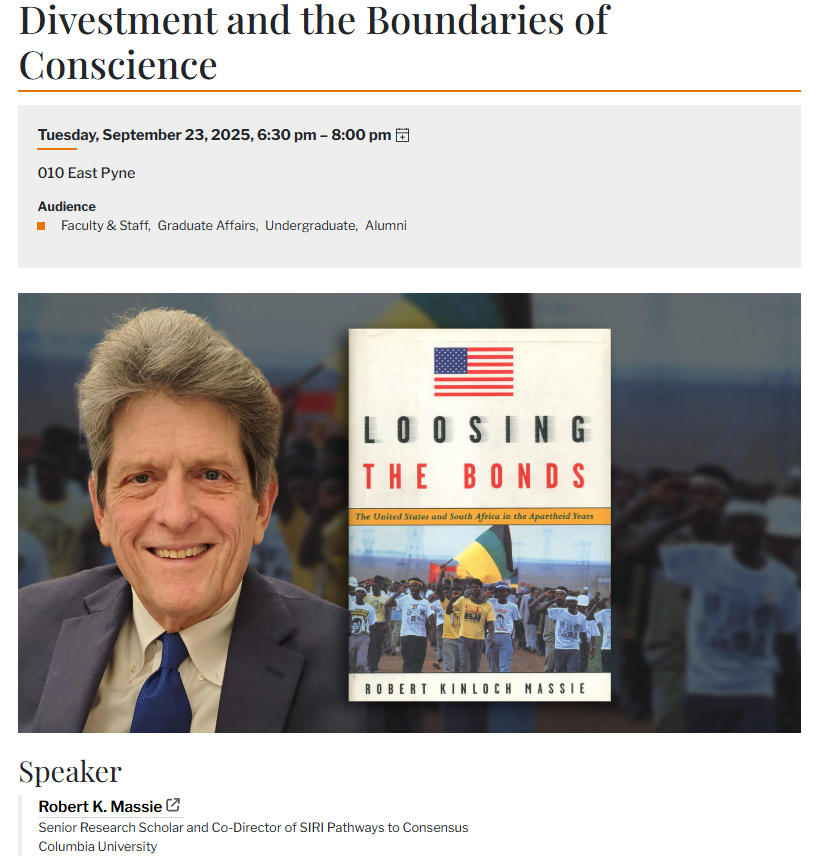
“Divestment and the Boundaries of Conscience”
Does Heterodox Academy Practice Institutional Neutrality?
The doctrine of institutional neutrality asserts that an institution ought not to make public pronouncements on matters of public controversy. It’s promoted most vigorously nowadays by organizations like Heterodox Academy, and by the 150 or so universities that have signed on to Heterodox Academy’s campaign. This gives rise to an oddly neglected question: does institutional neutrality apply to Heterodox Academy itself? Is Heterodox Academy itself bound by the doctrine of institutional neutrality? It’s not clear how to answer this question, or whether it can coherently be answered at all. Continue reading
 Policy of Truth