Character-Based Voting: Mamdani, Cuomo, Sliwa

For years now, I’ve been railing against an argument of Jason Brennan’s concerning character-based voting. Brennan’s argument holds that when it comes to voting, unless a candidate’s character can be shown to be a proxy for the policies he’ll adopt, predictions about those policies should trump judgments about character. In other words, when it comes to voting, the policies you predict that a candidate will adopt are more important than any character-based fact or set of facts about his fitness for office right now.  Continue reading

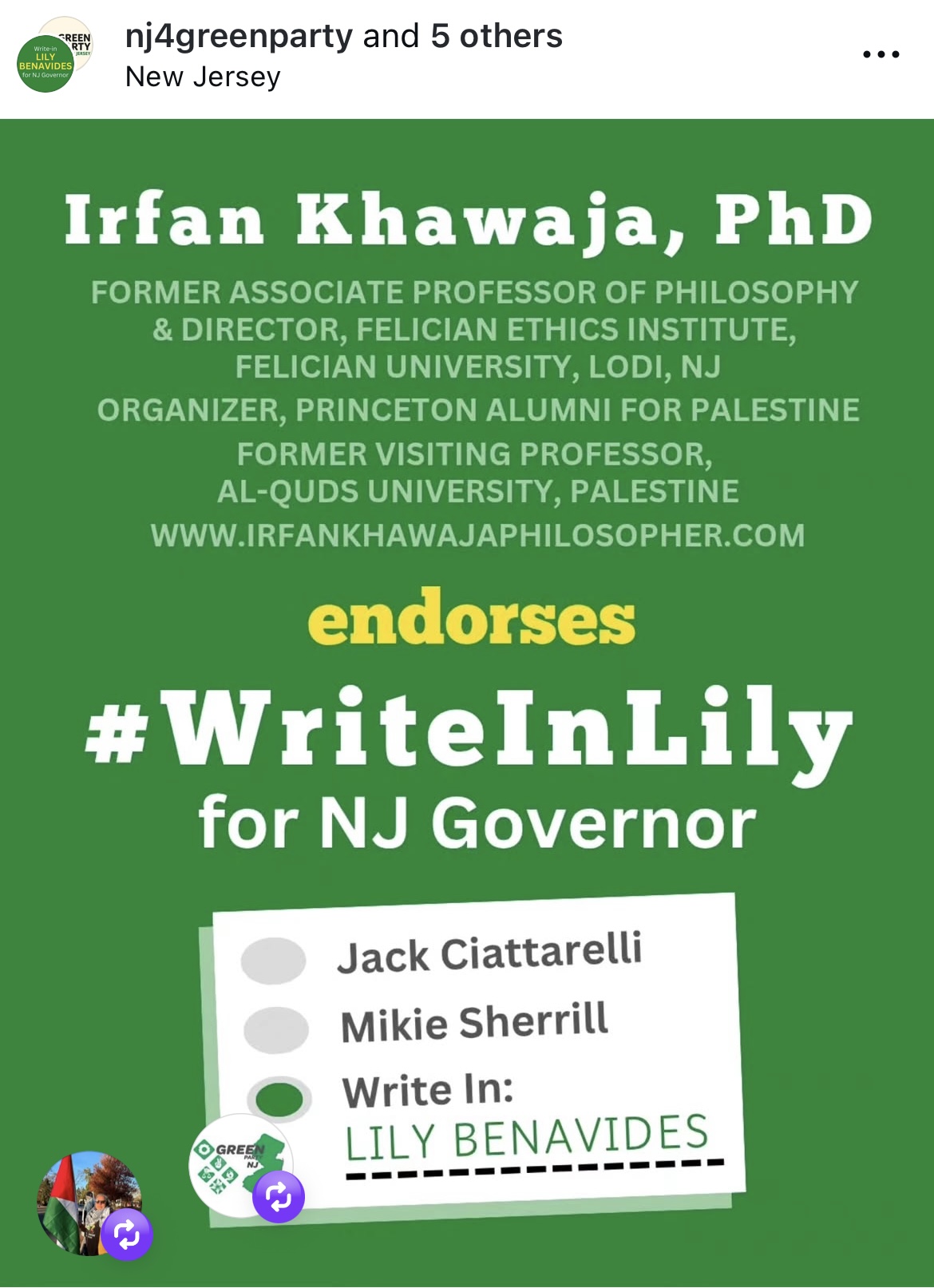
Karma Comes for Mikie Sherrill

A controversy has recently broken out in the New Jersey gubernatorial campaign. Mikie Sherrill, who has long touted her experience as a helicopter pilot for the Navy, is now facing the somewhat exaggerated charge that she “cheated her way” through the Naval Academy (to quote hearsay from the Internet).

The backstory is this: Nicholas DeGregorio, a supporter of Sherrill’s opponent in the race, made a records request re Sherrill, including her Naval Academy record, to the National Personnel Center of the National Archives. Continue reading

Resistance in Action (2)

The Princeton ITA Resolution Passes

Part 1 of this series. 

Well, readers, it passed: the “Princeton Resolution of the Mayor and Council of Princeton Supporting the Passage of the Immigrant Trust Act” passed unanimously tonight, 5-0, with two absences. Having read the texts of several of the ITA municipal resolutions out there, I would say that Princeton’s is probably the best of the bunch: the strongest, clearest, and most explicit about its political aims. Continue reading

Journey of a Thousand Miles

A journey of a thousand miles starts with the first step.
–Lao Tzu (supposedly)

From my March 22 post on recent events at Columbia:

What’s not a question is that strategic planners who couldn’t see this coming do not deserve to be employed. In a just world, these overpaid, over-hyped, preening incompetents would be thrown unceremoniously out of their plush offices directly into the streets of Morningside Heights.

From The New York Times, less than a week later: Continue reading

Academic Hiring and Genocide

“In the literature of complaint and reform, and in the endless reports from distinguished groups identifying a crisis in some element or all of higher education in America, a key defect is often the absence of practical solutions.” 

–John V. Lombardi, How Universities Work, p. 31. 

In an essay I posted here a few weeks ago, I argued that genocidaires seeking lower-level electoral office should be denied such offices at the ballot box. The argument was framed as a response to Jason Brennan’s account of the ethics of voting, which he describes as “the ethics of voting in political contexts.”(1) Though he doesn’t quite define “political contexts,” it’s obvious enough that he means voting in democratic elections for governmental office, e.g., for U.S. President, for legislative offices, and in some cases for judicial offices, taking U.S. electoral politics as the paradigm. Continue reading

Character-Based Voting and Genocide

It’s been a while since I’ve beaten up on Jason Brennan’s “argument” against character-based voting, but I’m feeling the urge again, so here I am, hot to go.(1) The crux of Brennan’s argument is that it’s wrong to vote for political candidates on the basis of their traits of character, except when character is a predictive proxy for the policies they can be expected to enact once in office. In a formula (Brennan’s formula, made in discussion here on PoT): “policy > character.” Taken literally, the argument proscribes voting against any candidate, no matter how evil, if the evil he exemplifies is policy-irrelevant. My aim here is to add yet another counter-example to my ever-growing list of counter-examples to Brennan’s thesis, partly for the understanding it affords, and partly for the fun of it. Continue reading

Save Your Outrage

About a month ago, a woman having a mental health episode was shot dead by the police in the city of Fort Lee, New Jersey. About a week ago, schools in South Jersey were closed after shooting threats there. Before that, a shooting at a New Jersey football game caused a stir. Then a dirt bike theft and shooting incident in Dennis, New Jersey caused school cancellations. Two days ago, a burglary suspect was non-fatally shot by the police in Rumson, New Jersey. Around the same time, perhaps for comic relief, a New Jersey police officer shot himself in the leg during a drill at a shooting range in Passaic County. Back on August 9, a Jersey City activist was shot in the leg by the Israel Defense Forces in Beita, in the West Bank. To cap it off, almost exactly a month later, another American activist was shot dead by the same Israel Defense Forces in the same place. She was buried yesterday. Continue reading

Why Don’t They All Just Fade Away?

I missed this earlier, but the indefatigable John Davenport had an Op-Ed published in the August 15 issue of the Star-Ledger (Newark, New Jersey): “Americans do not want a gerontocracy.” Following the argument of his Democracy Amendments, John makes the case for a constitutional amendment for age limits for office:

It is thus a safe bet that at least three-quarters of American adults would support a constitutional amendment to set a 75 as a maximum age, even if some would prefer a lower number. That could be enough to get such an amendment ratified if it ever reached state capitols or state ratifying conventions. It would mean that no president could be inaugurated later than a day shy of their 72nd birthday.

Continue reading