Complicity, Neutrality, Atrocity (1/5)

Complicity and the Strategy of Evasion

Imagine that an institution (“the Institution”) maintains a set of investments in various enterprises that make a clear and demonstrable contribution to some indisputable injustice. Now suppose that a set of stakeholders (“the Stakeholders”) objects to these investments, calling on the Institution to divulge the facts in a fuller way, and demanding divestment from the clearly objectionable investments.  Continue reading

Academic Hiring and Genocide

“In the literature of complaint and reform, and in the endless reports from distinguished groups identifying a crisis in some element or all of higher education in America, a key defect is often the absence of practical solutions.” 

–John V. Lombardi, How Universities Work, p. 31. 

In an essay I posted here a few weeks ago, I argued that genocidaires seeking lower-level electoral office should be denied such offices at the ballot box. The argument was framed as a response to Jason Brennan’s account of the ethics of voting, which he describes as “the ethics of voting in political contexts.”(1) Though he doesn’t quite define “political contexts,” it’s obvious enough that he means voting in democratic elections for governmental office, e.g., for U.S. President, for legislative offices, and in some cases for judicial offices, taking U.S. electoral politics as the paradigm. Continue reading

Character-Based Voting and Genocide

It’s been a while since I’ve beaten up on Jason Brennan’s “argument” against character-based voting, but I’m feeling the urge again, so here I am, hot to go.(1) The crux of Brennan’s argument is that it’s wrong to vote for political candidates on the basis of their traits of character, except when character is a predictive proxy for the policies they can be expected to enact once in office. In a formula (Brennan’s formula, made in discussion here on PoT): “policy > character.” Taken literally, the argument proscribes voting against any candidate, no matter how evil, if the evil he exemplifies is policy-irrelevant. My aim here is to add yet another counter-example to my ever-growing list of counter-examples to Brennan’s thesis, partly for the understanding it affords, and partly for the fun of it. Continue reading

My Foreknowledge of the New Orleans Attack

A couple of days ago, I predicted here that a “terrorist” attack on the United States would take place. Now one has, in New Orleans. Did I have foreknowledge of this attack? I sure did. In fact, I told you what the foreknowledge was in the post itself: You can’t spend decades supporting apartheid, conquest, occupation, and genocide, then take pride in shutting down the anti-war movement, and not expect to be attacked in retaliation. That’s what Americans and Israelis did, and that’s what happened to them. What did you think was going to happen? The victims of your psychopathic depredations were going to roll over and play dead forever? Continue reading

Secure Your Own Homeland

ICE showed up at my workplace today–or rather, ICE in the guise of DHS, “The Department of Homeland Security.” The agent flashed a badge and started asking about some people with Spanish names. Did I know anything about them? I had nothing to say.

The only thing I have for ICE or DHS–the only product I can promise–is wholehearted, undying hostility. I doubt they want to hear me talk about that. So there’s nothing to say. In any case, the Homeland they’re securing isn’t mine to worry about, and the land that I live in isn’t theirs to secure. Not a promising basis for a meeting of minds–the only kind that interests me.

I opened the door this time because I didn’t know who was ringing. Next time, as far as I’m concerned, they can stand there for as long as it takes to induce someone else to open the door. I’m not the doorman. So it won’t be me.

Divestment and Complicity

I’ve reproduced a comment of mine below the fold from the website of Princeton Alumni Weekly, responding to critics of the student divestment campaign described in my previous post. One critic had said: “I fail to see why students on campus should vote on how the University invests its funds.” Another had said: “Students shouldn’t be ‘running’ the University any more than alumnae/alumni should. Leave investing to the experts hired by the University to manage the endowment funds.” Continue reading

Diversity, Equity, Inclusion, Genocide

Work colleague A asserted the following in all seriousness to work colleague B, who related it to me:

All Palestinians are terrorists, and should be killed.

Granted, he was TUI at the time: talking under the influence of Fox News.

This is a slice of life from the “woke” corporation, where DEI mandates supposedly rule the day, and everyone supposedly cowers in fear that some innocuous comment of theirs might offend someone. In other words, welcome to the real-world corporate workplace, where 99.44% of the time, that woke-totalitarian scenario is just a right-wing fever dream.

Clearly, we need a new acronym. Call it “DEI + G”–Diversity, Equity, Inclusion, Genocide.

Nothing new, really. Nothing I haven’t heard for the last fifty years. Just never thought to blog it before. A slice of life from a pie that some of us have been forced to eat all our lives.

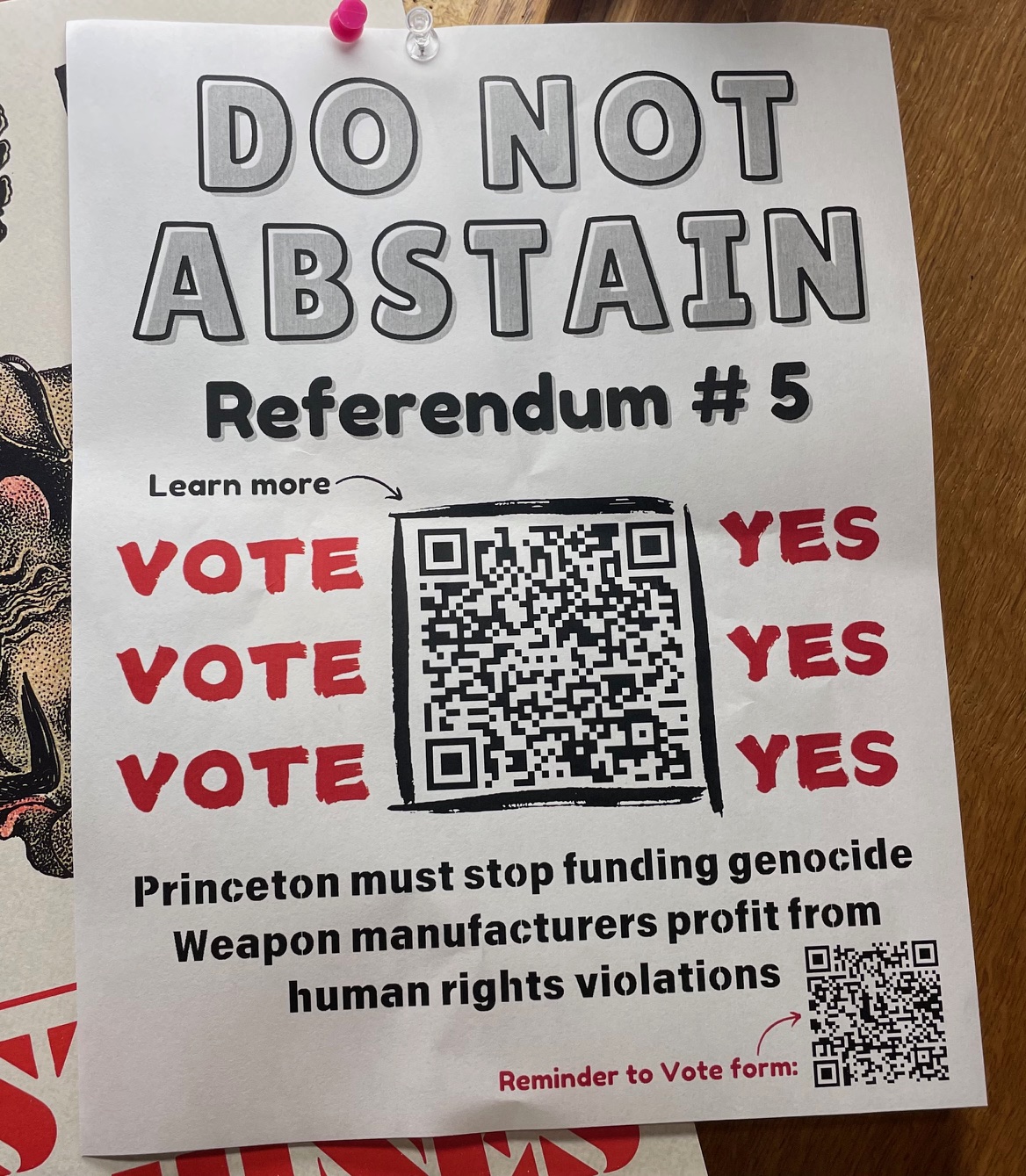
Princeton University USG Referendum Question #5: Divest

Referendum Question #5 of Princeton University’s forthcoming Undergraduate Student Government elections. Scroll down (you may have to click “download”) for a PDF with the wording of the referendum. Kudos to these students for the work they’ve done on this. If only I could vote on it, but I’m 33 years too late.

donotabstain

Continue reading

The Soft Domination of Everyday Life

Consider this post an unplanned addendum to my earlier series on domination and at-will employment.

A friend of mine just got “fired”–you’ll see in a minute why the word is in scare quotes–and we’re disagreeing about what it all means. Naturally, I thought I’d share tidbits of our discussion here. My friend blames himself; I blame his employer. Which of us is right? I’ll give you an impeccably impartial account below; you decide. Then feel free to chime in either way.

Let’s call my friend “Claude.” Claude was caught vaping on the job. There’s no explicit rule in his company’s handbook against vaping on the job. It’s simply understood that “one does not vape on the job.” It’s not clear why this is so. “It is what it is.” Argument is not invited, and evidence is not required. We all know evil when we see it. Continue reading