I recently attended a webinar, “Amidst the Wreckage of Neoconservatism: Jewish Progressives and the American National Interest,” organized by The Forum for Critical Jewish Thought (FCJT). The speakers were Suzanne Schneider, Executive Director of the Brooklyn Institute for Social Research; Ben Rhodes, former Deputy National Security Adviser under President Obama; and Eliyahu Stern, Professor of Religious Studies and Jewish Studies at Yale. (The discussion was moderated by Ezra Tzfadya.)
I enjoyed the conversation, and agreed with a great deal of what Schneider and Rhodes had to say, but in what follows, I want to lay out some criticisms of all three speakers’ presentations. I’ll devote one post to each speaker, starting with Schneider, and end by describing a problematic common to all three.
Suzanne Schneider on the (Alleged) Lacunae of Progressive Foreign Policy
I won’t try to summarize Schneider’s comments, with which I mostly agree, but I do have one basic disagreement. Schneider’s comments are largely intended as a critique of the Right, particularly of the Right’s fondness for militarism in foreign affairs (all of which I agree with). One of her complaints, however, is directed at the Left. Unlike the Right, she argues, the Left lacks a comprehensive picture–a grand strategy or unifying theory–of foreign policy. The underlying suggestion seems to be that it needs one to do what needs doing.

Shopkeeper, Old City Hebron, March 2023
I agree with the diagnosis, but not with the implicit prescription. The Left, I agree, does lack a unifying theory of foreign policy, but contrary to Schneider, I don’t think it needs one. Put somewhat differently: it’s not clear what it needs one for. You don’t need much of a theory to see that huge swatches of American foreign policy are unjust and dangerous to the point of sociopathy: the U.S. proxy war in Ukraine, the U.S. alliance with Israel and the Gulf States, its war with Iran, and its looming war with China, all fit this description. And that’s just a top five list. A more comprehensive list would be a post of its own.
No good arguments have been given in favor of these policies, and plenty have been given against. But none of the relevant issues here are a matter of deep theory, or require complex inferences from some grand strategy. Nor is there any need to wring one’s hands about “the paucity of good alternatives to what we’re doing,” or “how to handle the problems of the day after,” or “what happens next, after we succeed.” Every one of these projects is a dangerous, justice-defying military-industrial juggernaut, backed by powerful but morally bereft institutions and constituencies. That’s really all we need to know. We don’t need to theorize about them. We need to stop them.
At best, we need to theorize about how to stop them. But that’s largely a practical matter of matching means to ends, not a theoretical one that requires deep conceptualization of the ends themselves, or the construction of a grand strategy comparable to the ones we encounter on the Right.
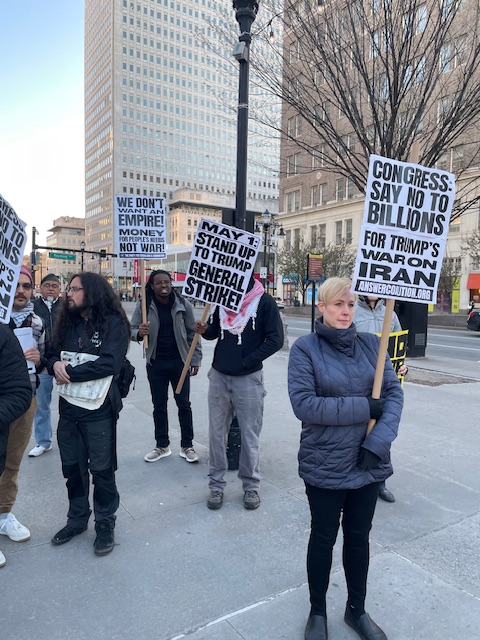
Anti-war protest, Newark, New Jersey, April 8, 2026
The amount of time and effort required just to put a dent in any one of these militaristic crusades is a counter-crusade of its own. The task of putting the militarist genie back in the bottle is so daunting, and the probabilities of success so low, as to render moot any grand strategy based on counterfactual conditionals about what the world might be if such-and-such were to obtain. By the time we achieve or even approximate any of our goals–ending or staving off the wars I’ve mentioned–the world will have changed so radically as to render comical any theorizing done before the changes had taken place. It’s not clear what the point of such theorizing would be. The endeavor seems to me like the discursive equivalent of planned obsolescence.
Forget the Left for a moment. What the United States needs is a mass, ideologically ecumenical anti-war movement aimed at stopping American involvement in foreign wars, along with one aimed at stopping or at least slowing down American involvement in the arms trade. This movement will have to address itself to the federal government, to be sure, but will also have to engage state and local governments, and ramify downwards into civil society, including the gamut of private-public partnerships with foreign policy implications, along with the educational system, industry, and public opinion.
On the bright side, we already have something of a template for this movement, albeit a dated one, and shelves of historiography to illustrate it: Vietnam. The Vietnam War came to an end by mass mobilization of latent anti-war sentiment to the tune of tens of millions of “ordinary” people. Producing such a movement, sustaining it, motivating it, and channeling its energies in the right direction is the full time task of a small army of participants.
As I’ve said, the chances of its success, particularly on a short time horizon, are relatively low. The tasks involved are thankless and unrewarding. And the problems involved would daunt Hercules. But the fact remains: what we need is effort commensurate to that task–not theory, but practice, not grand strategy, but a matter of hitting “repeat” as often as it takes. The watchword here is discipline or steadfastness–what Palestinians call sumud–rather than theory. Though Schneider doesn’t literally deny this, my worry is that it doesn’t seem to be what she has in mind.
Put another way, my worry about Schneider’s account is that it seems to want for the Left a mirror image version of what the Right has “accomplished” for itself over the past few decades: a grand theory of foreign policy that claims to guide practice in a semi-casuistic way, gilding the product in learned allusions to classic texts and grand moral visions.
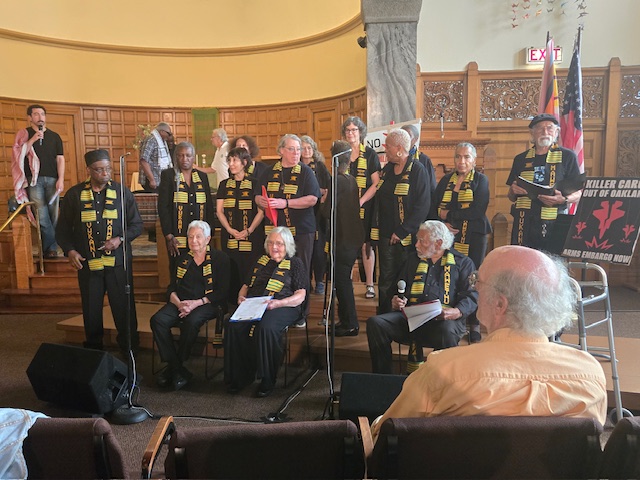
Oakland Arms Embargo, Oakland, California, March 29, 2026 (photo: Kate Herrick)
There’s no doubt that the Right has done this. Anyone who’s spent any appreciable amount of time in right-wing intellectual circles, as I have, will know the drill. I can’t count the number of armchair strategists I’ve met over the decades, learned theorists with a new principle for every new situation, capable of rationalizing the bloodiest imperial schemes through learned allusions to Thucydides, Machiavelli, Clausewitz, Strauss, Nitze, Kissinger, Kagan, and Codevilla.
What’s up for doubt is whether any of it counts as an “accomplishment” worthy of the name. The Right has filled libraries with learned tomes about American grand strategy, along with the moral vision supposedly underpinning it, and the civilizational imperatives supposedly animating it. And yet right-wing foreign policy has, for decades, been little more than a series of grandiose schemes for the conquest, subjugation, and mass murder of foreign populations, starting with the American Revolution and ending with Iran.

Wounded Knee, Pine Ridge Indian Reservation, Pine Ridge, South Dakota (August 2016)
The question that needs asking is not: how do we replicate this pattern on our own terms?, but what’s wrong with the pattern ab initio? How did all of this supposedly learned verbiage turn, time and time again, into misery, brutality, and disaster (and with recurring familiarity, defeat) as often as it has? Those are questions worthy of a theory, but they don’t amount to anything that looks like a grand strategy promoting “the national interest,” and we don’t need much theory in place to get started on the crucial practical task before us.
It’s a mistake to think that a grand theory can save us from the abyss, or that practice unguided by grand theory is disordered chaos. A grand theory, however ostensibly “progressive,” will take us to the same abyss as some ostensibly rival theory if both theories implicitly adopt the same constraints and parameters, differing only at the margins. The potential snare is right there in the subtitle of the event: “Jewish Progressives and the American National Interest.” Is Judaism really about the “American national interest”? Is progressivism? Is it really something to take on board?
Theorizing that tries too hard to accommodate itself to, or serve, “the national interest” puts itself in jeopardy of becoming theory that serves nationalist interests, no matter how benign the intentions it brings to the table (when they are). That danger has to be taken at least as seriously as the supposed danger of operating without a grand theoretical scheme. For all of the cogency of what was said at FCJT, my basic criticism is that that danger went undiscerned but desperately needs discussion.
Many of the citations for the claims I make can be found in my post, “We’re Going to Need a Bigger Anti-War Movement” (March 15, 2026). For a similar argument, see Schneider’s “The State of the Antiwar Movement” (Sept. 24, 2024). I’ve discussed the general issue of trade-offs between remote ideals and proximate aims in “Local Optima and Abolitionist Ideals” (apropos of Gerald Gaus’s The Tyranny of the Ideal).

