Permits, Nazis, and the Reclamation of Public Space
A pointed question came up during Public Comments at Princeton Municipal Council a few weeks ago, namely: “Why was a neo-Nazi group ‘allowed’ to march in Princeton despite lacking a permit?” As I’ve suggested here before, this is the wrong question to ask. It also diverts attention away from a series of questions that badly need asking.
The march in question took place in the vicinity of the War Monument on Bayard Lane, between 1 and 1:40 pm on Saturday, August 29th. About a dozen masked, teenaged “white nationalists,” aka neo-Nazis, marched in the area, chanted some slogans, raised a banner–“Keep New Jersey White”–and then left to attend a barbecue somewhere in town. The same group also released a propaganda video on X. Since then, two local papers have covered the event, but three have ignored it, the three being Town Topics, The Princeton Packet, and Planet Princeton.
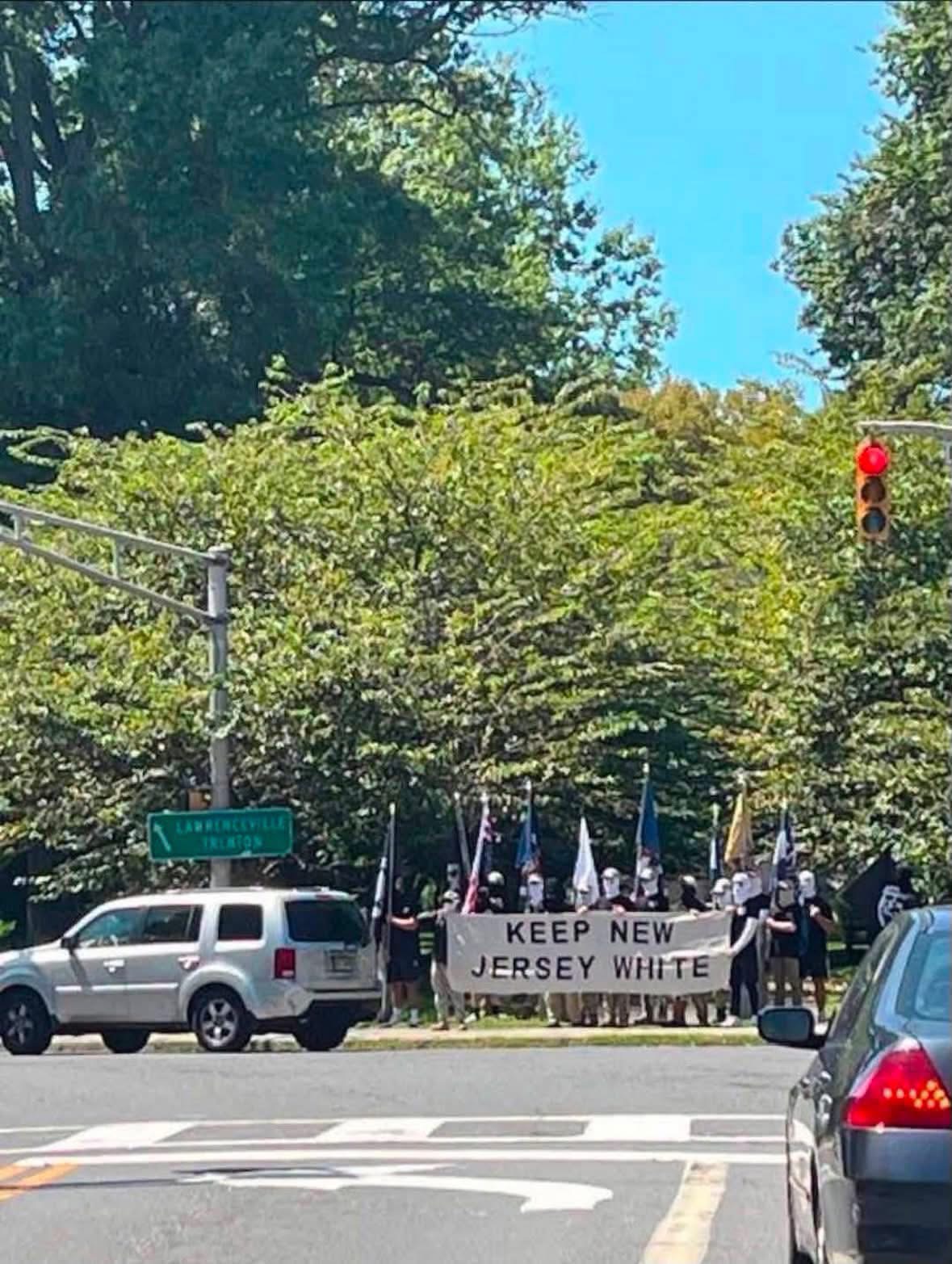
Neo-Nazi march, August 29, 2026, Princeton, New Jersey (photo credit: Andrea Christo)
Here’s a question worth asking: If the event had such significance, why was it so widely ignored by local media? Local media is tasked with covering events of local significance. This was an event of local significance. Yet it went ignored.
Either the three papers ignored the march because their editors thought it lacked significance, or they missed the march (and have continued to miss it) despite its having significance. Either way, we’re left with some puzzles. Why would an editor regard a neo-Nazi rally in the middle of town as a minor matter? For decades now, we’ve all been hit over the head with the slogan, “Never Again.” And yet when Nazis actually show up in the middle of town, their presence is met with editorial yawns. What happened between the fervent sloganeering and the complacent inaction?
Beyond this, these rallies are clearly part of a national trend. There have been rallies of this sort across the country, all organized by neo-Nazi and related organizations. Our local editors’ assumption seems to be that Princeton’s becoming part of a national trend toward neo-Nazism is an inconsequential matter, easily ignored. They’re in good company, I guess. The editors of Weimar Germany thought the same thing.
Granted, the march was only forty minutes long, and so, easy to miss in real time, but it’s been more than six weeks since the event, and not that easy to miss in six weeks’ time. How long does it take to catch up? A month? Two months? Never? The municipality forthrightly condemned the event, but has been asked to do more. Meanwhile, the local press ignored the event but has been let entirely off the hook. Why? What explains this rather weird discrepancy?
As I said, there was some coverage, but the coverage itself left something to be desired. Of the two publications that covered the rally, Princeton Patch focused primarily on the fact that the marchers lacked a permit to march. This has now become a kind of rallying cry in Princeton, as though the solution to Nazi marches is to deny the marchers a permit to demonstrate in public. But it’s not clear why anyone thinks this, or why it should have become the focus of coverage.
First, to belabor the obvious, there’s no law on the books that requires a permit for peaceable assembly of maybe a dozen people. It doesn’t matter what the assembly is for. There simply is no such law. To demand that “something be done,” presumably by the police, is to demand extra-legal action of the police. A resort to extra-legal police action doesn’t help anyone fight fascism; it’s a hallmark of fascism. Fascism can’t be fought by fascist means.
Second, the demand for a permit violates the law–constitutional law. It’s settled law in this country that you have the right to assemble peaceably without asking anyone’s permission. Here is the relevant clause of the New Jersey State Constitution:
18. The people have the right freely to assemble together, to consult for the common good, to make known their opinions to their representatives, and to petition for redress of grievances.
There’s nothing there about permits. At a fundamental level, a permit requirement implies that spontaneous assembly is a privilege rather than a right. But that gets things backwards: as the quotation above makes clear, free assembly is a right. A right is something that requires no permission for its exercise. It’s yours to exercise at your discretion. In the case of free assembly and speech, that means that the default rule is that you can assemble and speak without having to ask anyone for permission to do so.
It’s worth remembering that the issue of the municipality’s requiring permits came up a few months before the neo-Nazi rally, but was vociferously opposed by local activists, many of them associated with Resistencia en Accion, an explicitly anti-racist and anti-fascist organization. The consensus among area activists was that permits constituted an objectionable and unnecessary disincentive to activism. It’s hard enough to persuade people to show up at a protest under the best of circumstances–no permit, nice weather, popular cause. Bureaucratic hurdles like permits only makes things harder, and dilute whatever enthusiasm there might have been for a spontaneous rally.

Resistencia en Accion canvassing a neighborhood in Trenton, New Jersey, April 2025. No permit detected.
That brings me to a third point: it’s unclear what permits are supposed to accomplish. If the idea is to disincentivize protest, the problem is that permits disincentivize protests across the board. If you require permits of anyone, you have to require them of everyone. But it’s hard to see how this helps anyone fight Nazis. Disincentivization is not, after all, an iron-clad barrier to protest. Suppose that a permit regime is installed. It’s not as though our Junior Nazis are going to give up and go away because they need permits to march. They’ll just get the permits and march, at which point we’re back to square one. Legally, they have to be allowed to march, but legally, their adversaries are now burdened with having to get a permit to march against them. That’s not an improvement.

Resistencia en Accion, Union County Administrative Building, Elizabeth, New Jersey, March 2025. No permit detected.
Consider the same point in a concrete way. If a Nazi group gets a permit to march but conceals the date, anti-fascists are, in real time at least, legally prohibited from doing anything about it. Since the Nazis have a permit and anti-fascists lack one, the Nazis will have to be allowed to march while the anti-Nazis are told to stand down. It’s hard to think of anything more quixotic, unless your aim is to fight fascism by putting the would-be resistance to sleep, or by demanding that everyone put their heads in the sand. Unfortunately, fascism can’t be fought by the methods of ASMR or peek-a-boo. You actually have to rise up and resist with your physical body. Permits simply make it impossible to organize an anti-fascist counter-demonstrations in real time.
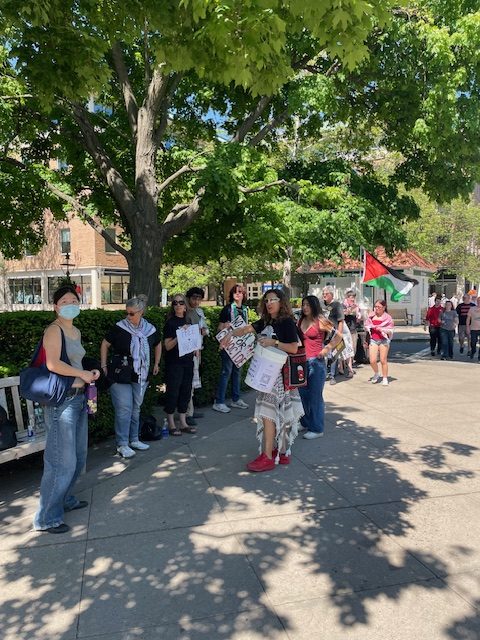
Free Palestine Rally, Palmer Square, Princeton, New Jersey, May 16, 2026. No permit detected.
Permits have a certain plausibility if the event in question is big enough to need municipal assistance, e.g., to close streets or help with crowd control. But for the same reason, they lack plausibility if what we’re talking about is a dozen people marching up the street and gathering on a street corner, which is what happened on August 29th.
Personally, I think the threshold for requiring permits should be set pretty high. I can see needing a permit for a gathering of several hundred people, or a thousand, but certainly not for anything less than a hundred.
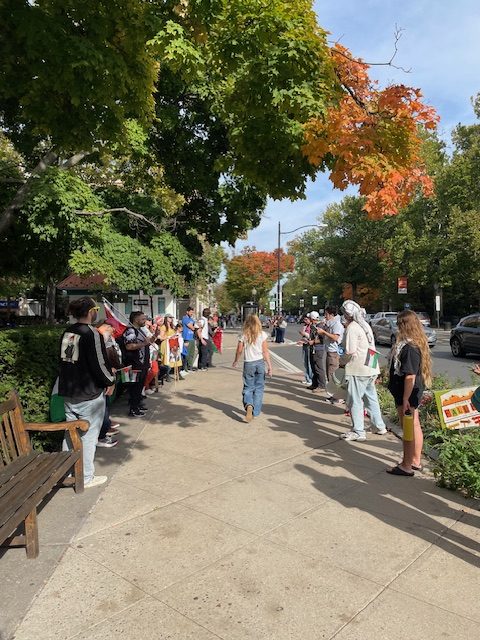
Free Palestine Rally, Palmer Square, Princeton, New Jersey, October 10, 2026. No permit detected.
Any park or square in this town can easily accommodate a hundred protesters. Go to Palmer Square any afternoon or evening during nice weather, and you’ll encounter hundreds of tourists crowding the Square and thronging Nassau, Witherspoon, Chambers, Tulane, and Spring Streets. The number of sidewalk diners or tourists on the streets far exceeds that of protesters on virtually any day of the week. Yet no one thinks that diners or tourists need a Fun Permit to eat on the street, go shopping in droves, take up space, or make noise.
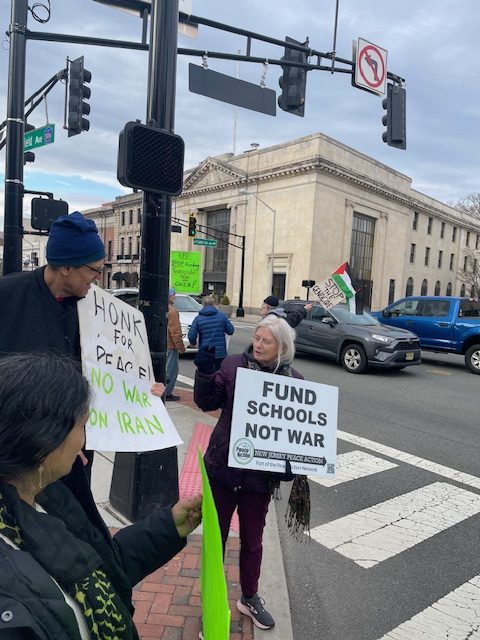
Anti-War Rally, Montclair, New Jersey, March 27, 2026. No permit detected.
Alternatively, spend some time on Prospect Street on a Friday or Saturday night in good weather, and you’ll see (and hear) throngs of noisy students, carousing and reveling, all without permits. Something similar is true of Halloween, of Princeton University’s Reunions, or of Ivy Inn (and vicinity) any night of the week: all three involve crowds and noise without permits. The general point should be clear enough. There’s no reason why fun should take precedence to politics as a protected activity, or why politics demands a permit when fun doesn’t. If people can put up with permit-less fun-lovers, as they do, they can put up with permit-less protesters.
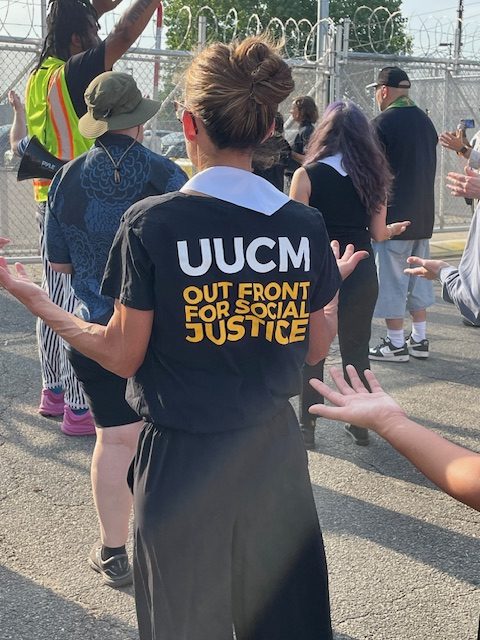
Peoples’ Prayer Vigil, Delaney Hall, Newark, New Jersey. June 29, 2026. No permit detected.
The sight of marching Nazis (etc.) on our streets is no doubt unpleasant and discomfiting, but as should be obvious enough, you don’t have to be a Nazi to be on the receiving end of the demand for a permit. Anyone who’s marched in this town for Palestine, against ICE, or against the Iran War, as I have, will have been on the receiving end of someone making that demand. “Where’s your permit?” people will demand, occasionally drawing the police into the fray with the express hope of getting someone arrested. Such people are undeterred by their ignorance of the law, and of the fact that no law exists for the enforcement action they want. Their peace of mind has to be purchased at any price, including other peoples’ right to assemble and protest. But again, you can’t fight fascism by piling up rights violations.
At a fundamental level, the demand for permits leaves the underlying issue untouched. At a basic level, we want to know: why have teenagers turned to Nazism? Is it TikTok? The rising price of diesel and fertilizer? The male loneliness epidemic? The tribulations of involuntary celibacy? A good explanation would help us tackle the problem at its source, and exclude pseudo-explanations at the outset.
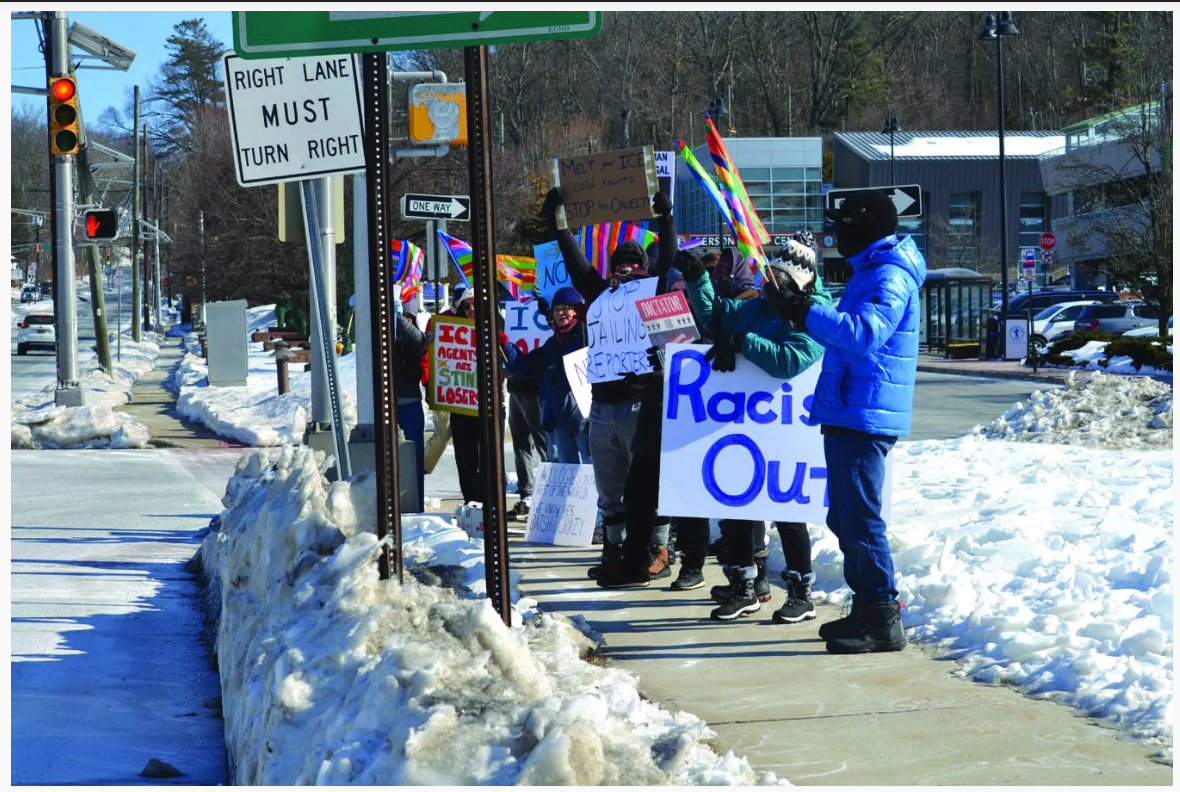
Anti-ICE Rally, Codey Arena, West Orange, New Jersey, February 2026. No permit detected.
Permits don’t. All that permits do is mask or sanitize the problem, reinforcing the sense that there are no deeper questions to be asked and no larger problem to solve. The deeper and larger problem we face is one of exposure and of audience: who is being drawn to Nazism, and why? Questions like that are the responsibility of the press and of Boards of Education, not the Police Department. What’s remarkable is the dearth of energy the former institutions have put into the problem. But little energy is required if you pretend that nothing is happening. The local press is afraid of bad news, and the average Board of Ed is afraid of anything that looks like a can of worms. It’s precisely that combination of fears that persuades people that permits are the answer. But permits are an anesthetic, not a cure.
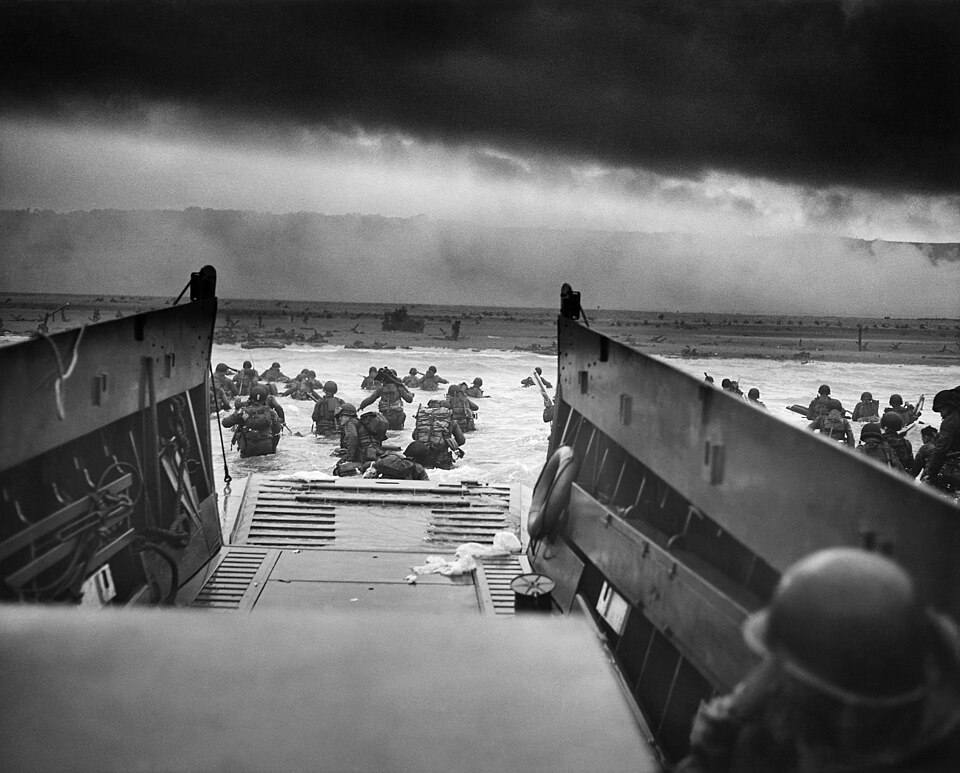
Normandy Invasion. Omaha Beach, Normandy, France. No permit detected.
This fact draws attention to another issue that’s largely gone unnoticed. It’s worth remembering that the marchers, largely teenagers, went out of their way to claim that they had conceived and organized this march on their own, including its logistics and its script. TapInto Princeton was the only local outlet to highlight this claim:
“This event is the first of its kind in American nationalist history. Never before has a nationalist demonstration with such regimentation and numbers been led by teenagers in American history. This was a youth-led effort.”
The claim is implausible to the point of absurdity. It’s also gone entirely uncontested. Yet in some ways, it’s the crux of the whole issue.
Go out and watch the marchers’ agit-prop video, which features a long, convoluted argument in the Nazi style about how white supremacy constitutes the apex of Western Civilization, replete with montages of artwork by Raphael, Botticelli, and Michaelangelo, etc, juxtaposed against footage of a professional football game (“overpaid Negro football players”), the Western Wall (“hooked nose bankers”), and the D-Day invasion.

What’s a nice girl like her doing mixed up with a crowd like this?
It’s as dumb as it is evil. It’s incoherent, for instance, to valorize D-Day while affirming racism: the Normandy invasion was part of a fight to the death against the racist project that these Junior Nazis want to re-enact. It’s also absurd to valorize Michaelangelo while expressing anti-Semitism: Michaelangelo’s Sistine Chapel depicts the Hebrew Prophets (Jeremiah, Jonah, Ezekiel, Joel, Isaiah, Daniel, etc.) alongside Jesus, and depicts scenes from the Hebrew Bible alongside those from the New Testament. Hate to break the news, but Jesus was a Jew. Alas, whatever its flaws, Western Civilization doesn’t fit as easily with the Fourth Reich as these people wish it did. But set this blatant set of self-contradictions aside to ask some common sense questions about the video itself, and about the people behind it.
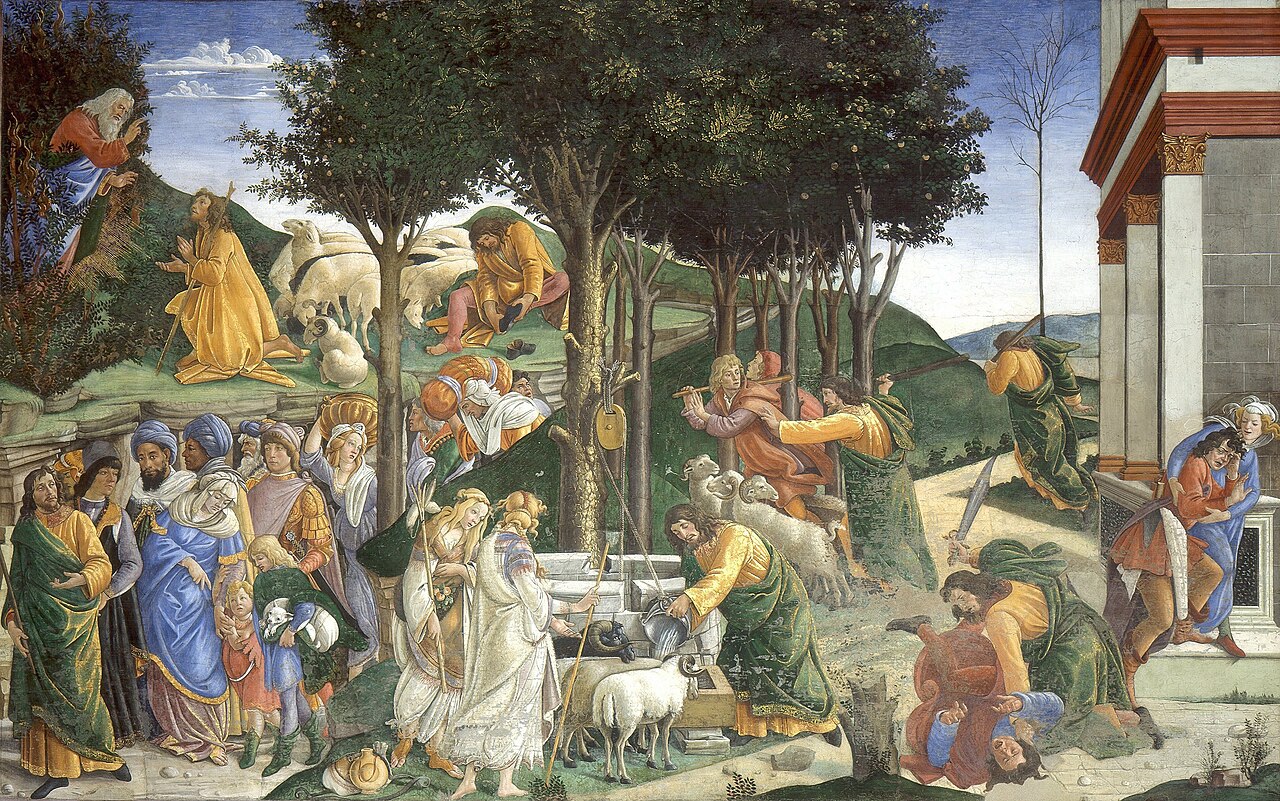
Botticelli’s “Trials of Moses.” Feel free to look for the “hooked nosed bankers” if you like. Highly doubt you’re going to find any.
How many teenagers are knowledgeable enough about history to understand the centrality of the Italian Renaissance to Western Civilization? How many know that Botticelli’s “Venus” is a paradigm of the Italian Renaissance? How many would grasp the symbolism (though evidently not the absurdity) of throwing Michaelangelo’s “David” into a Nazi propaganda video, or would know that the Western Wall is the eternal symbol of the Jewish People? How many teenagers, in short, would have both the knowledge and the expertise to put together a sophisticated propaganda video that included an integrated suite of words and images of this sort?
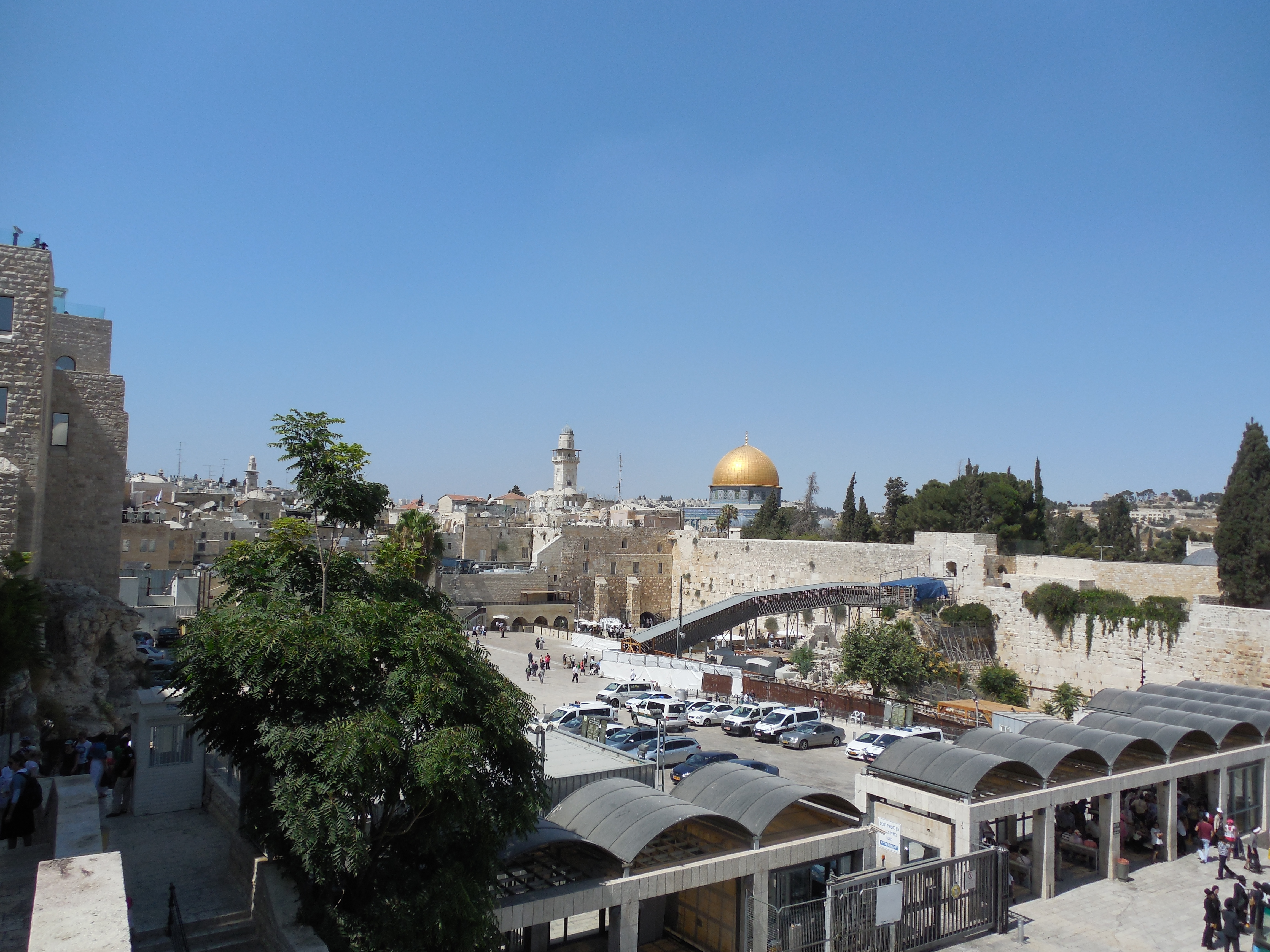
Western Wall, Dome of the Rock. No banks detected.
Almost none. Yet these words and images, and others like them, are central to the J-Nazis’ video. Somehow, this discrepancy has escaped notice. A bunch of kids dumb enough to become Nazis–dumb enough to become dumb Nazis–has also become a bunch of mini-experts on world history, including art history, and has figured out, without adult help, how to deploy both to advance a white nationalist agenda.
I’ve spent more than a quarter of a century teaching college-aged students at a dozen institutions on two continents, with a few precocious high school students thrown in as a bonus. It really is not plausible to me that a bunch of teenagers could have produced this video on their own, even with all of its incoherences and solecisms. What seems more plausible is that it was a “kids only” venture spearheaded by a bunch Nazi adults who exploited the kids under their care, and then pretended that their Hitler Youth group pulled it off on their own.
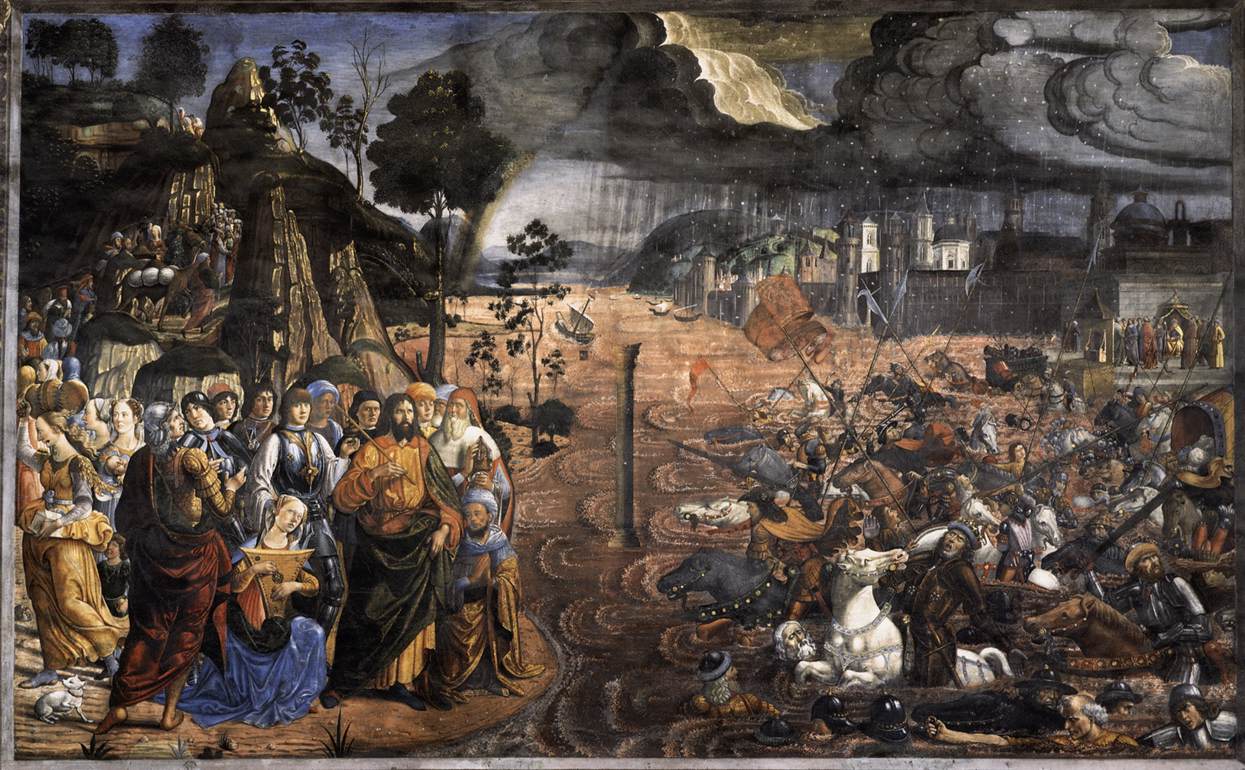
Rosselli’s “Crossing of the Red Sea.” I can see how this might be worrisome to some, but no hooked nosed bankers detected.
The real test here is the one Socrates devised: ask. The next time these kids show up in Princeton, the thing to do is to walk right up to them and give them a quiz on, say, the Italian Renaissance. Who was Michaelangelo, anyway? And what did he paint on the ceiling of the Sistine Chapel, again? What happened at D-Day? Who was fighting whom, and why? Have any of them been to the Western Wall? What does it have to do with “hooked nosed bankers”? Was Judah Maccabee a banker? Moses? Aaron? Joshua? Abraham? Abraham Heschel? If the NFL is full of “overpaid Negroes,” what about the white players? Are they overpaid? Are they Negroes?
I’d love to hear the answers, but that’s the option that a permit regime tries to obviate. The whole permit exercise presupposes that ideological conflict is to be outsourced to the cops so that the rest of us can preserve our peace of mind. I question the premise. Does it really make sense to preserve your peace of mind when your society is under attack by Nazis? When does agitation become appropriate? When they march you into a shower?
If all this historical talk is too heady for you, try some more prosaic questions about logistics. Who drove these kids to Princeton, and from where? Who prepared the barbecue they attended afterwards, and where did it take place? How much did the whole operation likely cost, and who paid for it? It’s not plausible to think that kids organized and handled this whole thing. The event bears the hallmarks of adult involvement. Given this, you’d think it crucial to ask who these adults are.
Despite Princeton’s reputation as a place of higher learning, and despite the hand-wringing over the Nazis’ presence here, you won’t find answers to any of these questions anywhere in Princeton. To find answers, you have to consult obscure publications like IdaVox, the newspaper of the Antifa organization of New Brunswick.
Once you do, you soon learn the identities of the adults (likely) behind this march, and you come to realize that the teenagers marching on the streets of Princeton likely came from elsewhere (see this as well), and were nothing but the pawns of these craven adults. You’d think this finding would be a matter of overriding significance to those who object to these Nazis’ presence here. Yet no one in Princeton is discussing it at all. It’s being discussed by unheralded anti-fascists like Daryle Lamont Jenkins of New Brunswick, who’ve spent their lives on the anti-fascist cause. Jenkins has what so many contemporary journalists today seem to lack: a manic, heroic passion for the truth unapologetically deployed in the service of justice. It’s telling that so few in Princeton knows who he is. That’s why we’re in the situation we’re in.
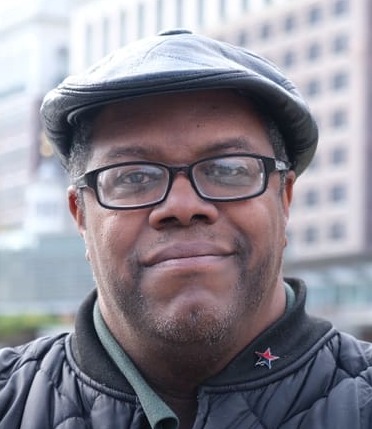
Daryle Lamont Jenkins (photo credit: DC Kaba)
The “permit Raj” idea being thrown around in Princeton is symptomatic of a way of thinking that has become entrenched in American life, particularly middle class suburban life. See a problem? Reach for the phone. Some service provider will fix your problem for you. Unfortunately, not all problems are like that. This one isn’t. There’s no service provider out there that you can call to take the streets back from the Nazis. If you have to call someone, it’s because you decided not to take to the streets yourself. But if that was your decision, it stands to reason that they weren’t your streets. You ceded them without a fight to the Nazis.
“Whose Streets? Our Streets,” goes a well-worn activist chant. People always complain that activist chants are “mindless,” but I wonder if they’ve grasped the wisdom in that one. If these streets are ours, we have to make them ours. We have to make clear with our bodies that our streets belong to every person of every color, ethnicity, religion, class, sex, sex/gender orientation, etc. and not to those who want to regulate the world in one of those ways, or some other way. There’s no one to call. You don’t need a permit. You just need the will to reclaim what’s ours, and the will to resist its seizure by anyone. The remedy is not a matter of permits, but of marching into the streets and taking them back: that’s how the streets were made our streets, and it’s the only way we can re-claim them again from those intent on taking them from us.

